Hyundai IT unveils Super Narrow Bezel LCD 3D Multi-Vision
 3D Display specialist Hyundai IT (www.hyundaiit.com) unveiled the world's first Super Narrow Bezel multi-vision LCD 3D at Korea Electronics Show 2010. The Super Narrow Bezel is a 138" super-size 3D screen, formed with a total of nine 46" LCD displays, arranged in a 3 by 3 configuration. Its height is comparable to that of an adult man. .... They will serve well in exhibition centers, museums, and 3D production companies. Hyundai IT is also planning to showcase their digital signage solutions for bus shelters and subways.
Read the full story here http://www.koreaittimes.com/story/11886/hyundai-it-unveils-super-narrow-bezel-lcd-3d-multi-vision
How to Show Off Your 3D HDTV
Here's how to present your 3D HDTV set in the best way possible--from setting up the room and calibrating the TV to picking the right programming.

Read the details here for:
Set Up the Room
Dim the Lights
Arrange the Furniture
Grab Some Glasses
Save on Shutters
Calibrate Your Television
The Basics
The Calibration Process
3D-Specific Settings
What to Watch
3D Blu-ray Discs
3D Broadcast Channels
Show Off!
Overview of the 3D device landscape: preparation for CES 2011
By Phil Lelyveld
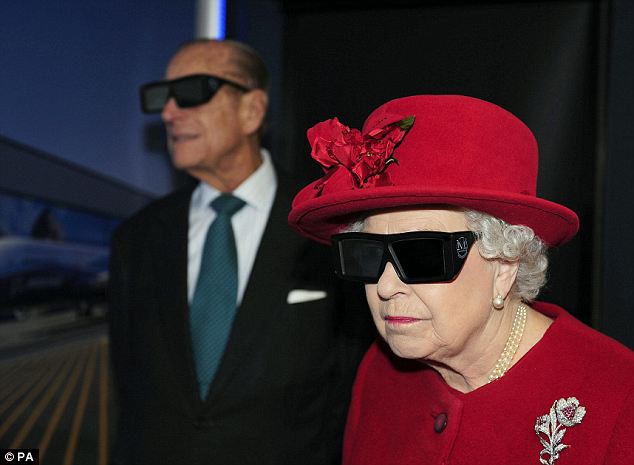
As 2010 winds down it is clear that 3D has become visible to the consumer worldwide on multiple fronts.
The number of 3D screens in theatres increased worldwide from 6,700 in 2009 to 19,700, with the US 3D screen count jumping from 3,349 in 2009 to 7,441 as of Oct. 25, 2010. From Nov. 2009 thru the end of 2010 there will be 25 major 3D releases, including six 3D theatrical releases in this holiday season.
E3, the Electronic Entertainment Expo that showcases the latest videogames, platforms, and peripherals, highlighted stereoscopic 3D as one of the top, hot tech trends going forward at last summer’s convention. Call of Duty, Black Ops, a 3D-optimized game, exceeded $650M is retail sales in its first 5 days – although many gamers will be playing it on 2D devices. Sony announced that over 50 3D games are coming to PS3.
By the end of 2010 there will be over 30 channels worldwide distributing 3D content on a regularly scheduled or VOD basis via satellite, cable, OTT, or internet distribution. Sports content and movies in 3D dominate the announced offerings, but there are also art, nature, reality series and dramatic series announced.
Recognizing both the trend to 3D and the added retention that 3D appears to induce in the viewer, advertising firms are developing stereoscopic 3D campaigns (example here) for theatrical and 3D TV release, special events, and billboards.
The terms “3D” and “3D capable” are currently being used to describe two very different capabilities; the stereoscopic viewing experience, and the ability of a device to render and display 3D graphics. This ambiguity will be a source of consumer confusion.
As preparation for CES 2011, here is an overview of the 3D device landscape.
3D TVs
ETC members LG and Panasonic, as well as Toshiba, Sharp, Sony, Mitsubishi, Visio, and others, will be showcasing 3DTV displays that continue to improve the viewing experience. Pay attention to comments about image brightness and crosstalk. Crosstalk occurs when the image intended for one eye is partially visible to the other eye (also called ghosting). In addition to image dimming caused by the transparency of the 3D glasses and, in the case of active shutter displays, the shuttering of the glasses, light loss is also increased by measures designed to reduce crosstalk.
Screen refresh rate is also important. Faster refresh rates can reduce technology-induced motion blur, reduce visual interference from fluorescent lights (also 60Hz), and be less stressful on the human visual system which has a 40-50hz natural refresh rate in the central vision area. Standard LED and LCD sets have a refresh rate of 60Hz. Those equipped with LG TruMotion offer faster speeds of 120Hz, 240Hz and 480Hz. Many Plasma TVs feature 600Hz refresh rates. Tom Galanis, operations VP for Sixth Avenue Electronics, has noted that his 3DTV customers are leaning toward plasma-based 3D TVs over LCD because of the refresh rate difference and perceived higher-quality 3D experience.
Most of the 3D TVs currently being sold at retail in the US use active shutter technology. Active shutter 3D TVs cost slightly more than standard HDTVs, but the active shutter glasses cost between $100-$200 per pair. Passive polarized 3D TVs cost significantly more than standard HDTVs, but the cheapest glasses can be give-aways (although designers are now making high-fashion polarized 3D glasses). Vizio has announced a 65" Polarized 3D TV For $3,700. LG has been selling polarized displays in the UK market, and in November announced plans to sell them to the US lodging and hospitality industry.
3D Laptops
Both active shutter and passive polarized 3D laptops have appeared on the market in the past year, with models using active shutter technology dominating the release announcements. Top PC makers like HP, Acer, Asus, Lenovo and Toshiba rolled out active shutter 3D laptops earlier this year with a 3D capable graphics card usually from either Nvidia or Advanced Micro Devices. The companies pitched the laptops to gamers and others as a way to redefine the home entertainment experience. The HP Envy 3D series and the Acer AS5745DG laptops are two recently announced examples. Sony is planning a 3D laptop for spring 2011. It will use the same 3D technology as the Bravia line of TVs.
Lenova has had an IdeaPad with passive polarized 3D technology on the market since last summer. LG has the LG A510 laptop, a premium notebook offering cinematic 3D experience at near Full HD quality using passive polarized technology. It ships with a pair of clip-on lenses as well as a pair of glasses. So far it is only available in Asia, Africa, and the Middle East.
The newly released Dell XPS 14 Laptop is described as having “3D capabilities.” It outputs a stereoscopic 3D video signal from Blu-ray discs and 3D-enabled games to an external 3D display if you have one, but the laptop’s screen is not a 3D display.
3D Projectors
Consumers looking for home 3D projection systems can purchase active shutter systems from ETC equipment donor Lightspeed Design, as well as Sony, Optima, ViewSonic, BenQ, JVC, and others. ETC member LG has the CF3D, a passive polarized projection system that can be viewed using inexpensive, lightweight polarizing glasses. Prices are generally in the $2k-$12k range, although models can be found for under $900. Adapter kits to convert existing DLP 2D projectors to 3D are available from Optima and others.
HMDs (head mounted displays, video eyewear)
ETC equipment donor Vuzix will be showing off their latest 3D augmented reality glasses and applications at CES, as well as their 3D movie viewing and motion-sensor gaming glasses. The ETC and LA-based IMTech (immersion technology) are working to involve the LA artist community in creating augmented reality pieces that can be used to demo HMD hardware. ETC equipment donor Zeiss is working to improve the perceived resolution in their HMDs. Other HMD vendors are Myvu, exGear, and I-O Display Systems.
Gaming platforms
Nintendo is returning to CES after a 16 year absence, illustrating how devices and products for all forms of entertainment and social interaction are breaking down the barriers of product categories. Motion control 3D game-play is possible with the Sony Move/PS3 combination and a 3D-enabled PC/peripheral configuration. The Nintendo Wii and Microsoft Xbox 360 Kinect do not offer stereoscopic 3D game-play yet. 3D mobile gaming is possible on android, iphone, and windows phone 7 devices, although there are currently few implementations.
The Nintendo 3DS, the small handheld device expected to be released in Q1/11, will have an autostereoscopic display for glasses-free 3D game play. It will also have a strong social component built into its games and will be capable of playing 3D movies.
3D Phones and small handheld devices
Phones with autostereoscopic displays have been on the market for a few years, but this might be the year when they finally catch on. Sharp and others have incorporated technology that allows the small device screen to toggle between 2D and autostereoscopic 3D. Sharp plans to sell autostereoscopic 3D-display smartphones in the United States, China, and India in 2011. They already have an agreement with DOCOMO to sell the Sharp LYNX 3D SH-03C phone through DOCOMO in DOCOMO’s markets. Another 3D phone manufacturer, Spice Mobility, will offer a 3D phone in India for under $100US. Spatial View and others have a screen overlay and app for autostereoscopic display of 3D content on the iPhone and Android phones.
3D Tablets
According to CEA Market Research, the tablet category is experiencing astonishing growth including advancements in 3D. The category represents 31 percent of the total U.S. consumer PC market, which includes desktops, notebooks and other tablet PCs. A prototype 3D tablet with glasses was shown in September by Telefunken. Recent tablet announcements from Acer, Haleron, and others have included ‘3D support’ for 3D graphic gameplay, not for stereoscopic 3D display. As discussed earlier, ambiguous marketing language will lead to consumer confusion. None of the exhibitors in the “Access on the Go” TechZone, the CES 2011 TechZone for tablet and eReader vendors, have mentioned stereoscopic 3D in their CES 2011 website posts yet.
Autostereoscopic (glasses-free) 3D Displays
Large autostereoscopic displays are excellent for advertising and other public space uses. They capture the attention of people as they walk by. Recent examples of implementations are in an Hungarian movie theatre and the Bahrain International Airport. Hyundai announced a 138" 3X3 screen matrixed display for exhibition centers, museums, bus stops, and subways.
Autostereo displays are also excellent for small handheld devices like phones and the Nintendo 3DS, because these are single-user devices and the user will hold the phone in the best position for the 3D effect.
There have been recent announcements by Toshiba and others touting new enhancements to the well established technologies (ex. lenticular and barrier). Toshiba’s glasses-free set has a very wide “sweet spot” for the 3D viewing experience. The Sunny Ocean Studios autostereo display has 64 “sweet spots.” However large autostereo screens being marketed to consumers for group viewing have two critical problems; 1) the left-eye/right-eye images from two zones mix and you get a distorted viewing experience when you are in-between sweet spots, and 2) the autostereo overlay on the screen cannot be turned off, so the screen cannot display 2D video without distorting it.
There is much R&D currently underway to address these two problems. New approaches to autostereo displays that work for many people regardless of where they are positioned may reach the consumer market in 5-10 years.
3D Camcorders
Ambarella, Viewsonic and Aiptek have all announced true consumer market ($200 range) 3D camcorders, while GoPro and possibly Flip are adapting two 2D camcorders for 3D capture. The DIY 3D community has been creating 3D content with two Flip cameras since 2009. A new camera from Sony expected in 2011, as well as Panasonic 3D camcorders, target the Prosumer and professional markets.
3D TechZone
The 3D@Home Consortium is organizing a 3D@Home TechZone at LVCC, South Hall 2. Click here for the link to exhibiting vendors.
Keynotes
Boo-Keun Yoon, President and General Manager of Samsung's Visual Display Business, will deliver a CES 2011 keynote address on Thursday at 4:30pm. Mr. Yoon will articulate Samsung’s vision for the future of visual display technology, including 3D. He is the only CES Keynote Speaker to explicitly mention 3D in his keynote description.
(For more 3D news, go here: http://www.etcenter.org/etc-activities/projects/consumer-3d-experience-project/3d-news/ )
Sony 3D pro camcorder gets new video demo
Sony has been showing off its latest professional 3D camcorder prototype, and it certainly looks like it could beat Panasonic’s AG-AF100 in a fight. DigInfo caught up with the twin-lens shoulder mount camcorder in Japan recently, and while Sony are playing coy with the full specifications, they have suggested it will be ready in time for a 2011 release.
The few hardware specs we have right now suggest the prototype has four SxS memory card slots, left and right channel HD-SDI outputs and manual controls for adjusting the point of convergence of the 3Dlenses. Of course, all that might change before the commercial release.
It’s not clear how much has been carried over from the Sony EX3 3D prototype shown earlier this year, which had six CMOS chips – three for each lens – taken from a pair of PMW-EX3 studio cameras, each capable of recording 35Mbps 1080p 4:2:0 MPEG-2 video. As then, Sony isn’t talking pricing at this stage.
Find the full story here: http://www.slashgear.com/sony-3d-pro-camcorder-gets-new-video-demo-24116097/
Shift to 3D Reignites TV Image Quality Competition
Three-dimensional (3D) TV is finally coming to the home, with sales making a strong start and expected to keep rising sharply. The trend has reignited the competition for better image quality, though, with manufacturers striving to slash crosstalk and boost screen brightness as a result. Japanese manufacturers are banking on their experience in creating beautiful imagery to put them back in the game.

The full, lengthy article on display technology (with charts/graphs/statistics) is here: http://techon.nikkeibp.co.jp/article/HONSHI/20101025/186796/?P=1
Lack of 3-D captioning standard stymies development
 As more content is being produced in 3-D, the need for captioning, now mandated by the U.S. government, has been brought to the forefront. While all of the vendors in this category are aware of the need to do it, very few customers have asked for it, which holds back development.
“We certainly have the capability to produce captions in 3-D space, but we’re not investing a lot in R&D until there is customer demand and a standard specification for how to do it,” said José M. Salgado, president and CEO of Los Angeles-based SoftNI, a veteran captioning and subtitling software provider.
To be clear, the issue has to do with closed-captioning, not necessarily “subtitling.” 3-D subtitling is typically predetermined by the content producer and is inserted into a plane (below, on the side or on top of the screen) that’s most aesthetically pleasing to the eye. Because subtitles are simply a part of the picture, there is no need for new technology to transmit or display them.
Closed-captioning, on the other hand, serves a greater need and must be done uniformly. This data is sent as text with timing information by a broadcaster or program provider and turned on or off at the TV set by the consumer. There is a method for doing this in 2-D (called CEA-708) that’s standardized by the Consumer Electronics Association. Every TV set sold in the United States must be able to recognize this code and display it when required. In that code, you can still control the positioning of the captioning but not the 3-D depth. The result is that the 3-D experience is often not the best it could be.
read the full story here: http://blog.broadcastengineering.com/3-D/2010/11/22/lack-of-3-d-captioning-standard-stymies-development/
Finland speed trap uses 3D camera
What's Finland most famous for? If you've answered Nokia phones just like most of the other people who don't reside in 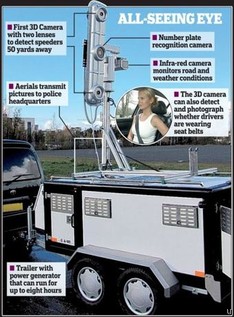 Finland, then you are most probably correct. Well, here's something that might take away that coveted position from the handset manufacturer - we're talking about automated 3D speed cameras which will be able to check out essential information such as insurance, taxes, seat belt usage and tailgating in a jiffy. Dubbed ASSET (Advanced Safety and Driver Support for Essential Road Transport), the effective range is about 150 feet, where you can have a slew of tickets issued almost simultaneously if you drive without wearing a safety belt while tailgating someone who just crossed through a red light at insanely high speeds. With that, prosecution can take just seconds - something tells us the legal system there will have to be extra efficient to handle the sudden increase in cases!
source: http://www.ubergizmo.com/15/archives/2010/11/3d_speed_cameras_in_finland_speed_up_prosecutions_to_seconds.html
The new XPAND Call Center will field all inquiries pertaining to 3D technology
In a move that reinforces XPAND’s commitment to educating consumers as the popularity of 3D continues to skyrocket, XPAND is announcing its new XPAND Call Center for technical support.
The XPAND Call Center will be operational 9:00 AM to 6:00 PM, Monday through Friday.
The XPAND Call Center will field any and all inquiries pertaining to 3D technology. The XPAND Call Center can be reached toll-free at 1-888-906-1190 or via email at technicalsupport@xpandcinema.com.
“As proud as we are of our revolutionary 3D products for consumers, we pride ourselves even more on offering reliable, dedicated customer support,” says Maria Costeira, CEO of XPAND. “Our new XPAND Call Center exemplifies this dedication and underscores our understanding that a satisfied customer base is the key to success for any company. Moreover, we understand that as the world leader in 3D, XPAND carries a responsibility to help eliminate confusion surrounding the numerous products and technologies related to 3D. We hope and believe that the Call Center will prove to be a valuable resource as the 3D industry continues to evolve.”
For more information on XPAND’s Universal 3D Glasses, please visit http://www.xpandcinema.com
Beamax Releases Gamers Guide to 3D
 Call of Duty - Black Ops 3D and other new generation games are best played large – and even better in 3D. A new, free guide, entitled The Gamers’ Guide to 3D, has been published by Beamax to help gamers prepare for affordable, 3D big screengaming. The Guide demystifies technical terms and sets out clearly the components gamers will have to buy to complete their system to get the best 3D results. The Beamax Gamers’ Guide To 3D is published to coincide with the release of Call of Duty - Black Ops 3D on the 9th November, and is available as a free PDF download at http://www.projectionscreen.net/3d .
Author of the Guide and founder of Beamax, Otto Tromm, an enthusiastic gamer himself, and explains that:
"At its highest level, gaming is about putting yourself at the heart of the action – where you share the perspective with the other characteristics, rather than looking into the game from the outside as you do with a flatscreen TV. To buy a TV big enough to create life size characters and to be fully immersive would cost many thousands. In our new Guide we show gamers how to achieve a high definition, 3D big screen gaming experience for a few hundreds."
Read the full story here: http://www.audioholics.com/news/industry-news/beamax-gamers-guide-3d
Navigating the video games of Black Friday
Motion gaming, mobile gaming, traditional gaming. More than any year before, shopping for that gamer in your life has become a minefield of games, deals and gadgets.
With Black Friday looming, Kotaku is here to help with a handy-dandy primer on what's new, what's hot and what's coming to the world of gaming.
-----
The full story discusses;
- motion gaming - PS3, Wii, XBox 360 Kinect
- mobile gaming - android, iphone, windows phone 7
- traditional gaming - DS, PC, PS3, PSP, Wii, XBox
Find the story here: http://www.kansascity.com/2010/11/23/2463775/navigating-the-video-games-of.html