Wants To Change “The Future Of Human/Computer Interaction”
... A year go, our own Alexia Tsotsis thought that OcuSpec/Leap Motion was probably working on a “poor man’s Kinect, except that it will work across any platform.” That still sounds like a pretty good guess. ...
According to the company’s CEO Michael Buckwald, Leap Motion is a solution “to the challenge of 3D motion control and motion sensing is completely unique from existing products, with tremendous implications across all aspects of computing and device interaction.” Andy Miller, a general partner at Highland Capital Partners says “Leap Motion’s founders have uniquely positioned this company to make the next giant leap forward in computing.”
See the full story here:
Hitting Every Angle with Autostereoscopic 3-D Displays
 [Philip Lelyveld comment: This is an excellent, comprehensive, readable overview of where things stand and where research is heading. If you are interested in the topic, go to the link and read the full article.]
Clever use of electro-optics, lens arrays, diffusers and software advances the multidimensional way of seeing
The broad field of autostereoscopic display – the creation of imagery that appears three-dimensional without requiring the use of additional eyewear1,2 – is evolving. Optical engineers continue to push 3-D display technologies to match depictions in science fiction movies. It’s 2012, after all – can’t one simply buy a “holographic video display” that snaps into a DVI port and generates a cubic meter of full-color, occlusion-bearing, utterly natural imagery?
Well, almost.
There is much to consider in our journey, with 38 species of stereoscopic and autostereoscopic displays in 3D@Home’s taxonomy, and several possible classifications.3,4 (Reference 3 is a recommended starting point for technically oriented newcomers to the topic.)
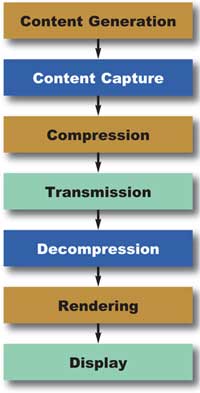
The 3-D display is just one element of a broad pipeline spanning content generation, or acquisition, to the production of a 3-D image (Figure 1). ...
Read the full story here: http://www.photonics.com/Article.aspx?AID=50765
Films as Startups: How Indie Producers Build Buzz
 [Philip Lelyveld comment: as more and more elements of film production are opened to the public, the whole philosophy of content protection will shift from 'everything' to special situations that the audience will embrace - like spoilers and surprise elements.]
The film industry is not what it used to be. Gone are the days when writers shopped a script around Hollywood, hoping to catch the eye of major production studios.
Instead, that model has been turned upside down. Films are aiming to captivate an audience first, without the assistance of studios. Technology and social media have made it feasible.
Writer Bill Balas entered his feature-length script into a contest for Fresh Voices, a social network for screenwriters, which captured the attention of producers Peter Katz and Don Le.
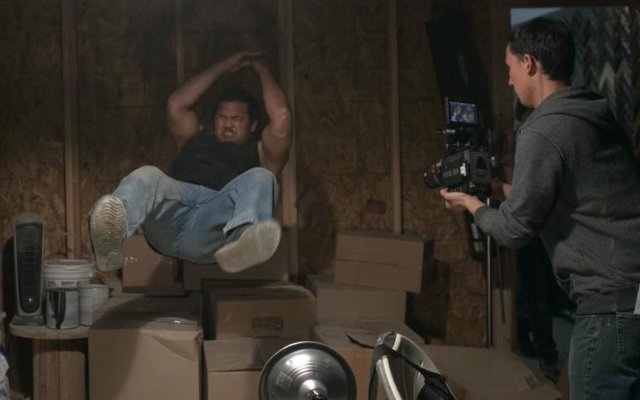
Rather than following the traditional path of production, the team used Balas’s script to create Already Gone, a short film about a crook who only robs from other criminals. The three-minute video is directed by Ross Ching, and stars Shawn Ashmore of X-men fame and Harry Shum Jr. from Glee.
This bite-sized teaser gets the premise of the film in front of an audience, and if the film is bought, will lead to a feature-length film at some point. Consider the video a less expensive pilot that will...
See the full story here: http://mashable.com/2012/05/02/indie-film-social-trailers/
Harvard, MFA Unveil Virtual 3D Tour Of Ancient Egyptian Pyramids
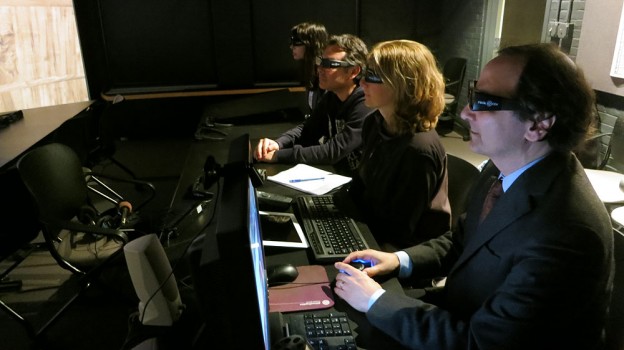
3D has become all the rage in movies and computer games, but the technology isn’t just for entertainment. Researchers at Harvard University and the Museum of Fine Arts are turning it into a learning tool, too. Beginning Tuesday, they’re offering you a free 3D virtual tour of the ancient pyramids of Egypt.
“I don’t play video games,” Peter Der Manuelian said with a laugh. “This is as close as I’ll ever come, but it’s great fun.”
Manuelian is one of the brains behind this project, called Giza 3D. He’s been fascinated by ancient Egypt ever since fourth-grade history, and he eventually turned that childhood fascination into a profession: he’s Harvard’s full-time Egyptologist. In a classroom with a curved floor-to-ceiling screen, he gave me some fancy battery-operated 3-D glasses. ...
This kind of “edu-tourism” has the potential to bring ancient Egypt to the masses, he said. A French software company with U.S. headquarters in Waltham, Dassault Systemes, is behind this technology. One of its vice presidents, Mehdi Tayoubi, called the Giza 3D project the “democratization” of a high-tech tool.
“When a student is here, it’s like he’s in Giza traveling with Peter as a guide,” Tayoubi said. “But back at home, he’s able to connect online and to do the travel by himself and to look at some details not raised by Peter during his course,” Tayoubi said.
And when Giza 3D goes public Tuesday, you might be able to pay a virtual visit to ancient Egypt, too.
The site will go live early Tuesday morning.
Cinema sound becomes a competitive environment again
Cinema sound is back on the agenda, as five manufacturers launch systems intended to align sound with the improvements in image quality brought about by digital cinema. Three of the systems are moving away from channel-based sound systems (5.1, 7.1 and so on) and into so-called immersive sound, effectively object-based sound tracks that can be mixed more flexibly. The front-runner because of its brand recognition and long experience is Dolby Laboratories, which is developing the Dolby Atmos system for a product launch in Q1 2013. The other four actors are Immsound, Iosono, Auro 11.1 (backed by Barco) and Illusonic 3D, all of which have systems in the market. Costs are currently unclear, although figures of $25-30,000 have been mooted for Dolby's system (in a medium-sized theatre) and upwards for others which may use more speakers.
Hollywood and Highland, home of the Academy Awards, is being rebranded Dolby Theatre and will be equipped with Dolby Atmos, underlining the company's film industry credentials. System is designed to carry up to 128 simultaneous and lossless audio channels together with the data capturing creative intent on a backwards-compatible DCP and renders on playback up to 64 discrete speaker feeds, including vertical sound, to match the original creative intent in a range of room shapes and sizes. In addition, Atmos can be built onto an existing Dolby sound system, and the company expects to have up to 1,000 units sold by summer 2013 although it is currently choosing 10-15 sites for a test phase over this summer.
Immsound is a Spanish company, which has 30 installed units of its 3D sound systems in the market in four continents. ...
Iosono is a German company, its technology based on Wave Field Synthesis in which it has several patents. Iosono has a test cinema at Grauman's Chinese in Los Angeles (one auditorium with the full 380 speakers and a second with a stripped back 64 speakers), one of around 30 installed units in place including US, Korea, China and Romania. The system can also support other formats, regardless of how many speakers are in place in the end auditorium.
Auro 11.1 is a channel-based 11.1 system, developed by Barco and Auro and installed in Doremi integrated media block (IMB). The system is compatible with both stereo and 5.1 surround. The speaker layout is defined for up to 13.1, ...
Illusonic 3D is a very new entrant, only showing at Cinemacon for first time, and being distributed by Digital Media Solutions. The French company's proposal can adapt to loudspeaker set-ups from 7.1 to 3D 65.2.
See the full story here:
How digital technology is reinventing cinema
 As of 2012, around 60% of all cinema screens worldwide have been converted from film to digital projectors. Over half of those digital screens are outfitted with stereoscopic (3D) projectors. By 2015, it is expected that almost every cinema screen will be digital and that film projection will all but die out.
Digital cinema is a lot more than just a digital projector, however — ...
Filming
For the most part, movies are still predominantly shot using 35mm film stock. Cinematography is certainly moving towards digital cameras, but the legacy of film is so great — ...
Digital intermediate
The irony of using film cameras, though, is that they’re all scanned into a digital intermediate anyway. Almost every big film of the 2000s was converted from film to a 2K (~2048×1080) digital intermediate — ...
Distribution
In 40% of cases (conventional projection cinema screens), the digital intermediate is then transferred back onto film, and copies are made (at a cost of thousands of dollars each) for each cinema that will be screening the movie. For digital screening, the digital intermediate is exported as a digital master, which includes all of the video, sound, and data required to project the movie correctly.
Now we get onto the techie bit of digital cinema. Before distribution to cinemas, the digital master is encrypted and compressed into a Digital Cinema Package (DCP), which is a standard format defined by Digital Cinema Initiatives (a joint venture by the major movie studios). ...
Digital cinema servers
Once The Avengers DCP hard drive arrives at the cinema, it’s slotted into a digital cinema server (DCS). A DCS is basically a proprietary, rack-mounted computer that has a hot-swappable hard drive bay on the front, and a bunch of video/audio outputs on the back. There are many companies that produce DCSes, but Dolby (pictured below) and Sony are two of the frontrunners (and their systems run Linux!) ...
Digital projection
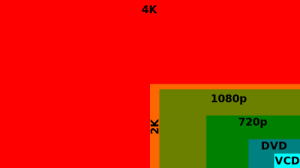
And finally we arrive at the bit that most consumers actually care about: digital projection. Because most digital intermediates over the last decade have been at 2K (2048×1080) resolution, a lot of cinemas are still outfitted with 2K projectors. With the emergence of 4K digital cameras from companies such as Red, and 4K projectors from the likes of Christie and Sony, 4K digital cinema is making inroads.
Digital projectors are beastly machines, with huge, 4-kilowatt xenon lamps that produce tens of thousands of lumens. Price-wise, these projectors — ...
The future of digital cinema
There is no doubt that cinema is moving away from film and towards digital — but is that a good thing? Digital distribution is undoubtedly more flexible than moving around bulky, costly film reels — but on the flip side, what about archiving? Properly-stored film stock can be archived for a hundred years, and ...
See the full story here:
3DTV Test and Tuning comes to iPad and iPhone
PixelSplincher is psyched to announce the first 3DTV test and calibration system for iPad and iPhone. TV TuneUp 3D sends stereoscopic and standard test signals to displays and projectors connected to the iPad via HDMI, analog video adapters, or AirPlay. In addition to a suite of standard professional-grade test signals for formats from NTSC to HDTV, TV TuneUp 3D offers an ‘Executive Mode’ with step-by-step instructions that let anyone tune a display for a presentation or movie night, in just minutes. In 3D Mode, TV TuneUp 3D delivers 3D video in top-and-bottom or side-by-side modes, with an alignment grid and precise overscan control. 3DTV owners or buyers can easily test and compare crosstalk levels, on different systems or with different glasses, even right in the store. TV TuneUp 3D provides calibrated stereoscopic parallax samples, indispensable for optimizing home-theater seating conditions to avoid uncomfortable viewing. TV TuneUp 3D is available now in the AppStore. ...
Pricing and Availability:
TV TuneUp 3D 1.0 is $2.99 USD (or equivalent amount in other currencies) and available worldwide exclusively through the App Store in the Photo & Video category.
See the full post here:
Kingdom of Plants 3D premieres
 On May 3rd, an audience were treated to the first ever screening of Kingdom of Plants 3D episode one – Life in the Wet Zone, followed by a ten minute preview of the other two episodes – Solving the Secrets and Survival.
Head of Sky 3D John Cassy and Executive Producer Anthony Geffen introduced the screening with Cassy saying “Anthony Geffen has absolutely pushed the boundaries of 3D television and I think what you are going to see tonight is very special. 3D offers a way of telling stories that you can’t get anywhere else.” He continued to say “We are looking to make more and more home grown programming and in the next three years we are going to raise our investment in home grown shows like this… it is a good time to be a programme maker working for Sky”.
Kingdom of Plants 3D is a three part 50 minute series filmed over the course of a year at the Royal Botanic Gardens, Kew, which houses some 90% of all known plant species in one form or another. In a similar model to Flying Monsters 3D, the show (formerly known as Kew 3D) will be released for IMAX as well as 2D TV (on Sky Atlantic). Free 3D clips will be made available for the Nintendo 3DS as well as a supporting tie-in book initiated by Kew, a ‘making of’ programme and “an amazing app experience” according to Anthony Geffen.
Each episode covers a different aspect of plant life and utilises a number of different camera techniques to draw the audience into the surprisingly competitive world of plants.Life in the Wet Zone (26th May) looks at the adaptation of plants to wet and humid environments, with episode two, Solving the Secrets (2nd June), exploring the behind-the-scenes lives of plant movement, scent and communication. Survival (9th June), the concluding episode, focuses on the continual adaptation of plants as well as a look at Kew’s Millennium Seed Bank, which houses almost two billion seeds of more than 30,000 species of wild plants to ensure their future for generations to come. ...
See the full, lengthy article here:
Connect The Physical World To The Web With Ninja Blocks
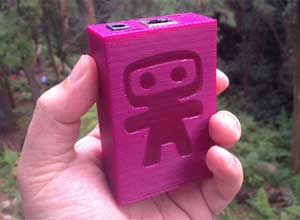 Most of us live in two separate worlds, the real world and the digital world of the Internet. Some strides are being made, likecontrolling your car with your smartphone, but there are surprisingly few ways to bridge the worlds together. Ninja Blocks aims to change that. Think of a Ninja Block as a Raspberry Pi computer that interfaces with objects and senses environments. Each Ninja Block is a powerful mini computer with a built-in accelerometer and thermometer complete with multiple USB ports and an ethernet port to connect the physical world to a host of web services.
For example, say you wanted to be notified if the postman or UPS comes near the front door. You could use a Ninja Block to not only sense it, but tweet you a picture and send a copy to DropBox. Another situation when it could be handy is alerting you that one of your friends just logged into Xbox live by switching on a lamp in your living room. Or if you have a dog that can’t stay off your bed during the day, a Ninja Block could help you train it by playing a sound or a voice recording every time it tries. ...
With it’s cool ninja logo engraved into the 3D printed cases, community-voted flashy color, and Festivus-like slogan, “The Internet Of Things for the rest of us”, the Australian-based Ninja Blocks just might be the kind of universal, easy-to-use little computers that can finally stitch our two worlds together.
See the full story here:
3-D print advances may create more jobs
An innovative process used to make three-dimensional product prototypes is poised to enter the mass market, and local leaders are working to bring part of a new federal center for the technology to Dayton.
Additive manufacturing, also known as 3-D printing, is expected to become a $3.7 billion global industry by 2015, more than doubling its current $1.7 billion value, according to Wohlers Associates, an independent consulting firm. Industry growth is expected to surpass $6.5 billion by 2019. ...
The biggest economic opportunity is using 3-D printing to manufacture actual products in plastic, metal and composite materials, said Terry Wohlers, principal consultant and president of Wohlers Associates. Currently, the technology is being used to print production parts for Boeing aircraft, as well as orthopedic implants, designer jewelry and custom braces for teeth. ...
The University of Dayton Research Institute is part of a statewide consortium of Ohio companies and organizations that are vying to win a federal pilot institute on additive manufacturing, said Brian Rice, head of UDRI's Multi-Scale Composites and Polymers division. UDRI operates a reverse engineering and rapid prototyping facility with 3-D part scanning and printing capabilities.
President Obama announced the pilot institute in March as part of a $1 billion plan for a network of 15 "Institutes for Manufacturing Innovation" around the nation, serving as hubs that help manufacturers and encourage domestic investment. ...
Cubify, a division of 3D Systems, started taking pre-orders last month for the Cube, a home color 3-D printer that sells for $1,299. It prints using ABS plastic at 25-thousands-of-an-inch layers up to a height, width and depth of 5.5 inches.
"I bet it won't be too many years away where it's going to be in Best Buy for $300 or $400," Staub said.
See the full story here: