Why Hollywood loves 3D printing
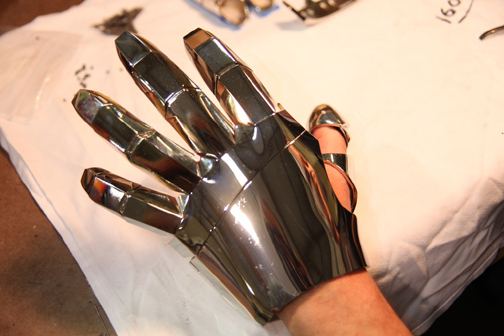 The movie industry is beginning to see how much value 3D printing offers, especially on effects-heavy films that are made with huge numbers of 3D digital models.
If you've seen "Iron Man 2," you've seen 3D printing in action at a very high level.
When director Jon Favreau and Paramount Pictures were making the hit 2010 film, they needed to find the best way to put together a physical Iron Man suit for certain scenes in the movie that couldn't be computer generated.
Rather than build models by hand, as was long the practice in Hollywood, the filmmakers turned to 3D printing, one of the hottest technologies around.
Indeed, in the film's scenes that were done in live-action -- as opposed to CGI (computer-generated imagery) -- its star, Robert Downey, Jr., can be seen wearing a suit that was first digitally modeled, then produced in pieces on a sophisticated 3D printer, and then painted.
Though it's not a technique that's much discussed outside the industry, 3D printing is increasingly being adopted as a way to help make movies more efficiently and quickly than ever, according to Jason Lopes, a system engineer at Legacy Effects, an Oscar-nominated effects studio. ...
Read the full story here:
Nolan’s 3D Shutdown
Dark Knight Rises director Chris Nolan has spoken dismissively of 3D before, but it can't hurt to reiterate...what the hell. DGA Quarterly's Jeffrey Ressner did the asking, transcribing and composing.
"3D is a misnomer," Nolan says. "Films are 3D. The whole point of photography is that it's three-dimensional. The thing with stereoscopic imaging is it gives each audience member an individual perspective. It's well suited to video games and other immersive technologies, but if you're looking for an audience experience, stereoscopic ishard to embrace. I prefer the big canvas, looking up at an enormous screen and at an image that feels larger than life. When you treat that stereoscopically, and we've tried a lot of tests, you shrink the size so the image becomes a much smaller window in front of you. So the effect of it, and the relationship of the image to the audience, has to be very carefully considered. And I feel that in the initial wave to embrace it, that wasn't considered in the slightest."
See the original post here:
Barco Projection for 3D Musical Art Installation
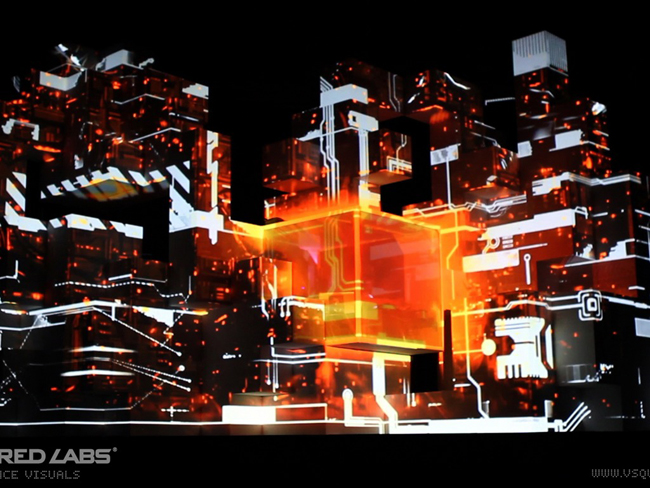 Barco recently supplied its FLM HD20 projectors to create a spectacular visual journey enlivening electronica artist Amon Tobin's latest international tour, ISAM Live. The centerpiece of the show was a 25' x 14' x 8' multi-dimensional, shape-shifting 3D art installation in which the world-renowned DJ performed his electronic music show from a control booth centrally located within the structure.
Combining 3D projection mapping and generative/audio reactive real-time and pre-rendered elements, the producers used Barco's FLM HD20 projectors to display the kaleidoscope of visual elements in concert with Tobin's music. The artist recently described the integration of projection mapping and music as a “reverse score,” alluding to the cinematic parallels he sought to achieve in creating the show.
See the full story here:
Six glasses with integrated displays that you can buy today
While Google's augmented-reality glasses are receiving immense attention -- and scrutiny -- they're certainly not the first pieces of eyewear to include an integrated display. ...
So, while Google leaves us hanging with very little actual information aboutProject Glass, the following headsets are doing their best to entice us into a world of integrated-display eyewear.
Recon Mod Live Alpine Goggles
Recon has been in the head-up display (HUD) game since 2010. ...
Vuzix Star 1200
Project Glass has been a pet project of Google for two years. Meanwhile,Vuzix's Star 1200 augmented-reality glasses are the company's third generation of AR headsets -- and, at $5,000 (£3,140), they suggest just how difficult augmented reality is to pull off. Starting with the previously mentioned iWear VR920, Vuzix has continued to bring integrated-display glasses to the market with limited success.. ...
Brother AiRScouter
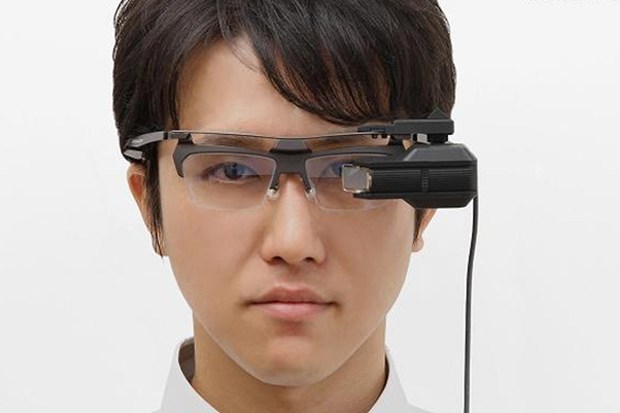
Yeah, Brother -- the printer company -- sells an augmented-reality eyewear device called the AiRScouter(above). ...
The glasses employ a monocular (single display) design with a translucent LCD that sits in front of the wearer's left eye. ...
Epson Moverio BT-100
While augmented reality gets everyone excited about integrated-display glasses, sometimes the technology can be overkill. Maybe you just want to replace the display on your desk, or the TV in your living room. In those instances, relatively simple (but still fully immersive) head-mounted displays offer a way to use a computer, watch TV, or just tune out the world while still sitting at your desk, or on your couch.
Epson's Moverio BT-100 head gear fits into this category, purportedly recreating the viewing area of a 80-inch monitor that sits 16.4 feet away. ...
Sony HMZ T1
While the Epson Moverio tries to cover all the bases, the $800 (£500) Sony HMZ T1 goes after one market: entertainment. Sony set its sights on creating the most immersive 3D movie and video gaming experience on the market, andaccording to glowing reviews of the device, it succeeded.
The HMZ T1 features dual 720p OLED displays that mimic a 750-inch screen that's 65 feet away. ....
Silicon Micro Display ST1080
A direct competitor to the Sony HMZ T1, the $800 (£500) Silicon Micro Display ST1080 headset also uses a controller box to view video content. But unlike the HMZ T1, the ST1080 displays video at 1080p and has a transparent display. You'll still be sitting in your living room tethered to a media device, but you'll be using new display technology while you're doing it. ...
Read the full story here:
Dolby and Philips Unveil 3D HD Format Capable of Bringing Full HD 3D to Glasses-Free 3D Devices
Dolby Laboratories, Inc. and Royal Philips Electronics today unveiled Dolby 3D, a 3D HD format and suite of technologies designed to deliver full HD 3D content to 3D-enabled devices, including glasses-free displays. Dolby 3D is being demonstrated at the NAB Show® (April 16–19, 2012) at booth SU1212.
The two leading companies have undertaken the joint project to improve the 3D viewing experience on displays of all sizes, including smartphones, tablets, PCs, and televisions. Dolby 3D is a complete system designed to work throughout the chain to deliver clear glasses-free 3D content that operates over existing distribution systems.
See the original press release here:
Daily Bite: BBC To Develop 3D Comedy
 British television’s first ever long-form 3D scripted content, Walt Disney’s struggle to bring ‘Mary Poppins’ to the big screen and news that ITV are set to be left shaken and stirred by Sky, are amongst the international stories in today’s Daily Bite.
BBC to develop 3D comedy drama…The BBC is developing British TV’s first 3D comedy drama as part of a two-year trial, Broadcast are reporting. No details about the programme are known, but it is aimed for broadcast early next year. The comedy will be the first long-form 3D scripted content aired in the UK. Sky previously aired a 10-minute short in 3D called ‘Little Crackers’.
...
Read the full story here:
Forget 3D, I’m Ready To Play This 4D Video Game
[Philip Lelyveld comment: the mind-stretching 4D concept is explained in a 1 minute video on the link.]
Miegakure is a video game set in four spatial dimensions: specifically, the dimension that goes out to the sides, like your keyboard; the one that goes up, like a tree; the one that goes out deep, like a dog fetching a stick... and that other dimension, the one you can't point to unless you've got 4D fingers.
Think of it another way. This is like the Mario from Super Mario Bros., who lives in a flat 2D world, being told that the 3D Super Mario 64 exists and being told he can play it.... one 2D slice at a time. Except you're Mario. You're 3D. And the "Super Mario 64" we're talking about is 4D. ...
It's been two years since designer Marc Ten Bosch first showed me Miegakure and convinced me that a game set in four spatial dimensions is possible. The math allows it... all you have to do is take any point in our three-dimensional understanding of space (x,y,z) and add a fourth coordinate to locate its position in a fourth dimension. And if the math allows it, a computer can plot it. If a computer can plot it, we can run through it. And if we can run through it... voila! Video game. ...
See the full story and the video here:
Sony nabs Spanish 3D toon ‘Justin’
Sony Pictures Releasing de Espana has acquired Spanish theatrical and home entertainment rights to Manuel Sicilia's 3D family toon pic "Justin and the Knights of Valor."
It looks set to be one of Spanish cinema's most ambitious theatrical releases for next year. Sony is skedding "Justin's" bow for Aug. 23.
Costing Euros22 million ($28.6 million) -- one of the biggest budgets ever for a Spanish animated feature -- "Justin" is produced by Spanish studio Kandor Graphics, Kerry Fulton and Antonio Banderas. ...
See the full story here:
Anchor Bay Films Takes ‘Bait’ in 3D

Anchor Bay Films has acquired North American rights to the Australian 3D action-horror film Bait.
Xavier Samuel, Sharni Vinson, Adrian Pang, Qi Yuwu, Phoebe Tonkin, Dan Wyllie and Julian McMahonstar in the story of shoppers in an underground supermarket who become trapped with a human killer and a bunch of great white sharks after a tsunami hits. Gary Hamilton, Todd Fellman and Peter Barber produced the Arclight Films horror show. ...
See the full story here:
Museum Crowd Embraces the Retro-Future
Sell-out rock shows usually mean a lot of shouting, some sweating, maybe a few drunken pass-outs. Kraftwerk inspired none of that on Tuesday night. The first of its eight consecutive sold-out performances at the Museum of Modern Art had reverence and stylistic weight; even for a New York museum crowd, there was a lot of black. Artfully swept hair, uncomfortable-looking shoes, architectural glasses: check, check and check. The high-design audience was rewarded with an equally aesthetically tuned concert, with the band, a foursome in graphic black-and-white unitards, playing neon-lighted synths. Behind them, a video screen offered a parade of simple 3-D images, like stick figure robots and spinning numbers, a retro-future in an MS-DOS font. ...
The performance was held in the museum’s atrium, but the whole place seemed to be prepped for what the program called “the first synthetic retrospective of Kraftwerk’s oeuvre.” There were robots in the lobby, and dim mood lighting everywhere. Audience members sipped German beer and discussed the audio quality of the space. (Mr. Weed said he recognized at least one person from the listening party.) When the show started, with the familiar beats of “The Robots” and a video with the lyrics in spinning text, people stood gaping with their 3D glasses on. Reverence eventually gave way to rapture, even a little head bobbing and swaying. Fran Drescher was there — she posted a photo of herself in her 3D glasses on Twitter — and Michael Stipe was spotted in the gift shop later. ...
See the full story here: