Army eyes glasses-free 3D display technology for future combat vehicles and unmanned vehicle control system
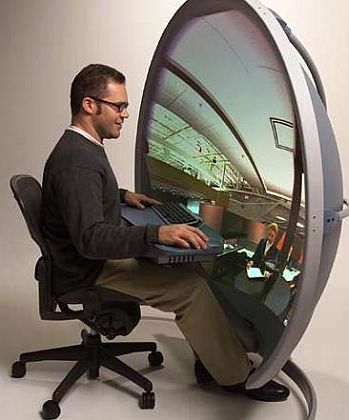 U.S. Armyvetronics researchers are canvassing industry to see which companies might be able to provide glasses-free 3D display technology, orautostereoscopic displays, and to determine if the time is right for a formal solicitation to acquire glasses-free 3D display technology for future armored combat vehiclesor unmanned vehicle control stations.
The Ground Vehicle Robotics branch of the Army Tank Automotive Research, Development and Engineering Center (TARDEC) in Warren, Mich., on Wednesday issued a request for information (RFI: W56HZVRFI3D) as part of a market survey to assess the potential to obtain an autonomously adjustable autostereoscopic display system and test it on an Army vehicle.
The market survey is part of a potential TARDEC 3D Display Without Glasses and Head Tracking program. Autostereoscopy refers to displaying stereoscopic images without the aid of special headgear or glasses -- typically by using eye-tracking and multiple views so that the display does not need to sense where the viewer's eyes are located. ...
Read the full story here:
Fraunhofer HHI reveal details of 3D TV Producer Bootcamp
For the first time, the MIPTV 3D conference will include a 3D Bootcamp, hosted by the Fraunhoher Heinrich Hertz Institute. Kathleen Schroeter, Executive Manager of the 3D Innovation Center in Berlin, reveals a sneak preview of what will be on show.
Ahead of the opening of the 3D Innovation Centre in Berlin, the Fraunhofer HHI will be holding a special 2.5 hour bootcamp on Wednesday April 4th between 10.00 – 12.30pm. Kathleen Schroeter will talk about some of the projects the institute has been involved with, including recent research in the field of broadcasting cameras plus provide some details about what the 3D Innovation Centre will offer.
Stephan Heimbecher from Sky Deutschland will talk about “3DTV past and now”. He will discuss the problems and solutions of broadcasting live German football in 3D and illustrate the optimum positions for cameras during a live 3D sports broadcast.
Marc Briede from Chroma TV & Film, will present three different productions including a 3D concert. Chroma can boast a lot of experience in 3D, especially in the commercials sector.
Gerd F. Schultze from Music Delight, will present a ‘behind-the-scenes’ session about ‘The Scorpians Live in 3D’ concert. Gerd F. Schultze is new in the 3D field, coming from 2D DVD concert production field and can show that one should not hesitate to work in 3D when working with in partnership with experienced 3D companies.
Sven Weissenfels, from D Telekom, will present a session called '3DTV live & on Demand to Entertain' and Sebastian Knorr from imcube labs will put his case forward as to why so many movies and parts of movies need conversion. Part of this presentation will include a 5 min showreel illustrating imcube’s 2D to 3D conversion processes.
All speakers will then join a panel discussion joined by Guenther Herrmann from EX3D/ Marchon 3D who will be bringing their designer passive 3D Glasses to the event. Marchon 3D have recently launched a 3D glasses shop called 3eyed.
Attendees to the MIPTV market will be free to attend the 3D Bootcamp on April 4th which follows the 3DTV conference on April 3rd. The Korea 3D Showcase also returns this year on Level 01/13.14.
See the original post here:
To 3D Or Not To 3D: Buy The Right Wrath Of The Titans Ticket
Final Verdict: You've really got nowhere to go but up after Clash of the Titans, butWrath of the Titans is a genuinely good example of how post-conversion 3D can be used for live-action films, planned out carefully and used to a really nice, but not obnoxious extent, throughout the movie. With a slightly goofy subject matter that lends itself well to the spectacle of 3D, Wrath of the Titans is about as well-suited to the format as you can possibly get. The 3D won't add some crucial element to the movie experience, but if you're a 3D fan, you'll probably get what you pay for here.
See the full review here:
Ridley Scott talks Prometheus’ 3D
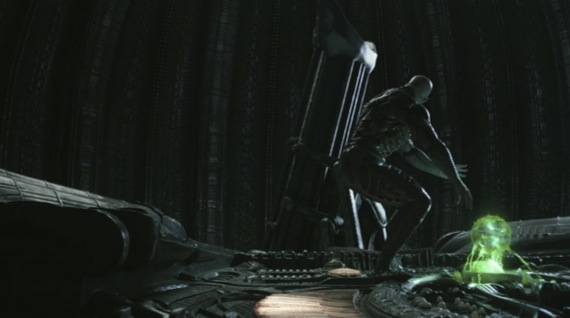
... “I’m kind of naturally visual anyway, that’s where I come from. And you’re working off superb 3D screens, which are on the floor, and are really big. It was just wonderful… I was shooting on 3D, then seeing it on the floor. It was easy, I must say… You only want to push it so far, before it becomes arrows popping out of the screen and stabbing you in the eye. You use it for visual effect.
“… I’m actually decided right now how deep to make [the depth of field in 'Prometheus'] on certain sequences. So you can literally, as it were, twiddle a knob, and the depth will increase. It’s kind of bizarre, but there it is. Technologically it’s absolutely staggering. I was working with MPC in London, looking after almost 1,300 big FX shots, and every night they would pipe through shots to a big screen in my office in Lexington Street; I would sit there watching a sequence that had just been graded or refined in perfect 3D. Really amazing.” ...
See the full story here:
Will 2012 be the Year of Passive 3DTV?
2011 was a disappointing year for 3DTV, with much less adoption rates than the industry was hoping for. One reason for that is of course a lack of good quality 3D content, however I strongly believe that a move to passive 3D could make a huge impact on global adoption rates.
Passive 3DTV has a number of distinct advantages over the active systems, and that is becoming more and more apparent. Most of the CE manufacturers launched initially with active systems, because the cost and time-to-market is much quicker, but we are now seeing them launch passive 3DTVs. Indeed, the recent announcement from Sony means there is only one 3DTV manufacturer left only doing active. ...
With so many manufacturers now offering passive sets, and likely more sets to come, we are truly seeing the move to passive 3DTV. The true effect of that remains to be seen, however, I truly believe that moving to passive 3DTV technology will be the first step to making 3DTV mainstream. The reduced cost of passive 3D glasses and the widespread compatibility across devices will surely catapult the marketplace to a level simply unattainable with active 3D.
Furthermore, I believe a move to passive technology will also bring with it a wider range of 3D content. ...
Read the full editorial here:
Glasses-Free Stunting 3D TV Growth, Claims Foxc
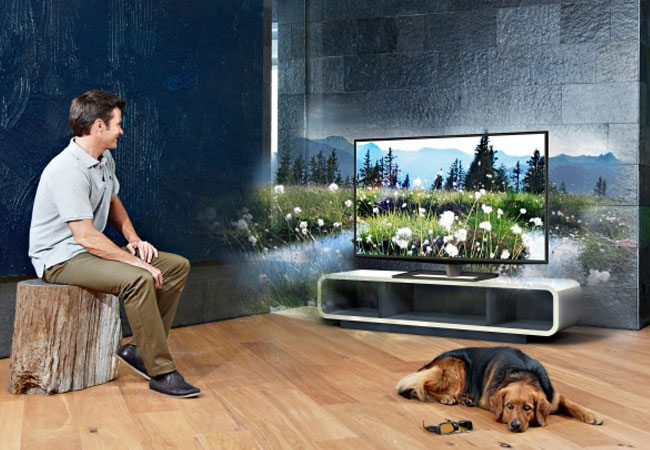 The reason for 3D not taking off has been attributed mainly to two issues by Twentieth Century Fox. One of them being the poor 2D to 3D conversion processes that exist today, and the other being the glasses-free technology that has come into the market. ...
Read the full story here:
Coy: 3D Redefines Film Medium
I can’t call 3D a worthless gimmick anymore. Complete artists like Martin Scorsese and Werner Herzog have proven it’s not just the tool of schlock-meisters. With “Hugo” and “Cave of Forgotten Dreams” they’ve elevated its purposes and explored this new format, revealing its indispensible cinematic capacity in the face of the apparently digital future. Now another brilliant director could save 3D from its current floundering. Peter Jackson’s “The Hobbit” will be released on December 14th of this year and it’s a foregone conclusion that it will be a financial success, but whatever box-office records the movie shatters will have a greater impact on the future of movies than on Peter Jackson, J.R.R. Tolkien or any of their fans, due to the innovations implemented in its production. A triumph of profit and creativity could ensure the death of celluloid film and ultimately bring cinema back to its origins of novelty.
...
If 3D is proven a form with visual and creative integrity, more directors will use it, giving theater owners a financial incentive to switch to digital projection, which is ultimately cheaper than film projection. When celluloid film has nowhere to be exhibited, it will become museum novelty.
After 3D has finished off celluloid, it will be the only form suited for talented, ambitious young directors in a landscape dominated by the flavorless 2D digital image. It will be the only way for anyone to explore the image with the same exuberance set by Scorsese, Herzog and Jackson, while subsequently giving the hacks flashier tools. ...
See the full story here:
NAB Tech Summit Spotlight: Toolsets for Independent 3D Filmmaking
| Technology Summit On Cinema (Formerly Digital Cinema Summit): Advances In Image and Sound Co-Produced by SMPTE for the NAB Show 2012 14 – 15 April 2012 ● South Hall, Las Vegas Convention Center Summit Spotlight: Toolsets for Independent 3D Filmmaking Moderator: Ray Zone, President, 3-D Zone |
|
| A new generation of emerging digital tools is creating a new wave of independent 3D movies – from documentaries and avant-garde experiments to dramatic and humorous narratives.
Join Ray Zone, a historian of stereoscopic cinema and a producer of independent 3D films, for a moderated discussion at the Technology Summit on Cinema at 2012 NAB Show (formerly Digital Cinema Summit) with four independent 3D moviemakers about the digital toolsets they each used for capture, post-production, and delivery of their stereoscopic motion pictures – and see short 3D clips of their work. Spanning cinema, broadcast, and broadband, the Technology Summit On Cinema at 2012 NAB Show (formerly Digital Cinema Summit) is a premier industry technology event, co-produced by SMPTE, that draws leading motion-imaging technologists, researchers, scientists, practitioners, manufacturers, and strategic thinkers. Register now:http://www.nabshow.com/2012/education/conferences/technology-summit-cinema.asp. |
|
Move Over Google: Epson Launches Moverio, World’s First Android-Powered Glasses
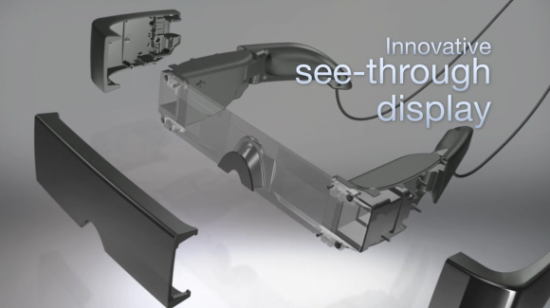 We recently reported that Google had plans to launch some very futuristic technology in the form of Android-powered video and Augmented Reality eyewear. Now it seems that printer and projector experts Epson have beaten the tech giant to the punch, launching the Android-powered Moverio video eyewear today.
Designed in a similar vein to that of Vuzix’s excellent Wrap 1200 video eyewear, the Epson’s Moverio can be worn like a pair of glasses, with two LCD displays laid out in front of each eye, combining to give the effect of an 80-inch screen. Content can be displayed in high quality in both 2D and 3D, the latter of which works using the side-by-side 3D format. Audio quality is also premium, with Dolby’s Digital Mobile surround sound delivered to your ears using the in-ear ‘phones provided, or a set of your own, which can be hooked up to the same connections. ...
While Google’s proposed “Google Goggles” promised much more with augmented reality and the possibility of connecting up to our Android smartphones, Epson’s Moverio looks like a promising product and one with an interesting use of Android. One pair will set you back $699 from Amazon, Epson directly or select retailers.
See the full story here:
Announcing Transmedia Hollywood 3: Rethinking Creative Relations
UCLA School of Theater, Film, and Television,
and
USC School of Cinematic Arts &
USC Annenberg School of Communications and Journalism
Present:
Transmedia Hollywood 3: Rethinking Creative Relations
April 6, 2012, USC
Conference Overview:
As transmedia models become more central to the ways that the entertainment industry operates, the result has been some dramatic shifts within production culture, shifts in the ways labor gets organized, in how productions get financed and distributed, in the relations between media industries, and in the locations from which creative decisions are being made. This year's Transmedia Hollywood examines the ways that transmedia approaches are forcing the media industry to reconsider old production logics and practices, paving the way for new kinds of creative output. Our hope is to capture these transitions by bringing together established players from mainstream media industries and independent producers trying new routes to the market. We also hope to bring a global perspective to the conversation, looking closely at the ways transmedia operates in a range of different kinds of creative economies and how these different imperatives result in different understandings of what transmedia can contribute to the storytelling process--for traditional Hollywood, the global media industries, and for all the independent media-makers who are taking up the challenge to reinvent traditional media-making for a "connected" audience of collaborators. ...
See the full story here: