EON Reality and Spatial Thinking Team Up to Deliver Interactive 3D Math Educational Simulation Applications
"Any product aimed at teachers and students must be one that inspires discovery, experimentation, and engagement. Other elements such as curriculum and standards alignment are equally important. Great care is taken so that all the ingredients that make up our products work together seamlessly to help nurture an environment that is conducive to learning," said George Dekermenjian, Founder of Spatial Thinking LLC.
George Dekermenjian began his work as an educator as a high school mathematics teacher. George spent three years experimenting with different visualization technologies including basic 3D models, 3D animations, and ultimately with interactive 3D simulations. During his preliminary work, he consulted with students and other teachers to help mold an idea of product that centered around the ultimately users -- teachers and students. He ended up with an EON based 3D math simulation for K-12 in geometry and shapes.
Learn more about Interactive 3D Learning for K-12 athttp://youtu.be/wDJ3DfpTnZ4.
See the original press release here
Low-price TVs spur Samsung and LG rethink
Samsung Electronics and LG Electronics, the world’s largest television makers by sales, are enjoying growing global dominance as Japanese rivals dramatically shrink their operations. But they are encountering a challenge at home from unexpected quarters.
As flat-panel TVs have evolved from a luxury item into a relatively cheap, mainstream commodity, the two South Korean groups are facing competition from supermarket chains and online retailers selling lower-priced television sets with names such as “Dream View” and “Shocking TV”.
Yandex launches 3D UI for Android tablets
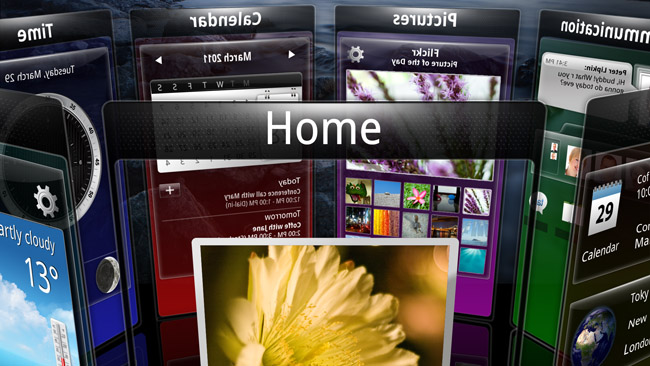 Yandex, the new owner of SPB Software, is using Mobile World Congress to launch
 SPBYandex Shell 3D for Android tablets. Similarly to the smartphone version, the tablet UI also comes with glasses-free 3D UI, allowing interested mobile operators and OEMs to differentiate their products from the competition, which may or may not have its own custom UI running on top of Google’s mobile OS.
Using the auto-stereoscopic technology, Yandex Shell 3D Tablet Edition creates an “immersive 3D experience” without the need for specialized screens. Moreover, the software enables end-users to personalize their devices with colors, themes and widgets.
Read the full story here:
3D Popcorn
 Kfir Ziv is a photographer who splits his time between New York and Tel Aviv working with still, motion and fine art photography. Ziv recently openedKZTLV, a full service photography studio, gallery space and artistic hub based in Tel Aviv. This is his series of 3D popcorn.
See the full story here:
National Inventors Hall of Fame Announces 2012 Inductees
In celebration of its mission to recognize and foster invention, the National Inventors Hall of Fame has announced its 2012 Inductees. The inventors to be honored this year created remarkable innovations that include the now ubiquitous laser printer commonly found in the workplace, the thin-film head technology that has contributed to the success of the disk drive industry, and the first statin which pioneered the class of drugs targeted at lowering cholesterol.
This year's Induction ceremony, sponsored in part by the United States Patent and Trademark Office, will take place on May 2 at the historic Patent Office Building, now the Smithsonian American Art Museum and the National Portrait Gallery, in Washington, D.C. At that time, the 2012 Inductees will be recognized for work such as the carbon dioxide laser which is widely used across diverse fields, the design of computer programming languages, and solar thermal storage innovations.
The National Inventors Hall of Fame 2012 Inductees are:
...
Dennis Gabor (1900-1979) Electron holography - Gabor is best known for his research in electron optics which led to the invention of holography. Because of his efforts and also the efforts of researchers after him, holography has seen numerous modern day applications.
Steve Jobs (1955-2011)Technology - Co-founder of both Apple and Pixar, Jobs was named on over 300 patents and is credited with revolutionizing entire industries, including personal computing, mobile phones, animated movies, digital publishing and retailing. ...
See the full story here:
Lytro camera – Walt Mossberg review
 The consumer point-and-shoot camera has just been reinvented—not tweaked, or remodeled, but actually re-thought from top to bottom. A Silicon Valley start-up called Lytro is shipping this week a camera that looks like no other and actually lets you focus or refocus your pictures on a computer after you take them.
Not only that, but the company is promising that pictures you take with the camera today will be able to be manipulated after the fact in additional ways in coming months. For instance, you'll be able to snap into focus everything at once, regardless of depth. Or change the perspective from which the picture is seen, and switch a photo back and forth between 2-D and 3-D. That's why it calls the images "living pictures."
This $399 camera, also called Lytro, can do all this because it is a so-called light-field camera, which is based on a different technology than traditional digital cameras. In simple terms, it uses a modified sensor, plus proprietary software, to capture and process more, and different, information about the light hitting its lens than other cameras do. This includes the direction of light rays. The result is a richer picture file that software, on the camera and on a computer, can use to manipulate images in new ways. Lytro doesn't even classify its camera by the familiar megapixel measure. Instead, the company says it has a resolution of 11 megarays—in other words, it can capture 11 million light rays. ...
But as in most revolutions, there are some downsides and trade-offs to the Lytro, at least at launch. For instance, it doesn't shoot video. Its "living pictures" can't be imported into standard photo software, only to its own accompanying software. And that Lytro software—necessary to store and share the photos—works only on Macs; a Windows version is due later this year. (However, Lytro pictures uploaded from the Mac software to Lytro's photo service, or to Facebook, can be viewed and refocused on Windows PCs and mobile devices via a Web browser.) ...
When I uploaded these pictures via my Mac to Lytro.com, the company's free photo-sharing site, or to a test account on Facebook, I was able to change the focus again—even on a Windows PC or an iPad—and so will my friends who see them. You can email friends links to your Lytro.com photos. ...
The Lytro is an exciting and novel leap in digital photography, but because it still has some missing features, like flash and a file format that works in other software, buyers should consider it a second camera, at least for now.
See the full story here:
World’s First Active 3D LED Projector Launched – SIM2 M.150 is Just £19,995
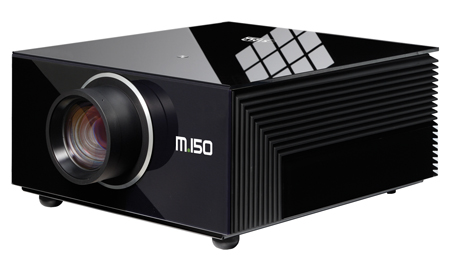 The world’s first Active 3D projector to use LED lighting has gone on sale for a whopping £19,995 apiece.
Italian electronics company SIM2 has crafted the product – the M.150 – to usher in a new era of projector technology. The M.150 uses LED lighting rather than the traditional bulb that is used in nigh on all projectors today, and it offers many advantages.
See the full post here
Everything You Wanted to Know About 3D Printing But Were Too Afraid to Ask
"We can already print semiconductors, and one printer prototype I know can already print batteries — if you have batteries and semiconductors, you have devices.”
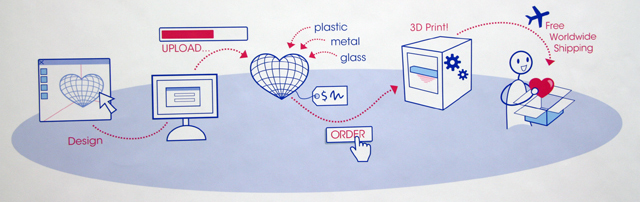
How It Works
What Can Be Printed?
To Print or Not To Print?
The Challenges of 3D Printing
The Future of 3D Printing
What’s in store for 3D printing? Weijmarshausen is adamant that it’s not a need-based business, but a want-based one — you don’t need a 3D-printed bikini, but some people like the idea of cocreation and partaking in the design of the things they own. The items have stories behind them and become conversation starters. So for Shapeways, the mission is to spread that gospel. “We keep growing our proposition to make it easier and more accessible for people,” Weijmarshausen explains.
...
As for the industry as a whole, it’s very much a wild west. “We just got started, we don’t really know what we can do — it’s like the early Internet years, when we couldn’t imagine web browsing or Facebook or Twitter orSkype,” says Weijmarshausen. “We’ll get more exciting materials, we’ll get a mix-up of materials. We can already print semiconductors, and one printer prototype I know can already print batteries — if you have batteries and semiconductors, you have devices.”
Though there are current limitations, a burgeoning 3D-printing industry can let imaginations run wild in the years to come.
“A lot of things — even things we don’t know and that aren’t yet possible — will be 3D printed.”
Read the full post here
Google’s Schmidt gleeful at 3D-capable personal robots
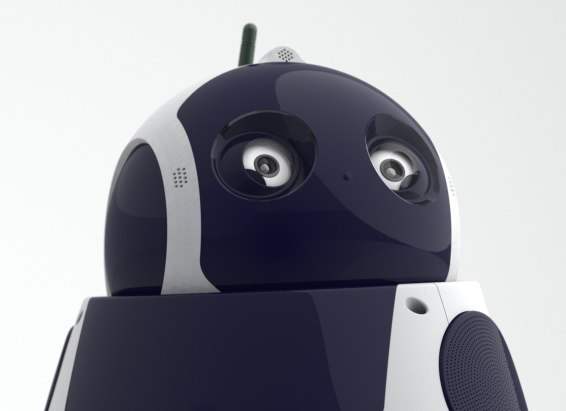
Google chairman Eric Schmidt has presented his vision of the future and technology, describing a world where people have their own personal robot that can represent them remotely and from which they can see a remote 3D visual stream. “We’re beginning to see science fiction become a reality” Schmidt said during his MWC 2012 keynote. ”Look at Star Trek or, my favorite, Hitchhikers Guide to the Galaxy.”
As Schmidt described it, people would have access to compact telepresence robots, small enough to carry in a bag and deploy at will. They would then be able to beam back a 3D picture to a portable 3D-capable screen, part of huge mesh networks of devices talking to each other. “We can look forward to a future of essentially unlimited speed and unlimited processing power … tiny, powerful sensors will be embedded in everything. By 2020, fiber networks will be deployed in every city.”
MIXING POSITIONAL AUDIO AND WEBGL – HTML5 Rocks Tutorial
[Phil Lelyveld comment: this article is a deep dive into HTML5 coding.]
SUMMARY
In this article you learned how to add positional audio to your 3D scenes using the Web Audio API. The Web Audio API gives you a way to set the position, orientation and velocity of audio sources and the listener. By setting those to track the objects in your 3D scene, you can create a rich soundscape for your 3D applications.
To make the audio experience even more compelling, you can use the ConvolverNode in the Web Audio API to set up the general sound of the environment. From cathedrals to closed rooms, you can simulate a variety of effects and environments using the Web Audio API.
Read the full post here: