PRESIDENT OBAMA IS BECOMING QUITE THE 3D FAN
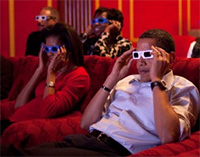 More recently, the President also reportedly had the film ‘Up’ in 3D screened there.
The White House is pretty tight lipped about what tech is in the White House Theater, but clearly 3D projection is now part of the equipment.
The history of the theater is pretty interesting. The theater was converted from a cloakroom in 1942 during the construction of the east wing. It overlooks the sculpture garden established by Hillary Clinton, and for years had white curtains with a red floral design. In 2004 it was converted to the current bright red color. The first film shown at the White House was ‘Birth of A Nation’ in 1915, but there was no formal theater then.
President Eisenhower loved westerns, and screened more than 200 films during his time in office. A favorite was ‘High Noon’.
President Kennedy loved historical films, and was particularly fond of ‘El Cid’. Before the President left for his fateful appointment in Dallas in 1963, he watched Charlton Heston in ‘55 Days at Peking’.
President Reagan loved ‘The Sound of Music’, while President Clinton was a fan of ‘Fight Club’ and ‘American Beauty’.
As far as I can tell the first 3D screenings have been during the Obama administration. While there was both anaglyphic 3D and the polarized variety available beginning in the 60’s I can’t find any evidence that 3D films were shown at the White House in any format.
Read the full story here:
$350 3D printer may come to your desk sooner than you think
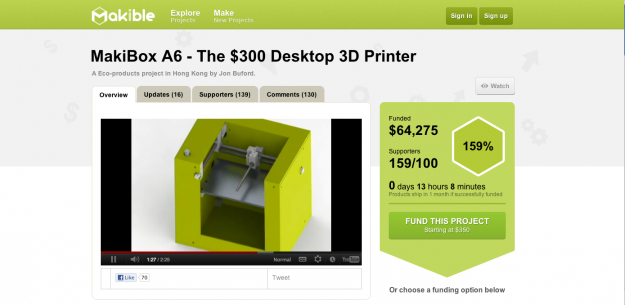 In just one month from today, you can own your own portable and affordable 3D printer at a fraction of the cost of the famous MakerBot printer.
Since its premiere, 3D printers have been make huge progress in a variety of industries, from printing tiny plastic models to prosthetic jaws for medical reconstructive surgeries. Culinary institutions have even tried to 3D print food like cake icing and ramen noodles. But the reason 3D printers have only been in experimentation is because most machines cost upward of $1000. MakiBox wants to change that by affording you the opportunity to own a portable 3D printer for as low as $350.
The MakiBox is currently hosted on Makible, a site similar to Kickstarter but aimed specifically toward craft makers who need funding for their projects.
See the original post here:
We’re Dreaming of a 3D iPad
... Regardless of what happens next week, Apple's been working on 3D screens for years. While the company likely started thinking about how to do 3D way back in the 80s, when Apple emerged as the leading computers for image-manipulation. But the patent applications for 3D technology have only really started flowing in the past three years.
 The most recent 3D-related patent that Apple was awarded basically turns your computer screen into a room that you can play around in. However, in an separate application filed on February 9, the company described new technology as a "three dimensional user interface effects on a display by using properties of motion." In other words, it's a screen that produces 3D images without glasses. How, you might ask? It tracks your eyeball movement. "Once this continuous frame of reference is known, the position of a user's eyes may either be inferred or calculated directly by using a device's front-facing camera," the patent application reads. "With the position of the user's eyes and a continuous 3D frame-of-reference for the display, more realistic virtual 3D depictions of the objects on the device's display may be created and interacted with by the user." (See Figure 8 to the right or check out the full application in PDF format here.) An iPhone is used in the patent application, but an iPad is just one big iPhone. We wrote about some more Apple 3D patents last year, if you're interested in reading more.
This month's application comes in addition to 14 other patents Apple was awarded a couple of weeks before Steve Jobs's death in November. Among them are a couple of mobile 3D screen-related inventions, one of which Patently Apple described as "a patent for Motion Plane Correction for MEMs-Based Input Devices -- which utilizes a form of nanotechnology." In plain English, the blog says that "the invention could equally be used in context with a remote or game pad." ...
See the full post here:
Is The $300 3D Printer Finally Here? Makible Thinks So
MakiBox is a riff on the open source RepRap 3D printer that fits a print head and motor inside a box about the length and width (but not the thickness, silly) of a sheet of paper. The MakiBox kit will start at $350 while an assembled kit will cost $550.
Watch the short video below. See the full story here: http://tinyurl.com/7to24ez
Neonode 3D touch headed to tablets and phones: Hands-on
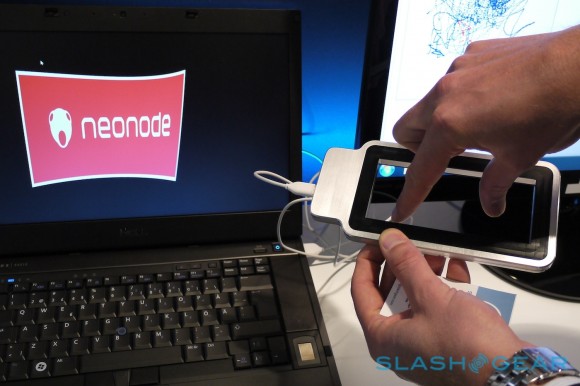 Announced last week, the new finger-tracking kit uses light rather than physical touch sensors: in Neonode’s demo, you can reach through the frame and control on-screen graphics. However, Neonode envisages special cutaway sections showing up on tablets, phones and laptops, allowing us to more precisely interact with the device UI. ...
By layering several of the optical sensors into the body of the new frame, however, the new tech can track far more than just pressure – it can follow motion of two fingers in 3D space. Neonode only develops the hardware technology, not the software – that’s left up to the company’s manufacturing partners...
Neonode says its optical touch sensors are cheaper to implement than even resistive traditional touchscreens, at less than a dollar apiece, and even the new frame version should be a similar price. It’s also artificially thick in this demo implementation: the final design could be as little as 2mm thick. ...
See the full post here:
Aardman Animations moves into 3D with Nintendo 3DS collaboration
 In a world of CGI and digital special effects, the plasticine farmyard of Shaun the Sheep has shown that sometimes it’s better to keep things simple. But, like bringing a combine harvester to a shire horse convention, the series is going hi-tech.
In collaboration with gaming giant Nintendo, the stop-motion characters from Aardman Animations will appear in three dimensions on the 3DS handheld console. On a weekly basis from March 7, 15 one-minute episodes, featuring Shaun, Timmy, Bitzer and The Farmer, will be available to download for free. ...
The one-minute episodes have plenty of harmless adult references, despite being aimed at eight to ten-year-olds. An episode where Shaun turns into a platform-style Super Mario character to an eight-bit soundtrack is a team favourite – even if the idea of making Shaun 2D for a 3D episode seems contradictory.
‘Before 3D, we didn’t have to worry about what we had in the background,’ says Malone. ‘But shooting in 3D, you really can see the space between the characters. ...
I ask Sproxton what kind of games Shaun would play on it.
‘Probably a game involving wool, a knitting game, perhaps, or a grass maze,’ he laughs. ‘It would involve food at some point.’
See the full story here:
Korean LG 3DTV commercial
[Philip Lelyveld comment: watch a recent LG 3DTV commercial with K-pop stars Girls’ Generation and actor Won Bin.]
Microsoft demos Kinect-powered transparent 3D desktop
Researchers at Microsoft's Applied Sciences Group have used a transparent OLED screen, a Kinect and "some software magic" to build a prototype 3D desktop you can manipulate with your hands.
The demonstration shows a pop-up monitor arm, which holds a see-through Samsung display. The user puts their hands behind the screen, and a Kinect -- Microsoft's body-tracking camera for Xbox 360 -- detects finger movements and gestures.
This allows you to rifle through a digital filing cabinet of windows and documents, and use a pinch gesture to make a window fill the screen. ...
The prototype also uses Kinect for head-tracking, so as you look around the screen the 3D perspective changes. This lets you size-up a stack of documents just by tilting your head and seeing how far the digital pile goes into the distance. ...
See the full story here:
3D technology to be used in museums across Turkey
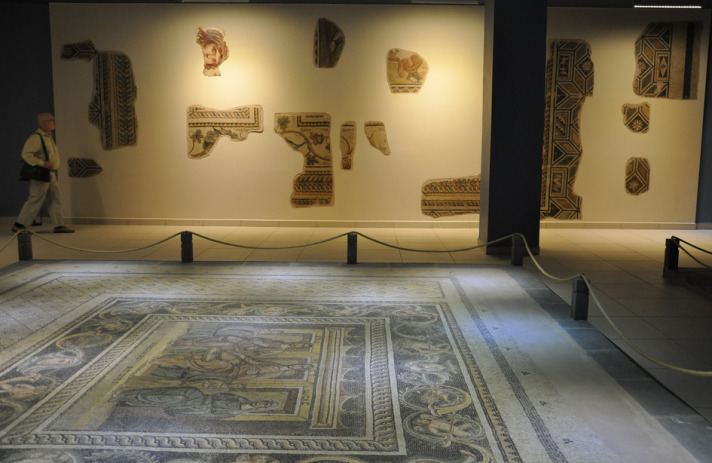 The Ministry of Culture and Tourism announced on its website on Wednesday that it will install three-dimensional visual systems in museums in Turkey to make them more attractive to visitors.
By installing 3D visual effect technology, the Ministry of Culture and Tourism aims to attract more visitors to museums. The first museum that will see this technology installed will be the Zeugma Museum in Gaziantep province, which contains an internationally renowned Turkish mosaic depicting a gypsy girl titled “Çingene Kızı” (Gypsy Girl) that is frequently used in promotional films about Turkey.
Through this new project, museum visitors will be able to see artworks three-dimensionally with the help of 3D simulator glasses. The Ministry of Culture and Tourism has started a bidding process for companies to produce 3D simulator glasses that will be given to visitors to view the artworks in 3D.
After the Zeugma Museum, the ministry plans to install the same 3D technology in two other museums, the Hacıbektaş Külliye (complex) and Archeology Museum and the famous Galata Mevlevihane (dervish lodge) in İstanbul's Beyoğlu district.
See the original post here.
The Basics of Shooting Stereoscopic 3D – Part 5: The Cut-Out Effect, Scene Focus and Viewing Distance
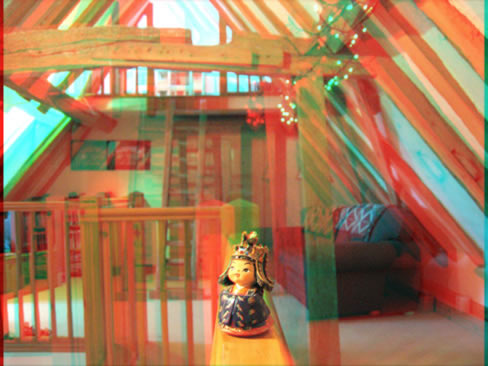 Conclusion
Using long lenses to provide close-ups on distant objects is often unavoidable, but it will result in image foreshortening. However, while it is tempting to increase the interocular distance in order to compensate for this, as I have shown in the above examples, this can in fact make the problem worse.
The issue of focus is even more important with objects in the foreground, as these are closer to the viewer, and the brain knows that these should be clearer than images further away. However, focus can be used to guide the audience to specific locations within the image, as demonstrated on a number of occasions in Martin Scorsese’s film Hugo.
As also shown above, the ratio of the viewer from the screen, based on the screen size, needs to be understood in determining the amount of stereoscopic effect that will be apparent. Again, there are all sorts of calculations for this, but as was stated at the beginning of this series, our industry is about the image, not about strict mathematics!
In my final part of this series next month, I will discuss projection and displays, and headache-inducing problems.
See the full story here: