Sensics smart goggles
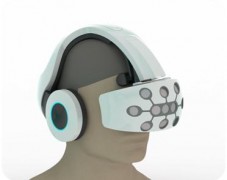
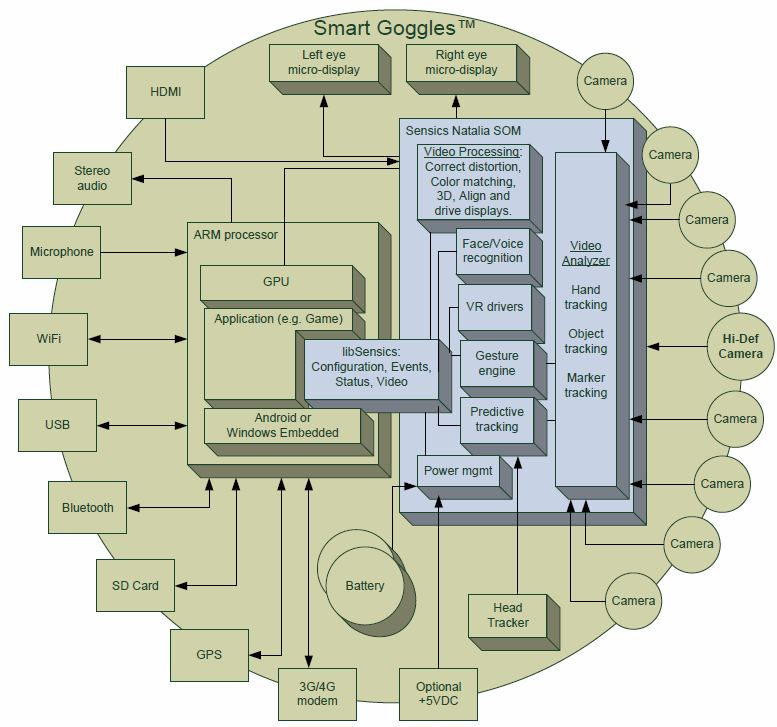
Sensics offers a head mounted display with built-in sensors to detect your hand motion for a more interactive and immersive gaming experience.
See more here.
6 Big HealthTech Ideas That Will Change Medicine In 2012 (Singularity Institute)
... Singularity University‘s executive director of FutureMed Daniel Kraft M.D. sat down with me to discuss the biggest emerging trends in HealthTech. Here we’ll look at how A.I, big data, 3D printing, social health networks and other new technologies will help you get better medical care. ...
3D Printing
3D printing has been around for a while but now it’s being applied to medicine in ways such as being able to scan the remaining leg of a patient that’s missing one from an accident. It can then build a prosthetic leg with skin and size that matches. 3D printing is integrating with the fast-moving world of stem cells and regenerative medicine with 3D ink being replaced by stem cells. In the future we’ll probably use 3D printing and stem cells to make libraries of replacement parts. It will start with simple tissues and eventually maybe we’ll be printing organs.
...
Read the whole story here:
25 big ideas for 2012: 3D surfaces
Founded in 1996 by graduates of the MIT Media Lab, where they studied under founder Nicholas Negroponte, Zebra Imaging is making waves in laser-printing. Fuelled by contracts from the US Army and by research funds from the Defense Advanced Research Projects Agency (Darpa), Zebra has been quietly changing the world of printable holographs from its headquarters in Austin, Texas. The company's chief technology officer Michael Klug describes Zebra's images as "geospatial prints" that "reproduce light-fields in space". All you need is a high-speed holographic printer and 3D data sets manipulated by ZScape software, which the company gives away for free.
For now, Zebra's machines cost around £650,000, and a 60cm by 91cm print, the firm's largest option, will cost you £3,000. But Klug expects these prices to fall dramatically, ...
Read the full story here:
3D Fingernail Gun Art
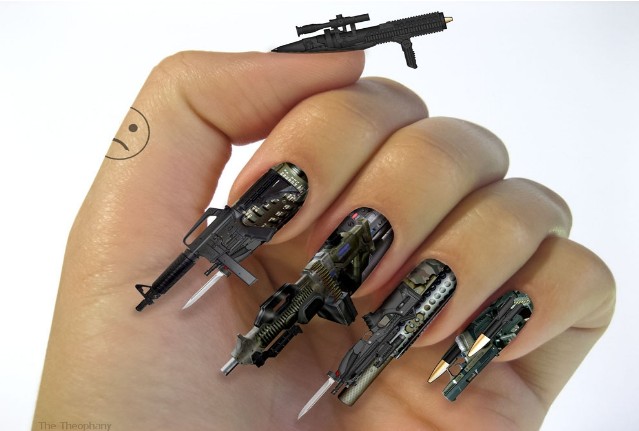
You’ve got anything more attractive than this 3D fingernail gun art, at the very beginning of 2012? No, at least that’s my answer. Designed by Laurent Theopane Bertrand, these amazing fingernails are especially created for the cover of London-based SuperSuper!magazine, and we bet it would soon become a new fashion trend worldwide.
There story is here.
The 5 Most Intriguing Patent Applications of 2011
#1 Google Patent #8,078,349: Transitioning a Mixed-Mode Vehicle to Autonomous Mode
(related to a self-driving car)
2. Microsoft Patent Application #20110197052: Fast Machine Booting Through Streaming Storage
3. IBM Patent Application #20110219208: Multi-Petascale Highly Efficient Parallel Supercomputer
4. Apple Patent Application #20110194140: Walk-Up Printing without Drivers
5. Microsoft Patent Application #20110109724: Body Scan
Read the details here
The 2012 Crystal ball
...
3D will be a hot buzzword, with the introduction of consumer-oriented 3D scanners and 3D printers that will push the idea of scanning and printing your own plastic parts. This will lead to some controversy around the concept of 3D objects piracy popping up in the media, with little actual evidence to back those fears. On the 3D projection end, we will see the rise of designer 3D glasses and the first glasses-free 3D television hitting the market, as we as a few consumer-grade 3D cameras. At the same time, we will see more and more technology to upscale 2D to 3D, in an attempt to develop a larger consumer market for 3D technology.
Read the full story here
2011: The Year In 3D
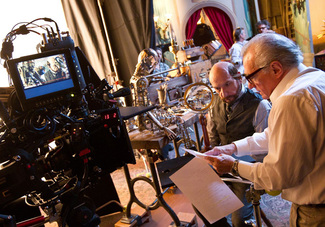
...we are plunging headlong into the fray to take a look back at what 3D did for 2011 at the movies, and what 2011 did for 3D. ...
Beginning And End Of Year Snapshots
Firstly, it should be noted that we leave 2011 in much a much better frame of mind towards 3D than we entered it: January’s big 3D release “The Green Hornet” was a mess, and displayed the worst excesses of both a post-conversion cash grab, and a substandard generic January release. Spin forward twelve months and we get Martin Scorsese’s “Hugo” -- everything ‘Hornet’ was not -- shot in 3D, lovingly designed for the format, and a celebration of its dramatic potential that detractors (like us) hadn’t really glimpsed. While perfect for grandeur and spectacle, even "Avatar" arguably didn't immerse us in the dramatic texture that Scorsese demonstrated in "Hugo." Perhaps this is why James Cameron himself started doing the press rounds with Scorsese, clearly impressed with what a true artist and auteur could bring to the medium.
The Emergence of Arthouse 3D ...
Let’s Not Get Too Excited ...
(Credit) Crunching The Numbers
If such additional revenue is actually to be had. And here’s where we get into the choppy waters of trying to analyze 2011’s 3D box office stats without our heads exploding. ...
Sequels Make Money, 3D Or Not
So bearing in mind that there exist more sophisticated matrices of market analysis than ours (which consists of Box Office Mojo, a calculator and a tub of mango yogurt for sustenance), what is the 3D bottom line for 2011? As far as we can make out, 3D movies, year to date, brought in approximately $3.175 billion domestically: a little over a third of 2011’s $9.244 billion domestic overall total. ...
Michael Bay To The Rescue ...
National Treasure Declares Format Dead ...
Cynical Casher-Inners Cash In, Cynically
Maybe it’s a hangover of the sense of possibility that “Hugo” left us with, and to a lesser extent, Spielberg’s “The Adventures of Tintin” and the last ‘Harry Potter,’ but even we have to admit grudgingly that on rare occasions, 3D can genuinely add something to the filmgoing experience that might be worth a few extra quid (though maybe not the further added charge for glassesthat Sony is threatening us with). Absolutely not, however, in the case of the aforementioned goddamned reissues. “Top Gun 3D”? Really?And let’s not forget to lay a wreath at the graveside of George Lucas’ integrity, as he goes back to the "Star Wars" well for the gazumpteenth time to 3D-imify and re-release those hideous prequels. ...
The Nostalgia Cash-In ...
We Can’t Beat Them, So We Join Them (Sorta)
If you sense a certain resignation in our demeanor, you’d be right. While we’re as wary about some of the mooted 3D projects as ever (we’re um, curious to see how Baz Luhrmann makes longing and heartbreak boing off the screen into our laps in “The Great Gatsby 3D,” for example), we’ve also been given more reason than before to be hopeful that the format may yet yield a few further gems (Alfonso Cuaron's epic spacy odyssey in 3D, "Gravity," we're looking at you and to a slightly lesser degree, "The Hobbit"). And since we can’t expect ‘Avatar’s 2 and 3 until 2014 and probably 2015, it’s unlikely we’ll see anything like a cessation in 3D moviemaking before then (never, ever bet against Cameron). So, you know, we have serious reservations, but also a dose of cautious optimism that we absolutely didn’t feel this time last year. Yes, we no doubt have yet to suffer the worst that 3D is going to literally throw at us ..., but maybe for every ten bad/mediocre efforts, we’ll get a good one. That ratio, after all, is not so very different from that of the standard-format movies that we deal with every day, and it hasn’t dimmed our enthusiasm for those, now has it?
See the full story here
3D scanners ‘will cut crash delay times’
 It is estimated the closure time will be cut by almost 40 minutes, as a 3D image of the site can quickly be created, rather than investigators painstakingly surveying multiple sections of the scene.
This digital image of the site can then be viewed on a computer screen remotely, allowing investigators to take measurements of where vehicles are in relation to each other and examine other important evidence.
In partnership with Hertfordshire Constabulary, Beds Police will receive £158,270, which will pay for two scanners.
Read the full story here:
‘Hugo’s’ Ben Kingsley: ‘I Can’t Act in 3D’
In many ways, we think of 3D as just another special effect. But "Hugo" doesn't treat it like that at all. It uses 3D to say, "Come into this space where our story is happening."
Yes, absolutely. Absolutely. Marty does bring you into the world, and he uses 3D to surround you with that world: the railway station and the toy shop and the apartment and the little hole in the wall where Asa lives. He pushed 3D round a very important corner, I think. He's done it.
Did shooting in 3D change how you did your work?
Yes. Every gesture you make has to be linked directly to the narrative. Nothing can be arbitrary. Nothing can be explained. I learnt a long time ago, you must never explain anything to the camera, because it doesn't need it. All it needs is to see the behavior of the character. It doesn’t want to see any acting. The camera is allergic to acting, it hates it. But the 3D camera has such x-ray capacity that you almost have to modify your acting to a terrifying degree.
...
Read the full story here
Clubbing: Music in 3D
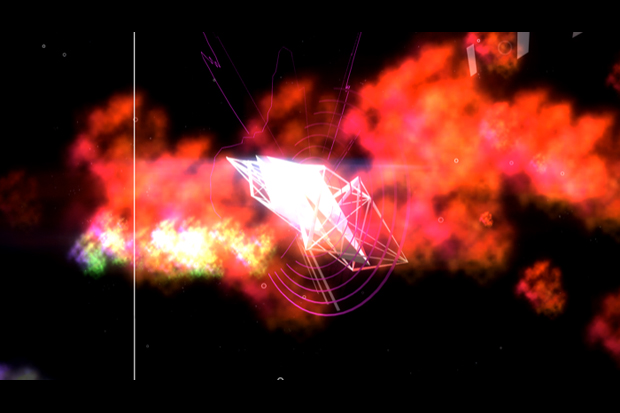 After Hollywood made the jump to 3D, the rush was on to give everything an upgrade ( 3D TV! 3D opera! 3D fashion shows!). Clubbing appeared safe -- until Novak, a collective of Newcastle-based creatives, launched 3D Disco, a high-tech, globally-touring party.
Clubbers in red-and-cyan shades watch 3D visuals on 3.5m-diagonal screens at eye level around the dancefloor -- but with pre-rendered graphics, images can't react in real time.
Andrew Nixon, a 34-year-old partner at Novak, turned to Unity, the software used in games such as Marvel Super Hero Squad. With Unity, visuals can be altered on the fly. "It's built to react instantly," says Nixon. "It's like playing an instrument live, rather than playing back sections of recorded music. For every beat, say, we could have a circle getting bigger." If 3D graphics operators can immediately alter the imagery, they can react to the crowd and potentially create new shows with other acts. And to think, people used to take narcotics to have 3D visions in discos.
See the original post here