Leap Motion teams with HP for 3D Motion Control integration
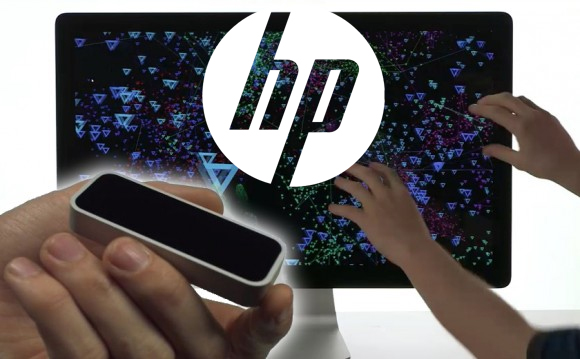 If you were thinking that Leap Motion’s motion control experience was only going to be created as a stand-alone experience, you might need to think again. Today HP has announced a relationship with Leap Motion, this deal showing up thus far as a bundled Leap Motion Controller existing with severalHP products through the future. Can you imagine motion control coming with your desktop products as a matter of fact from here on in?
Read the full story here: http://www.slashgear.com/leap-motion-teams-with-hp-for-3d-motion-control-integration-16278008/
Cisco Unveils their Vision of Second Screen 2.0
By Phil Lelyveld

In a room at the back of the Cisco NAB booth (North Hall booth A113), and in a few session presentations by UK VP of Technology Simon Parnall, Cisco is showing its vision of the next generation of in-home audiovisual experiences. They have prototyped a system that allows browsers to work among multiple tiled screens, seamlessly joined in any configuration, and built into walls in the home. The screens are controlled by and can pass data back and forth from tablets, smartphones, and laptops. There is a counterpart sound system that balances the sound to the area on the wall where the corresponding video is being displayed.
The 4 components of their A/V vision are
- Seamless; the screens join with no visible bezel. The bezel on LCDs is very small now. R&D on next generation OLED displays may allow for seamless tiling in the foreseeable future. (Advances in OLED technology was discussed at an NAB Supersession on Display Technologies of the Future by Gary Mandle of Sony Electronics)
- Unobtrusive; portions of the screens that are not displaying a video image take on the appearance of the surrounding walls. In the demo suite they blend with the wallpaper color and pattern.
- Ultra high def; because the image can be enlarged to fill an entire wall, the system is designed to accommodate ultra high resolution, and
- Ambient; the information is controlled by you, adapts to you, and can be tailored to your tastes, geolocation, and other hyperpersonalization factors.
The demonstration installation manipulates audiovisual feeds from broadcast, broadband, and “domotic” sources (e.g. home-generated data like temperature controls, baby cams, and photo albums).
This browser-based solution is similar to other systems that allow the user to move and manipulate data among multiple screens and to and from tablets and smart phones, such as Oblong Industries (http://oblong.com/client-solutions/ ) business solution (they did the ‘Minority Report’ visualization) and Apple and Microsoft apps.
What makes the Cisco prototype interesting at this time is the context in which is it being shown.
First, it is not far from NHK’s demonstration of 8K video capture and display. NHK's 20 minute theatrical demo clearly showed the value of an occasional 8K viewing experience. Cisco’s approach of feeding an 8K signal to a seamless tiled 8K-equivalent screen that has other uses when not displaying 8K content could put 8K experiences in consumers’ homes much faster, and sell more displays, as a complementary strategy to selling single-piece large 8K displays.
Second, the large amount of video real estate available through this approach could greatly expand the use of, and monetization opportunities of, 2nd screen applications. It allows for multiple sidebars on the wall, and a new interplay between large displays and tablets. If one person in the room wants to do a 2nd screen activity, they can do it on their tablet. If others in the room want to interact, their tablets are all networked and can interact with the same app on the wall display. Cisco included a ‘couch cam’, so you could ‘look to your side’ and interact with your friends as they watch a program along with you at other locations.
Cisco showed an infrastructure that others companies - hardware, content, and applications developers – can build to. It is a unified vision of how information and entertainment, personal activities and public resources, can be integrated. It isn’t a new vision, but perhaps technology has advanced and prices have come down to the point where it can finally be realized.
The State of Disruption at NAB
By Philip Lelyveld
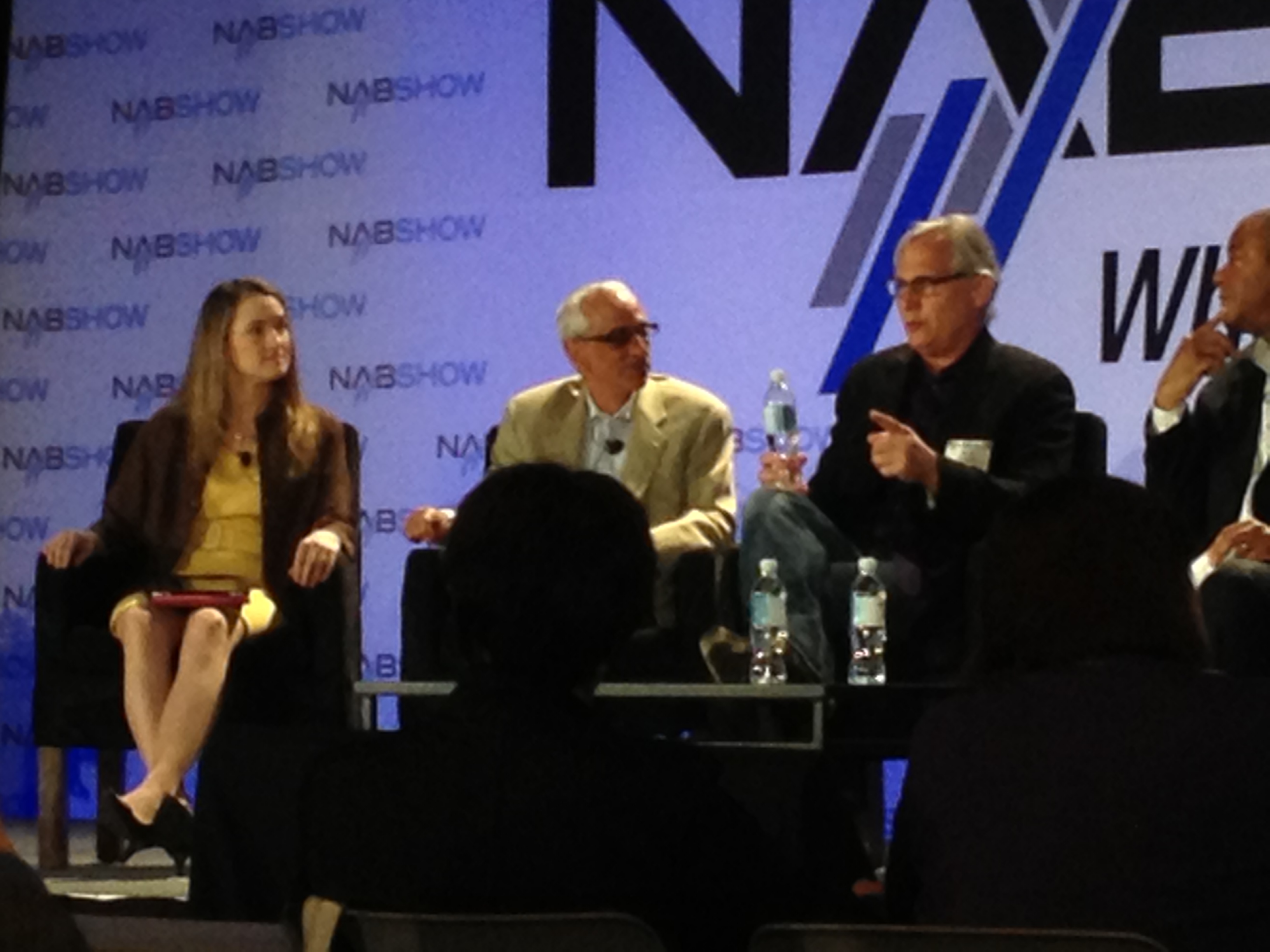
A surprisingly large number of people, at times as many as 100, stayed at NAB through Thursday afternoon to attend the 2-day Disruptive Media Conference produced by Ned Sherman and Digital Media World.
Sony’s Mitch Singer helped frame up the topic of the initial panel, ‘how to successfully harness disruption,’ by positing that there are two types of innovation, competitive and parasitic. Competitive innovation adds value to the ecosystem by making it possible to do things faster, cheaper, better, and more efficiently. Parasitic innovation, such as pirate content and software sites, free ride on the work of others while sucking value out of the ecosystem.
Greg Philpott of mDialog Corp advised the audience to follow the money and do what you know.
Mitch noted that maintaining trade secrets is probably a more important near-term strategy than relying on patent protection, since the patent office moves incredibly slowly relative to the pace of innovation and business activity. If you want to use the patent system defensibly, he added, think about how your business could be disrupted and patent that idea.
Chris Mahoney, Director of Emerging Platforms for Sony’s Playstation group noted that gaming and content are now divorced from the hardware. Gaming is no longer tied to consoles, and consoles are becoming general entertainment and social media devices.
Adobe’s Jeremy Helfand, VP Video Monetization, noted that 10% of online video viewing in the US is done on mobile devices, over 50% of authentications now come from tablets, and 97% of children’s content goes to an iOS device. Even as more content is coming online, CPMs are staying firm. Ad production appears to be standardizing on 15 second or 30 second spots.
The greatest challenge, according to Jeremy Helfand and other panelists, remains content discovery. StumbleUpon’s Teal Newland commented that it is getting harder to find trusted sources for discovery. Search results need to be unbiased if they expect to maintain consumer trust, she said. Gracenote CTO Ty Roberts pointed out that content silos that put up obstacles to data crawling exacerbate the problem. ‘It is as if there were no TV Guide,’ he said.
Samsung’s Adam Sexton suggested that recommendations should take screen size into account. Teal countered that ‘you have to own the format, not the destination.’ Comedy and bizarre oddities are StumbleUpon’s biggest categories.
Barry Blumberg, President of SMOSH, said that it is unlikely that recommendation engines for content will be successful for the foreseeable future because they cannot deal with the nuance of program selection; the understanding that the person likes a specific characteristic of a program, and not just the genre or other generic aspect of it.
When it comes to second screen, or apps development, in many instances they are the stepchild of the production. It is not clear if they fall under TV production, IT, or some other group, said Scripps Networks Interactive SVP Channing Dawson. ‘Who has the incentive to produce the second screen app?’ he asked. There may be some form of joint incentive program evolving.
Many panelists commented that metrics to define and measure success on the second screen are needed. Rentrak president Cathy Hetzel stressed that they are currently gathering data from 30,000 US Households. Rentrak tracks usage on multiple platforms, including tablets and PCs. Right now the data they gather is fairly coarse; such as whether a second screen app is being used. In the future they hope to develop more granular analysis, so that they can say what types of second screen engagements work with different types of primary experiences.
One thing is clear, the second screen app “should not curate a linear experience. … It should bring something unique,” said Dawson. It should “amplify the TV experience.”
Colin Dixon, chief analyst for nScreenMedia, added that five years from now there will be transmedia that won’t make sense just viewing the TV portion.
Monetization of disruptive content types remains challenging. “You have to get a lot of people to come to YouTube to make the production cost make sense, said Barry Blumberg, President of SMOSH. His programs are very carefully developed for a known audience and released on a regular schedule. In short, he sees the road to his success as translating the traditional media model to the digital space using lower budgets while maintaining high production values. But, he added, their website earns an equal amount of money for them as their YouTube videos.
MIT’s Luminoso Claims It’s Cracked the Code on Text Mining
 Luminoso, a startup hatched from MIT's Media Lab that is officially launching this month. Luminoso's not the only company analyzing text on the Internet in order to mine such relationships, but it claims its technology is a quantum leap over competitors like Lexalytics, Crimson Hexagon and Clarabridge.
How?
Catherine Havasi, Luminoso's co-founder and CEO (pictured, third from right), says the company's technology is based on 14 years of research at MIT that applies artificial intelligence, probability and a database of 17 million facts (many taken from Wikipedia) to appropriate common sense knowledge to text mining.
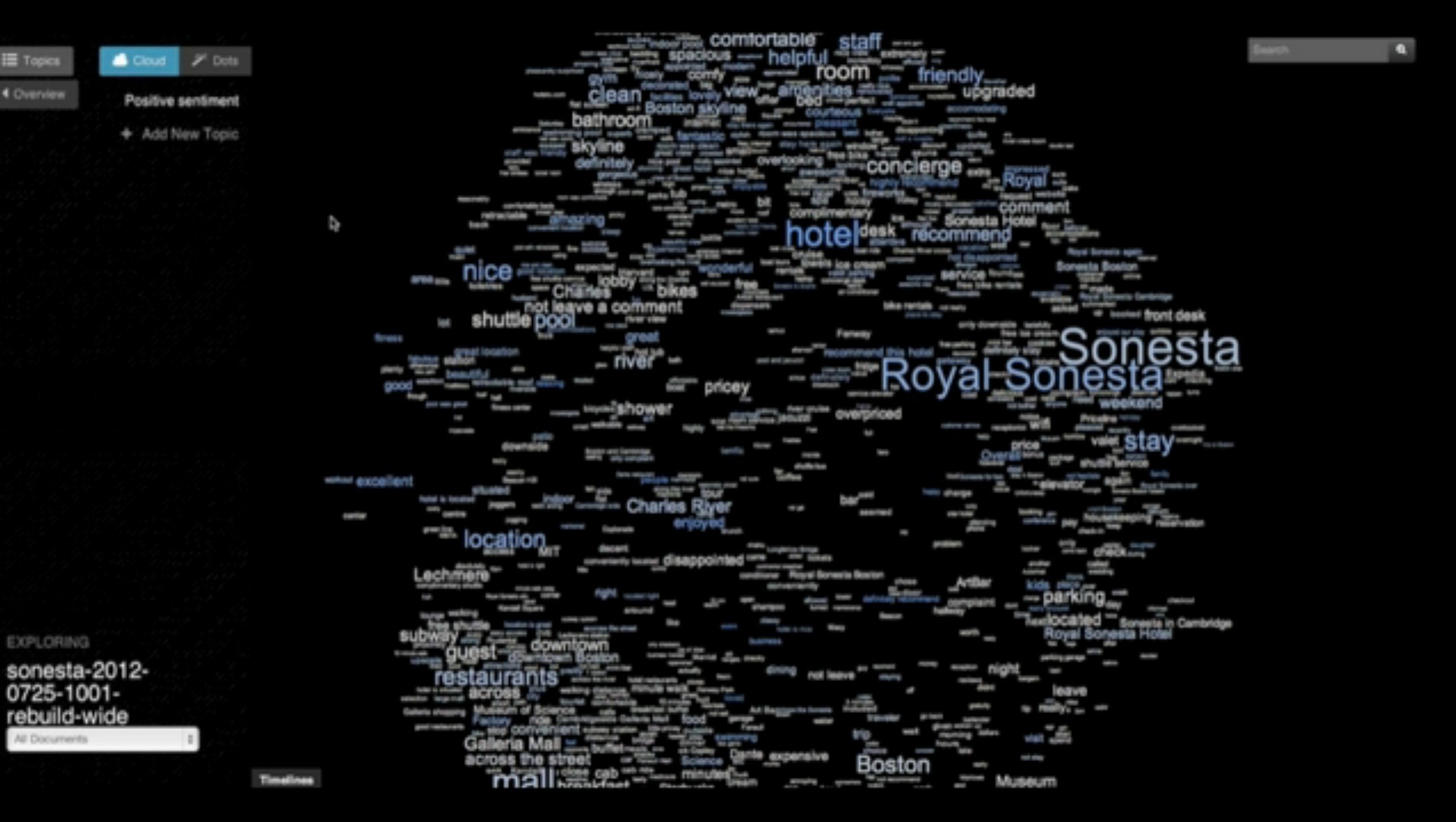
A video on Luminoso's website explains how the technology works. First a word cloud appears of all the terms related to a business. In the video's example, Luminoso scoured reviews for a Boston-based hotel. The software then lets its users cross-search for the word "loved" and then colored those terms blue. In that case, the name was blue, so you could surmise that people love the name of the hotel.
So far, Luminoso at least has been successful in convincing some top companies — who pay in the five figures for its services — that it has built a better linguistic mousetrap. Partially this is because of the rigor that Luminoso (the name is a musical term meaning "to play luminously") has applied to its searches. While the conventional wisdom is that Twitter is the mother lode of such knowledge, Havasi says that YouTube comments are often richer sources and "don't get me started on mommy blogs." The technology's efficacy has let Luminoso exist without funding since 2009. The company has also attracted MIT Media Lab alums Jason Alonso and Rob Speer as well as Kenneth Arnold, a doctoral candidate at Harvard.
See the full story here: http://mashable.com/2013/04/12/luminoso/?utm_medium=feed&utm_source=feedburner&utm_campaign=Feed%3A+Mashable+%28Mashable%29&curator=MediaReDEF
Second Screens vying for viewers’ attention
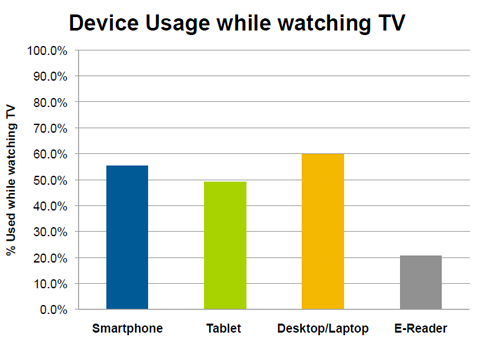
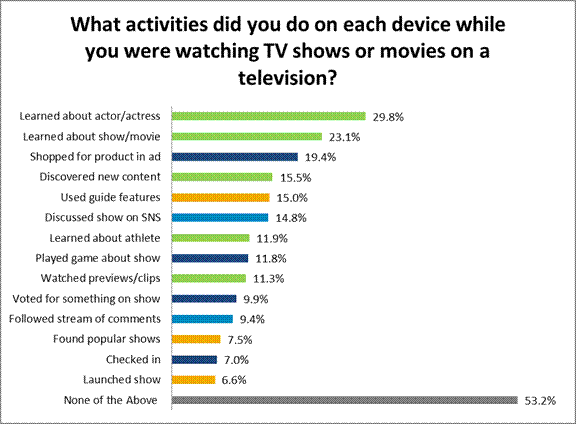
According to The NPD Group, consumers are not widely using applications designed by broadcasters on their laptops, smartphones, and other second-screen devices.
See the full story here: https://www.npd.com/wps/portal/npd/us/news/press-releases/divided-viewing-second-screens-vying-for-tv-viewers-attention/