Steady growth in broadband revenue has helped cable operators offset a stagnant pay-TV market in recent years. But now, the industry is resisting pressure from local governments, businesses and universities to offer ultrafast Internet service, opening the door to new competitors.
Google Inc. GOOG +1.93% and a host of smaller companies working in partnership with cities like Seattle and Urbana, Ill., are building fiber-optic networks that offer speeds of a gigabit per second. That's more than three times as fast as the maximum speeds available to residential subscribers of major cable or phone companies.
Mr. Tolva in Chicago says business services offered by cable operators are far too expensive for "the kind of growing companies that we're trying to foster." He estimates it would cost businesses about $3,500 a month for a dedicated fiber line with gigabit-speed Internet from a cable operator.
By contrast, gigabit speeds in Chattanooga, where the public utility started offering fiber Internet in 2009, cost $300 a month. Some residential gigabit services are even cheaper: Google charges $70 a month for its Kansas City service, as does Sonic.net in California.
[Phil Lelyveld comment: Despite this momentary buzz, I'd be surprised if this gets more traction than its many competitors. Its price is only a few dollars less then some other 3D printer start-ups, and we may already be past the point where people want to buy a single-material 3D printer. There are already online and location-based multi-material 3D shops.]
...if early reaction on Kickstarteris any indication, this 3D printer could become a massive hit with consumers. With 32 days left in its campaign, the RoBo has already raised a whopping $78,000 after setting an initial goal of just $49,000.
So what's got all those backers so excited? It likely starts with the RoBo's super-affordable (relatively speaking) price point. The team behind the RoBo says it will sell for just $520, compared to most 3D printers, which have price tags well into the thousands of dollars. Another big sell for the RoBo is its convenience. Users will essentially be able to plug it in and start printing "within minutes" after bringing it home.
It’s kind of cool that the PBS documentary series “American Experience” has plans to air a film called “Silicon Valley” in February. I’ve always liked the series — “American Experience” was the platform through which such ponderous historical TV masterpieces as “The Civil War” and “Baseball” reached the screen. I’ll certainly see this new production before I see a minute of Bravo’s maligned reality seriesabout the Valley.
[Philip Lelyveld comment: this article contains good stats on 3D (consumer and theatrical) and Blu-Ray market.]
3D home video defies overall down trend of physical video market. In the 3D homevideo segment, the US continues to make up the largest market for Blu-ray 3D (BD 3D), equivalent to 51% of global BD 3D spending. And while both value and volume for traditional physical video are decreasing, BD 3D is an exception to the trend, with forecasts showing strong growth even out to 2016. Spending by US consumers on the medium is up 94% this year from 2011 levels, to $220 million, with BD 3D unit sales set to climb 105%, to 9.9 million units.
Too Big to Know, Rethinking Knowledge now that the facts aren't the facts, experts are everywhere, and the smartest person in the room is the room, by David Weinberger, 2011.
The author also cowrote ClueTrain Manifesto. This book has an equally limited world view from which it makes all sorts of projections. He spends a lot of the early portion of the book defining "facts" in a way that ignores how hard science - as opposed to the softer social sciences - works, although he throws in hard science cases to cover the shortcoming.
Here are a few good, useful quotes from early in the book.
"Transform the medium by which we develop, preserve, and communicate knowledge, and we transform knowledge."
"If we've always had information overload, how have we managed? Internet scholar Clay Shiry says: "It's not information overload. It's filter failure." If we feel that we're overwhelmed with info ration that means our filters aren't working. The solution is to fix our filters, and Shirky points us to the sophisticated tools we've developed, especially social filters that rely upon the aggregated judgements of those in our social circles."
"Filters no longer filter out. They filter forward, bringing their results to the front. What doesn't make it through a filter is still visible in the background."
1. What was the biggest news for you/your firm this year?
The biggest news for Digital LA this year has been creating and spearheading Silicon Beach Fest, LA's first startup entertainment community festival in Santa Monica and Venice in June, 2012. There was energy and excitement in the air with more than 2,000 startup and entertainment attendees mostly from LA, and also curious VCs, investors and angels from Silicon Valley, Chicago, and New York. We met and shared ideas and business cards, from the opening party at the Viceroy, to the packed panels starring Silicon Beach accelerators, VCs, startup CEOs, digital content creators, movie, music, games, and PR pros; hackathon, demo days, student pitch fests, parties and more. At the closing party, attendees kept saying "This is great! When's the next one?" So we did a one-day fall Silicon Beach Fest at io/LA in Hollywood. Both Silicon Beach Fests featured LA Mayoral Candidate Eric Garcetti, and were covered in several Forbes articles, TechCrunch, PandoDaily, and national and local press. We'll head back to the beach on the first week of summer for a week-long Silicon Beach Fest in Santa Monica June 2013. In addition to Silicon Beach Fest, we also held Digital LA events at Sundance, SXSW, E3, Comic-Con, and in London during the Olympics. We launched a Digital LA - Women series with four panels starring female founders, entrepreneurs, developers and PR, which will also continue into the new year. All of these new Digital LA activities reflects the energy and dynamic nature of LA's digital community, with thanks to our friends at TechZulu, PageWoo, StartEngine, Amplify, Launchpad, MuckerLab, io/LA, Cross Campus, ROC, startup CEOs, USC, UCLA, and many more!
4. What are the technologies, companies, or things we ought to watch in 2013?
In LA tech, keep watch on our accelerators, coworking spaces, content creators, and startup CEOs over the next year. This past year 2012 was all about forming teams, picking players, and choosing uniforms. Now the stage is set for Silicon Beach to really start to play ball in 2013.
Why fight for Hollywood? Because making our spreadsheets recalculate faster is no longer enough to inspire new generations of computer hardware. Because Silicon Valley has come to appreciate continuing income streams from subscription services. Because there are legacy players in the TV industry who are easily seen as vulnerable.
[Philip Lelyveld comment: this is deceptive, because the lens allows you to focus on an image projected onto glasses. There is NOT a display in the lens itself. But it is still an interesting approach.]
Instead of oversized virtual reality helmets, digital images are projected onto tiny full-color displays that are very near the eye. These novel contact lenses allow users to focus simultaneously on objects that are close up and far away. This could improve ability to use tiny portable displays while sill interacting with the surrounding environment.
Developed as part of DARPA’s Soldier Centric Imaging via Computational Cameras (SCENICC) program, SCENICC’s objective is to eliminate the ISR capability gap that exists at the individual Soldier level.
"We need to be careful we don't drown in the data," said David Deptula, a retired Air Force lieutenant general and a senior military scholar at the Air Force Academy.
Air Force officials have met with the sports cable network ESPN to discuss how it handles large amounts of video that stream in. The visit resulted in no technological breakthroughs, but helped in developing training and expertise, the Air Force said.
"The real value added would be if I could have that tool go back and say, 'How many times has this vehicle appeared in this geographic area over the last 30 days?' and it automatically searches volumes of full-motion video," said Col. Jeffrey Kruse, commander of the 480th Intelligence, Surveillance and Reconnaissance Wing.
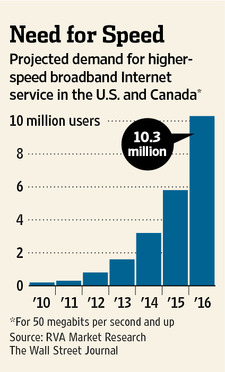
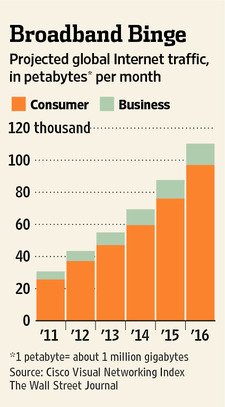 Steady growth in broadband revenue has helped cable operators offset a stagnant pay-TV market in recent years. But now, the industry is resisting pressure from local governments, businesses and universities to offer ultrafast Internet service, opening the door to new competitors.
 1. What was the biggest news for you/your firm this year?