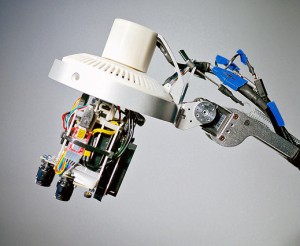
 [Philip Lelyveld comment: How many MIT Media Lab students does it take to change a light bulb?]
The LuminAR device, created by Linder and colleagues at the Media Lab, can project interactive images onto a surface, sensing when a person’s finger or hand points to an element within those images. Linder describes LuminAR as an augmented-reality system because the images and interfaces it projects can alter the function of a surface or object. While LuminAR might seem like a far-fetched concept, many large technology companies are experimenting with new kinds of computer interfaces in hopes of discovering new markets for their products (see “Google Game Could Be Augmented Reality’s First Killer App” and ”A New Chip to Bring 3-D Gesture Control to Smartphones”).
See the full story here: http://www.technologyreview.com/news/507836/augmented-light-bulb-turns-a-desk-into-a-touch-screen/?utm_campaign=newsletters&utm_source=newsletter-daily-all&utm_medium=email&utm_content=20121129
Of the approximately 60 graduate engineering students who completed the survey, 68% stated that they did not know enough to answer the question “what is a trade secret?” 21% stated that they did not know enough to answer the question “what is a patent?” The percentages of students unable to provide an answer to “what is copyright?” and “what is a trademark?” were 32% and 51% respectively.
This problem is even more pressing now that many cash-strapped universities are making IP a key focus of efforts to more effectively leverage their research output.
See the full article here: http://www.forbes.com/sites/johnvillasenor/2012/11/27/intellectual-property-awareness-at-universities-why-ignorance-is-not-bliss/?utm_source=feedburner&utm_medium=email&utm_campaign=Feed%3A+mediaredef+%28jason+hirschhorn%27s+Media+ReDEFined%29
5. The Team Spirit
USC, UCLA, Cal Tech and JPL are geek-rich feeding ponds for tomorrow’s big-fish startups. Kevin Winston’s Digital LA is the largest networking organization for the digital entertainment industry. Add in coworking spaces, hackerspaces, consulting firms, startup capital events and monthly breakfast lecture series and Los Angeles is an interactive idea hive of startup juju. Take a look at this visualization map of L.A.’s startup scene to see all the connections.
See the full article here: http://www.forbes.com/sites/davidhochman/2012/11/26/six-reasons-los-angeles-is-suddenly-booming-with-startups/
[Philip Lelyveld note: the 3D will be shown at 24fps triple flash, 48fps double or single flash - depending on the projector's capabilities.]
Wendy Aylsworth fixed her eyes on a screen at the Landmark theater in West Los Angeles, carefully studying a scene of hobbits preparing a lavish feast.
"We're seeing good detail and a richness in the characters," Aylsworth said. "It's right on."
The Warner Bros. senior vice president of technology was reviewing a test reel for the "The Hobbit: An Unexpected Journey," and a new projection technique that will show the highly anticipated Peter Jackson movie at 48 frames a second.
The controversial new technology could revolutionize traditional movies, which have been projected at a standard 24 frames per second for almost 90 years. Warner Bros. will become the first studio to release a major Hollywood movie in 48 frames a second when its "Hobbit" premieres in the U.S. on Dec. 14.
Warner is also hedging its bet: The high-frame-rate version of "The Hobbit" will be shown on only about 450 screens of an estimated 4,000 screens in the U.S. and Canada that will show the movie.
For now, theaters will not be charging extra for the higher-frame-rate screenings, which will be included in the higher-priced 3-D tickets.
The cost of bringing high-frame-rate viewing to most theaters is $1,000 to $2,500 per screen. Cinemas that already have the newest digital projectors typically require only a software upgrade or a new video card.
See the full story here: http://www.latimes.com/entertainment/envelope/cotown/la-fi-ct-48frames-hobbit-20121121,0,5343864,full.story
The Sony Store in New York can be a chaotic place with all those PlayStations giving it the feel of a loud arcade. But walk to a back corner and there is an island of peace. Sony’s new Ultra High-Definition (UHD) or 4K TV set has its own showroom, where customers can absorb the pristine resolution of the 84-inch display.
The in-store experience is free. To take it home, it’s $24,999.99.
On Thursday, Southern California retailer Video & Audio Center (VAC) will begin selling the Sony force. There have been at least five pre-orders, according to the chain's corporate director Tom Campbell.
The fledgling 3net Studios is looking to be a pacesetter in native 4K production, announcing Wednesday it is in motion with “Space,” with three hour-long episodes. The series promises to provide some sense of how the speed of light feels and the view inside a comet’s tail looks.
Read the full story here: http://www.mediapost.com/publications/article/187310/ultra-high-definition-content-lifting-off.html#axzz2DKi09JjD
According to the interim results of the CEA’s Black Friday Survey, 47 percent of shoppers bought electronics through Friday, with 26 percent buying a smartphone and 22 percent grabbing a tablet.
Noting that roughly 31 percent of U.S. households currently have a tablet, CEA's chief economist and senior director of researchShawn DuBravac said, “It would not surprise me if half of U.S. households own tablets by the beginning of 2013.
CEA’s pre-Black Friday survey found half of consumers say the impending “fiscal cliff” will have a moderate to large negative impact on their holiday spending, and 84 percent said they believed the fiscal cliff would have a moderate to large impact on the U.S. economy.
“For a lot of folks, second screen is about being second to TV. I think we can see that start to reverse, especially when you start to talk about 50-60 percent of U.S. households having tablets," he said.
See the full story here: http://www.hollywoodreporter.com/news/tablets-smartphones-black-fridays-top-393903
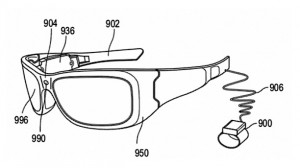 The Redmond-based computer company states in the patent that the specs would incorporate technology enabling a user to view supplemental information while watching a live event.
The patent outlines various ideas for how the specs might be operated, including a wrist-worn computer, voice commands or gestures.
It’s not known if the computer giant has invested any time or money on building a prototype of the high-tech specs, or whether it’s simply a case of laying claim to various features early on to avoid threats of patent-related litigation from rivals should they wish to develop the idea further down the road.
Read the full story here: http://www.digitaltrends.com/cool-tech/microsoft-glass-patent-shows-computer-giant-considering-augmented-reality-specs/
[Philip Lelyveld comment: Pearson takes on Udacity, Coursera, and EdX.]
Pearson should be among the walking dead of global media conglomerates, fatally wounded by the shift to digital media. Pearson is the world’s largest book publisher and dominates the market for textbooks, which are facing a competitive attack from inexpensive or even free course material online.
But education has been one of the last holdouts against the onslaught of computing and communications advances, and that’s given this 168-year-old company time to adapt. It grew sales in its education division by nearly 70 percent to $7 billion over the last four years, as profit margins also increased. That alone has lifted the company’s overall results as its other two main divisions—Penguin, a publisher founded in 1935, and the group that publishes theFinancial Times—have grown more slowly.
But setting up and running the required infrastructure isn’t a job colleges want to do themselves. So this fall, Pearson spent $650 million to buy EmbanetCompass, a startup with technology that helps universities launch online courses.
Read the full story here: http://www.technologyreview.com/news/506361/the-education-giant-adapts/?utm_campaign=newsletters&utm_source=newsletter-daily-all&utm_medium=email&utm_content=20121123
“Millennials are 53 percent more likely than all U.S. adults to feel that social media sites are very important for finding information about news and current events,” Scarborough said.
The demographic represents the first generation of people raised with near constant access to digital networking, the study noted. Millennials now spend more than 82 minutes a day engaged in social networking—32 minutes more than the average adult.
While their comments indicated they go to social media sites to see what’s trending, Millennials use traditional news sources to track down further information. More than half reported reading a newspaper—either hard copy or online—within the previous week. The figure conflicted with longer-term data on adults 21-34 starting in 2001 (instead of Millennials as most were not yet adults, Scarborough said), that indicated newspaper readership fell from 40 percent in 2001 to 24 percent in 2011.
See the full story here: http://www.tvtechnology.com/article/one-fifth-of-americans-rely-on-social-media-for-news/216488
 Vuzix already sells wearable—if clunky—displays to consumers looking to immerse themselves in movies, and it provides more expensive products, such as augmented-reality glasses with a camera and display in each lens, to researchers and the Department of Defense. The Smart Glasses, which have a notably slimmer design than those products, should launch next year for under $500.
Vuzix has a longer history in this field, and about 60 patents, but like Google, it will probably face challenges persuading people to actually wear the devices.
Travers says he has sold versions of that technology to the Pentagon’s early-stage research agency, DARPA, and will launch monocular wearable displays for industrial use in December; the Smart Glasses will eventually get the technology too. However, costs will have to fall significantly for that to happen. Vuzix’s industrial monocular system is expected to cost $2,500 and up, depending on the features.
See the full story here: http://www.technologyreview.com/news/507666/googles-glass-gets-a-competitor/?utm_campaign=newsletters&utm_source=newsletter-daily-all&utm_medium=email&utm_content=20121121
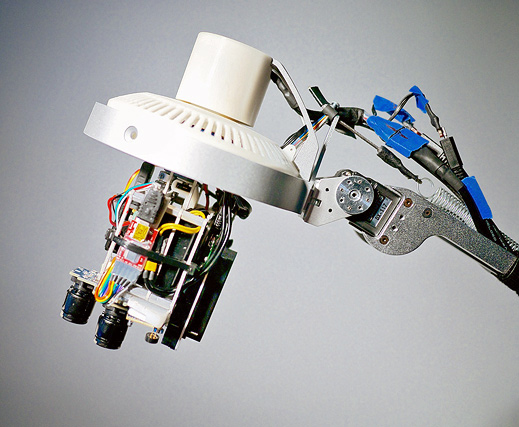 [Philip Lelyveld comment: How many MIT Media Lab students does it take to change a light bulb?]
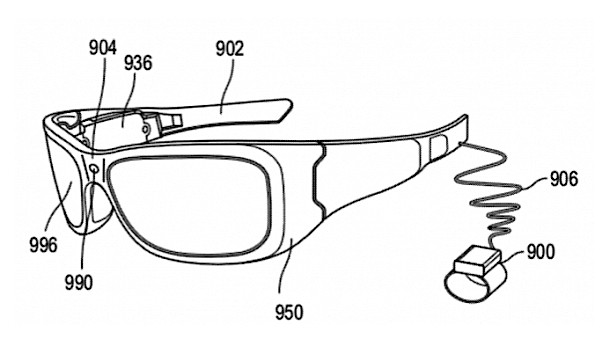 The Redmond-based computer company states in the patent that the specs would incorporate technology enabling a user to view supplemental information while watching a live event.
 Vuzix already sells wearable—if clunky—displays to consumers looking to immerse themselves in movies, and it provides more expensive products, such as augmented-reality glasses with a camera and display in each lens, to researchers and the Department of Defense. The Smart Glasses, which have a notably slimmer design than those products, should launch next year for under $500.