Silicon Valley Is Bracing for a Permanent Underclass
...
“Whenever someone wrote a paper which talked about some negative aspect of A.I., he would say, ‘We’re not going to release something about a problem until we have a solution for it,’” said an employee who worked with Mr. Lehane, and who spoke on the condition of anonymity to discuss internal deliberations. Mr. Lehane characterized his approach differently: He wanted the economists on OpenAI’s global affairs team to “inform smart public-policy making,” not conduct “niche” academic research.
...
And what if we don’t act? What if we “let technology rip”? What if millions of people do lose their jobs to A.I., and nobody puts up the money or policy solutions to help them? In March, the Palantir chief executive, Alex Karp, spoke on a panel with the Teamsters president, Sean O’Brien. “The biggest challenge to A.I. in this country is political unrest,” Mr. Karp said. “If I were sitting here in private with my peers, I’d be telling them the country could blow up politically and none of us are going to make any money when the country blows up.”
See the full story here: https://www.nytimes.com/2026/04/30/opinion/ai-labor-work-force-silicon-valley.html
Canadian Feds reveal 6 pillars for long-touted, repeatedly delayed national AI strategy
...
The federal government said it will achieve those objectives through six pillars:
- Protecting Canadians and safeguarding our democracy.
- Empowering Canadians
- Powering AI adoption for shared prosperity.
- Building the Canadian sovereign AI foundation.
- Scaling Canadian champions.
- Building trusted partnerships and global alliances.
...
See the full story here: https://www.cbc.ca/news/politics/ai-strategy-pillars-evan-solomon-9.7180418
OpenAI Publishes 5 Principles For Its AGI Push
...
The Five Principles Announced This Week
The company says it will resist concentrated power and wants major AI decisions shaped through democratic processes, not only by AI labs, as part of its first principle of democratization. ...
The second principle, empowerment, gives users broad latitude. OpenAI says people should have meaningful control over how they use AI. Yet the same section ties that freedom to a duty to reduce catastrophic harm, local harm and social damage. ...
The third principle, universal prosperity, links AI access to massive infrastructure buildout and lower compute costs. ...
The fourth principle, resilience, moves the company closer to the language of national security. OpenAI points to biological risk, cybersecurity and critical infrastructure. It says no single lab can secure the future alone, and it wants to put in oversight to ensure that any society-wide harms can be detected early and mitigated easily. ...
The fifth principle, adaptability, is the most revealing. OpenAI says it will change course as it learns and that some periods may require placing resilience ahead of empowerment. This means that the closer AI gets to AGI capabilities, the more access may become conditional.
...
See the full story here: https://www.forbes.com/sites/ronschmelzer/2026/04/27/openai-publishes-five-principles-for-its-agi-push/
OpenAI just changed its principles. Here’s what’s changing
...
Both versions of the company’s principles say that OpenAI’s mission is to guarantee this technology “benefits all of humanity,” but the 2018 version explicitly mentions building it safely and beneficially.
“Our primary fiduciary duty is to humanity,” the document reads. “We anticipate needing to marshal substantial resources to fulfil our mission, but will always diligently act to minimise conflicts of interest among our employees and stakeholders that could compromise broad benefit.”
The 2026 version, however, said it needs to continue to build safe systems, but that society needs to contend with “each successive level of AI capability, understand it, integrate it, and figure out the best path forward together.” ...
The way forward, as CEO and cofounder Sam Altman sees it in 2026, is to democratise AI at all levels by giving everyone access to it and resisting the idea that the technology could “consolidate power in the hands of the few”. ... [philNote: "resistance is useless."]
AGI has a “ring of power” to it that “makes people do crazy things,” Altman wrote. To fight back, he said the only solution is to “orient towards sharing the technology with people broadly, and for no one to have the ring.” ...
See the full story here: https://ca.news.yahoo.com/openai-just-changed-principals-changing-112531234.html
Why Cohere is merging with Aleph Alpha
Canadian AI startup Cohere is taking over Germany-based Aleph Alpha, with the blessing of their governments, in a bid to offer a sovereign alternative to enterprises in an AI landscape dominated by American players. “Sovereign AI” refers to systems where companies and governments retain full control over their own data — rather than routing it through U.S. tech giants like Microsoft or Google. ...
While Cohere reported $240 million in annual recurring revenue in 2025, Aleph Alpha had previously generated little revenue and significant losses. But investors are betting that teaming up will improve their odds against much larger rivals. ...
The new entity plans to target highly-regulated industries — including defense, energy, finance, healthcare, manufacturing and telecommunications— as well as the public sector. ...
According to Gomez, “Cohere will become a Canadian-German company.” But that promise could be harder to keep if the company goes public — putting ownership in the hands of global shareholders with no particular allegiance to either country.
See the full story here; https://techcrunch.com/2026/04/25/why-cohere-is-merging-with-aleph-alpha/
The core thesis: this isn’t just a merger—it’s a geopolitical AI move
The merger between Cohere and Aleph Alpha is fundamentally about “sovereign AI”—not just scaling models.
- Governments (especially in Europe) want AI systems they control
- Enterprises in regulated sectors want data residency + compliance guarantees
- There’s growing resistance to dependence on U.S. hyperscalers
...
See the full story here: https://chatgpt.com/?utm_source=Daily+Email+2025&utm_campaign=dd635137fe-EMAIL_CAMPAIGN_2026_04_27_01_24&utm_medium=email&utm_term=0_-dd635137fe-303719286&mc_cid=dd635137fe&mc_eid=116e9f337b&model=gpt-5-3
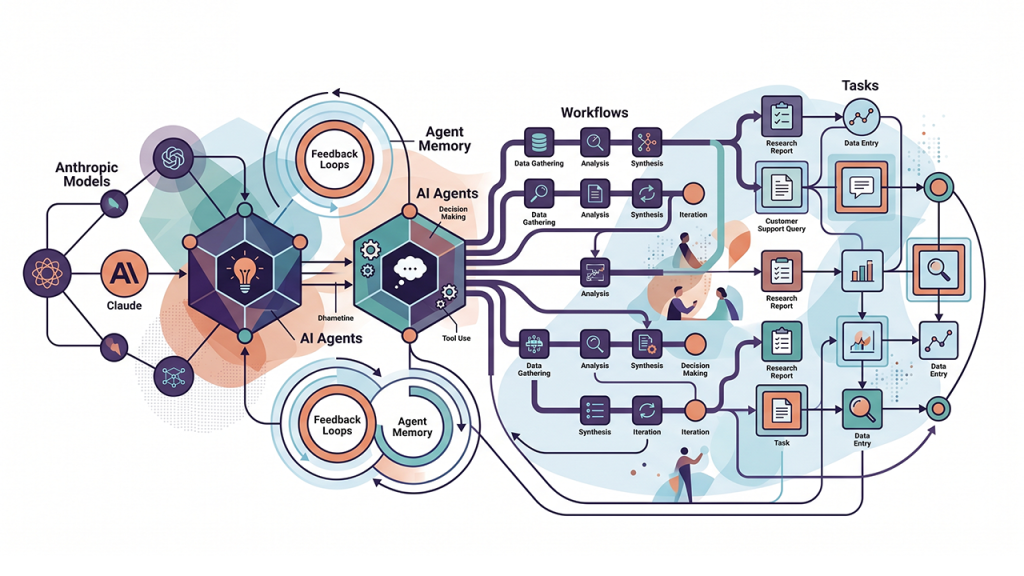
How Anthropic Thinks About Agents, Workflows, and Tasks
...
Task – A single model call: Summarize this. Classify that. Extract these fields. Two years ago this felt like magic. Today it is table stakes. The cost is predictable and the failure modes are bounded.
Workflow – Multiple model calls in a predefined control flow. You decide the steps, the model fills them in. Route the customer email to the right queue, draft a response, check the response against policy, then send. The control flow is yours. The intelligence happens at each node.
Agent – A model using tools in a loop, deciding its own trajectory. You give it a goal, a set of tools, and a system prompt. It decides what to do next based on what just happened. The control flow belongs to the model. ...
China blocks Meta from acquiring AI startup Manus
...
In a one-line statement, China's National Development and Reform Commission, the country's top planning agency, said it was prohibiting a foreign acquisition of Manus and had required all the parties to withdraw from the deal. It did not specifically name Meta Platforms, which owns Facebook and Instagram.
The decision was made by the commission's Office of the Working Mechanism for Security Review of Foreign Investment in accordance with Chinese laws and regulations, the statement said. ...
Meta announced in December that it was acquiring Manus, which has Chinese roots but is based in Singapore, in a rare case of a major U.S. tech group buying an AI company with strong links to China. Its deal with Manus, whose "general-purpose" AI agent can perform multistep complex work autonomously, was expected to help expand AI offerings across Meta's platforms. ...
See the full story here: https://www.npr.org/2026/04/27/g-s1-118892/china-blocks-meta-from-acquiring-ai-startup-manus
The Sphere Looked Like a Disaster. It’s Become a Huge Hit Instead.
...
Sphere has discovered an unexpected hit formula: the performance space that is the most cutting-edge technically works with bands whose frontmen are old enough to have decades of greatest hits that everyone knows by heart. And it can fill the arena with fans the age of its stars—U2’s Bono (65)—as well as vintage-curious Gen Z.
It stacks the calendar with established artists for residencies that can last days, weeks or months—pairing safe, broadly appealing musical acts with spectacular visual flair in shows that take months to produce: U2, Eagles, Kenny Chesney and Backstreet Boys, among others. During the day before a concert, it can charge $200 a ticket for “The Wizard of Oz,” remastered so audiences feel like they’re walking with Dorothy on the yellow brick road. ...
See the full story here: https://www.wsj.com/business/media/sphere-vegas-dolan-disaster-hit-fa0e6b17
AI remains lacking in clinical reasoning abilities, according to study of 21 large language models
Despite increasing use of artificial intelligence (AI) in health care, a new study led by Mass General Brigham researchers from the MESH Incubator shows that generative AI models continue to fall short in their clinical reasoning capabilities. ...
By asking 21 different large language models (LLMs) to play doctor in a series of clinical scenarios, the researchers showed that LLMs often fail at navigating diagnostic workups and coming up with a testable list of potential or "differential" diagnoses.
Though all tested LLMs arrived at a correct final diagnosis more than 90% of the time when provided with all pertinent information in a patient's case, they consistently performed poorly at the earlier, reasoning-driven steps of the diagnostic process, according to results published in JAMA Network Open.
"Despite continued improvements, off-the-shelf large language models are not ready for unsupervised clinical-grade deployment," said corresponding author Marc Succi, MD, executive director of the MESH Incubator at Mass General Brigham. ...
See the full story here: https://medicalxpress.com/news/2026-04-ai-lacking-clinical-abilities-large.html
The AI Brain That Gets Smarter by Shrinking
Summary: In the world of AI, bigger is usually seen as better—but this leads to massive energy consumption and computational costs. Taking a cue from human biology, a research team has developed a brain-inspired “selective pruning” framework for Spiking Neural Networks (SNNs).
The study reveals that AI doesn’t need more connections to learn complex tasks; it needs the right ones. By mimicking how an infant’s brain strengthens long-range links while “pruning” away local clutter, this new AI achieves continual learning—mastering perception, motor control, and interaction—while actually getting smaller and more energy-efficient over time.
Key Facts
- The “Infant” Approach: Human brains don’t just add connections; they refine them. This model follows a “simple-to-complex” trajectory, maturing primary modules (like perception) before moving on to higher cognition.
- Selective Pruning: Unlike traditional AI that freezes weights to prevent forgetting, this system introduces a feedback mechanism that actively inhibits and removes redundant local connections from earlier tasks.
- Knowledge Reuse: While local clutter is pruned, cross-regional “long-range” connections are strengthened. This allows the AI to reuse knowledge from old tasks to solve new ones without needing more “brain” space.
- No More “Catastrophic Forgetting”: A major hurdle in AI is that learning something new often “erases” the old. This developmental framework mitigates that loss without using energy-heavy tricks like “experience replay.”
- Sustainably Evolving: The network scale is continuously reduced as learning progresses, offering a low-energy pathway toward General Cognitive Intelligence.
See the full story here: https://neurosciencenews.com/brain-inspired-pruning-continual-learning-30497/
Pages
- About Philip Lelyveld
- Mark and Addie Lelyveld Biographies
- Presentations and articles
- Trustworthy AI – A Market-Driven approach
- Tufts Alumni Bio