... When students step into a classroom, read assigned books, or meet with a professor during office hours, those students are engaged in knowledge transfer. It is not just the knowledge gained in the transferring of knowledge, but also bringing disparate pieces of knowledge together to form cohesive and sometimes innovative output.
Students who become too dependent upon AI in college and who are not gaining knowledge and learning how to solve problems may find themselves facing difficulty within their future careers. If you find yourself using AI and producing output such as papers and other academic work that you do not understand or cannot validate, that may be a sign that you are depending upon AI output that you cannot defend. ...
... Some applications of AI will be banned entirely if lawmakers consider the risk “unacceptable,” while technologies deemed “high risk” will have new limitations on their use and requirements around transparency.
Here are some of the major implications:
Ban on emotion-recognition AI. The European Parliament’s draft text bans the use of AI that attempts to recognize people’s emotions in policing, schools, and workplaces. Makers of emotion-recognition software claim that AI is able to determine when a student is not understanding certain material, or when a driver of a car might be falling asleep. The use of AI to conduct facial detection and analysis has been criticized for inaccuracy and bias, but it has not been banned in the draft text from the other two institutions, suggesting there’s a political fight to come.
Ban on real-time biometrics and predictive policing in public spaces. This will be a major legislative battle, because the various EU bodies will have to sort out whether, and how, the ban is enforced in law. Policing groups are not in favor of a ban on real-time biometric technologies, which they say are necessary for modern policing. Some countries, like France, are actually planning to increase their use of facial recognition.
Ban on social scoring. Social scoring by public agencies, or the practice of using data about people's social behavior to make generalizations and profiles, would be outlawed. That said, the outlook on social scoring, commonly associated with China and other authoritarian governments, isn’t really as simple as it may seem. The practice of using social behavior data to evaluate people is common in doling out mortgages and setting insurance rates, as well as in hiring and advertising.
New restrictions for gen AI. This draft is the first to propose ways to regulate generative AI, and ban the use of any copyrighted material in the training set of large language models like OpenAI’s GPT-4. OpenAI has already come under the scrutiny of European lawmakers for concerns about data privacy and copyright. The draft bill also requires that AI generated content be labeled as such. That said, the European Parliament now has to sell its policy to the European Commission and individual countries, which are likely to face lobbying pressure from the tech industry.
New restrictions on recommendation algorithms on social media. The new draft assigns recommender systems to a “high risk” category, which is an escalation from the other proposed bills. This means that if it passes, recommender systems on social media platforms will be subject to much more scrutiny about how they work, and tech companies could be more liable for the impact of user-generated content.
The risks of AI as described by Margrethe Vestager, executive vice president of the EU Commission, are widespread. She has emphasized concerns about the future of trust in information, vulnerability to social manipulation by bad actors, and mass surveillance.
“If we end up in a situation where we believe nothing, then we have undermined our society completely,” Vestager told reporters on Wednesday.
... “Our mission is to get to artificial general intelligence and figure out how to deploy that safely,” she said, referring to a future software that could perform a range of cognitive tasks at human level. “And so we’re always very careful not to lose sight of that.” Meanwhile, the company is reshaping the tech industry.
The launch of ChatGPT, which has about 100mn users a month according to SimilarWeb, led tech giants such as Google to redraw their AI strategy and rush out rival chatbots. Businesses around the world have begun to experiment with the technology in the belief it could transform industries from media, finance, law and professional services. ...
Murati said she supported the use of technical “guardrails” to reduce, erase or even prevent some of these dangers.
“Progress is happening very fast, obviously,” she said. “But today, we use these systems more like assistive tools. We don’t rely on them blindly, or entirely. They’re more like tools that enhance our productivity [and] creativity.”
Computer generated imagery (CGI) made its film debut in 1957 with a purple spiral expanding out of an eyeball in the opening credits of Alfred Hitchcock’s thriller “Vertigo.”
... NVIDIA Omniverse Audio2Face, for example, lets artists generate realistic facial expressions and emotions from a real time or recorded audio source. The beta reference application simplifies animation of a 3D character to match any voice-over track for film, games, digital assistants and more. The app can be used for interactive real-time applications or as a traditional facial animation authoring tool. ...
The Omniverse Audio2Gesture (A2G) neural network is trained to generate body motion derived entirely from an audio source. ...
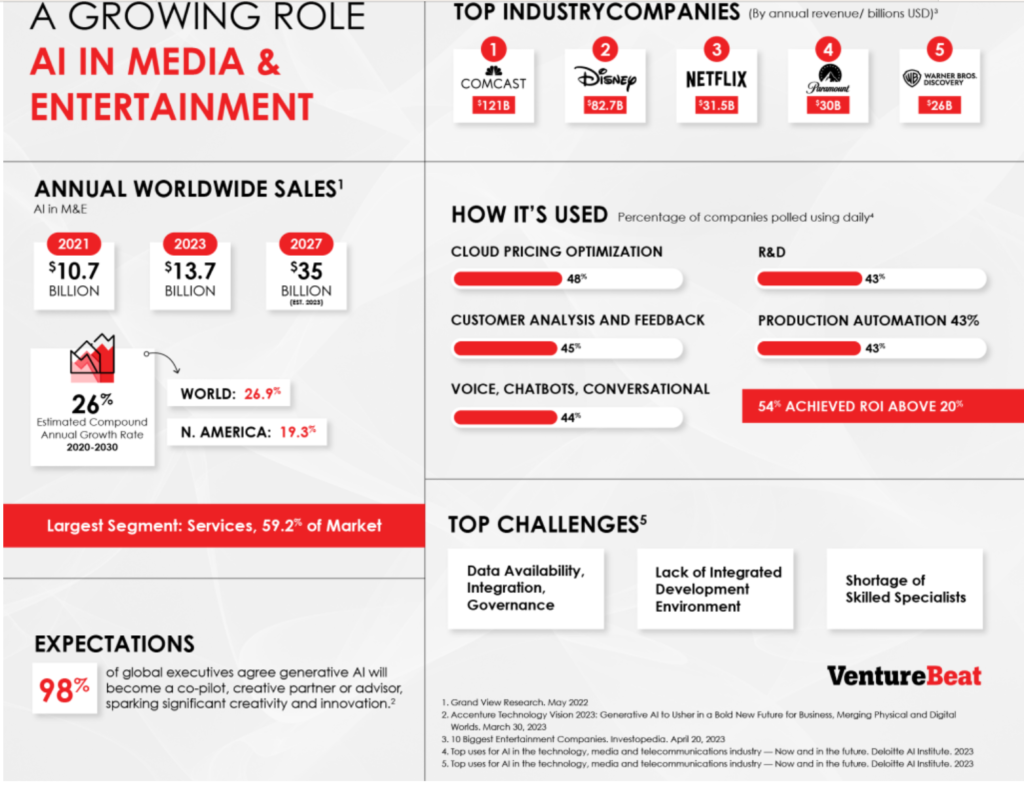
HYPER-PERSONALIZATION. Analyzing data – such as box office, sweeps and readership — has long been an important focus of M&E. Content providers have become increasingly sophisticated in tracking how consumers use their platforms. Many already employ ML to suggest content based on an individual’s habits and preferences. Gaining better, more granular understanding of customers is essential to the industry’s current massive push to identify and deliver highly personalized content. More interaction provides more data for AI-enabled algorithms. That means better, on-target recommendations and playlists for content delivered to a preferred mobile device, PC, smart TV, digital media player or game console. ...
Parliament’s priority is to make sure that AI systems used in the EU are safe, transparent, traceable, non-discriminatory and environmentally friendly. AI systems should be overseen by people, rather than by automation, to prevent harmful outcomes.
Parliament also wants to establish a technology-neutral, uniform definition for AI that could be applied to future AI systems.
AI Act: different rules for different risk levels
The new rules establish obligations for providers and users depending on the level of risk from artificial intelligence. While many AI systems pose minimal risk, they need to be assessed. ...
The Lighthouse is open to brands interested in learning about AR, MR and holographic technologies. The mixed reality space features three areas—The Portal, Originals Theatre and Reflections—where brands and guests can try a variety of immersive experiences and learn about the possibilities available with these emerging technologies.
The space is dedicated to developing next-generation productions designed to be shown its parent company’s Sphere venues. ...
Sphere Studios, which features a quarter-sized replica of the Vegas Sphere screen as a means of helping creative teams fine-tune their work, will showcase technology like the Big Sky ultra-high resolution camera system. ...
Big Sky, Dibble maintained, is “the most advanced camera system in the world” and was created by the company “out of innovative necessity. This was the only way we could bring to life the vision of our filmmakers, artists and collaborators for Sphere.” ...
Apple’s announcement of Vision Pro, a headset that will make videos resemble real life, gives me hope as I look forward to the future of wasting time. I do not call it ‘leisure’ or ‘relaxing after a hard day’s work’ or ‘me-time’ or any such comforting nonsense. Entertainment is not entirely a waste of time but mostly it is, and it is for that reason that I find it entertaining. ..