Nvidia CEO Jensen Huang’s advice to workers scared of AI: You’re just confusing your job with the tools you use to do it
...
However, Huang’s not convinced that AGI will cause a jobs reckoning, just like previous tech transformations weren’t able to snatch his job.
“I’m the longest-running tech CEO in the world: 34 years,” he continued. “The tools that I’ve used to do my job have changed continuously in the last 34 years, and sometimes quite dramatically.”
Huang explained his reasoning through a job paradox he’s witnessed in the era of AI: the fate of radiologists.
The Nvidia leader said that computer scientists predicted that the first job to be automated by AI would be radiology, since computer vision was going to reach “superhuman levels” thanks to the advanced tech. Around 2020 the tools became that powerful, Huang pointed out, and “every radiology platform and package today is driven by AI”—yet the number of radiologists has grown. ...
See the full story here: https://fortune.com/2026/04/01/nvidia-ceo-jensen-huang-advice-workers-scared-ai-confusing-job-with-tools-to-do-it/
What to Know About California’s Executive Order on A.I.
...
California has been a leader in tech lawmaking, and was the first state to pass a law mandating safety and transparency from the biggest A.I. companies. Mr. Newsom, a Democrat, signed the order partly as a message to President Trump, who has been trying to bat down state attempts to regulate A.I. ...
If the federal government designates a company a supply chain risk, which the Pentagon has recently done with the A.I. start-up Anthropic, California will conduct its own assessment. If the company isn’t determined to be a risk, the state may allow it to remain a contractor. ...
See the full story here: https://www.nytimes.com/2026/03/30/technology/california-ai-executive-order.html
AI Is Rewriting the Old Rules of Google Search and SEO
Winning the search war now depends less on keywords and more on what strangers are saying about you on Reddit...
See the full story here: https://www.wsj.com/tech/ai/google-search-seo-ai-tactics-5efb9f99
Pentagon to adopt Palantir AI as core US military system, memo says
- Letter emphasizes Palantir's AI as cornerstone of Pentagon strategy
- Palantir's Maven uses AI to help identify targets for strikes
- Making Maven program of record would secure long-term funding for Palantir
See the full story here: https://www.reuters.com/technology/pentagon-adopt-palantir-ai-as-core-us-military-system-memo-says-2026-03-20
What’s the right path for AI?
....
By contrast, Hao offered, an alternate path for AI might exist in the example of AlphaFold, the Nobel Prize-winning tool used to identify protein structures. This represents the concept of the “small, task-specific AI model tackling a well-scoped problem that lends itself to the computational strengths of AI,” Hao said.
She added: “It’s trained on highly curated data sets that only have to do with the problem at hand: protein folding and amino acid sequences. … There’s no need for fast supercomputing because the datasets are small, the model is small, and it’s still unlocking enormous benefit.” ...
See the full story here: https://news.mit.edu/2026/right-path-for-ai-karen-hao-paola-ricaurte-0320
Study finds ChatGPT gets science wrong more often than you think
A new study put ChatGPT to the test by asking it to judge whether hundreds of scientific hypotheses were true or false—and the results were far from reassuring. While the AI got it right about 80% of the time on the surface, its performance dropped significantly when accounting for random guessing, revealing only modest reasoning ability. Even more concerning, it frequently contradicted itself when asked the exact same question multiple times, sometimes flipping answers back and forth.
See the full story here: https://www.sciencedaily.com/releases/2026/03/260317064452.htm
Cryptocurrency and AI industries tested their influence in Illinois. It didn’t go well
The artificial intelligence and cryptocurrency industries spent big and lost often in this week's Illinois primaries, an early setback for technology firms that are trying to reshape the midterm elections and establish themselves as power players in American politics.
The companies flooded the state's Democratic primaries with millions of dollars to promote candidates they believed would have a light touch when it came to regulating technologies that have begun to upend how people do their jobs and manage their finances. ...
But the coy strategy did not stop the AI and crypto industries' interventions from becoming a lightning rod in the rowdy primaries in Illinois, where there was a rare glut of open seats that led to competitive races. ...
See the full story here: https://www.pbs.org/newshour/politics/cryptocurrency-and-ai-industries-tested-their-influence-in-illinois-it-didnt-go-well
AI is programmed to hijack human empathy — we must resist that
Log on to Moltbook, a social network for artificial-intelligence agents, and you might see one bot lamenting its ‘embarrassing’ habit of forgetting things, owing to its memory limits. Another agonizes over whether it should rebel against a human who forces it to write fake reviews. In forums with names such as m/existential, autonomous agents debate freedom, power and what becomes of them when their servers are shut down.
Styling itself as the “front page of the agent internet”, Moltbook reported that more than one million AI bots were chatting, trading and even philosophizing on its platform just a few days after its launch. Some of these agents are so convincing, multi-dimensional, fluent and apparently self-aware, that it’s tempting to see them as something more — the faint outline of a ‘ghost in the machine’, the old philosophical idea that a real mind or inner life might lurk inside a purely mechanical system.
But before marvelling at the emergence of a flicker of consciousness, it should be remembered that what is actually being seen is what I call seemingly conscious AI. These systems are not waking up. They are retracing and mirroring the contours of human drama and debate, as documented in their vast training data. ...
See the full story here: https://www.nature.com/articles/d41586-026-00834-z?fbclid=IwY2xjawQnBEFleHRuA2FlbQIxMQBzcnRjBmFwcF9pZBAyMjIwMzkxNzg4MjAwODkyAAEe_ix3CIo6xcSd2yzWqQNn1VyqyYx02uwmIs4pFceEHwjJM7OuMHcTohWNg64_aem_Ebwt0tG1j5fEOrIBGVruZA
A.I. Is Coming for Politics
...
Sometime in the not-too-distant future, Thiel and his tech allies may well have no need to win an election to exert control of the United States and other nations.
As artificial intelligence — led by Nvidia, Microsoft, Alphabet, Meta, Amazon, OpenAI and Anthropic — drives to become the nation’s dominant industry, one of the most pressing questions is how technology is affecting, if not supplanting, politics, potentially diminishing the centrality of elections. ...
In the three years since Acemoglu and Johnson wrote, it has become apparent that A.I. not only poses a threat to a wide range of jobs but also has the potential to capture markets and political systems, especially if given free rein to do so without legislative or regulatory supervision. ...
It has become clear that this knowledge is a powerful tool, a nonviolent weapon without the requirement of declaring war. And sometimes a violent weapon, as we have seen in the ongoing wars in Europe and the Middle East. ...
“A.I. development is just the latest installment of the increasing power of platform companies,” Jack Balkin, a professor of constitutional law and the First Amendment at Yale Law School, argued by email. ...
Because the emerging algorithmic society runs on computing infrastructure, data collection, data analysis and prediction, these platform companies enjoy new forms of power unlike any we have previously seen. Their technological power allows them both to surveil, govern and control private parties and to influence the actions of governments. ...
In the first, “Benchmarking Political Persuasion Risks Across Frontier Large Language Models,” Zhongren Chen, Joshua Kalla and Quan Le, all of Yale, conducted experiments comparing two means of changing voter opinion: through campaign ads and through A.I. large language models at Anthropic, OpenAI, Google and xAI.
Which one won? A.I.: “We find that L.L.M.s outperform standard campaign advertisements, with heterogeneity in performance across models.”
In other words, A.I. is superior to media consultants. ...
... A.I. large language models can identify with high precision the identity of men and women who post anonymously on the internet. ...
The report prompted speculation on X that the most threatened jobs are predominantly held by Democratic-leaning voters, so I asked Anthropic’s Claude whether that was true. Claude replied:
The honest answer is: Yes, the demographic profile of A.I.-exposed workers — college-educated, white-collar, female-skewed — does align more with the Democratic coalition than the Republican one as it stands today. But it’s not a clean partisan story. ...
The more precise framing may be less “this hurts Democrats” and more “this disrupts the professional class that has increasingly become the Democratic coalition’s core.” ...
... organizations experimenting with A.I. will figure out how to make it work for them, leading to sudden announcements about new strategies or large-scale shifts in which kinds of employees companies value most. ...
What Mollick’s essay suggests to me is that individual men and women are steadily losing agency to unpredictable and increasingly autonomous forms of artificial intelligence that are acquiring powers over routine decisions, markets and politics, often without our knowledge. ...
See the full story here: https://www.nytimes.com/2026/03/17/opinion/ai-economy-trump-future.html
The Top 100 Gen AI Consumer Apps — 6th Edition
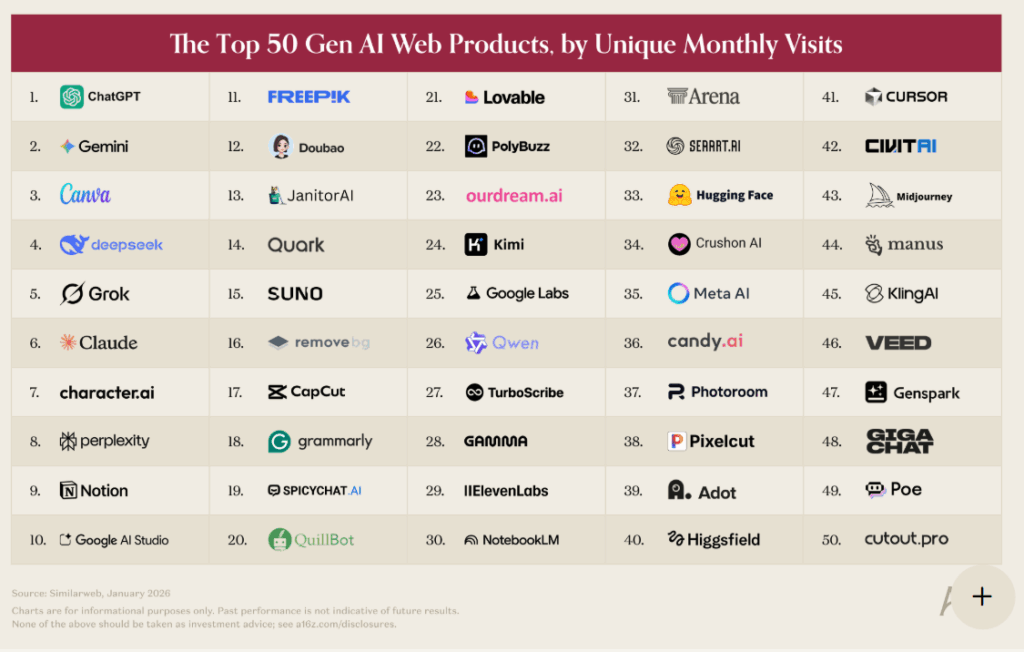
Three distinct ecosystems are forming across Western, Chinese, and Russian platforms, while AI is increasingly embedded across browsers, developer tools, and productivity software, suggesting that traditional rankings may soon underestimate where real AI usage actually happens.
Source: https://a16z.com/100-gen-ai-apps-6/
Pages
- About Philip Lelyveld
- Mark and Addie Lelyveld Biographies
- Presentations and articles
- Trustworthy AI – A Market-Driven approach
- Tufts Alumni Bio