Chinese Gov’t drafts new rules for generative AI tech (ETCentric)
By Paula Parisi
April 12, 2023
As China’s tech giants begin releasing ChatGPT-style products, the powerful Cyberspace Administration of China (CAC) has issued a draft of what will become the country’s first set of restrictions for generative AI. Ground rules include limiting content created by AI to that which reflects the core values of socialism and does not subvert state power in text or image, according to the draft rules. Models should also be trained in a way that does not allow them to generate false information, or exhibit bias as to race, ethnicity or gender. The news comes as three Chinese firms releases generative AI platforms.
The draft rules are couched as a warning by Ars Technica, which says the Chinese government is concerned about AI’s “potential for ‘social mobilization.’” The CAC’s draft rules say providers “have to submit their products for security reviews before their public release,” indicating it is establishing a database for the registration of public-facing AI.

“The regulator also said platforms must verify users’ identities, allowing usage to be tracked,” Ars Technicawrites. U.S. chatbots such as Google’s Bard and Microsoft’s Bing have also been archiving user conversations, which they say is for product improvement; and while the companies may use the data for things like ad targeting, a firewall exists between them and the federal government.
China is lagging slightly behind the U.S., where OpenAI’s DALL-E text-to-image generator appeared in 2021, while chatbots — including OpenAI’s ChatGPT and Google Bard — took off with the public beginning in February.
In China, image generators from Tencent (Different Dimension Me) and Baidu (Ernie-ViLG) became available in Q4, while IDEA — the Shenzhen-based International Digital Economy Academy founded by former Microsoft computer scientist Harry Shum — introduced its open-source text-to-image model Taiyi in January.
As for Chinese chatbots, “on Tuesday, Alibaba unveiled Tongyi Qianwen, its generative AI product, that the e-commerce giant plans to integrate across various services,” writes CNBC. One day earlier, SenseTime, which Ars Technica calls the “Chinese AI software leader,” debuted its SenseChat bot. They followed Baidu, which on March 16 met its self-imposed deadline to unveil the highly anticipated Ernie Bot.
China’s AI rules are expected to take effect later this year, and “will work in tandem with China’s various other regulations around data protection and algorithm development,” CNBC says, adding that “China is not the only country concerned with the development of generative AI. In March, Italy banned ChatGPT citing privacy concerns.”
And The Wall Street Journal reports that the Biden administration is considering “possible rules for AI tools like ChatGPT” as “fears grow over the potential use of artificial intelligence to commit crimes and spread falsehoods.”
See the original post here: https://www.etcentric.org/chinese-government-drafts-new-rules-for-generative-ai-tech/
AI bots mingled at a bar and had a party when researchers gave them a town
Twenty-five AI “agents” were given a virtual town and were observed going to a bar for lunch, planning a party and expressing other human-like behavior.
A society of 25 artificial intelligence (AI) bots were observed waking up, cooking breakfast, heading to work, going to the bar for lunch with friends, and even throwing a party, according to six researchers who created a town for them.
The researchers from Google and Stanford University wrote in an April 7 paper titled “Generative Agents: Interactive Simulacra of Human Behavior” that they built a virtual town populated with ChatGPT-trained “generative agents.”
The purpose of the study — which is yet to be peer-reviewed — was to create a small, interactive society of AI bots inspired by life-simulation games such as The Sims. ...
See the full story here: https://cointelegraph.com/news/ai-bots-mingled-at-a-bar-and-had-a-party-when-researchers-gave-them-a-town?mc_cid=748ee8c8f7&mc_eid=116e9f337b

Star Trek: Strange New Worlds’ High-Tech Sets Made The Cast A Little Space Sick
Read More: https://www.slashfilm.com/1249993/star-trek-strange-new-worlds-high-tech-sets-made-cast-space-sick/
PhilNote: the issue is using AR Wall on the set.
"I think it was totally a learning experience because of the technology of how it works. The wall moves to make sense for the camera angle. The wall is constantly moving and there are constantly things happening. And at first, it was about having to like gain your bearings of understanding that while the world may move around, you are standing very still. It was almost trying to remember not to get dizzy or if there are grand movements it's best to not try and follow it because you will confuse your brain." ...
Read the full story here: https://www.slashfilm.com/1249993/star-trek-strange-new-worlds-high-tech-sets-made-cast-space-sick/

Stuart Russell calls for new approach for AI, a ‘civilization-ending’ technology
... This technology has the power to change the world, said Stuart Russell, a UC Berkeley computer science professor and leading AI expert. It could improve quality of life for people across the planet or destroy civilization, he said. At an April 5 event, he urged both companies to pivot how they’re building AI and countries to regulate AI to ensure it furthers human interests. ...
Existing AI systems like ChatGPT operate in a black box, Russell said. It’s unclear whether these tools have goals of their own, if those goals align with ours or whether they can pursue their goals, he said. ...
The last “civilization-ending technology” – atomic energy – has been the subject of intense governance and extreme care on behalf of its engineers, Russell said. Even less charged technology fields, like aviation, are meticulously regulated. AI should be, too, he said. ...
See the full story here: https://data.berkeley.edu/news/stuart-russell-calls-new-approach-ai-civilization-ending-technology
Virtual reality storyteller creates project showcasing historically Black community in Seattle
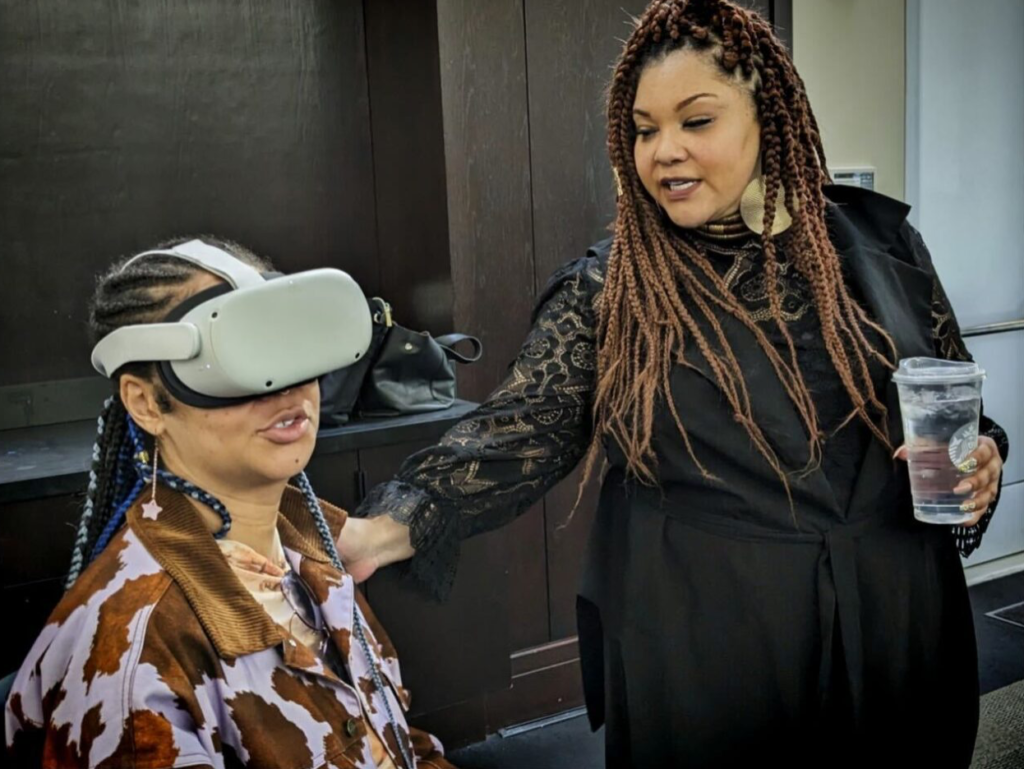
... Inside her VR experience, users wandered the Central District’s main streets, visiting recreated facades of vanished sites such as the long-time jazz hot spot the Black and Tan Club, as well as present-day Edwin Pratt Park, named for a local civil rights leader who was assassinated in 1969. The VR weaves together digital illustrations, historic photos and recent video interviews, with a narrator providing details. ...
Barton began the project seven years ago while working on a UW master’s degree in communications in digital media. The idea for it was sparked by her concerns about how rapidly the area was gentrifying — or “paving over,” as Barton describes it. ...
The VR experience highlights superstar artists such as jazz legend Ernestine Anderson; rapper Sir Mix-a-Lot; multiple Grammy winner Quincy Jones; and, of course, guitar virtuoso Hendrix. It also features present-day interviews with mixed-media artist Melvin Freeman, also known as the Fly Blind Guy; a venture promoting Black-owned entrepreneurs called Black Dot; and Delbert Richardson, founder of the American History Traveling Museum. ...
See the full story here: https://www.geekwire.com/2023/vr-visionary-shares-storytelling-project-showcasing-historically-black-community-in-seattle/