Jail threats stop AI ‘robot lawyer’ from making its debut in court
Mariella Moon·Contributing ReporterWed, January 25, 2023, 10:30 PM PST·3 min read
Joshua Browder, the CEO of New York startup DoNotPay, recently announced that his company's bot will represent a defendant fighting a traffic ticket in the courtroom on February 22nd. "DoNotPay A.I will whisper in someone's ear exactly what to say. We will release the results and share more after it happens," he said. We may never know how the "robot lawyer" will fare in court, though, because a few days later, Browder announced that DoNotPay is postponing its court case after reportedly receiving jail threats from state bar prosecutors if he was to go through with his plan.
The CEO told NPR that multiple state bar associations had threatened his company, and one even said he could be imprisoned for six months. He told the media organization: "Even if it wouldn't happen, the threat of criminal charges was enough to give it up. The letters have become so frequent that we thought it was just a distraction and that we should move on." While the State Bar of California refused to talk about DoNoPay's situation, it told NPR that it has a duty to investigate potential instances of unauthorized law practice. ...
A defendant using the technology in court would have worn smart glasses to record the court proceedings, as well as a headset that would give the AI a way to tell them what to say. ...
As CBS News said in a previous report, though, the tech isn't legal in most courtrooms. Also, in some states, all parties must consent to being recorded. ...
See the full story here: https://www.yahoo.com/entertainment/jail-threats-ai-robot-lawyer-court-case-063006308.html
Gemba Raises $18M for Executive Training in the Metaverse
... As an educational technology company, Gemba evolved out of an executive training business known as The Leadership Network. But while The Leadership Network utilized more traditional technologies in its approach to workplace training, Gemba is designing training tools for the remote working environment using virtual reality (VR).
Rather than businesses sending their executives to corporate training events, often running up a hefty bill in the process, with Gemba, they can run educational exercises remotely in virtual environments.
Robinson said that Gemba’s VR learning platform has been deployed by some of the largest corporations in the world, including Philips, Pfizer, Nike, Coca-Cola, Caterpillar, Johnson & Johnson, Dell and Amazon, which use the company’s system to train their leaders and senior workforces around the world. ...
See the full story here: https://www.pymnts.com/metaverse/2023/gemba-raises-18m-for-executive-training-in-the-metaverse/
CES: Startup Leverages AI to Address Problematic Acoustics
By Phil Lelyveld
January 9, 2023
There are a growing number of companies working on technologies that strive to make a person’s voice more intelligible to the listener over speakers, headphones, hearing aids and other consumer audio devices. Augmented Hearing, a Danish startup launched two years ago, is one of the more interesting companies at CES 2023 focusing on this space. The firm’s software-based solution runs on iOS, Windows and other CE operating systems. Their solution could mitigate the current trend of people across all age groups turning on closed captioning because they often find video dialogue difficult to understand.
Augmented Hearing, which develops extended earbuds with AI to enhance speech in challenging acoustics, designed its product for first responders and other critical communication situations where loud background noise would be expected and could make critical spoken information difficult to hear.

The company cites public safety, aviation and call centers as just some of the sectors that would benefit from its products.
There are multiple ‘before and after’ demos of the tech at work on the company’s website. They currently achieve 20ms latency on real-time processing, and they expect to achieve 6-8ms latency in the near future for the hearing aid market. That means that the enhancement doesn’t interfere with the natural flow of conversation.
The software was trained primarily on the voices of English speakers, but the solution is language-agnostic and will improve for all languages with more diverse training.
See the original post here: https://www.etcentric.org/ces-startup-leverages-ai-to-address-problematic-acoustics/
CES: Kardome Audio Solution Could Serve Virtual Production
By Phil Lelyveld
January 9, 2023
The rise of virtual production stages has elevated the importance of finding a solution to echoing and sound distortion on the set. A company called Kardome that has created a sound isolation technology and “Spatial Hearing” solution for automobile cabins may have a solution applicable to the virtual stage. At CES, the company was demonstrating targeted speech and voice tech that brings clarity to speech recognition devices. According to Kardome, its “AI-driven Spatial Hearing and noise reduction technology facilitate a seamless voice recognition experience in any acoustic environment, from the quiet to the chaotic.”
“Kardome’s spatial sound analysis algorithms and innovative speech-AI models leverage reverberations and eliminate interfering noises, focusing on the desired speech with unparalleled accuracy,” CEO and co-founder Dani Cherkassky explains on the company’s blog. “As a result, Kardome knows who is talking, where they’re talking from, and what they’re saying in any soundscape.”

Their approach requires N+1 microphones to isolate and capture each voice in a room with N people speaking (for example: five microphones in a room with four people).
Kardome is promoting number of applications for assisting voice-enabled devices “in the office, home, car or other environments,” in addition to those “used in mixed or virtual reality environments.” High-quality voice capture with echo and noise reduction for virtual production stages was not on their radar until we discussed it with them at length. The reps expressed interest in additional conversations on the matter.
See the original post here: https://www.etcentric.org/ces-kardome-audio-solution-could-serve-virtual-production/
CES: Superimaging Creates New Clear Window Display Tech
By Phil Lelyveld
January 9, 2023
Last year we told you about VideowindoW, a high resolution clear-glass display that transforms windows, including the entire glass curtain of a skyscraper, into a black and white video screen. This year at CES, Superimaging Display showcased a proof-of-concept demo of a simpler approach to transparent window displays. The company has developed a thin film embedded with nanophosphors that display visible RGB images when excited by ultraviolet light from a DLP projector. The thin film can be attached to any glass surface, and the image is visible but translucent in daylight.
Superimaging is an advanced materials development research lab based in Fremont, California with many years of industry- and government-funded R&D work, including projects with the National Science Foundation, National Institutes of Health, Department of Energy and NASA. Its commercial partners include GM, Volkswagen and Texas Instruments, among others.

According to its website: “Superimaging develops advanced photo-emissive films that convert any glass window or vehicle glass to a haze-free transparent emissive heads-up display screen, with unlimited viewing angles.”
Superimaging hopes to find support to commercialize the product it demonstrated at CES, a technology that could have applications related to advertising, exhibition, sports and more.
See the original post here: https://www.etcentric.org/ces-superimaging-creates-new-clear-window-display-tech/
CES: Contact CI Shows Maestro EP Haptic Feedback Gloves
By Phil Lelyveld
January 8, 2023
Ohio-based startup Contact CI has launched its Maestro EP haptic gloves that work by mirroring the human body’s sheathed tendon design. They provide light- to moderate-haptic feedback by pulling on a cloth sock covering each fingertip. There is also vibrotactile feedback technology in the glove’s fingertips. The “multi-force ergonomic haptics” product is compatible with any system designed for hand tracking (for example: Meta Quest 2). The Department of Defense and enterprises are already purchasing the gloves at $3,750 a pair, primarily for simulation training purposes, while Contact CI continues to improve the design for a wider commercial rollout.
Unlike other haptic feedback gloves that use a mechanical rigging on the back of the hand to physically push and pull on fingertips, the Maestro EP has sheathed cables that move imperceptibly between the forearm-mounted mechanism housing and the fingertips. The lightweight housing looks bulky, but during my demo inside a VR headset it had no impact on my experience. That is probably because it is sewn into the forearm sheath so the glove and forearm move as a unit.
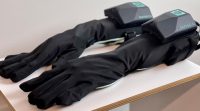
All of the haptic feedback is in the fingertips so pushing buttons and flipping switches is a natural and effective application. However, catching objects was less effective because they involve your palm more than your fingertips.
In Contact CI’s CES 2023 press release, USAF simulator chief innovation officer Margaret Merkel weighed in on the quality of the Maestro DK3 haptic interactions: “Contact CI has done an excellent job of blending force feedback and vibrotactile feedback, they have been able to create complex tangible interactions like switchology tasks inside VR cockpits while using a wireless lightweight wearable glove.”
While Contact CI is selling the gloves in their current form, it is clear from the care required to put the gloves on properly that the design has to be made simpler and more robust. However, their embedded cable approach enables them to withstand rugged use, so they have the potential of being a successful consumer peripheral product.
See the original post here: https://www.etcentric.org/ces-contact-ci-shows-maestro-ep-haptic-feedback-gloves/