Defining what’s ethical in artificial intelligence needs input from Africans
Research and development of AI and machine learning technologies is growing in African countries. Programmes such as Data Science Africa, Data Science Nigeria, and the Deep Learning Indaba with its satellite IndabaX events, which have so far been held in 27 different African countries, illustrate the interest and human investment in the fields.
The potential of AI and related technologies to promote opportunities for growth, development and democratisation in Africa is a key driver of this research.
Yet very few African voices have so far been involved in the international ethical frameworks that aim to guide the research. This might not be a problem if the principles and values in those frameworks have universal application. But it’s not clear that they do.
For instance, the European AI4People framework offers a synthesis of six other ethical frameworks. It identifies respect for autonomy as one of its key principles. This principle has been criticised within the applied ethical field of bioethics. It is seen as failing to do justice to the communitarian values common across Africa. These focus less on the individual and more on community, even requiring that exceptions are made to upholding such a principle to allow for effective interventions.
See the original post here (ToyMatrix is a global news aggregator): https://toysmatrix.com/defining-whats-ethical-in-artificial-intelligence-needs-input-from-africans/

INTERSTELLAR TRAVEL: THE FOUR TOP TECHNOLOGIES FOR GETTING THERE
University of Rochester astrophysicist Adam Frank looks at the possibilities of interstellar travel, given the “insane scale” of the distances between stars and galaxies, in relation to space exploration, whether by ourselves or by intelligent extraterrestrials. ...
Frank offers four: Cryosleep, solar sails (or light sails), wormholes, and warp drives. ...
See the full story here: https://mindmatters.ai/2021/11/interstellar-travel-the-four-top-technologies-for-getting-there/

Holographic Camera Scatters Light to See Around Corners
A team of researchers at Northwestern University has invented a new high-resolution camera that can see around corners and through scattering media, which can be anything from skin to fog.
The research was published on November 18 in the journal Nature Communications.
The new method is called synthetic wavelength holography, and it indirectly scatters coherent light onto hidden objects. The coherent light then scatters again before traveling back to a camera.
The next step is for an algorithm to reconstruct the scattered light signal to reveal the hidden objects. This new method could also image fast-moving objects, such as the beating heart though the chest, thanks to its high temporal resolution.
Non-line-of-sight Imaging
There is a name for this relatively new research field that involves imaging objects behind scattered media: non-line-of-sight (NLoS) imaging. The new method developed by the research team can rapidly capture full-field images of large areas, and it does so with extreme precision and accuracy.
See the full story here: https://www.unite.ai/holographic-camera-scatters-light-to-see-around-corners/

Europe’s AI laws will cost companies a small fortune – but the payoff is trust
...As well as banning some uses outright (facial recognition for identification in public spaces and social “scoring,” for instance), its focus is on regulation and review, especially for AI systems deemed “high risk” — those used in education or employment decisions, say.
Any company with a software product deemed high risk will require a Conformité Européenne (CE) badge to enter the market. The product must be designed to be overseen by humans, avoid automation bias, and be accurate to a level proportionate to its use.
Some are concerned about the knock-on effects of this. They argue that it could stifle European innovation as talent is lured to regions where restrictions aren’t as strict — such as the US. ...
Mistakes at the very start of this new era could damage public perception irrevocably. ...
That’s why the legislation’s focus on reducing bias in AI, and setting a gold standard for building public trust, is vital for the industry. ...
In 2019, Harvard Business Review found that patients were wary of medical AI even when it was shown to out-perform doctors, simply because we believe our health issues to be unique. We can’t begin to shift that perception without trust. ...
See the full story here: https://venturebeat.com/2021/11/21/europes-ai-laws-will-cost-companies-a-small-fortune-but-the-payoff-is-trust/

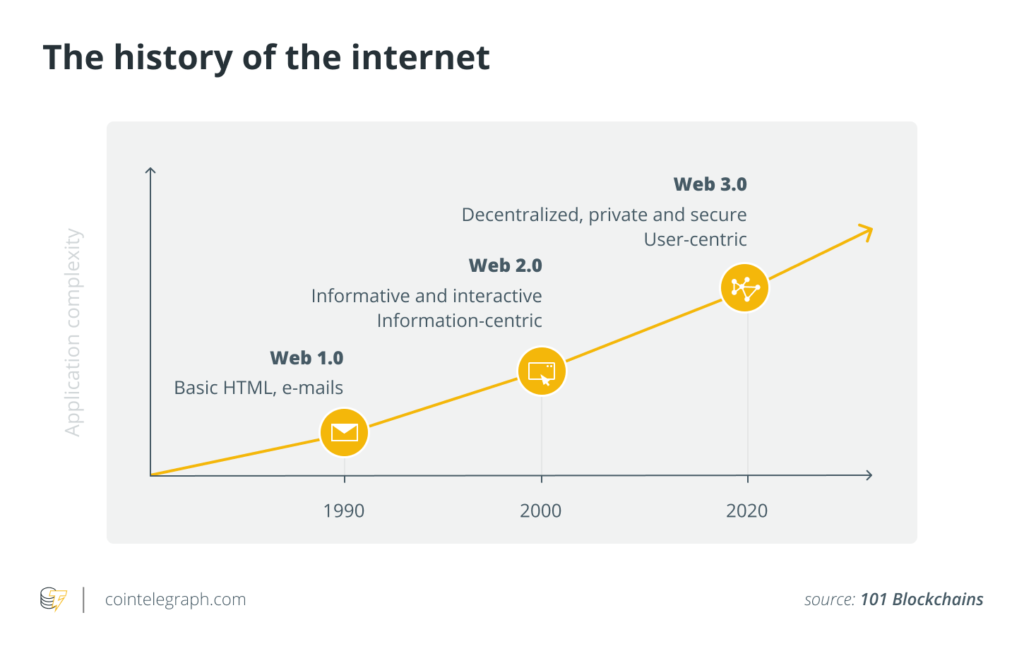
The three traits of Web 3.0 that fix what went wrong with today’s internet
Open code
Transparent economics
Aligned incentives
With Web 3.0, governance is often decentralized via a decentralized autonomous organization, or DAO, or other ingrained community feedback mechanisms. By decentralizing community management away from centralized authorities, there’s a tendency toward self-moderation. Communities built around shared passions enjoy natural moderation and when community members step out of line, the community takes action. And if a community member dislikes something, they can submit proposals for community vote to change the platform’s direction. ...
What’s next for Web 3.0
Web 3.0 builders must recapture this narrative and move beyond “winner takes all” to “community above all.” It won’t be easy. And there’s still a way to go until Web 3.0 generates more creator wealth than the internet ever did.
...
After watching Web 2.0’s recent stumbles, it’s clear that we’ll continue to be gifted with impactful examples of just how far we’ve gotten off track — and what we need to do to restore the original vision of the internet as an open place that’s additive and creative for society.
We’re in this for the long haul. It’s on us to evangelize, listen to users and build with a community mindset first and foremost.
See the full story here: https://cointelegraph.com/news/the-three-traits-of-web-3-0-that-fix-what-went-wrong-with-today-s-internet
China’s first sci-fi opera explores threat of AI
What happens when a romantic artist is uploaded to cyberspace and meets his first love? What happens when centuries-old opera meets futuristic artificial intelligence?
Such abstract questions are explored in China's first sci-fi opera directed by Yang Jingze. The opera, entitled "AI's Variation," recently premiered at Shanghai Symphony Orchestra Hall with a chamber orchestra conducted by Zhang Jiemin, one of China's top female conductors.
... "AI's Variation" describes a dying artist, both physically and creatively. His secret admirer, a scientist, "saves" him by turning him into AI. His first love rushes to meet him. The three characters recount the same meeting from their own perspectives on days two, four and six, while day one, three and five consist of pure melody; no lyrics. ...
See the full story here: https://www.shine.cn/feature/entertainment/2111198433/

NYC aims to be first to rein in AI hiring tools
A bill passed by the city council in early November would ban employers from using automated hiring tools unless a yearly bias audit can show they won’t discriminate based on an applicant’s race or gender. It would also force makers of those AI tools to disclose more about their opaque workings and give candidates the option of choosing an alternative process — such as a human — to review their application.
Proponents liken it to another pioneering New York City rule that became a national standard-bearer earlier this century — one that required chain restaurants to slap a calorie count on their menu items.
... “The approach of auditing for bias is a good one. The problem is New York City took a very weak and vague standard for what that looks like,” said Alexandra Givens, president of the Center for Democracy & Technology. She said the audits could end up giving AI vendors a “fig leaf” for building risky products with the city’s imprimatur. ...
See the full story here: https://apnews.com/article/technology-business-race-and-ethnicity-racial-injustice-artificial-intelligence-2fe8d3ef7008d299d9d810f0c0f7905d

Gangs, Prison, Stanford University, Holllywood, Startups, Millionaires
By building a blockchain ecosystem, Stooty helps users trade, build, and manage their creative resources. Stooty Technologies, Inc is currently valued at $100 million with advisors from Microsoft, Capital One, and marketing expert Darryl Cobbin. This year Stooty was invited by tech entrepreneur Andy Jacques, CEO of The Factory to join his Venture Studio.
Anderson and Richardson have been accepted into Stanford University’s Transforming Learning Accelerator by StartX to launch their second tech startup PipeDreamers, a Web 3.0 platform using gamification to connect at-risk youth to educational opportunities.
They are also involved in many social justice initiatives helping former incarcerated teens and men. Summer of 2021, Anderson signed a film production deal with global entertainment agency WME’s scriptwriter, Rachel Michiko, to produce a biographical film on his life story. The film production’s soundtrack will be produced by Anderson & Richardson.
Anderson is currently a Master’s student in Stanford University’s Graduate School of Education, with a focus on education technology