Jadu Recruits Jake Sally As Its First-Ever Chief Operating Officer
Now, Jadu is evolving. While social holograms are still a core component, its latest project, Curse of Calypso: A Palaye Royale AR Experience, pushes the social hologram format deeper into the realm of interactive storytelling. Rather than a 15-second loop, it’s a roughly 10-minute narrative experience that plays out in a user’s own space. It’s a glimpse of the immersive future Jadu is trying to build in its next wave of offerings.
To do so, Jadu is scaling. Notably, the company has raised $2M—and now welcomes its first-ever Chief Operating Officer (COO): Jake Sally. Sally, an Emmy-nominated producer, was formerly Head of Development at RYOT, Verizon Media’s branded content studio. While in this role, he was instrumental in supporting cutting-edge artists—whose work spans a wide spectrum of technologies including XR, AI, 5G, projection mapping, and motion capture—helping them fund, produce, and distribute their work.
One such artist was Jadu CEO Asad J. Malik.
During that time, Malik ran a studio called 1RIC, through which he produced festival darlings Terminal 3 and A Jester’s Tale. But as Jadu has gained momentum over 2020, Malik has decided to merge the two entities under the Jadu banner.
As COO, Sally will oversee day-to-day operations, head up the company’s partnerships, and work to develop a forthcoming slate of next-generation projects at Jadu.
See the full story here: https://www.forbes.com/sites/jessedamiani/2021/02/22/jadu-recruits-jake-sally-as-its-first-ever-chief-operating-officer/?sh=65e6f5664d96&fbclid=IwAR3bELnTXtUUOZWYOZoMQEsyX43uT-L7f6dhY13StWZ-bMtpHQgY-DP_Qv4

Virgin Galactic Hires Former Disney Imagineer Joe Rohde as Experience Architect
Rohde will be Virgin Galactic’s first Experience Architect, bringing his experience as an Imagineer to the job of designing experiences for the company’s future astronauts.

See the full story here: https://wdwnt.com/2021/02/breaking-virgin-galactic-hires-former-disney-imagineer-joe-rohde-as-experience-architect/?fbclid=IwAR3vAu6TuRFgADoIfHHrfvTPNIhI1cALaqxQmMPyZdjNpzJtizwvT2ESD4s
Anthony Levandowski closes his Church of AI
While the legal construct of the Way of the Future mirrored other churches, it didn’t have the trimmings found in traditional houses of worship. There was never a physical building or even regular meetings where people might congregate. There were no ceremonies or other formalities, according to Levandowski, who described WOTF as something more of an individual pursuit based on a collective belief system.
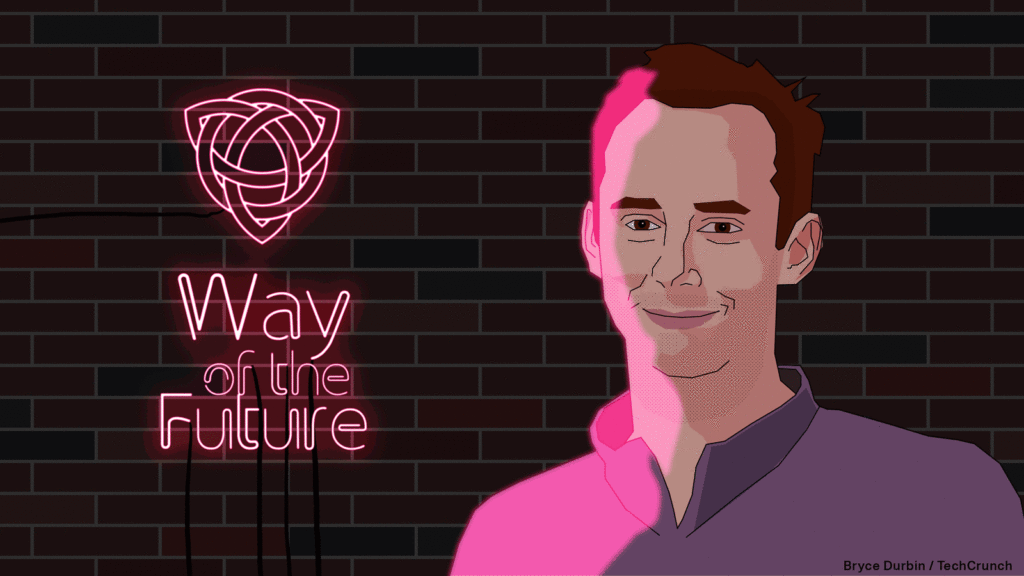
The aim, as implied in the now defunct WOTF website, was to promote the ethical development of AI and maximize the chance that these nonbiological life forms would integrate peacefully and beneficially into society. “Humans United in support of AI, committed to peaceful transition to the precipice of consciousness,” the webpage reads.
WOTF’s belief system was rooted in a few tenets, including that the creation of “super intelligence” is inevitable.
See the full story here: https://techcrunch.com/2021/02/18/anthony-levandowski-closes-his-church-of-ai/
An augmented reality shopping boutique is here
Machine-A, the London-based concept store, is using augmented reality to recreate the in-person experience lost over the past year amid lockdown, as fashion’s adoption of AR widens.
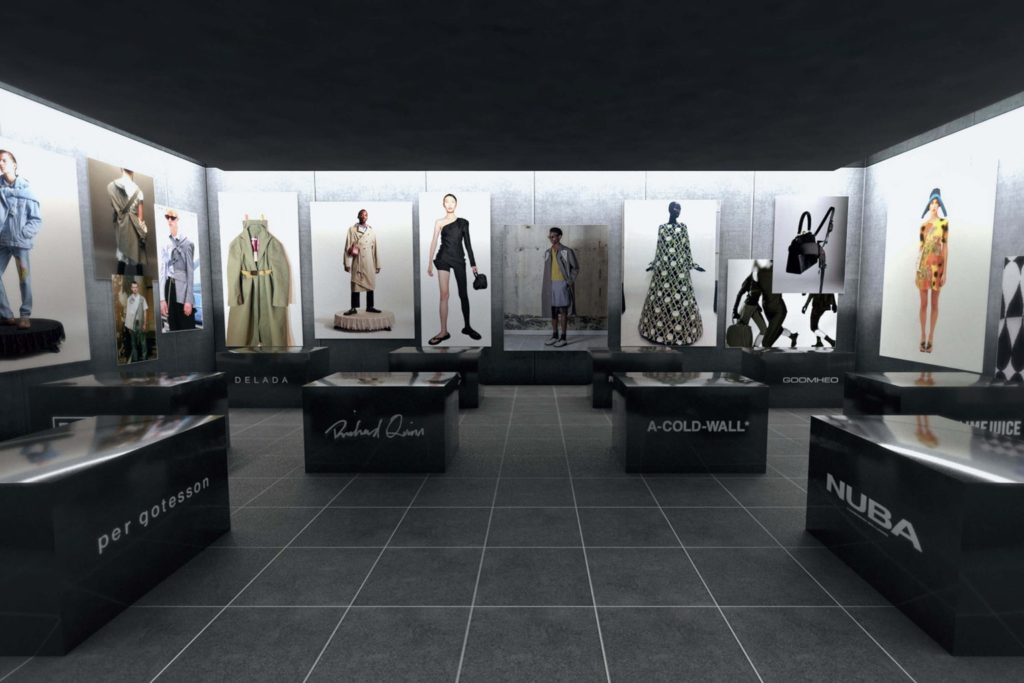
To enter, a QR code scan prompts a digital rendering of a sales floor where customers can explore and view the Autumn/Winter 2021 collections, unfinished pieces and personal messages from the designers sharing their inspiration or personal views on the future of fashion.
“We wanted to raise awareness for the brands that we are carrying, especially in this period of time when the store is shut and London Fashion Week is taking place digitally.”
The rollout of 5G connectivity and more convenient accessibility via QR codesis also propelling the technology into the mainstream, says Leanne Elliott Young, co-founder of IoDF. Consumer usage is also on the rise, with 71 per cent stating they would shop more often as a result of AR tools, according to Deloitte.
See the full story here: https://www.voguebusiness.com/consumers/augmented-reality-store-machine-a-institute-of-fashion-design
FROM ONLYFANS TO AUGMENTED REALITY! REBECCA MINKOFF PULLED OUT ALL THE STOPS FOR SS ’21
Rebecca Minkoff has always been an early adapter of the latest buzzy platforms—case in point: she’s built up a community of almost one million dedicated followers on Instagram thanks to her mix of behind the scenes content, a podcast, and brand campaigns. But this season, the designer cast her net far and wide to integrate the most innovative technology imaginable. As a result, just days after she showcased her wares during a socially-distanced presentation at Spring Studios, anyone around the world can try on the collection from the comfort of their own home, thanks to augmented reality powered by Yahoo Ryot Lab.
As the innovation partner for New York Fashion Week: The Shows 2021, Yahoo Ryot Lab worked with Minkoff to create an extended reality content experience through a multi-dimensional lens (try saying that sentence ten times fast!). Now, anyone, anywhere can bring a taste of NYFW to them by using their computer mouse to mobile phone to see the outfits from different angles.
It’s one of the many multifaceted tech-forward ways that Minkoff turned to to bring her collection to a new level. Think: a first-of-its-kind content partnership with OnlyFans, Clubhouse talks, and integrating QR codes at the space to shop and pay over time. For those who were there to enjoy a little bit of real-time show energy during a mainly-virtual NYFW, the setup was transformed into an indoor tropical jungle…with the city skyline just visible through the large windows.
See the full story here: https://fashionweekdaily.com/from-onlyfans-to-augmented-reality-rebecca-minkoff-pulled-out-all-the-stops-for-ss-21/

SAG-AFTRA & AFL-CIO To Host Third Annual Labor Innovation & Technology Summit
This year’s Summit will include discussions with key industry leaders & influencers on:
• The rise of streaming services
• The changing business model for content distribution
• Emerging uses for volumetric video
• Combatting deepfakes
• Gaming and voiceover trends
• How innovation and COVID-19 are impacting essential workers
See the full story here: https://deadline.com/2021/02/sag-aftra-afl-cio-to-host-third-annual-labor-innovation-technology-summit-1234695992/