Virtual reality takes users back to a 15th-century community of religious women
USC Dornsife’s Sabina Zonno and Lynn Dodd receive a National Endowment for the Humanities grant to develop an immersive experience around a Renaissance-era manuscript. [4¾ min read]
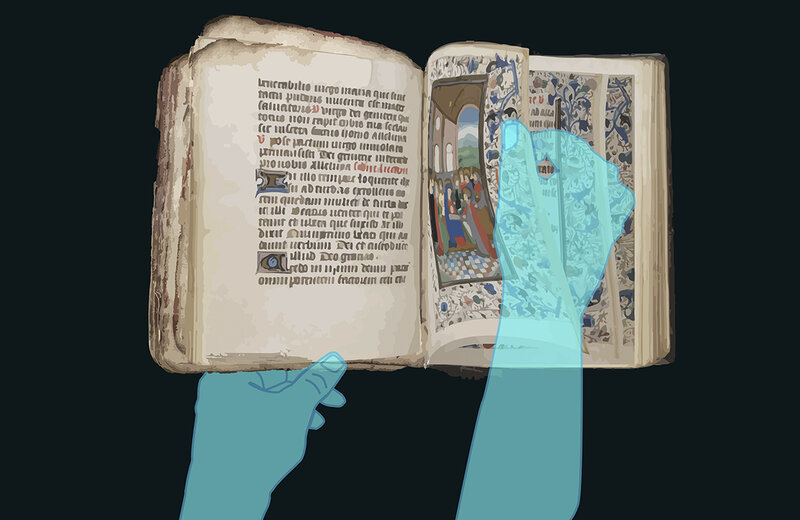
To create a virtual reality for the manuscript and its context, Zonno and Dodd, along with Eric Hanson, associate professor of cinematic practice at the USC School of Cinematic Arts, will first take thousands of still photography images of the manuscript and beguinage, the latter of which still exists. Those photos will be used to build three-dimensional models, which are then brought to a game engine unit (a framework used by developers to construct video games), which renders them so they are ready to use in a virtual reality headset, Hanson said. He added that virtual reality gives an experience far deeper than that of film.
Dodd said that in addition to connecting people with the past, virtual reality can help bring them together in the present. A virtual recreation of a prayer session at a mosque, for example, could show translations of the prayers and songs involved, and let users watch adults and children in their everyday interactions within the building. Such an experience might help “demystify” Islam and counter Islamophobia, she added.
See the full story here: https://dornsife.usc.edu/news/stories/3348/virtual-reality-manuscript/
Why 5G May Not Need a Killer App—for Now
The big increase in speed and network capacity may be enough to attract customers
“If I put 5G everywhere in the urban area that there’s 4G cells—without adding any extra real estate—I now can double, or triple or quadruple the amount of data that I can put down those pipes,” says Mr. Thode. “So do you actually need a killer app? No.”

See the full story here: https://www.wsj.com/articles/why-5g-may-not-need-a-killer-appfor-now-11604952000
Chinese AI Unicorn Giants SenseTime and Megvii Survive US Ban and Makes It Washington’s Entity List!
Chinese AI Unicorn giants SenseTime and Megvii recently escaped the US Ban on Foreign Technology Companies from operating in the country without regulations or US Ownership. The two companies from China are even included in Washington's Entity List in October but are now planning to move away from the surveillance business that services the government.

What Megvii did is to directly purchase from third-party suppliers of the same technology they were prohibited from accessing. Several Chinese startups are using this method to go around the US Entity Ban and even sell their products to American clients and soil.
The surveillance startup companies survived the US' Entity List ban and are still fairing satisfactorily on the global market and even in several of the country's business ventures.
See the full story here: https://www.techtimes.com/articles/253979/20201108/chinese-ai-unicorn-giants-sensetime-megvii-survives-ban-makes-washingtons.htm
What Would A Future Range Rover For Urban Life Look Like In A Fully Autonomous World?
A number of companies are working on autonomous shuttles and Tomas Zumalakarregui recently completed his master’s thesis which envisions a fully autonomous Range Rover for 2027.

The 1970 Range Rover was the first European luxury SUV that was capable both on- and off-road. Today, it has been turned into a family of models including the Range Rover Sport, Evoque and Velar. The latter two have a “clear urban character” and that’s reflected in Zumalakarregui’s Range Rover Urban concept.
See the full story here: https://www.carscoops.com/2020/11/range-rover-urban-concept-envisions-a-fully-autonomous-future/
How Introducing AI Across the Curriculum May Address Key Equity Concerns
Now, no matter what field you go into, you are likely to be using AI tools to do your job effectively. We want all students to have an equitable opportunity to succeed, to know what those fields are like and see if they might identify themselves as being there. If we don’t have diverse voices going into the creation of tools—for medical purposes, in the criminal justice system, environmental problems, etc.—we will continue to have products out in the market that are discriminatory against different populations. We really want equity at the front of what we’re doing. The idea that AI education is for every student is a message that we get out all the time, that that’s just the core of what we’re doing and the materials that we produce.

The messaging that ISTE has had consistently, not just in this program, is that computational thinking is for every student in every classroom. That is huge. And what we’ve seen is that our participants—the majority of whom are not computer science educators—are now putting it into all those other classrooms. Even our computer science teachers have started to partner with other subject area teachers to get that AI message out earlier.
Funded by General Motors, this ISTE program provides professional learning for educators to support student-driven AI explorations. http://isteaiexplorations.org
See the full story here: https://www.edsurge.com/news/2020-11-05-how-introducing-ai-across-the-curriculum-may-address-key-equity-concerns
Teaching AI agents to communicate and act in fantasy worlds
Researchers at Georgia Institute of Technology and Facebook AI Research have recently explored the possibility of equipping goal-driven agents with NLP capabilities so that they can speak with other characters and complete desirable actions within fantasy game environments. Their paper, pre-published on arXiv, shows that combined, these two approaches achieve remarkable results, producing game characters that speak and act in ways that are consistent with their overall motivations.

LIGHT, the platform that the researchers used to train their goal-driven conversational agent, offers a vast number of fantasy worlds containing a rich assortment of characters, locations and objects. Nonetheless, the platform itself does not set particular objectives or goals for each of the characters navigating these environments.
See the full story here: https://techxplore.com/news/2020-11-ai-agents-fantasy-worlds.html