The National Institute of Standards and Technology will soon kick off two national innovation contests that aim to strategically leverage augmented reality and internet of things technologies to transform public safety officials’ abilities to respond to emergencies.
While the IoT contest focuses on the production of smart city data streams to simulate disaster scenarios, its AR counterpart seeks to create AR interfaces for first responders. Each contest envelops research and development phases leading up to a final fourth phase of competition—NIST’s CHARIoT Challenge—which will ultimately integrate the IoT data streams into AR headsets to demonstrate how the wearable and sensor technologies can ultimately help public safety officials to make quicker, more informed decisions.
... offers up more than $1 million in cash prizes ...
‘All Show’ platform allows artists to self-publish their work and buyers can preview them at home.
Multifaceted designer Sebastian Errazuriz teamed up with artist Zander Eckblad to develop an augmented reality platform called All Show. Functioning as an online exhibition, the project allows collectors to preview artworks in the comfort of their homes during the coronavirus pandemic. Viewers can browse artworks self-published by artists on the website using their smartphones. Once they find the work they are interested in purchasing, they can choose to preview them in augmented reality by clicking the “See in AR” toggle.
To help medical staff (re)acquire the necessary skills to do that, FundamentalVR, a start-up that develops immersive simulations to train surgeons, has worked with Imperial College London and Imperial College Healthcare NHS Trust to develop an online tool that allows medical professionals, to gain the key knowledge they need to properly ventilate patients in around 30 minutes.
The program, which consists of short how-to videos and educational graphics, is being rolled out at Imperial College London prior to its deployment nationally and internationally to help combat Covid-19.
“It takes years to specialize a clinician in intensive care; while this new training course is not designed to replace this expertise, it will enable health systems across the world to act now and provide the care that their patients desperately need,” says project lead Professor Ara Darzi, co-director of the Institute of Global Health Innovation at Imperial College London.
With non-urgent surgeries cancelled, the company, based out of London and Boston, recently made its Fundamental Surgery platform multiuser. This allows students to exercise their skills at home while in isolation using the company’s @HomeVR system which was launched two weeks ago for standalone VR headsets such as Oculus Quest and HTC Vive Focus Plus.
As more people turn to VR to connect during these times, Space Popular has released a 2D movie showing off the Venn Room, a VR installation concept that combines the physical spaces of two people communicating via their headsets. This "hybrid space" works like a Venn diagram (hence the name), allowing users to decide how their physical spaces would merge, with their own homes serving as the skeleton. Space Popular founders Lara Lesmes and Fredrik Hellberg, both architectural designers, created the concept as a VR installation for the Tallinn Architecture Biennale in 2019. The VR movie for the installation hasn't been released until now, premiering on Dezeen.
A new program has launched to make your Zoom meetings a little more interesting, reportedly offering ‘deep fake’ filters for impersonating your favourite celebs.
Avatarify superimposes your chosen target’s face onto your own, and uses an algorithm to follow your facial movements, moving the mask’s eyes and mouth in sync, and in real-time.
The program can currently run on Zoom and Skype, adding a whole new element to the humble video conferencing prank.
Programmer Ali Aliev told Vice‘s Motherboard he developed the product using open-source code, from the First Order Motion Model for Image Animation, the tracking algorithm first created by researchers at the University of Trento in Italy.
Aliev developed a prototype in a matter of hours, he said, and tested it out by posing as Elon Musk in his weekly call with colleagues.
“[I] was surprised by the result,” he said.
...Considering what one developer was able to do in hours, given a little more time, and paired with a more convincing vocal, could this be the beginning of a sinister new world of deepfake Zoombombing?
OpenAI has launched Microscope, a neural library of nine popular and oft used neural networks, which hosts millions of images. The aim is to help AI researchers understand the behaviour of the tens of thousands of neurons that make up a neural network.
In a blog post, OpenAI said it will help AI learners understand neural networks by reverse-engineering the workings of the neurons that make up the networks.
Artificial Intelligence (AI) expert, serial entrepreneur, and noted software developer, Charles Simon, CEO of FutureAI has launched Brain Simulator II, a software platform for proving how Artificial General Intelligence (AGI) – the next phase of AI – will emerge.
Brain Simulator II enables experimentation into diverse AI algorithms to create an end-to-end AGI system with modules for vision, hearing, robotic control, learning, internal modeling, and even planning, imagination, and forethought. ...
Brain Simulator II marries Neural Network and Symbolic AI techniques to create unbounded possibilities. It creates an array of millions of neurons interconnected by any number of synapses.
Further, any cluster of neurons can be collected as a “Module” which can execute any desired background programming. For example, Brain Simulator II can integrate neural network recognition techniques with symbolic AI software structures efficiently creating a relational knowledge store.
Other features of Brain Simulator II include:
The availability of millions of neurons via a desktop computer;
The ability to create networks from scratch or from a library of functions;
More than 20 module types for speech, vision, and robotic controls;
Universal Knowledge Store modules, capable of storing any kind of information and synapses;
The ability to write modules in any language supported by Microsoft’s .NET platform.
With coronavirus mitigation making gatherings and travel taboo, his company, Philadelphia-based Virtual Reality for Rent, is staying afloat by filling the growing demand for entertainment beyond Netflix. He’s now mailing out about 60 VR Oculus headsets (made by Facebook Inc.) a week to individuals, a seven-fold jump from before the outbreak. The technology allows kids to visit carnivals, while twenty-somethings can dance at a club with strangers from around the world.
“Kids don’t go to arcades anymore, but they can go to VR arcades,” said Dunning, who is now offering rentals as low as $35 a day.
Alex Gerasimov, owner of the VR Zone DC, is seeing a new wave of interest, too. His company operates virtual-reality play spaces that are temporarily closed because of the virus. That pushed him to pivot to a new rental model. Gear, including wipes and masks, is dropped off via contactless delivery. Setup is done over video chat. Its social distancing party package (“Stay 7 ft. apart and have fun”) starts at $299.
More than 800,000 Americans turn a year older every day.
Camp, a toy retailer with a handful of locations, is now hosting daily free virtual birthday parties. Over videoconference, the company’s “camp counselors” lead sing-alongs, story time and magician shows. More than 350 kids, as well as some adults, have participated.
Even after social distancing measures end, the workarounds may bring permanent change to parties because people will want to keep including out-of-town friends and family, according to Jamil Zaki, associate professor of psychology at Stanford University and author of “The War for Kindness.”
In this preliminary study, three chocolate types (milk, white, and dark) were evaluated under three contextual settings, including sensory booths (control) and two VR environments (360-degree videos using VR headsets: (i) a pleasant sightseeing tour, and (ii) a live music concert). Untrained participants (n = 67) were asked to rate their liking and the intensity of different chocolate attributes based on the 9-point hedonic scale and just-about-right-scale (JAR). Emotions were evaluated using the check-all-that-apply (CATA) method. Results showed that there were no significant effects of context type on the tasting experience; however, there were significant effects of chocolate type. Milk and white chocolates were preferred over dark chocolate irrespective of the context type. Additionally, more positive emotions were elicited for the dark chocolate in the “virtual live concert” environment. Dark chocolate under the other two environments was associated with negative emotional terms, such as “bored” and “worried.” In terms of more reliable and ecologically valid sensory responses, further research is needed to match suitable VR environments to different chocolate types.
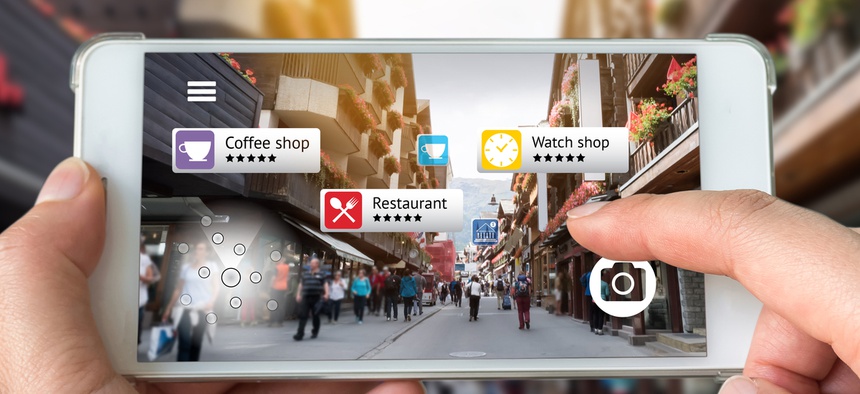 The National Institute of Standards and Technology will soon kick off two national innovation contests that aim to strategically leverage augmented reality and internet of things technologies to transform public safety officials’ abilities to respond to emergencies.
 To help medical staff (re)acquire the necessary skills to do that, FundamentalVR, a start-up that develops immersive simulations to train surgeons, has worked with Imperial College London and Imperial College Healthcare NHS Trust to develop an online tool that allows medical professionals, to gain the key knowledge they need to properly ventilate patients in around 30 minutes.
 OpenAI has launched Microscope, a neural library of nine popular and oft used neural networks, which hosts millions of images. The aim is to help AI researchers understand the behaviour of the tens of thousands of neurons that make up a neural network.