Chip-based device opens new doors for augmented reality and quantum computing
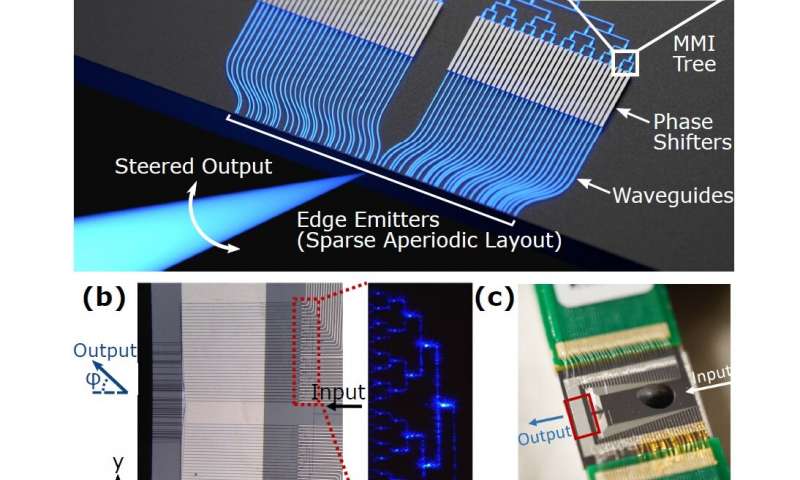 "Our blue phased array platform can rapidly and precisely reconfigure visible light for many emerging applications, spanning holographic displays, quantum information processingand biological sensing and stimulation," said research team leader Michal Lipson from Columbia University. "It paves the way for chip-scale light projection across the entire visible range with a large field of view and can miniaturize the current bulky optical systems."
Lipson and colleagues describe the new device in The Optical Society (OSA) journal Optics Letters. It is the first chip-scale optical phased array (OPA) operating at blue wavelengths using a silicon nitride platform. OPAs function like reconfigurable lenses by enabling arbitrary reconfigurations of 3-D light patterns.
The new OPA was developed as part of a DARPA-funded project that aims to create a lightweight, low power head-mounted display that projects visible information onto the retina with extremely high resolution and a large field of view. This type of augmented display isn't possible today because the light projection components used to shape and steer light are bulky and have a limited field of view.
Using the new blue light OPAs, the researchers demonstrated beam steering over a 50-degree field of view. They also showed the potential benefits of this type of platform for image projection by generating 2-D images of letters.
See the full story here: https://techxplore.com/news/2020-03-chip-based-device-doors-augmented-reality.html
Representing Scenes as Neural Radiance Fields for View Synthesis
Abstract & Method
We present a method that achieves state-of-the-art results for synthesizing novel views of complex scenes by optimizing an underlying continuous volumetric scene function using a sparse set of input views.

Our algorithm represents a scene using a fully-connected (non-convolutional) deep network, whose input is a single continuous 5D coordinate (spatial location (x, y, z) and viewing direction (θ, φ)) and whose output is the volume density and view-dependent emitted radiance at that spatial location.
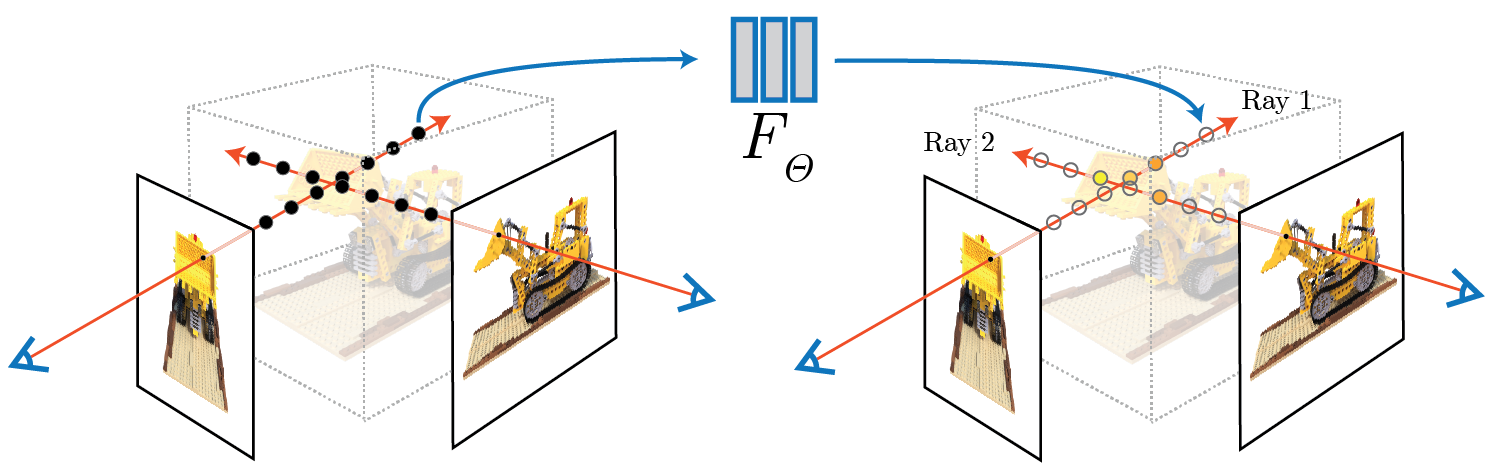

We synthesize views by querying 5D coordinates along camera rays and use classic volume rendering techniques to project the output colors and densities into an image. Because volume rendering is naturally differentiable, the only input required to optimize our representation is a set of images with known camera poses. We describe how to effectively optimize neural radiance fields to render photorealistic novel views of scenes with complicated geometry and appearance, and demonstrate results that outperform prior work on neural rendering and view synthesis.
See the full story here: http://www.matthewtancik.com/nerf?fbclid=IwAR2Gn_HSWGfPVQn29-zm6ZmSJjBN_2qsIcwpa0DFcwVFlpfNNTfXPgezP_U
LiDAR scanner makes 2020 iPad Pro an augmented reality powerhouse
 The 2020 iPad Pro is the first Apple computer with LiDAR. This innovation enables the tablet to make an accurate 3D map of its location. Combine it with software improvements and this tablet is, in Apple’s words, “the world’s best device for augmented reality.”
And the LiDAR scanner might be usable for other purposes, as well.
Time for LiDAR 101
The LiDAR scanner in the latest iPad Pro works like a short-range version of radar. It scans a laser over the entire area behind this tablet, measuring the distances to objects by seeing how long it takes light to reach an object and reflect back.
Apple’s version of this Time of Flight sensor has a range of 16 feet (5 m). It works indoors and outside, and creates maps nearly instantly.
This ToF sensor will upgrade the capabilities of Apple’s ARkit software, which is already in iOS and iPadOS. “ARKit as it stands can find flat surfaces and place a virtual object on that, but not do a lot else when it comes to understanding the environment. ToF sensors could help ARKit go beyond that and open up new possibilities to app developers.”
But with the 2020 iPad Pro just announced but not yet released, there are questions about what it else the LiDAR scanner can be used for. Currently, there’s no way to know if it be able to scan an object accurately enough so a copy can be made with a 3D printer, for example.
See the full story here: https://www.cultofmac.com/693611/lidar-scanner-2020-ipad-pro-augmented-reality-3d-scanner/
5 Virtual trade show from Cinema5D in the works to replace canceled NAB 2020 April event
 ...the talks will take place in hosted, moderated live streams on April 20 - 22 from 9 AM to 6 PM PST.
The hosted broadcasts will be mixed with prerecorded new product announcements and virtual studio talks with various guests; topics will include trends, new products and industry analyses. As well, Behiri says that the team plans to integrate streamed live press events from major manufacturers into the virtual trade show.
According to Behiri:
'All of this is an evolving plan but we invite manufacturers to get in touch with us via our contact page to share NDAs about new products so we can interview them beforehand and align plans to integrate them into our coverage. We are also happy to consider working together with other online publications.'
Though the virtual trade show will attempt to offer 'a bit' of coverage on a broad range of subjects, Behiri says that it will focus on production tech aimed at aspiring and professional filmmakers.
See the full story here: https://www.dpreview.com/news/9243474017/virtual-trade-show-from-cinema5d-in-the-works-to-replace-canceled-nab-2020-april-event
Virtual reality: Now even the online Google Cloud Next event is postponed
 ...there are many ways to hold virtual events. It was common in pre-COVID-19 days for tech companies to run virtual sessions between its staff and sometimes a select group of press or other invitees, and to use streaming and online Q&A management to extend this to a wider audience. Running an event like this requires staff and partner speakers to be there in person, which does not work if they are trying to isolate.
The alternative is a pure virtual event in which even the presenters can work separately, but doing this to the standards expected of something like Google Cloud Next introduces its own set of challenges.
It is also possible that Google is rethinking its approach somewhat in these strange and unpredictable times. The disruption from the pandemic is profound and new ways of working may become the norm, with some tech trends being accelerated and others held back. One prediction seems safe: the role of cloud computing will not diminish.
In Virtual Reality, Your Right Thumb Can Become Your Left Arm
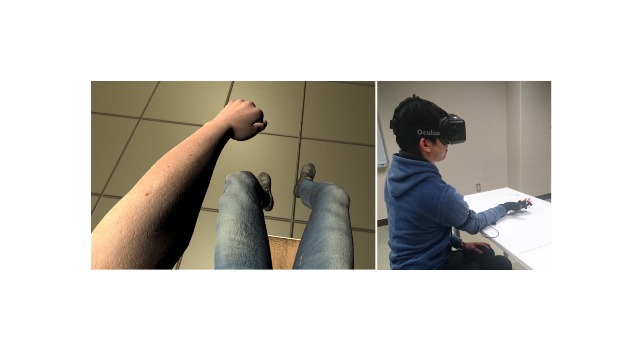 Researchers have revealed that its possible for volunteers to re-associate one body part to another using virtual reality. This association is nonetheless likely to be weaker than a natural association.
This study contributes to the expanding perspectives on body schemes of augmented humans and understanding their limitations. Body-part re-association can be applied to developing functional prosthesis and embodied tools in future. This research was published in the open access journal Frontiers in Robotics and AI in 19th March 2020.
See the full story here: https://www.technologynetworks.com/tn/news/in-virtual-reality-your-right-thumb-can-become-your-left-arm-332301
Trends from Amusement Expo 2020
The rise of unattended VR games
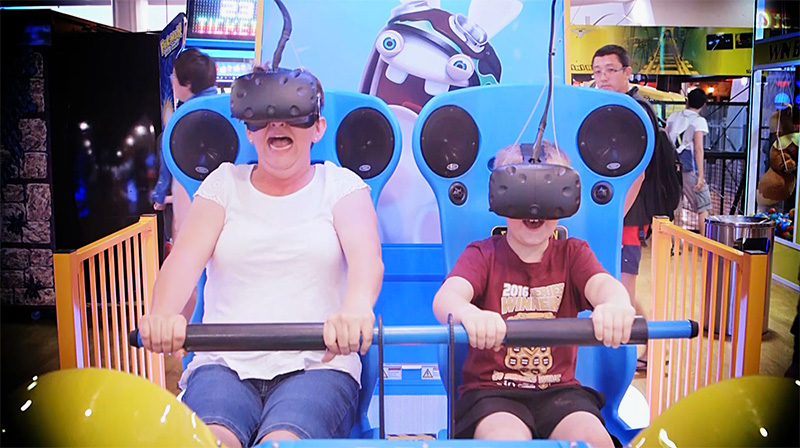
One of the newest trends at Amusement Expo International was unattended VR games. These require no staffing and have simple instructions for guests to put on the VR headsets and controls and start playing in a matter of seconds. The industry is developing robust headsets to accommodate for all-day use too. LAI Game’s Virtual Rabbids was the first attendant free game to market, with Triotech’s Storm, VRsenal’s Beat Saber, and Rilex all launching shortly after.
These games have a smaller footprint and with no staff, they cost less to run. However, operators do need to consider the cleanliness of the headsets and the wear and tear on the headset cables.
Social and cross-reality trends at Amusement Expo International
Another trend was cross-reality experiences like projection-mapped bowling by Unreal Bowling and projection-mapped go-kart experiences. Another key example is Valo Motion’s augmented climbing wall, which uses new technology to create active entertainment experiences.
eSports
Amusement Expo International showed that content is (still) king
Kevin Bachas, Senior Vice President of Entertainment Games and Strategy at Dave & Busters summed up the importance of content: “The novelty of VR itself is not enough to build a business around. People want experience, build the VR around the content”.
Partnerships with large players drive the industry forward
“We can work with our partners like Google, Apple, Amazon and take their technologies. And we can integrate them into our business and then pilot them with our partners. We tweak them and get them right. ... “Our smallest customers get to benefit from all of the work that we have done from the big players. Those partners get a lot out of it as they can be first in the market too” said Hutson.
Utilising dead space
Looking upwards, Drone Interactive’s Arcadrone utilises the airspace above an FEC, allowing guests to race drones competitively.
Slim-lining operations for operators and suppliers
As well as utilising space, operators should be maximising their assets and processes too. Brandon Willey, CEO at Hownd educated attendees on how operators can slim down. He looked at overproduction of assets, long wait lines, too much inventory, and how “micro-improvements can have a big impact to improve efficiency”.
The way in which suppliers respond to problems is changing. “Statistically, members of Generation Z prefer to do self-help via chat boxes,” said Lopez. “Baby boomers still prefer to pick up the phone and call and the get the answer. But if we can get information into the hands of Gen Z’s they can do that self-help. This really fast tracks the process of learning”.
See the full story here: https://blooloop.com/features/amusement-expo-international-2020-review/?fbclid=IwAR2OsYqbrHlZnEn6sgcDkAp-1De_BozPw8tqLwhEq4wheJqx25YWR-vLn2g