How Maria Brodskaya Uses Virtual Reality For Art Therapy
 Recently, I had a chance to sit down with one of VR pioneers who is merging classical performance, neuroscience and holistic body practices into one-of-a-kind experiences for her growing audiences. Meet Maria Brodskaya, a Russian-American musician, producer, educator and entrepreneur known as ÅMBE. Since winning her first music award at the age of seven, she has recorded and performed around the world with Grammy-winning producers and artists. Her latest work has been exhibited at South by Southwest, MORA (The Museum of Russian Art) and Bowery Film Festival. Oh, and she is also a ViolinBorg with impeccable otherworldly style.
See the full story here: https://www.forbes.com/sites/stephanrabimov/2020/01/03/how-maria-brodskaya-uses-virtual-reality-for-art-therapy/#6d13a4cf7679
How to Start Your Own Career in Virtual Reality
 How to Shine as a Candidate

VR technology is the most innovative customer-friendly technology out on the markets. And it will probably be like this for a long time. Because of this, companies are looking for individuals who are incredibly passionate about what they do and will always be looking for talent that are in this for the long haul. Companies want to grow with their teams as the industry continues to expand.
One of the best character attributes you can have is to be bold and courageous. Companies are not going to want too many people who take risks. However, you definitely need to have the ability to think outside the box and push what people will currently define as the norm.
Having unique skills and experiences can also help you to get ahead and to stand out from the crowd, but this will depend on how you present yourself. Always keep an eye on industry trends to see if you can find a relatable trend to use as your way in.
See the full story here: https://arpost.co/2020/01/03/how-to-start-your-own-career-in-virtual-reality/
Gracenote to Tout OTT Guide Solutions at CES
 Building on its work in the linear broadcast electronic program guide space, Gracenote’s OTT guide offering aims to enable connected-TV manufacturers, along with cable and satellite operators, to make video content searchable across multiple services, platforms and devices, elevating content visibility across the board.
Unique Gracenote IDs (to link related content assets for universal search capabilities), descriptive metadata (to enable intuitive content navigation and more-focused recommendations), and custom content images (to fill OTT guide interfaces, and smart enough to represent individual TV episodes) will all be offered up in Gracenote’s solution.
See the full story here: https://www.mesalliance.org/2020/01/02/gracenote-unveils-global-ott-guide-offerings-for-on-demand-video-streaming-services-mesa/
Samsung’s Neon ‘Artificial Human’ will debut at CES 2020: What is it?
 ... this is apparently not a Bixby reboot.
Samsung has been mindful to not describe it as a voice assistant or artificial intelligence. Instead the company is using terms like ‘artificial human’ or ‘artificial intelligence being’ to market the project.
If you visit Neon's website you'll be met with a countdown scheduled to end at midnight on January 7
See the full story, with very little info, here: https://www.tomsguide.com/news/samsung-to-announce-neon-at-ces-2020
Sharing in AR, Today and Tomorrow
Putting It Together
By assembling author, recipient, subject, location, and content together, we can craft AR sharing controls that make these use cases possible:
- Alice shares a board game session with Bob in her dining room.
- Charlie shares the virtual HVAC sensors with Daniel, a new hire at the University.
- Erin builds a 3D model of a long demolished mansion on the site of its former location and shares her creation with her local history group.
What is Underway Now
Ubiquity 6
Since the last post, Ubiquity 6 has surfaced as an AR platform for sharing and editing AR content.
VERSES
Just last week VERSES left stealth mode and launched a new blockchain token expressly for AR applications: indexing spaces and smart objects. Blockchain (and more specifically smart contracts) represents an entirely new family of geospatial indices — one which offers to trade the advantages of decentralization with the challenges of blockchain adoption.
Unity Project MARS
Even better than a global AR sharing platform would be developer tools and services that allow for AR sharing across otherwise fragmented applications.
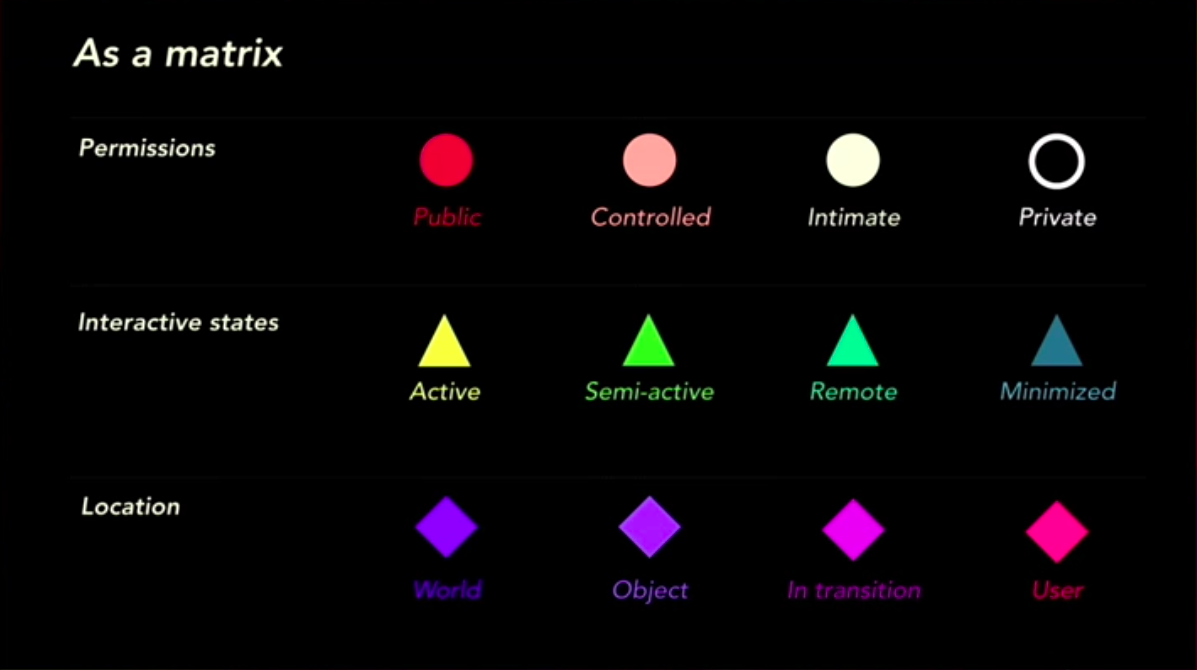 Just a few weeks ago Timoni West, the Director of XR Research at Unity, presented one of the first detailed looks at Unity’s Project MARS — Mixed and Augmented Reality Studio.
West expresses her permission model as a matrix for describing application states:
See the full story here: https://medium.com/@3d_jb/sharing-in-ar-today-and-tomorrow-da285881cd65
Only You Can Prevent Dystopia
 I’ll be honest with you: I’m terrified. I spend a lot of my time looking for edifying ways of interacting with technology. In the last year, I’ve told you to meditate, to keep a digital journal, to chat with people on the phone and to never tweet. Still, I enter the new decade with a feeling of overwhelming dread. There’s a good chance the internet will help break the world this year, and I’m not confident we have the tools to stop it.
Unless, that is, we are all really careful.
And so: Here are a few tips for improving the digital world in 2020.
Virality is a red flag. Suspect it.
If I were king of the internet, I would impose an ironclad rule: No one is allowed to share any piece of content without waiting a day to think it over.
... in the 2010s virality got too easy, and then it grew sour, venal and dishonest.
Resist the easy dunk.
In the 2010s, Twitter became the center of the political universe. ... Twitter is a daily toxic nightmare of reflexive egotism and groupthink that will prompt you to question your priorities, not to mention your sanity.
What’s Twitter’s most damaging sin? I say it’s the too-easy mocking joke — what’s known, in the jargon, as the “quote-tweet dunk.”
The imbalance discourages any possibility of meaningful conversation and reduces all of political discourse to empty, shallow quippery.
Find a well-moderated corner of the internet.
What distinguishes the productive online communities from the disturbing ones? Often it’s something simple: content moderation. The best places online are bounded by clear, well-enforced community guidelines for participation. Twitter and Facebook are toxic because there are few rules and few penalties for flouting them. A Reddit community like r/relationships, meanwhile, is a haven of incredible, empathetic discussion because its hosts spend a lot of effort policing the discussion toward productive dialogue.
See the full story here: https://www.nytimes.com/2020/01/01/opinion/social-media-2020.html
California’s Privacy Law Goes Into Effect Today. Now What?
 The CCPA applies to any company that operates in California and either makes at least $25 million in annual revenue, gathers data on more than 50 thousand users, or makes more than half its money off of user data. For California residents, it creates a handful of new rights over their data. The most significant categories are what Alastair Mactaggart, the California real estate magnate behind the ballot initiative that led to the law being passed, calls “the right to know” and “the right to say no.” That means users will, as of today, be able to see what data companies have gathered about them, have that data deleted, and opt out of those companies selling it to third parties from now on.
Well, WIRED doesn’t exactly “sell” your data right now—no one is giving us cash (or withholding military aid, for that matter) in exchange for dirt on our readers. But, like just about every site on the internet, we track your behavior—what articles you read, for how long, etc.—on Wired.com using cookies. We use that data internally for research and site improvements, but the information can also go to a third-party vendor, like Google AdSense, which combines it with similar data from other sites to create user profiles that advertisers can target. The infamous shoe ad that follows you across the internet long after you close out your Zappos tab? That’s how it works—and advertisers pay extra for the privilege of this personalized ad targeting.
The law grants Californians the right to sue companies for failing to take reasonable precautions to prevent data breaches. But apart from that, making sure companies comply with the CCPA is the sole province of the Attorney General’s office, which has indicated that it will only have the bandwidth to bring a handful of cases each year.
The initiative would create an independent agency focused just on the privacy law, with the power to audit companies for compliance. It would also restrict the legislature from watering the law down in the future—a serious concern given the amount of industry lobbying that has already taken place.