Baidu, which is often termed as China’s Google, surpassed traditional players when it comes to AI and language learning. It has achieved the highest ever score in the General Language Understanding Evaluation (GLUE), which has been widely considered to be the benchmark for AI language comprehension skills. For most humans, the managed score is usually an 87 out of 100, however, Baidu’s model, called ERNIE (Enhanced Representation through knowledge Integration has scored a 90, which is a first for any AI models. This model was initially developed to understand the Chinese language but researchers soon realised its ability to understand English as well.
Behind The Scenes
ERNIE was completely inspired by Google’s BERT (Bidirectional Encoder Representations from Transformers), a “masked” language model, created in 2018, used to train AI to understand human language. ...
While, Google’s model hides 15 per cent of the words in each sequence and then tries to predict them based on the context, the scene for Baidu is completely different. This is because, many Chinese characters do not have an inherent meaning until they are strung together with other characters, which is a key linguistic difference from English, and therefore Baidu’s team need to take steps further in training its AI model to better understand a way to hide a string of meaningful characters and predict the masked ones. The company has already started to use the model in order to improve results for its search engine and make its AI assistant Xiao Du more accurate.
...Baidu comprehends meaningful words instead of individual characters and therefore performing better in both English as well as Chinese.
Business Prospect
Baidu, with a total of 5712 AI-related patents, is currently at an expanding mode different sectors like virtual assistants, smart speakers and autonomous cars. The company’s patent applications were followed by Tencent (4,115), Microsoft (3,978), Inspur (3,755), and Huawei (3,656), according to the report issued by theChina Industrial Control Systems Cyber Emergency Response Team, a research unit under the MIIT. The report also mentioned how Baidu is leading the patent application in several key areas of AI, which include deep learning (1,429), NLP (938), and speech recognition (933). The company also leads in the highly competitive area of intelligent driving, with 1,237 patent applications.
I did [AR]T Walk on a glorious fall day in Central Park, starting at the Apple store on 59th Street and Fifth Avenue. I used one of its iPhones (you do not use your own) to experience the artworks, and to get each piece to appear, I pointed the phone at an object, usually a sign, part of process that the company calls “anchoring.”
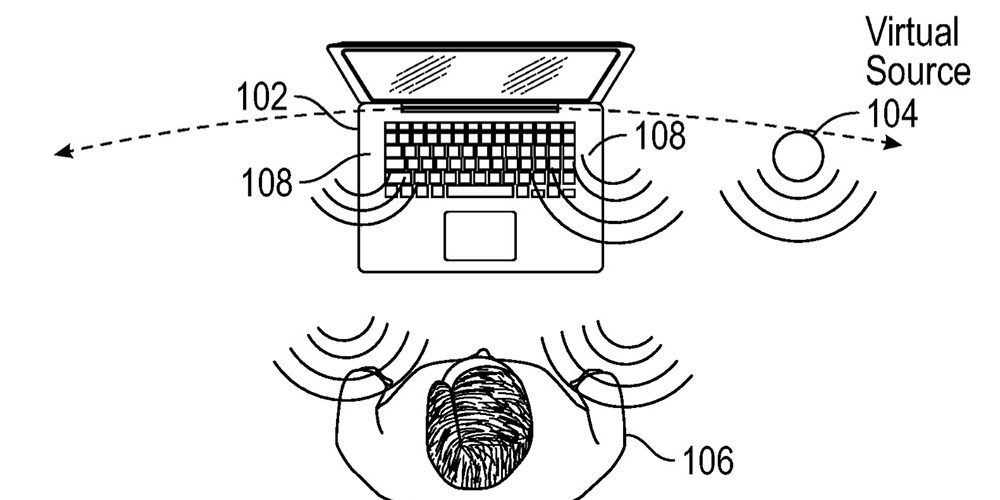
Apple has been granted a patent for AR headphones, which enable you to hear where people are located within a room even when they are not physically present.
The patent positions augmented reality headphones as a business tool, ideal for listening to conference calls, but it’s not hard to imagine entertainment-based uses for the same tech.
The patent granted today, and spotted by Patently Apple, achieves the same thing with MacBook speakers.
A virtual acoustic system is one that gives the user the illusion that sound is emanating from elsewhere in an indoor or outdoor space than directly from a loudspeaker (e.g., one that is placed in a room, one that is built into a laptop computer, etc).
Audio signal processing for virtual acoustics can greatly enhance a movie, a sports even, a videogame or other screen viewing experience, adding to the feeling of “being there”.
It works by canceling crosstalk, which is a similar technique to noise-cancellation. At its simplest, Apple employs noise-cancellation on one side of the MacBook so that the sound appears to come from the other side.
But the patent describes supplementing this with a similar approach to the HomePod, where microphones pick up reflected sound and the speaker output can then be adjusted to suit the acoustic characteristics of the room. In this case, adjustments are made so that the combination of direct and reflected sound can be used to fool us into thinking the sound originates from a particular position off to one side.
“If you have a TV capable of broadcasting images in 4K, but the signal you receive has less quality, the device’s software can‘ increase ’the quality of what you receive. But how interesting that now comes with continuous improvement. A TV with AI is constantly connected via the Internet to a database powered by thousands of users. And that database allows the algorithm to vary and thus the software is improved at all times, ”says Martín Hilgert, Visual Display senior product & marketing manager of Samsung Argentina.
“Now TV is learning – Hilgert adds – there is continuous improvement, even in sound.” Samsung sells three devices with AI in the country. They are from the Q60R QLED Smart TV 4K line. 55 ”($ 84,999), 65” ($ 119,999) and 82 ”($ 269,999). They include a Quantum 4K processor and reach a resolution of 3,840 x 2,160. They include the Ambient Mode system, to put photos or some other type of decoration when the TV is turned off. The idea is that, not being on, there is no black rectangle in the environment that breaks the harmony.
LG brought its Artificial Intelligence to the country in its Ultra HD Smart TV UM line, which offers six versions, between 43 and 65 inches.
Snapchat’s most popular yet under-exploited feature is finally getting the spotlight in 2020. Starting in February with a global release, your customizable Bitmoji avatar will become the star of a full-motion cartoon series called Bitmoji TV.
Creating original in-house shows for its Discover section that can’t be copied could help Snapchat differentiate from the plethora of short-form video platforms out there, ranging from YouTube to Facebook Watch to TikTok.
With Bitmoji TV, your avatar and those of your friends will appear in regularly scheduled adventures ranging from playing the crew of Star Treky spaceships to being secret agents to falling in love with robots or becoming zombies. The trailer Snapchat released previews an animation style reminiscent of Netflix’s Big Mouth.
“TV” is actually a return to Bitmoji’s roots. The startup Bitstrips originally offered an app for customizing the face, hair, clothes and more of your avatar and then creating comic strips for them to appear in.
In 2019, Snapchat wised up. Bitmoji have become nearly ubiquitous amongst teens and Snapchat’s 210 million daily users. They’re the Google or Kleenex of cartoonish personalized avatars. Their goofy nature is also a perfect fit for Snapchat, and a reason they’re tough for stiffer and older tech giants to convincingly copy.
A haploscope is an optical system which produces a carefully controlled virtual image. Since the development of Wheatstone's original stereoscope in 1838, haploscopes have been used to measure perceptual properties of human stereoscopic vision. This paper presents an augmented reality (AR) haploscope, which allows the viewing of virtual objects superimposed against the real world. Our lab has used generations of this device to make a careful series of perceptual measurements of AR phenomena, which have been described in publications over the previous 8 years. This paper systematically describes the design, assembly, calibration, and measurement of our AR haploscope. These methods have been developed and improved in our lab over the past 10 years. Despite the fact that 180 years have elapsed since the original report of Wheatstone's stereoscope, we have not previously found a paper that describes these kinds of details.
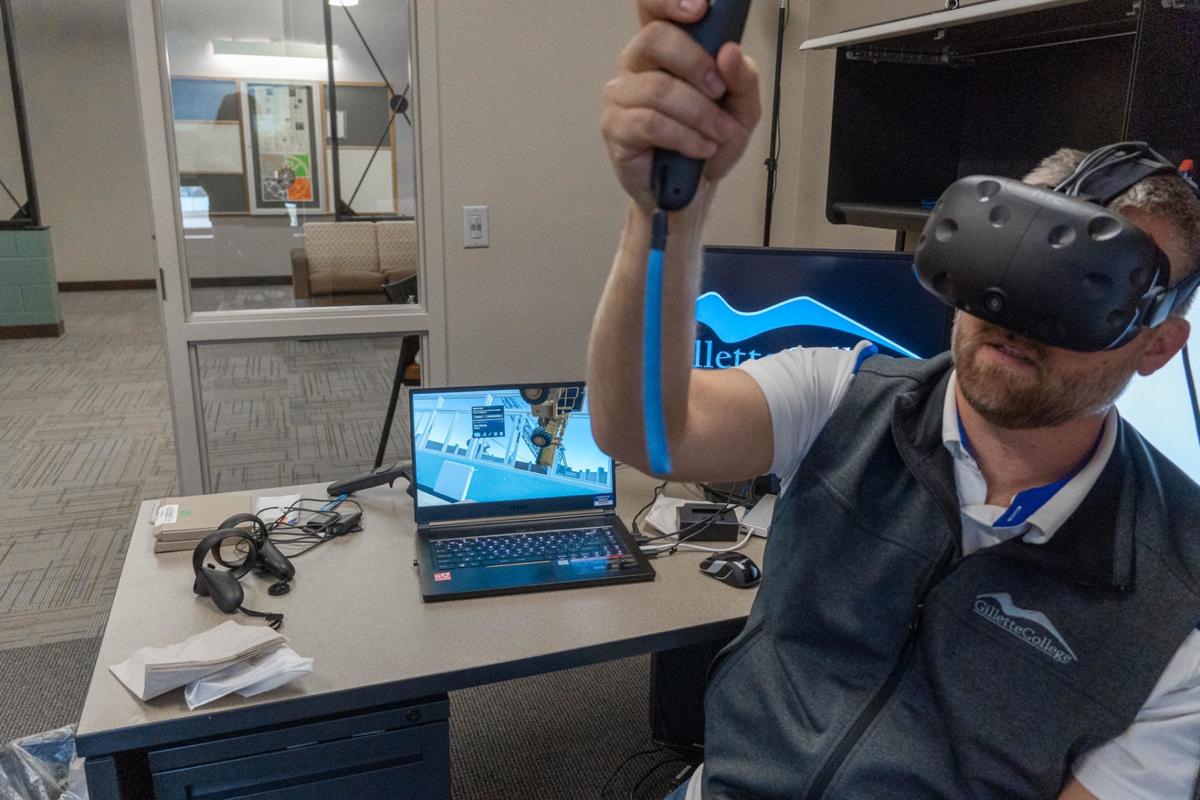
“Having them experience it for themselves and showing what it actually looks like from up there makes a huge impact on their memory,” Ullrich said.
Not only can they physically jump into several pieces of mine equipment, they can even pick up small Hot Wheel-size demo versions of the equipment from their desk seats in a virtual classroom. They can also view videos, take tests or transport themselves into a piece of equipment or to the top of the dragline.
In the future, along with improving the realistic quality of his virtual reality graphics, Ullrich would like to make some of the various dangers real, so the trainees could experience walls falling on them or running over a truck or other pitfalls without actually getting hurt. Again, he feels the sensory memory of the experience would go a long way for those trainees when they actually get onto a job site.
 I did [AR]T Walk on a glorious fall day in Central Park, starting at the Apple store on 59th Street and Fifth Avenue. I used one of its iPhones (you do not use your own) to experience the artworks, and to get each piece to appear, I pointed the phone at an object, usually a sign, part of process that the company calls “anchoring.”
 Apple has been granted a patent for AR headphones, which enable you to hear where people are located within a room even when they are not physically present.
 “If you have a TV capable of broadcasting images in 4K, but the signal you receive has less quality, the device’s software can‘ increase ’the quality of what you receive. But how interesting that now comes with continuous improvement. A TV with AI is constantly connected via the Internet to a database powered by thousands of users. And that database allows the algorithm to vary and thus the software is improved at all times, ”says Martín Hilgert, Visual Display senior product & marketing manager of Samsung Argentina.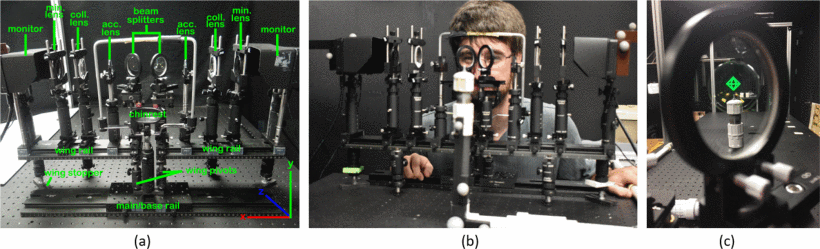
 “Having them experience it for themselves and showing what it actually looks like from up there makes a huge impact on their memory,” Ullrich said.