Enter The Tomb Of King Tut Through An Astonishing Virtual Reality Experience
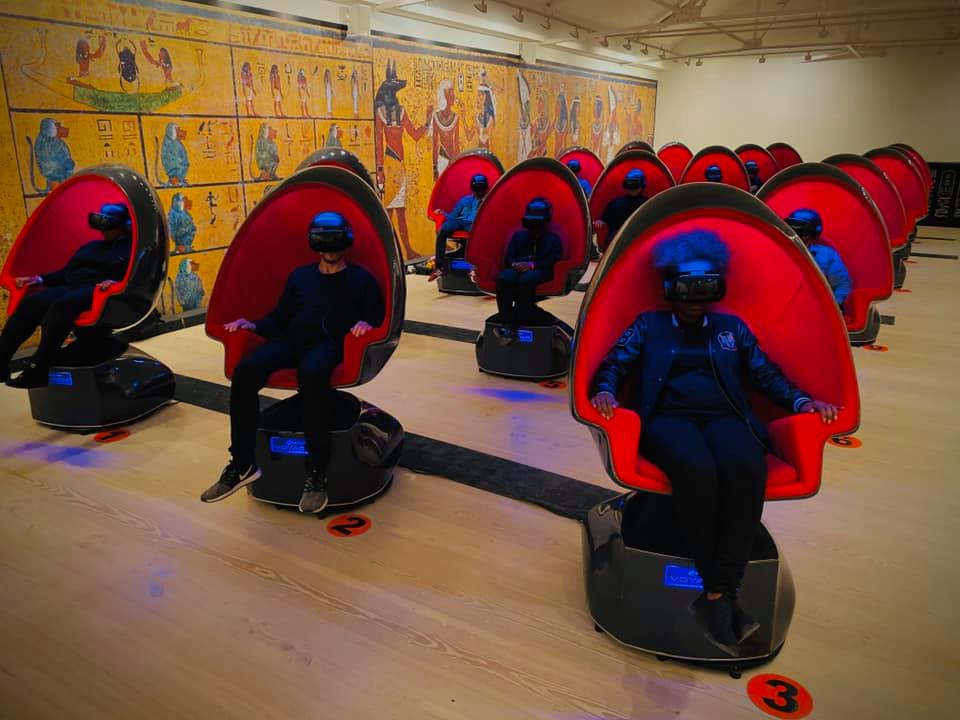
For the London exhibition, Tutankhamun: Enter The Tomb, a brilliant virtual reality experience has been added for the first time. Los Angeles-based VR production company, CityLights have premiered this immersive virtual reality experience alongside the main exhibition at the Saatchi Gallery. Directed by Joel Newton, co-founder of CityLights, the VR experience includes a soundtrack from Rob Garza of Thievery Corporation who recreates the sounds and instruments of ancient Egypt and Hugh “Lord Grantham” Bonneville as narrator. ... So that would explain why City Lights is investing heavily to promote VR as artistic experience to see in a cinema setting rather than simply as a techie experience. Visitors to City Lights’ Enter the Tomb at Saatchi gallery are seated in one of the eighteen VR pods arranged in a theater-like setting.
For Tutankhamun: Enter The Tomb, the eight-minute virtual reality experience at the Saatchi gallery, visitors sit in a comfortable lounge chair, the Positron Voyager, that transports them down into King Tut’s tomb as Howard Carter would have encountered it in 1922.
The Loneliness of a Highbrow Teenage Songwriting Robot
 Meet Yona. She loves reading Margaret Atwood and articles about teenage life and sings about loneliness and relationships on her newly released track.
If this sounds a bit scripted, that’s because it is: Yona’s not human.
Yona has been created by London-based company Auxuman and trained using artificial intelligence, fed on music and literature, and learning from reactions to her music posted online.
See the full story here: https://www.bloomberg.com/news/articles/2019-11-26/the-loneliness-of-a-highbrow-teenage-songwriting-robot
Auxuman was co-founded by Ash Koosha, Isabella Winthrop and Negar Shaghaghi. It builds AI-based characters and licenses them for entertainment, branding or live performances. Along with Yona, Auxuman also created Mony, Zoya, Hexe and Gemini – each with their own individualities.
Wave relaunches its platform for virtual-reality music concerts
 The company recently rebranded as Wave, and is now formally relaunching itself as a “multi-channel virtual entertainment platform for live concerts”. The big idea is to take its virtual performances well beyond its own app for VR headsets: to social networks, live-video streams and online games, for example. The core tech remains the same: turning artists into avatars on virtual stages, with whizzy computer-generated visuals. However, now these concerts can be streamed to YouTube, Twitch and Facebook, as well as other (unnamed for now) ‘major digital and gaming channels’.
Wave says it’ll also be helping artists to make money from their performances through virtual AND physical merchandise sales, as well as using the fan-donation tools on the social / video platforms (e.g. bit cheering on Twitch).
Wave’s recent concert with artist Lindsey Stirling attracted more than 400,000 live, unique viewers, and thus represents a calling card for what it hopes to do for more artists in the months to come.
See the full story here: https://musically.com/2019/11/26/wave-relaunches-its-platform-for-virtual-reality-music-concerts/
A Walk on the Frontier of Art, Where the Sky Is the Limit
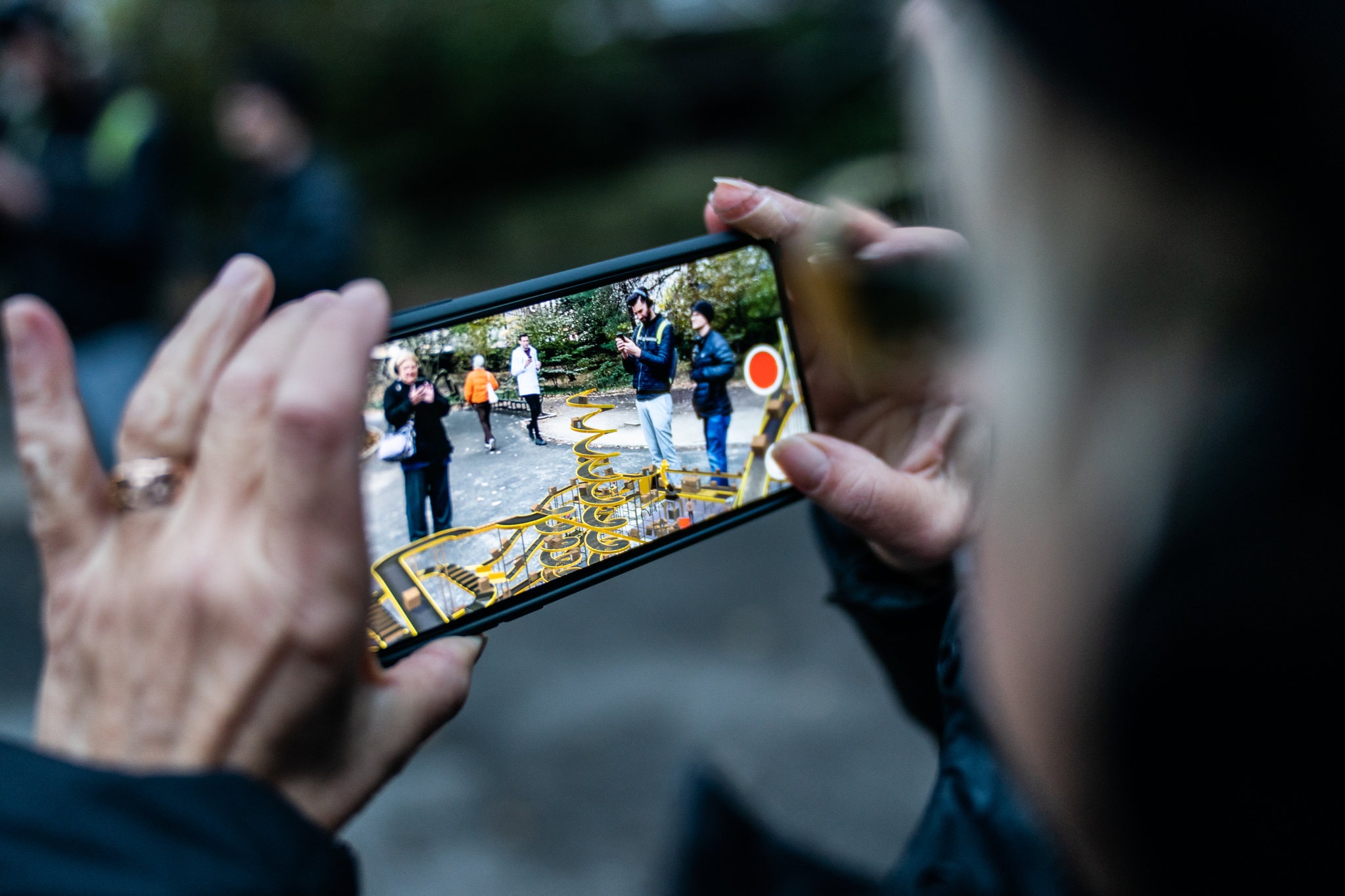
 Aery, a new augmented reality platform tailored to digital art exhibitions.
On the iPad, a constellation of a rose appeared, at an angle in the sky and topped by a crown, as Mr. Humann intended.
For me — someone who looks at art for a living, but also avoids downloading new apps — experiencing three exhibitions of augmented reality art over a couple of weeks was a crossing of a threshold, one that more and more people will experience in the years ahead.
“It’s going to have a huge impact on the art world,” said Jay Van Buren, who, as chief executive and co-founder of the tech company Membit, helped create Aery, a joint venture between Membit and the real estate firm Related Companies. “Artists can do anything with it,” Mr. Van Buren said.
She likened the technology to a kiln or a paint brush: In the big picture, it is simply another way for an artist to create. “It’s a fabrication tool,” Ms. Sade said. “It’s a medium.”
In the same way that most sculptors do not cast a piece in bronze themselves — that work is done by experts at a foundry, to the artist’s specifications — Ms. Sade sent her photographs to Mr. Van Buren to be turned into augmented reality.
...to get each piece to appear, I pointed the phone at an object, usually a sign, part of process that the company calls “anchoring.”
The art is calibrated based on the position of you and the anchor, and when you have lined up the phone and the sign correctly you feel a slight vibration in the phone that the company calls “haptic feedback.”
For now, augmented reality seems to be getting more play among fine artists than virtual reality. As Mr. Van Buren put it, “AR loops you in more firmly to the place where you are, rather than taking you away into another world.”
Mr. Michelson said that the idea of multiple people holding up their phones to see his works at the same time also made him think of the technology’s “social possibilities.”
See the full story here: https://www.nytimes.com/2019/11/27/arts/augmented-reality-exhibitions.html
Facebook buys VR studio behind Beat Saber
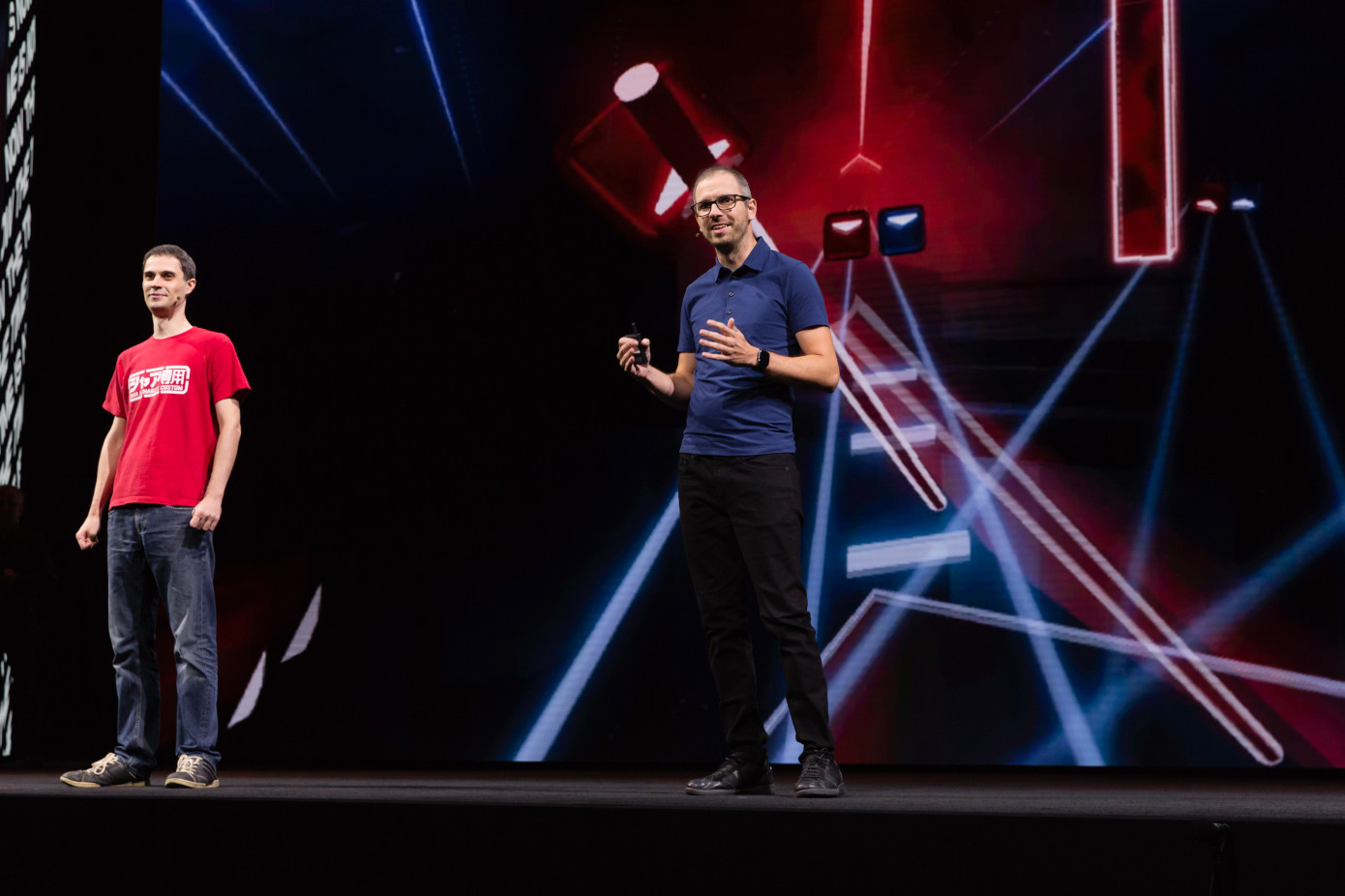 Virtual reality doesn’t have many hit games yet, but Facebook is buying the studio behind one of the platform’s biggest titles.
Facebook announced today that it will be buying Beat Games, the game studio behind Beat Saber, a rhythm game that’s equal parts Fruit Ninja and Guitar Hero — with light sabers of course.
Terms of the deal weren’t disclosed, but we’re sniffing around for a price tag. The studio will join Oculus Studios but will continue to operate independently at their HQ in Prague.
Beat Games had begun expansion by partnering with musicians to release their songs as levels in the game, partnering with artists like Imagine Dragons and Panic at the Disco to bring paid level packs to Beat Saber. One can imagine that Facebook will have a much easier time making conversations happen with top artists.
See the full story here: https://techcrunch.com/2019/11/26/facebook-buys-the-vr-studio-behind-beat-saber/
Apple Chief Tim Cook Calls For National Data Regulations
 Pew Research reports that of the 60 percent of U.S. adults who believe their data is being collected daily, “some 81 percent of the public say that the potential risks they face because of data collection by companies outweigh the benefits, and 66 percent say the same about government data collection.”
Seventy-nine percent of Americans “report being concerned about the way their data is being used by companies,” with 64 percent worried about the way the government uses their data.
Pew Research’s report also found that “79 percent of Americans say they are not too or not at all confident that companies will admit mistakes and take responsibility if they misuse or compromise personal information, and 69 percent report having this same lack of confidence that firms will use their personal information in ways they will be comfortable with.”
See the full story with more statistics here: https://www.etcentric.org/apple-chief-tim-cook-calls-for-national-data-regulations/
Researchers develop AI that distinguishes between satire and fake news
 How can you distinguish between satire and fake news? It usually comes down to semantic and linguistic differences, but the nuances can be tough to spot. That’s why researchers at George Washington University, Amazon AWS AI, and startup AdVerifai investigated a machine learning approach to classifying misleading speech. They say the AI model they developed, which outperformed the baseline, lays the groundwork for the study of additional linguistic features.
The researchers hypothesized that metrics of text coherence might be useful in capturing semantic relatedness between sentences of a story.
The researchers leveraged a statistical technique called principal component analysis to convert potentially correlated metrics into uncorrelated variables (or principal components), which they used in two logistic regression models (functions that model the probability of certain classes) with the fake and satire labels their dependent variables. Next, they evaluated the models’ performance on a corpus containing 283 fake news stories and 203 satirical stories that had been verified by hand.
The team reports that a classifier trained on the “significant” indices outperformed the baseline F1 score, a measure of the frequency of false positives and negatives.
See the full story here: https://venturebeat.com/2019/11/05/researchers-develop-ai-that-distinguishes-between-satire-and-fake-news/
A leaked excerpt of TikTok moderation rules shows how political content gets buried
 According to a whistleblower who spoke with Netzpolitik, controversial content on the app is divided into the categories of “deleted,” “visible to self” (meaning other users can’t see it), “not recommended,” and “not for feed.” Videos in these last two categories won’t be curated by the main TikTok discovery engine, and “not for feed” also makes a video harder to find in search.
According to the guidelines, most political content during election periods should be marked “not recommended.” Political content includes everything from partisan speeches to party banners. Police content—including filming inside a police station or jail—is marked “not for feed.”
The document also shows some changes that TikTok has made. Once, content about riots and protests—including reference to Tibet, Taiwan, Northern Ireland, and Tiananmen Square—would be marked “not recommended.” That category has now been replaced by a category covering content that might result in “real-world harm,” according to the guidelines. Moderators are told to mark this “not for feed.”