China says its digital currency will have “controllable anonymity”—but who will control it?
 Blockchains by themselves, even the most decentralized ones (China’s will presumably be controlled by the government), are not anonymous. Generally, they generate a permanent record of every transaction, including information about the sender, recipient, and amount. Some cryptocurrencies, like Zcash and Monero, have employed cutting-edge cryptographic approaches to hide transaction-related information. One thing is for sure: financial policy makers across the world are eager to learn exactly what China has up its sleeve.
The USPTO wants to know if artificial intelligence can own the content it creates
 The US office responsible for patents and trademarks is trying to figure out how AI might call for changes to copyright law, and it’s asking the public for opinions on the topic. The United States Patent and Trademark Office (USPTO) published a notice in the Federal Register last month saying it’s seeking comments, as spotted by TorrentFreak.
The office is gathering information about the impact of artificial intelligence on copyright, trademark, and other intellectual property rights. It outlines thirteen specific questions, ranging from what happens if an AI creates a copyright-infringing work to if it’s legal to feed an AI copyrighted material.
See the full story here: https://www.theverge.com/2019/11/13/20961788/us-government-ai-copyright-patent-trademark-office-notice-artificial-intelligence
Lawmakers Introduce Sweeping Online Privacy Legislation
 “Our country urgently needs a legal framework to protect consumers from the ever-growing data-collection and data-sharing industries that make billions annually off Americans’ personal information,” said Lofgren. “Privacy for online consumers has been nonexistent — and we need to give users control of their personal data by making legitimate changes to business practices.”
See the full story here: https://www.etcentric.org/lawmakers-introduce-sweeping-online-privacy-legislation/
Twitter co-founder invests in AI project to create ‘new type of media’
 Twitter co-founder Biz Stone has spoken about his decision to invest in artificial intelligence as part of a project which aims to create “a new type of media”.
Mr Stone was joined by AI Foundation co-founder and chief executive Lars Buttler at the One Young World conference to introduce the concept of “personal media”
The digital pioneers presented the concept, which is communication through an artificial version of yourself, as the next type of media following on from mass media and social media.
The AI Foundation, a start-up business based in San Francisco, is working on artificial intelligence “that think and act like you” using 10 billion dollars of funding from investors.
Users of this technology would own an AI version of themselves, which would “share their values and interests” by being programmed and controlled by them.
Lawyers hate timekeeping — Ping raises $13M to fix it with AI
 Ping, which uses artificial intelligence to automatically track lawyers' work and fill out timesheets for them. There's a massive opportunity to eliminate a core cause of burnout, lift law firm revenue by around 10% and give them fresh insights into labor allocation.
Traditionally, lawyers have to keep track of their time by themselves down to the tenth of an hour — reviewing documents for the Johnson case, preparing a motion to dismiss for the Lee case, a client phone call for the Sriram case. There are timesheets built into legal software suites like MyCase, legal billing software like TimeSolv and one-off tools like Time Miner and iTimeKeep. They typically offer timers that lawyers can manually start and stop on different devices, with some providing tracking of scheduled appointments, call and text logging, and integration with billing systems.
Ping goes a big step further. It uses AI and machine learning to figure out whether an activity is billable, for which client, a description of the activity and its codification beyond just how long it lasted. Instead of merely filling in the minutes, it completes all the logs automatically, with entries like "Writing up a deposition - Jenkins Case - 18 minutes." Then it presents the timesheet to the user for review before they send it to billing.
The big challenge now for Alshak and the team he's assembled is to grow up. They need to go from cat-in-sunglasses logo Ping to mature wordmark Ping.
See the full story here; https://www.yahoo.com/entertainment/lawyers-hate-timekeeping-ping-raises-133345567.html
Fordham University business students have a new tool to prepare them for boardrooms: Virtual reality
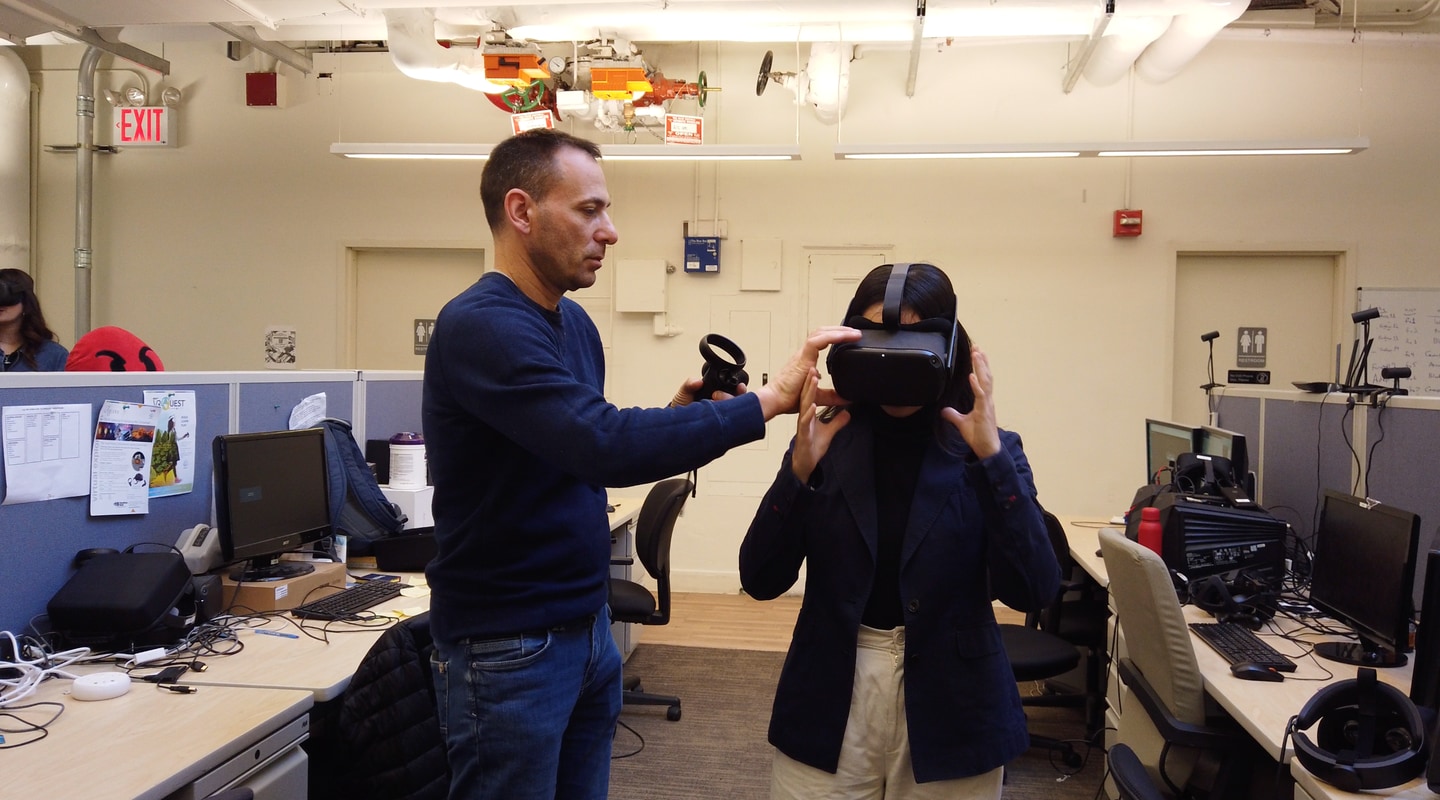 In one simulation, students learn how to network among groups of strangers gathered in a room. In others, they lead negotiations at a high-stakes business meeting in a conference room or give presentations in front of colleagues. While a handful of students are immersed in a simulation, their virtual selves are broadcast on a projector for the rest of the class to watch, and critique, in real time.
The students in the VR experience are given new names, genders and voices so that their true identity remains anonymous, which enhances the realism, according to Lyron Bentovim, the professor leading the class alongside professor Christine Janssen.
Beyond their in-class VR, the Glimpse Group this week unveiled a new way for Fordham students to experience class from outside the classroom. They call it Project Chimera, an immersive educational broadcast that mixes virtual reality with 180-degree video and real life. With a VR headset strapped on, remote students can sit in on the class in real time as if they are physically present, and even interact with one another, the teacher and local students via a custom avatar.
See the full story here: https://www.washingtonpost.com/technology/2019/11/12/fordham-university-business-students-have-new-tool-prepare-them-boardrooms-virtual-reality/