Arca will use AI to soundtrack NYC’s Museum of Modern Art
 If you pay a visit to New York City's Museum of Modern Art in the near future, you'll be awash in artificial intelligence before you've even seen an exhibit. Electronic musician Arca (who has produced for Bjork and FKA Twigs) has announced that a piece she wrote using Bronze's AI creative tool will provide the soundtrack for MoMA's lobby for the next two years once it reopens on October 21st. Don't think that it'll be just the same tune playing on loop, though. The AI will "never make the music play the same way twice," Arca said. In that sense, it's more like one very large piece.
Bronze is built for precisely for these "non-static, generative and augmented" compositions, using machine learning to expand on the artist's core ideas. It's also a music format that will let artists release these AI tunes to the public.
See the full story here: https://www.yahoo.com/entertainment/2019-10-17-arca-ai-soundtrack-for-nyc-moma.html
As rapes rise in Myanmar, augmented reality could help smash sex taboos

People pray at a pagoda during the Thadingyut festival in Mandalay, Myanmar, October 13, 2019. Photo taken on October 13, 2019. REUTERS/Ann Wang
The 38-year-old Harvard graduate was named one of 40 social entrepreneurs of the year by the World Economic Forum in New York last month for her work in transforming the way hundreds of thousands of students learn in Myanmar.
Key to her work is augmented reality,...
Her project on sex education, named Bay Kin (Danger Free), was launched in August soon after the child-rape case ignited national debate about sex, safety, children and consent.
The product includes a series of sex education books — in both paper and AR formats — as well as comics and games, that teach students about everything from sex organs to pregnancy.
“We’re in the early stage because many teachers still feel embarrassed to teach sex in schools, but AR is fun, so we hope it can help to overcome this,” said Hla Hla Win.
The 3-year-old girl, nicknamed “Victoria,” testified via video link at a trial last month after a school employee was charged with raping her. The case has been a lightning rod for popular protest in Myanmar, be it over the many nurseries that lack licenses or the hasty way police handled investigations.
Child rapists face a maximum of life imprisonment if convicted.
See the full story here: https://www.japantimes.co.jp/news/2019/10/18/asia-pacific/social-issues-asia-pacific/augmented-reality-myanmar-smash-sex-taboos/#.XankxS2ZNPM
IndieCade brings the future of underground gaming to Santa Monica
At the cliffhanger end of the demo for “ARBox,” an in-development augmented-reality game that uses a mix of digital and physical objects to allow for escape room-like experiences in our home, players were given a choice: Join a magic revolution and risk it all or pledge allegiance to a corporation and opt for the promise of security. The cost? A life without sorcery.
For more than a decade, IndieCade has showcased what’s underground, what’s next and what’s important in interactive storytelling. Perhaps more vitally, IndieCade puts the emphasis on individual developers, highlighting gaming’s idiosyncratic voices who believe play is a language as much as it is a tool for a medium.
there was “Liberated,” a living comic book in which democracy slowly devolves into authoritarianism. As characters run through panels, billboards flash their credit score, showing a populace paralyzed by its debt. Both “Headliner: NoviNews” and “The Occupation” took differing approaches to journalism and the spread of information — or disinformation. “The Occupation” unfolds as a time-sensitive thriller in which controversial laws that will erode civil liberties and stoke anti-immigrant fervor are in the hands of those shaping the government’s narrative. “Headliner: NoviNews,” meanwhile, focuses on choosing headlines and staying one step ahead of an administration that increasingly may view the media as an enemy.
Thinking of play, however, as a communicative tool is still something of an experiment. About seven years ago, the mobile game “Spaceteam” became a darling of IndieCade for the way it asked mobile phone users to come together to stop a spaceship from failing. This was done by each player having a slightly different screen, and everyone working together under a time crunch to prevent failure. Essentially, players barked nonsense orders at one other.
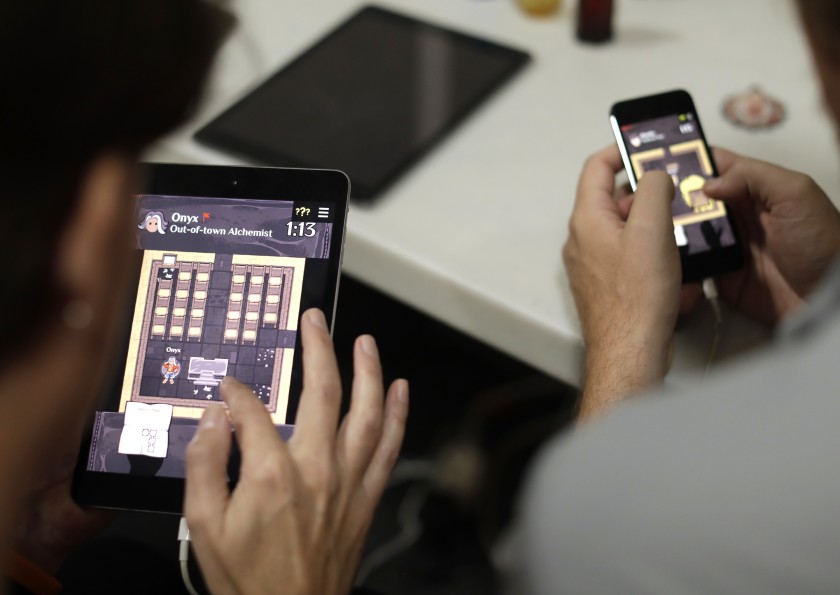 “Video games are so ubiquitous now,” Smith said. “Bringing that out of the screen and into the world is exciting to people … It’s a shared space that people can navigate together and do interesting things in, and I think that can be the foundation for many different experiences.”
See the full story here: https://www.latimes.com/entertainment-arts/story/2019-10-13/indiecade-shows-whats-next-underground-gaming
Cracking the ‘da Vinci’ code: Virtual reality accelerates helicopter aviator training
 The Air Force plans to wait to try out another small group of candidates until the just-graduated class progresses through the formal training units to learn how to fly the UN-1N Huey, HH-60G Pave Hawk and CV-22 Osprey. That will allow the Air Force to gather feedback on how well these students did after learning through virtual reality.
In the meantime, the Air Force will add VR systems to the normal helicopter training syllabus to give students more chances to rehearse and repeat instructions and training flights.
Leonardo da Vinci is believed to be the first to dream up the concept of an aircraft that used a rotary device to lift vertically. His “Helical Air Screw” drawing outlining the basic concepts was made in 1493 — about 450 years before the first true helicopter would take off.
See the full story here: https://www.airforcetimes.com/news/your-air-force/2019/10/15/cracking-the-da-vinci-code-virtual-reality-accelerates-helicopter-aviator-training/
Google abandons its phone-powered virtual reality headset Daydream, admitting almost no-one used it
- Google is abandoning Daydream, its attempt to make virtual reality headsets powered by phones.
- The company has acknowledged that consumers weren't interested in the product.
- Daydream had only basic functionality compared to more sophisticated rivals like Facebook's Oculus Quest.
- Despite billions of dollars of investment across the industry, virtual reality is still struggling to go mainstream.
 See the full story here: https://www.businessinsider.com/google-discontinues-daydream-virtual-reality-view-headset-2019-10
Meeting the ‘Mona Lisa’ for an Intimate (Virtual) Rendezvous
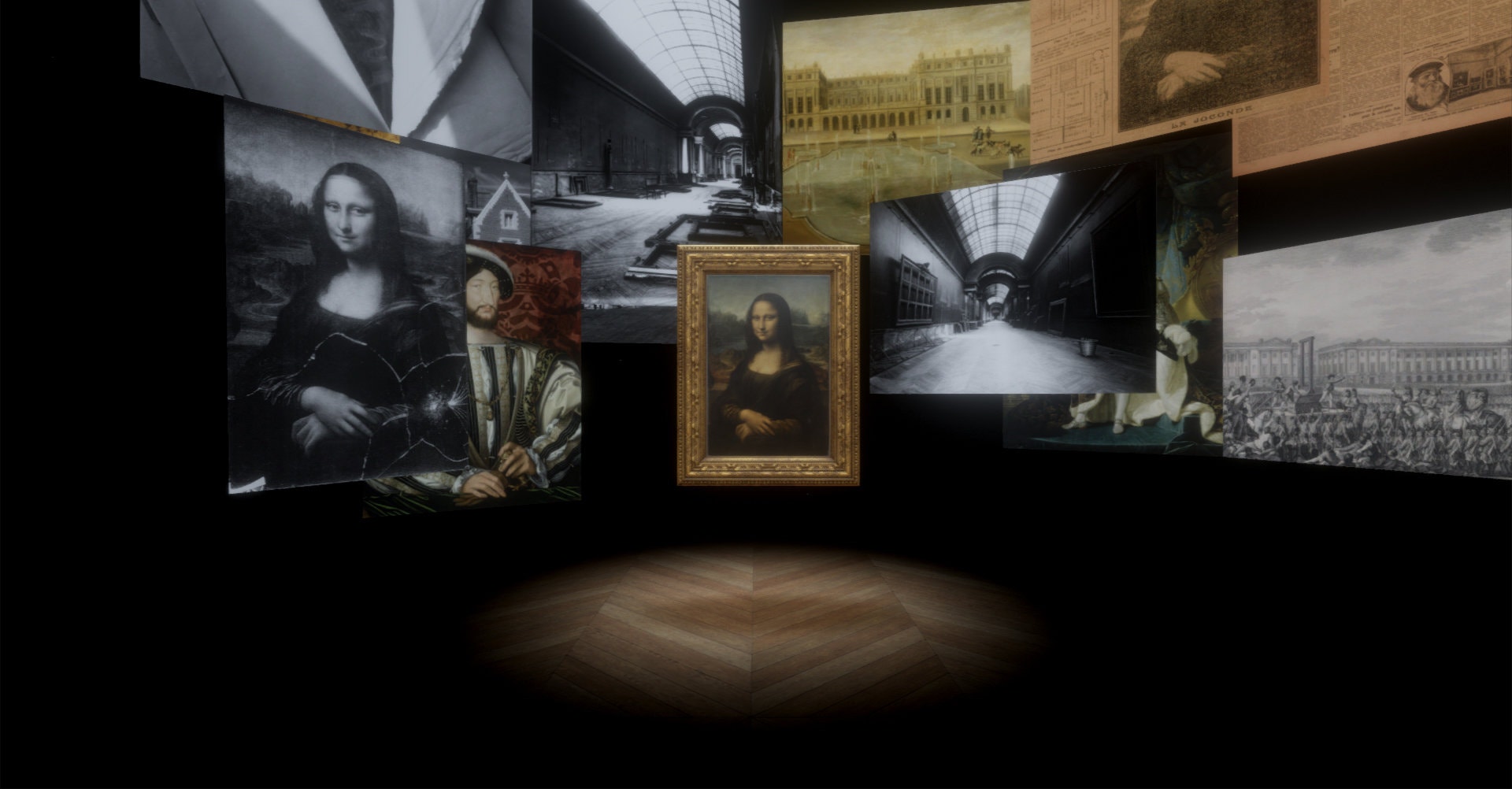 Mona Lisa’s lingering smile remains the same, but she is getting a first-of-its-kind virtual makeover from the Louvre Museum, which has struggled this year with the popularity of Leonardo da Vinci’s masterpiece and the throngs of selfie-snapping tourists.
With a blockbuster Leonardo exhibition fast approaching, the Louvre and its production partners are fine-tuning a virtual reality tour with three-dimensional views of the portrait that look beyond the jostling crowds, the shatterproof glass case and the layers of varnish from restorations and the fading green patina.
The virtual reality tour will be a more intimate encounter. The VR tour, designed to remedy the problem of crowds and distance, will be housed in a small gallery room near the main Leonardo exhibition and apart from the “Mona Lisa.”
The gallery, equipped with 15 headset stations, will offer seven-minute virtual tours that begin in a familiar crush of visitors with mobile phones aloft. They lead through a gallery of paintings to the portrait of Mona Lisa, the wife of an Italian silk merchant.
In this virtual land of Leonardo, spectators eventually fly over a valley and jagged hills aboard a wing-flapping glider he sketched (and which appears in the traditional exhibition).
In September, Franck Riester, France’s minister of culture, unveiled a project to develop a thousand “micro-follies,” or digital pop-up museums, over the next three years in rural and suburban locations — including movie theaters, libraries, social centers and even hair salons. France intends to spend 3 million euros to offer virtual reality and 2D digital tours to show off the masterworks of a dozen major Paris museums, including, potentially, the Louvre’s “Mona Lisa” tour.
The reactions of visitors impressed Louvre officials. “Not only young people were using it. There were people over 65, including my father, who is 83,” said Ms. de Font-Réaulx, of the Louvre.
See the full story here: https://www.nytimes.com/2019/10/15/arts/design/mona-lisa-vr-louvre.html
Is the world ready for virtual graffiti? 5
 Imagine a world that’s filled with invisible graffiti. Open an app, point your phone at a wall, and blank brick or cement becomes a canvas. Create art with digital spraypaint and stencils, and an augmented reality system will permanently store its location and placement, creating the illusion of real street art. If friends or social media followers have the app, they can find your painting on a map and come see it. You might scrawl an in-joke across the door of a friend’s apartment, or paint a gorgeous mural on the side of a local store.
Now imagine a darker world. Members of hate groups gleefully swap pictures of racist tags on civil rights monuments. Students bully each other by spreading vicious rumors on the walls of a target’s house. Small businesses get mobbed beyond capacity when a big influencer posts a sticker on their window. The developers of Mark AR, an app that’s described as “the world’s first augmented reality social platform,” are trying to create the good version of this system. They’re still figuring out how to avoid the bad one.
At launch, Mark AR is supposed to work a bit like Facebook. Users will log in with real names, probably through Facebook itself. When they create art, they can share the location with a single person, a list of friends and followers, or the members of a group. Google’s ARCore platform stores the location using GPS and computer vision, capturing details in the environment to use them as anchor points. When somebody shares art with you, a thumbnail will appear on a map; if you visit that location and point your phone at the place shown in the thumbnail, you’ll see whatever image they’ve created.
they hope a real-name policy and the friend-based model will limit people making offensive or harassing images. “Because there’s no anonymity, that helps govern what people are doing,” says Sybo CEO Mathias Gredal Norvig. (It’s unclear how true that is — Facebook has faced repeated problems with closed groups devoted to swapping non-consensual pornographyor degrading women or immigrants.)
See the full story here: https://www.theverge.com/2019/10/12/20908824/mark-ar-google-cloud-anchors-social-art-platform-harassment-moderation
Breakbulk Middle East 2020 reveals plans to incorporate augmented reality
 Speaking on the addition of ‘Breakbulk AR’ at next year’s event, His Excellency Dr. Abdullah Belhaif Al Nuaimi, the UAE Minister of Infrastructure Development and the Chairman of Federal Transport Authority for Land and Maritime said, “Those who don’t fall in line, fall behind, and Breakbulk Middle East has done a tremendous job of aligning with the global shift of digitalization to avoid the latter. A willingness to adapt in a timely manner has contributed to the event’s continual progression and its simultaneous influences in the industry’s development.”
“The breakbulk industry, and all associated industries which are integral to the Middle East’s infrastructure, are reliant on innovative efforts for fostering a technologically sound and sustainable environment; The 5th annual edition of the event in February 2020 will assist in nurturing such innovation, and ‘Breakbulk AR’ is a commendable addition,” he added.
See the full story here: https://www.logisticsmiddleeast.com/business/34260-breakbulk-middle-east-2020-reveals-plans-to-incorporate-augmented-reality
Tesco supermarkets with no tills could mean history for shop queues
 Queuing at Britain's largest supermarket chain could soon be a thing of the past thanks to Tesco investing in the development from a company in Israel.
The startup - Trigo - is reported to make use of artificial intelligence and cameras to take 3D images of items picked up by customers, charging them via an app on their phone once they leave the store.
Dave Lewis, Tesco's Chief Executive told Jewish News: "We benchmarked the market in this space and they were by far and away the best."
However he added that the technology is still in the testing phase, and is not intended to replace all tills at Tescos.
See the full story here: https://www.entertainmentdaily.co.uk/food/tesco-supermarkets-with-no-tills-could-mean-history-for-shop-queues/