The best way to do this is to nominate a team member to take the lead, to be your internal accessibility advocate. When undertaking internal design critiques, add a section for an accessibility review. These conversations help to up-skill the whole team on conformance guidelines. You can also decorate the office with educational snippets; the GDS team here at Dept UK have produced some great posters about accessibility that you can download for free.
Secondly, we need to create empathy within our UXD teams. In design, it can be hard for people to grasp the importance of accessibility if they have no personal experience, whether directly or indirectly. Invite people with disabilities into your design process so they can educate the team on the challenges they face with your creations. This real world experience will stick in the team’s mind much longer than statistics ever will, and its impact will be much more profound.
Now, these biggest marketers, which spent $4+ billion annually in advertising, have narrowed the gap considerably — to as little as a few months for tentpole movies — to better respond to the expectation of on-demand content.
The New York Times reports that Universal president of worldwide marketing Michael Moses pointed to the influence of Netflix, Hulu, Spotify and other streaming services. “The long journey you used to be able to take the audience on — a teaser to a trailer to TV over a year or longer — isn’t as available anymore,” he said, adding that much shorter campaigns are becoming “the new normal.”
“There’s an entire generation that is very skilled at skipping marketing,” Moses said. “They don’t see television advertising. They can easily navigate around it in the digital space. But what does grab their attention is new content, especially that first trailer. So you are better off waiting until you can really pack a punch.”
Just recently, Vuzix Corporation partnered with Verizon and Zoi Meet, a popular multi communication platform, to introduce real-time language translationfunctionality to the device, allowing users to instantly interpret multiple languages, including Arabic, Chinese (simplified), Dutch, English, French, German, Italian, Japanese, Korean, Portuguese, and Spanish.
Earlier this month the company announced the arrival of a DJI Drone companion app that allows both enterprise clients and consumers to control DJI brand drones without the need for a smartphone or tablet device. Compatible with the Mavic Pro, Mavic Air, and Spark, Vuzix Blade users are able to access the remote devices via a WiFi connection and view a live video feed as well as receive navigational feedback directly from their headset.
Today, the company announced a new addition to the Vuzix Blade Smart Glasses which introduces Alexa Built-in official certification, allowing users hands-free access to Amazon’s proprietary voice assistant technology. Similar to standalone Alexa devices, the smart glasses can register voice commands and perform a variety of tasks, from ordering products on Amazon.com and controlling compatible smart devices, to ordering takeout from food delivery apps and scheduling rideshare pick-ups.
The motor above is little more than a magnet and coil with some structural parts, but it can “walk” back and forth or make the gears of a more complicated machine move back and forth.
On its own, this little moving microbe is impressive enough, but its real potential lies in what could happen were it to be assembled with others of its ilk, and with other building-block robotics components made up of simple parts, which is the vision of Gershenfeld and his research team.
Previously, they’ve already shown that other core components can be assembled from the same limited set of fundamental ingredients, and in the future, the idea is that these tiny core machines could actually automatically self-assemble into larger structures capable of carrying out specific tasks.
The news: Microsoft says OpenAI will help it jointly develop and train new AI technologies for its Azure cloud computing service. They’ll also work together on OpenAI’s mission to try to achieve AGI—machines with the capacity to learn tasks the way human beings do.
Show me the money:OpenAI began as a nonprofit research lab in 2015 with the mission of developing safe AGI. But AI models need mountains of data to crunch, and that requires expensive computing power. So earlier this year, OpenAI set up a new for-profit arm to help pay for its work.
Moonshot: Many AI researchers believe AGI is unachievable. OpenAI may try to reach it by scaling existing deep-learning approaches rather than by developing new ones. There’s no guarantee that will work, so Microsoft’s billion-dollar bet is a risky one.
In a sign that times are indeed a-changin’, it has emerged that the number of people who watched Wireless Festival in virtual reality was almost double the number of people who attended in real life.
Held in London’s Finsbury Park earlier this month, Wireless Festival was attended by 130,000 people, with music fans turning up to see rappers like Cardi B, Skepta, Travis Scott and J Hus.
But some 250,000 people watched the festival live on virtual reality app MelodyVR, which works on smartphones and VR headsets like Oculus and Samsung Gear VR.
The stats suggest that VR, which has struggled to break into the mainstream, might still find an audience.
Today, the John S. and James L. Knight Foundation announced a commitment of nearly $50 million in research to better understand how technology is transforming our democracy and the way we receive and engage with information. Amidst a growing debate over technology’s role in our democracy, these investments will help ensure society is equipped to make evidence-based decisions on how to govern and manage the now-digital public square.
Knight’s investment will fund new, cross-disciplinary research at 11 American universities and research institutions, including the creation of five new centers of study — each reflecting different approaches to understanding the future of democracy in a digital age (see descriptions and Table A below). In addition, Knight has opened a new funding opportunity for policy and legal research addressing major, ongoing debates about the rules that should govern social media and technology companies.
There are many challenges to developing robots that could operate within your body, not the least of which is finding a power source -- you can't exactly strap a big battery on them. That might not be an issue thanks to Georgia Tech researchers. They've developed minuscule "bristle-bots" that move by tapping vibration from a variety of sources, whether it's ultrasound or a nearby speaker. The trick was to mate a tiny piezoelectric actuator to a 3D-printed polymer body whose bristle-like legs are angled to move in specific directions in a resonant response to vibrations.
The bots are only 2mm (about 0.08in) long and weigh just 5mg (less than 0.0002oz), but they can move relatively briskly at about 8mm (just over 0.31in) per second. They're flexible, too. The actuators are made out of lead zirconate titanate that can turn voltage into vibration for movement, or the reverse if they need to power sensors.
November 9, 2019 : Notification of first review cycle results
January 6, 2020 : Revised paper submissions due to second review cycle
January 22, 2020 : Final notifications
January 31, 2020 : Camera-ready material due from authors of accepted papers
Overview
IEEE VR 2020 seeks original, high-quality papers in all areas related to virtual reality (VR), including augmented reality (AR), mixed reality (MR), and 3D user interfaces (3DUIs).
Inquiries contact: program2020@ieeevr.org
Topics
IEEE VR 2020 seeks contributions in VR/AR/MR and 3DUI including, but not limited to, the following topics:
3D and volumetric display and projection technology
3D authoring
3D user interaction
3DUI metaphors
Audio interfaces, sound rendering, spatialized audio, auditory perception and psychoacoustics
Collaborative interactions
Computer graphics techniques
Crowd simulation
Embodied agents, virtual humans and (self-)avatars
Ethical issues
Haptic and tactile interfaces, wearable haptics, passive haptics, pseudo haptics, other touch-based UI
Human factors and ergonomics
Immersive / 360° video
Immersive analytics and visualization
Input devices
Locomotion and navigation
Mediated and diminished reality
Mobile, desktop or hybrid 3DUIs
Modeling and simulation
Multi-user and distributed systems
Multimodal capturing and reconstruction
Multimodal input and output
Multimodal/cross-modal Interaction and perception
Multisensory rendering, registration, and synchronization
Non-fatiguing 3DUIs
Non-visual interfaces (such as olfactory)
Perception and cognition
Presence, body ownership, and agency
Scene description and management issues
Software architectures, toolkits, and engineering
Storytelling
Teleoperation and telepresence
Therapy and rehabilitation
Touch, tangible and gesture interfaces
Tracking and sensing
Usage research, evaluation methods and empirical studies
All VR Journal Papers submissions should be formatted using the IEEE Computer Society TVCG journal format described at http://junctionpublishing.org/vgtc/Tasks/camera_tvcg.html. Including a teaser image on page 1 is encouraged but not required.
Contacts
Journal Papers Chairs:
Joseph Gabbard, Virginia Tech, USA
Joaquim Jorge, INESC-ID / Técnico Lisboa, POR
Torsten Wolfgang Kuhlen, RWTH Aachen University, GER
Two German engineers from the Research Center for Artificial Intelligence have come up with a unique VR controller that uses a dual folding fan-like system that opens and closes in different configurations—based on what is happening in the VR experience—to give you dynamic and passive haptic feedback.
Put simply, they’ve created artificial weight in VR through drag and weight shifting.
In a recently published paper, André Zenner and Antonio Krüger outlined their work on a system they are calling Drag:on that gives you the sensation of haptic weight through different types of feedback based on body movement, the digital object being interacted with, and how you handle said digital object.
...
Perception of Virtual Ratchet Resistance lets you grab a tool in VR to loosen or tighten a bolt. As you turn your tool to tighten the bolt, the fans will open causing more resistance. Turn your tool the other direction, and the fans will close giving you the sensation of the bolts loosening.
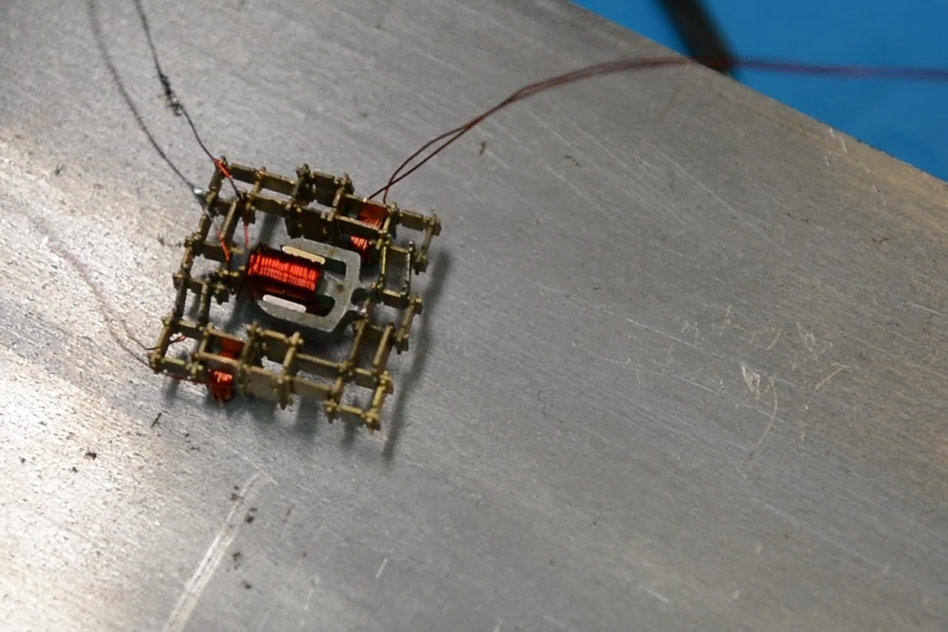 The motor above is little more than a magnet and coil with some structural parts, but it can “walk” back and forth or make the gears of a more complicated machine move back and forth.
 In a sign that times are indeed a-changin’, it has emerged that the number of people who watched Wireless Festival in virtual reality was almost double the number of people who attended in real life.