Fortnite – Battle Royale weaponises a virtual world
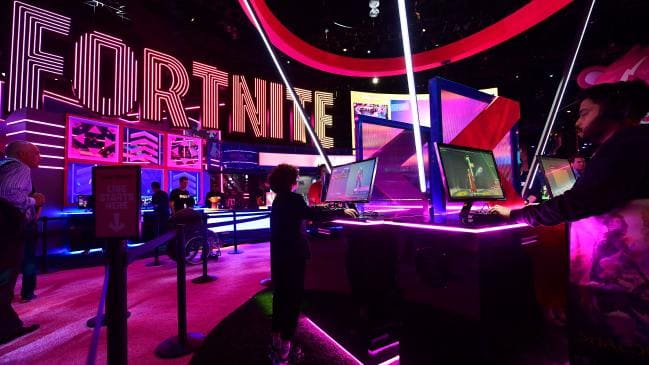 With its cartoon-like graphics, silly outfits and dance moves Fortnite’s visual elements deliberately eschew gritty reality to sanitise the gaming environment. There’s no blood, no gore, just cute avatars shooting at each other.
Besides the disarming visuals, Fortnite is also immensely shareable. The Battle Royale is almost as much about players interacting with each other inside the game as it is about staying alive.
The diverse battle arenas in Fortnite have quickly become digital playgrounds, where users congregate, create and share collective experiences.
This is Fortnite’s secret sauce: the cartoonish combat may be the objective of the game but inhabiting a consequence-free virtual world is the real drawcard.
See the full story here: https://www.theaustralian.com.au/inquirer/battle-royale-weaponises-a-virtual-world/news-story/54cb24ede763195afbebb2d40650aa8b
VIRTUAL REALITY FESTIVAL LAUNCHES IN PARIS
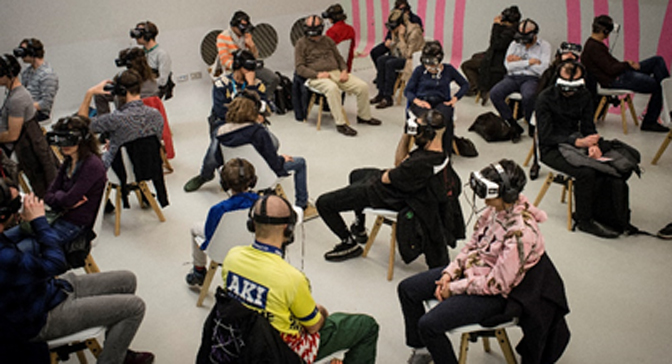 This year NewImages Festival has shortlisted 12 immersive or interactive works, this selection will take you on a tour of the latest in VR creation around the world. From the US (Wolves in the Wall by Pete Billington) to Paraguay (Opus VR), Romania (RocketMan 360), Moldavia (Aripi) and four French works. Open to all genres – fiction, animation, video game, experimental –, it provides an overview of the best in VR production.
The works in the competition will be evaluated by a distinguished jury, presided by US filmmaker Colin Trevorrow, who re-launched the Jurassic franchise with the smash hit Jurassic World (he is currently producing the third chapter in the Jurassic World trilogy)
He will be assisted by talented choreographer and director Bianca Li, who is developing a work of VR; Legendary Entertainment’s Katie Calhoon, executive producer of Alejandro Gonzáles Iñárritu’s installation Carne y Arena; and Taiwanese new media artist Hsin-Chien Huang, whose collaborations with Laurie Anderson were recently screened at the Directors Fortnight in Cannes.
The Festival will also feature a unique focus on Taiwanese VR creation, a selection of multiplayer interactive experiences (including escape games and virtual table football), large-scale immersive installations, concerts mixing the digital with the traditional, and an AR exhibition.
See the full story here: https://www.gameindustry.com/news-industry-happenings/virtual-reality-festival-launches-in-paris/
Facebook Open-sources AI Habitat To Help Robots Navigate Realistic Environments
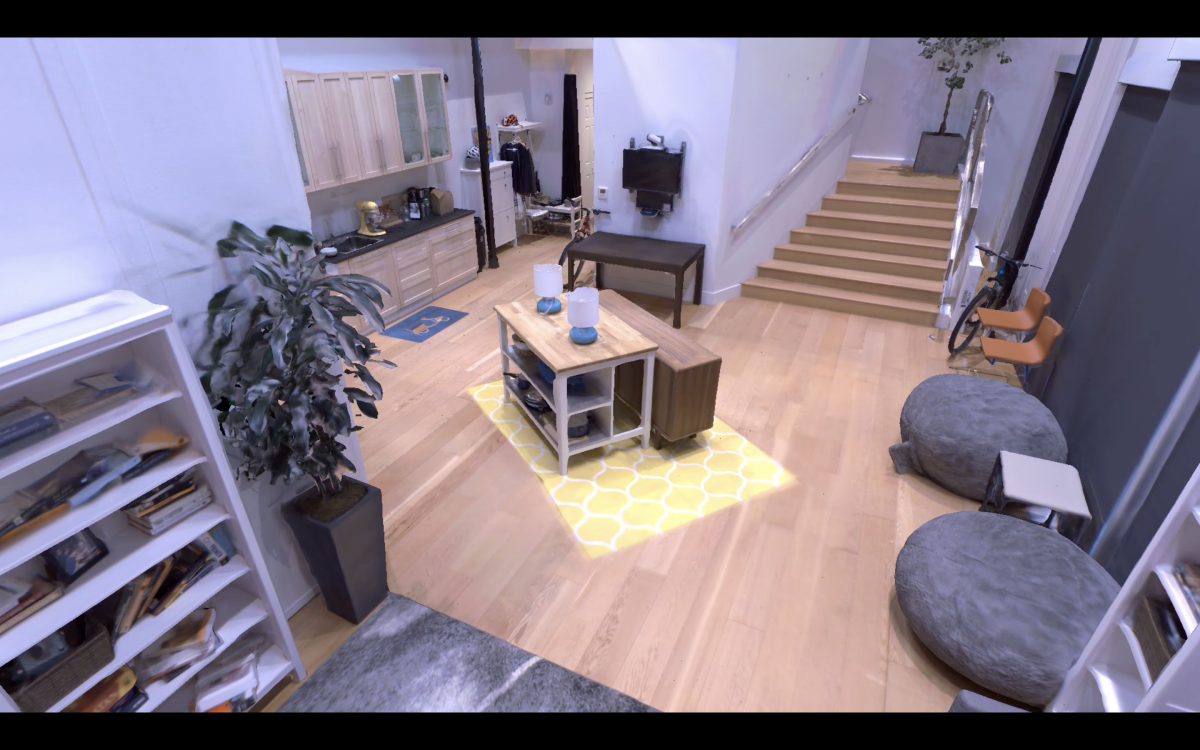 “Habitat-Sim achieves several thousand frames per second (fps) running single-threaded, and can reach over 10,000 fps multi-process on a single GPU, which is orders of magnitude faster than the closest simulator,” a dozen AI researchers said in a paper about Habitat. “Once a promising approach has been developed and tested in simulation, it can be transferred to physical platforms that operate in the real world.”
Facebook Reality Labs, formerly named Oculus Research, is also open-sourcing Replica, a data set of photorealistic 3D environments like a retail store, apartment, and other indoor environments that resemble the real world. AI Habitat can work with Replica but also works with other embodied AI research data sets like Matterport3D for indoor environments.
Facebook VP and chief AI scientist Yann LeCun told VentureBeat the company is interested in robotics because the opportunity to tackle complex tasks attracts the top AI talent.
How AI Habitat works was detailed in an arXiv paper written by a team that includes Facebook AI Research, Facebook Reality Labs, Intel AI Labs, Georgia Institute of Technology, Simon Fraser University, and University of California, Berkeley.
See the full story here: https://uploadvr.com/facebook-open-sources-ai-habitat-to-help-robots-navigate-realistic-environments/
Transmedia Storytelling Initiative launches with $1.1 million gift
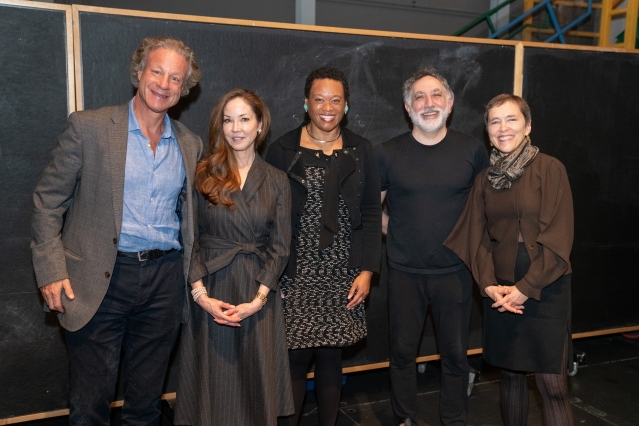 MIT’s School of Architecture and Planning (SA+P), working closely with faculty in the MIT School of Humanities, Arts, and Social Sciences (SHASS) and others across the Institute, has launched the Transmedia Storytelling Initiative under the direction of Professor Caroline Jones, an art historian, critic, and curator in the History, Theory, Criticism section of SA+P’s Department of Architecture. The initiative will build on MIT’s bold tradition of art education, research, production, and innovation in media-based storytelling, from film through augmented reality. Supported by a foundational gift from David and Nina Fialkow, this initiative will create an influential hub for pedagogy and research in time-based media.
The goal of the program is to create new partnerships among faculty across schools, offer pioneering pedagogy to students at the graduate and undergraduate levels, convene conversations among makers and theorists of time-based media, and encourage shared debate and public knowledge about pressing social issues, aesthetic theories, and technologies of the moving image.
Vision for the initiative
Understandings of narrative, the making of time-based media, and modes of alternative storytelling go well beyond “film.” CMS in particular ranges across popular culture entities such as music video, computer games, and graphic novels, as well as more academically focused practices from computational poetry to net art.
See the full story here: http://news.mit.edu/2019/transmedia-storytelling-initiative-launches-0612?fbclid=IwAR0BaxxrZxZ6MslkfATuOiKwEfTiR4AQpGV7gDiPO5h9bqi4R3ghoSFqtMs
From Brueghel to Warhol: AI enters the attribution fray
 The computer, says Honig, can pick up “so many more details, so much more easily”. Take windmills: hundreds of pictures featuring them fill her Brueghel database. The algorithm has picked up identical images of the structures in multiple paintings. It can even show when a replica has been flipped. And it has helped to pinpoint exact copies of lions, dogs and other figures. The workshops of many Renaissance artists were co-working spaces, so the computer technique helps Honig to piece together how different artists, in the family or not, might collaborate. “Rubens comes in and does some figures, and then Jan Breughel comes in and does the horses, the dog and the lion, because he’s ‘Mister Animal’,” Honig says. “And so they fit the things together.”
Elsewhere, AI is being harnessed to address a perennial problem of material legacy that underpins art history: deterioration. For instance, the Verus Art system from start-up Arius Technology in Vancouver, Canada, is deploying a 3D scan–print system — initially devised to study damage to Leonardo da Vinci’s Mona Lisa — to replicate artworks precisely, down to textured brushstrokes and pigment hues. Intended for education, outreach and archives, the ‘backed-up’ paintings might have another use: foiling thieves more discerning than those fooled by Castelnuovo Magra’s cheap copy.
Stanford Team Aims at Alexa and Siri With a Privacy-Minded Alternative
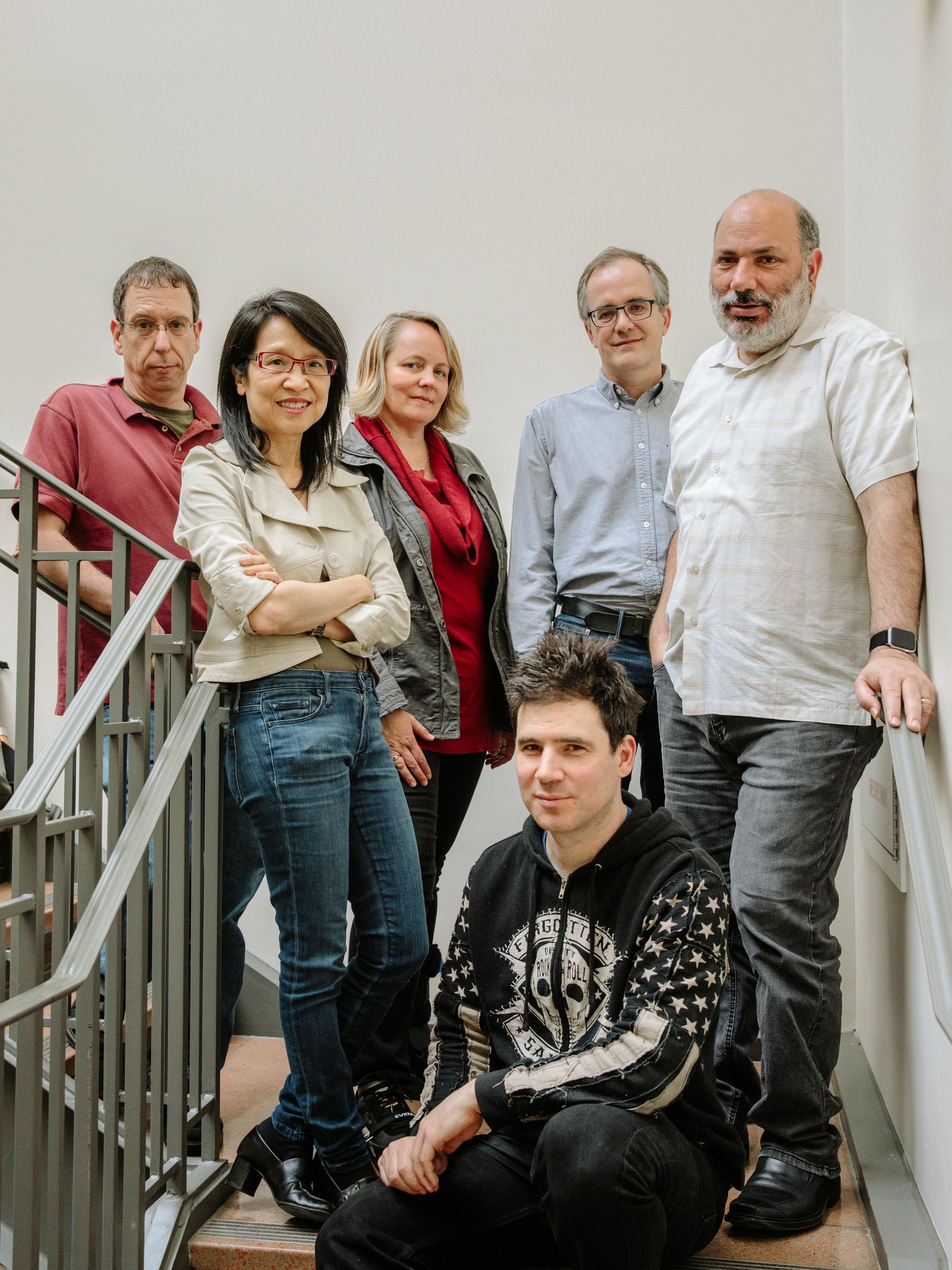
The group at Stanford, led by Monica Lam, a computer systems designer, last month received a $3 million grant from the National Science Foundation. The grant is for an internet service they hope will serve as a Switzerland of sorts for systems that use human language to control computers, smartphones and internet devices in homes and offices.
The researchers’ biggest concern is that virtual assistants, as they are designed today, could have a far greater impact on consumer information than today’s websites and apps. Putting that information in the hands of one big company or a tiny clique, they say, could erase what is left of online privacy.
The system from Dr. Lam’s group is called Almond. In a recent paper, they argued for an approach in which virtual assistant software is decentralized and connected by programming standards that will make it possible for consumers to choose where their information is stored and how it is shared.
A first version of the service was released last year, and the Stanford researchers are now trying to build an alliance with larger technology and consumer companies.
 They also hope Almond can leapfrog existing virtual assistant systems in its ability to understand complex language.
Dr. Lam said the threat to privacy cannot be overstated. For example, she noted that Wynn Resorts in Las Vegas last year installed Amazon Echo devices in rooms.
“Once they said that what happens in Las Vegas stays there,” she said. “Now that’s no longer necessarily true. Now it might end up in Seattle.”
See the full story here; https://www.nytimes.com/2019/06/14/technology/virtual-assistants-privacy.html?