Safer Pain Management
Called virtual reality hypnosis distraction (VRHD), the technique could provide a valuable drug-free alternative for pain management free of the negative effects of traditional intravenous sedation.
"Given the immersive and distracting nature of the virtual reality experience, this technology has the ability to act as a preventive intervention transforming local anesthesia into a less distressing and potentially pain-free medical procedure", says Dr Dragos Chirnoaga from CUB Erasmus Hospital, Brussels, Belgium who co-led the research.
To test whether VRHD could aid during surgery the team looked at a randomized trial of 60 adults scheduled for orthopedic surgery. They put 40 of them through a VRHD therapy that consisted of wearing virtual reality goggles and headphones and watching a relaxing video.
Up to 90%
Impressively, only 25% of patients receiving VRHD during anesthesia required intravenous sedation. That percentage was even lower, only 10%, for patients given VRHD both before and during the anesthesia.
See the full story here: https://interestingengineering.com/vr-reduces-the-need-for-sedation-during-surgery-by-up-to-90-finds-research
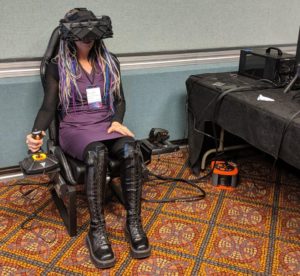 If you are hard-core, however, then a new generation of high-resolution glasses have arrived. The most impressive were those of Varjo which, at $6,000, had better be very good. Varjo places a rectangle in the center of the view which has nearly "retinal" resolution. The rest of the screen is not that shabby either. The things you focus your attention on are almost as sharp as real. You can see fine detail, read small print. The small rectangle can be noticed but it's fairly subtle. I felt much closer to being in a real place than I have felt before.
North Focals
The other exciting device as the conference was the North "Focals" glasses. These glasses are very close to being devices that could be worn all day by the average glasses wearer, going after the same goal that Google Glass had.
Unlike Glass, the North's display shows up right in the center of your field of view.
See the full story here: https://www.forbes.com/sites/bradtempleton/2019/06/03/vrar-begins-picking-up-steam-again-with-new-glasses-including-one-you-might-wear-in-public/#68845be66a17
 Critics say the government is trying to crack down on the internet by stifling dissent and increasing censorship, but authorities say they are trying to prevent terrorism and cyber attacks.
Last month, President Vladimir Putin signed into a law a "sovereign internet" bill, designed to enable Russian authorities to sever the country's internet from the rest of the world.
See the full story here: https://www.bbc.com/news/world-europe-48510026
Abstract:
In rockfall hazard management, the investigation and detection of potential rockfall source areas on rock cliffs by remote-sensing-based susceptibility analysis are of primary importance. However, when the rockfall analysis results are used as feedback to the fieldwork, the irregular slope surface morphology makes it difficult to objectively locate the risk zones of hazard maps on the real slopes, and the problem of straightforward on-site visualization of rockfall susceptibility remains a research gap. This paper presents some of the pioneering studies on the augmented reality (AR) mapping of geospatial information from cyberspace within 2D screens to the physical world for on-site visualization, which directly recognizes the rock mass and superimposes corresponding rock discontinuities and rockfall susceptibility onto the real slopes. A novel method of edge-based tracking of the rock mass target for mobile AR is proposed, where the model edges extracted from unmanned aerial vehicle (UAV) structure-from-motion (SfM) 3D reconstructions are aligned with the corresponding actual rock mass to estimate the camera pose accurately. Specifically, the visually prominent edges of dominant structural planes were first explored and discovered to be a robust visual feature of rock mass for AR tracking. The novel approaches of visual-geometric synthetic image (VGSI) and prominent structural plane (Pro-SP) were developed to extract structural planes with identified prominent edges as 3D template models which could provide a pose estimation reference. An experiment verified that the proposed Pro-SP template model could effectively improve the edge tracking performance and quality, and this approach was relatively robust to the changes of sunlight conditions. A case study was carried out on a typical roadcut cliff in the Mentougou District of Beijing, China. The results validate the scalability of the proposed mobile AR strategy, which is applicable and suitable for cliff-scale fieldwork. The results also demonstrate the feasibility, efficiency, and significance of the geoinformation AR mapping methodology for on-site zoning and locating of potential rockfalls, and providing relevant guidance for subsequent detailed site investigation.
The market of virtual technologies (Augmented, Mixed and Virtual Reality) is anticipated to grow exponentially. Technological development and high-speed 5G mobile connections will accelerate the growth within the next few years. More content and concepts need to be created and tested for these technologies. One of those concepts is City Stories, a location- based Augmented Reality experience. A pilot of it is examined in this study. It was pro-duced during spring and summer 2018 by the funding of Media Industry Research Foundation of Finland. This study is also part of the project.
In this study the early history of AR technology is summarized, the XR industry is analyzed briefly, previous research on immersion and AR design is examined. The level of immersion of the City Stories is measured with ARI (Augmented Reality Immersion) questionnaire that is designed for a location-based augmented reality setting. It is found that the level of feeling immersion was quite high according to the ARI questionnaire, and the conclusion is that City Stories and similar concepts are potentially viable concepts for further development. It is also con- cluded that the taxonomies of immersion and flow should be clarified and the instruments for measuring these should be tested more.
See the full story here: https://www.theseus.fi/handle/10024/172150
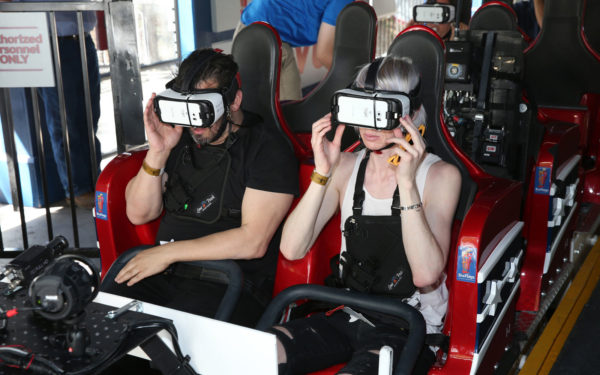
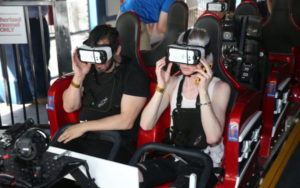 So, was VR in amusement parks a complete failure? Not exactly. For all the places that it didn’t work, other parks took the components that did work and tried to adapt them to their advantage. Only a few parks still have VR attractions—most notably Freedom Flyer at Fun Spot America in Orlando and Battle for Eire at Busch Gardens Williamsburg.
On Kraken at SeaWorld, the headsets were attached to the coaster trains, as were their syncing devices, so the ride was never out of sync. However, the loading and cleaning process was still a hassle, hence it being removed. It was a very noble effort and may have led to what I believe to be the most successful implementation of the technology, Battle for Eire.
See the full story here: https://www.coaster101.com/2019/05/31/so-what-ever-happened-to-virtual-reality/
Popov, formerly the chief executive of a video-game production company, originally designed Cappasity to help businesses make digital presentations in augmented reality. However, after finding commercial success in this sphere, Popov decided to reappropriate the software in order to make it compatible with the curation of art galleries.
“The partnership between Cappasity and the New York Academy of Art began with a shared conviction that fast and qualitative production of virtual museums, galleries, and exhibitions is possible,” Popov tells me. “The experience was meant to help convert online visitors into physical ones.”
Next level
Cappasity is pushing this to the next level. “The ongoing, multi-year partnership is aimed to showcase the Academy’s Cast Collection, on loan from the Metropolitan Museum of Art, as well as sculptures created by faculty, students and other artists,” Popov says. Because Cappasity exists in a virtual space, this collection will be made available to anybody with a VR set-up.
“We also plan to offer virtual and augmented reality tours of the Academy’s major exhibitions and galleries, allowing viewers all over the world to ‘virtually’ visit the Academy,” he adds. At present a basic version of this tour can be accessed as a demo on Steam.
“We expect Cappasity to become the industry standard for art schools’ student digital portfolios in the next few years.” As the partnership with the New York Academy of Art continues to blossom, the Cappasity for Art initiative will gain momentum, hopefully becoming a widely recognised curation tool in the near future.
See the full story here: https://www.irishtimes.com/culture/art-and-design/visual-art/could-virtual-reality-be-the-future-of-art-exhibitions-1.3905993
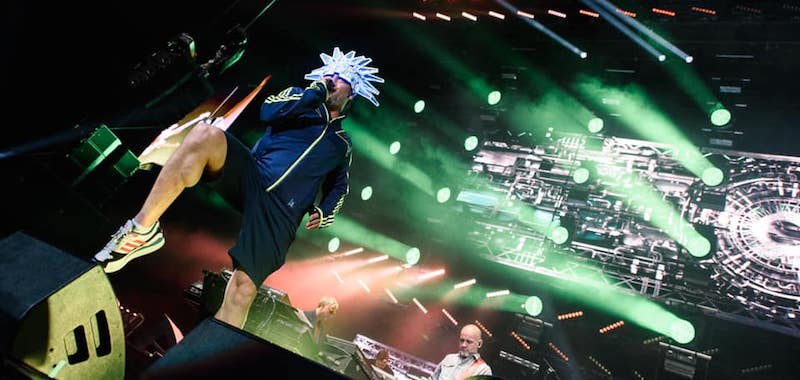
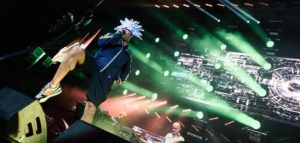 MelodyVR, the only licensed music virtual reality (VR) company, has partnered with four new artists, bringing shows from Kelly Clarkson, Jamiroquai, Bullet For My Valentine and Plan B to its platform.
MelodyVR captured Clarkson’s recent hometown show in Dallas, allowing viewers to watch the show from nine different perspectives, including from on stage, through the MelodyVR app on participating VR headsets.
Clarkson, who describes the the experience of watching the VR shows as “weird, but awesome”, says the VR platform is a good way for fans who are unable to attend her concerts to see the show.
See the full story here: https://www.iq-mag.net/2019/05/kelly-clarkson-jamiroquai-virtual-reality/#.XPFEdS2ZNPM
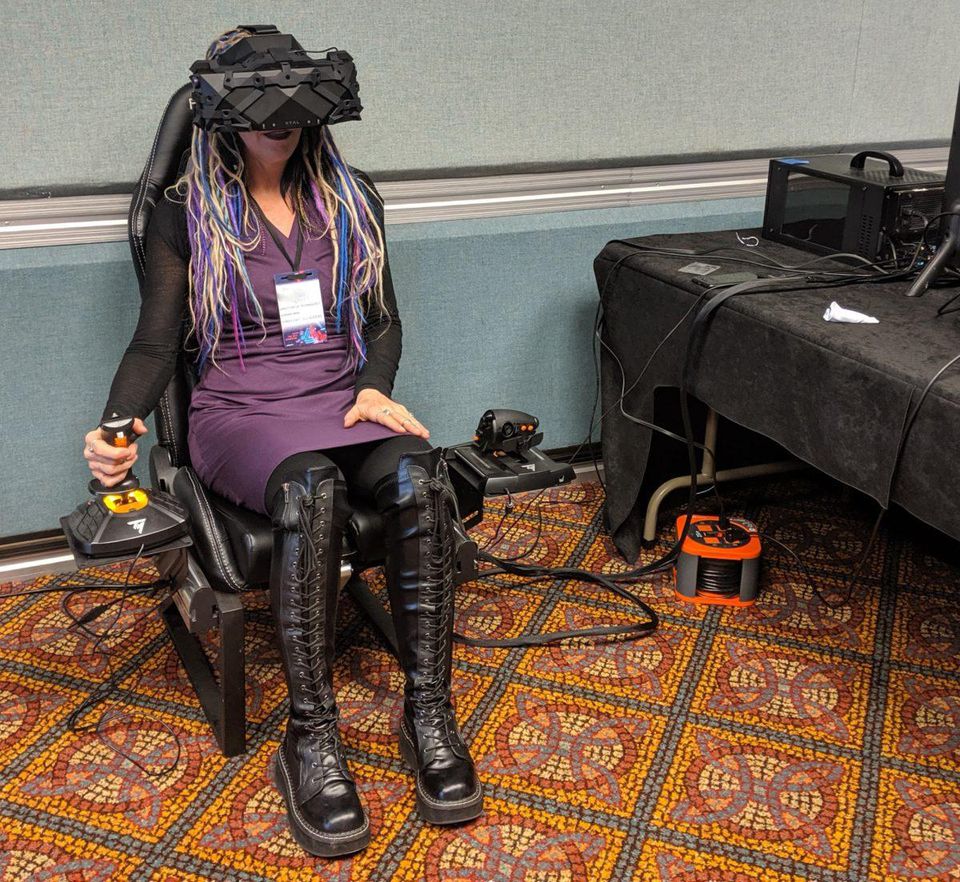 If you are hard-core, however, then a new generation of high-resolution glasses have arrived. The most impressive were those of Varjo which, at $6,000, had better be very good. Varjo places a rectangle in the center of the view which has nearly "retinal" resolution. The rest of the screen is not that shabby either. The things you focus your attention on are almost as sharp as real. You can see fine detail, read small print. The small rectangle can be noticed but it's fairly subtle. I felt much closer to being in a real place than I have felt before.
 Critics say the government is trying to crack down on the internet by stifling dissent and increasing censorship, but authorities say they are trying to prevent terrorism and cyber attacks.
 See the full report here: https://venturebeat.com/2019/05/31/the-deanbeat-the-building-blocks-of-better-ar-vr-at-augmented-world-expo/
 So, was VR in amusement parks a complete failure? Not exactly. For all the places that it didn’t work, other parks took the components that did work and tried to adapt them to their advantage. Only a few parks still have VR attractions—most notably Freedom Flyer at Fun Spot America in Orlando and Battle for Eire at Busch Gardens Williamsburg.
 MelodyVR, the only licensed music virtual reality (VR) company, has partnered with four new artists, bringing shows from Kelly Clarkson, Jamiroquai, Bullet For My Valentine and Plan B to its platform.