Lytro Reveals Immerge 2.0 Light-field Camera with Improved Quality, Faster Captures
Lytro’s Immerge light-field camera is meant for professional high-end VR productions.
The company has revealed a major update to the camera, the Immerge 2.0, which, through a few smart tweaks, makes for much more efficient production and higher quality output.
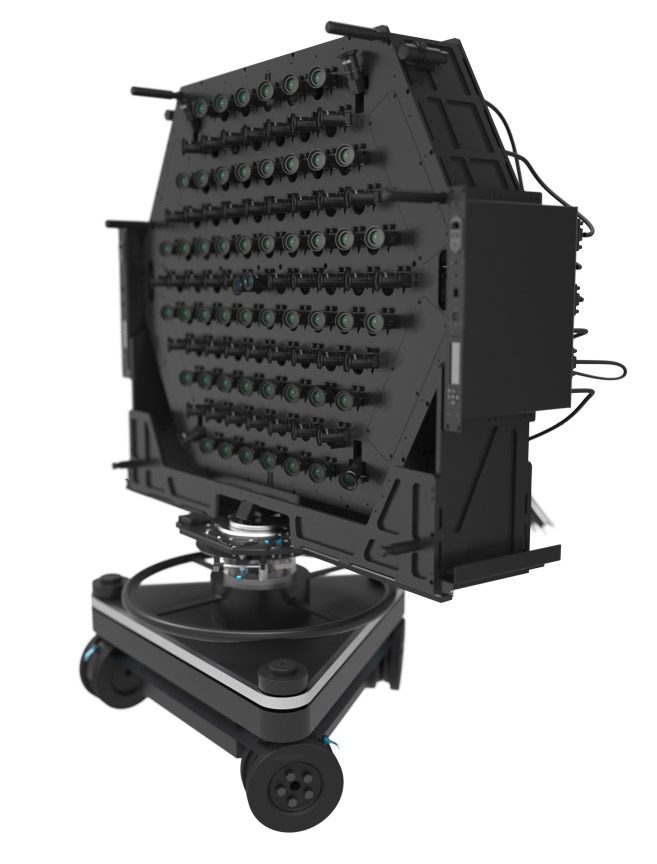
Light-field specialist Lytro, which picked up a $60 million Series D investment earlier this year, is making impressive strides in its light-field capture and playback technology. The company is approaching light-field from both live-action and synthetic ends; last month Lytro announced Volume Tracer, a software which generates light-fields from pre-rendered CG content, enabling ultra-high fidelity VR imagery that retains immersive 6DOF viewing.
...the Immerge 2.0 has alternating rows of cameras pointed off-axis in opposite directions.
With the change to the camera angles, and tweaks to the underlying software, the lenses on Immerge 2.0 effectively act as one giant camera that has a wider field of view than any of the individual lenses, now 120 degrees (compared to 90 degrees on the Immerge 1.0).
In practice, this can make a big difference to the camera’s bottom line: a wider field of view allows the camera to capture more of the scene at once, which means it requires fewer rotations of the camera to capture a complete 360 degree shot (now with as few as three spins, instead of five), and provides larger areas for actors to perform.
Ever Increasing Quality
Lytro has also been refining their software stack which allows them to pull increasingly higher quality imagery derived from the light-field data.
HOME » EMERGING TECH Explore bitcoin now in virtual reality with Blockchain 3D Explorer
 In most cases, block explorers act as search engines allowing users to seek out and view specific transactions that happened with bitcoin, Ethereum, Litecoin or any other number of publicly visible blockchain currencies. With an explorer, it is possible not just to visualize the movement of currency across the history of a transaction trail but to export specific and pertinent information about that history for later analysis.
Popular examples include cryptocurrency analytics startup Blocktrail B.V., which was acquired by Bitmain Technologies Ltd. in 2016, and digital wallet Blockchain Luxembourg S.A.’s blockchain explorer on Blockchain.info.
The Blockchain 3D Explorer currently uses data drawn from the tracker on Blockchain.info, but Small has plans to open up the explorer to draw from more sources.
The currently available version of the Blockchain 3D Explorer works on Windows (32-bit and 64-bit) as well as MacOS, iOS and Linux. Users of Android-based virtual reality headsets can also download the app from the Google Play store, which enables the use of Google Cardboard version 2 or higher.
See the full story here: https://siliconangle.com/blog/2017/11/24/explore-bitcoin-now-virtual-reality-blockchain-3d-explorer/
Also https://news.bitcoin.com/new-virtual-reality-tool-lets-explore-bitcoin-blockchain-3d/

All About Virtual Reality Review – A Decent Introduction To VR For Kids
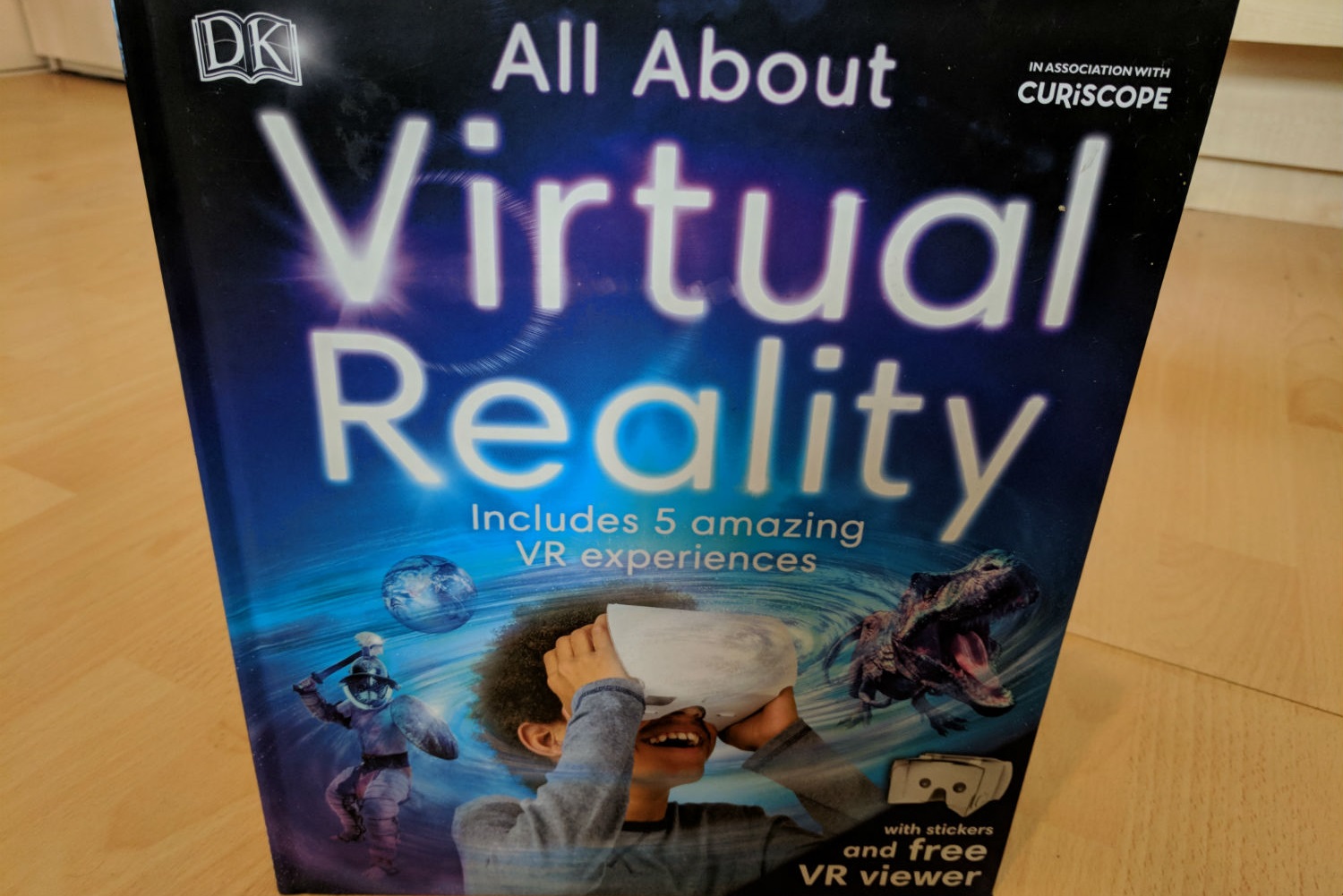 All About Virtual Reality, a new book published by DK in association with educational VR company, Curiscope, essentially productizes Expeditions. It’s a 32-page hardback that comes with its very own Cardboard headset and aims to teach young children about VR and its use cases. It’s part user-manual, part history, geography and science lesson, with an app that takes you back to prehistoric times and beyond. If you have a young child that’s taken an interest in VR, this is a pretty safe starting point.
It’s quite refreshing to see VR explained in such simple terms, and the book does a good job at giving a young child enough of an understanding for them to perhaps pursue an interest in the technology going forward. To me, the book seems aimed for kids around the age of 10.
See the full story here: https://uploadvr.com/virtual-reality-review-decent-introduction-vr-kids/
Rise of the ‘digisexual’ as virtual reality bypasses need for human intimacy
 In a new report published in the Journal of Sexual and Relationship Therapy, ethics researchers from the University of Manitoba, Canada, argue that psychotherapists need to be prepared for a rise in ‘clients participating in digisexualities.’
“As these technologies advance, their adoption will grow and may people will come to identify themselves as ‘digisexuals’- people whose primary sexual identity comes through the use of technology
Although in their infancy, today’s sex robots are already programmed with artificial intelligence, and equipped with all-over body sensors which respond to touch. They can even be customised to look like an ex, if required.
The Android Love Doll can perform ‘50 automated sexual positions,’ while Abyss Creations, which sells the ‘Harmony’ model boasts ‘conversational abilities’ and connects to an app which learns as the user talks with it. The company is also hoping to bring a walking version to market within the next decade.
In April, a Chinese artificial intelligence engineer Zheng Jiajia, 31, married a robot he built for himself, after failing to find a human wife.
See the full story here; http://www.telegraph.co.uk/science/2017/11/26/rise-digisexual-virtual-reality-bypasses-need-human-intimacy/
A Cryptocurrency for the New Age of Content and Virtual Reality
 Currently, YouTube stars make money via two strategies: ads provided by YouTube/Google that play before or during the video, or via direct corporate sponsorships who have their brand or products incorporated in their video - often discreetly. While the latter has its own system and only affects the heavy hitter channels, the former is handled entirely by YouTube and could be improved.
by utilizing a smart contract by a blockchain network, an advertiser could set out pay-out to viewers, curators, the platform, and the content creator programmatically. The technical advantage of blockchain is that advertisers could create contracts that execute on a cross-platform basis without the hassle of complex money flows. Instead, since the value of the contract will be directly woven into the many players of this attention economy, creating, distributing, and executing such contract will be simple.
There is a company that is making headway into this concept: Spectiv VR.
The way it works is fairly straightforward: advertisers will sell Signal Token’s - the digital currency - for a set rate, currently just 50 cents, to content creators that attach it to their content. Signal Token’s will have a preset smart contract that any utilization of it, on any platform (YouTube, Vimeo, etc.), will generate value to the content creator for the provided attention.
How does the content creator, curator, and viewer get paid? The value of that specific token increases when videos by that content creator get views. If a content creator buys a token for 50 cents and that video reaches 1,000 views, then that token is worth $1.50 in the system. Each part of the system, including the platform, curator, and viewer will get a piece of this contract, with a grand amount going to the content creator.
Spectiv VR is launching their pre-sale December 8th to fund the currency.
See the full story here: https://www.huffingtonpost.com/entry/a-cryptocurrency-for-the-new-age-of-content-and-virtual_us_5a19cad3e4b068a3ca6df844
Will.i.am releases augmented reality app to go with his graphic novel
 Masters of the Sun: The Zombie Chronicles, published by Marvel Comics, is about a hip-hop group from East Los Angeles who decide to take on an ancient, alien god who transforms drug dealers and gangsters into zombies. The story mixes Egyptology and L.A. gang culture, and the first issue was released back in August, co-written by Benjamin Jackendoff and illustrated by Damion Scott.
“We did the book first for the traditionalists, and will expand upon it with augmented reality and then virtual reality,” will.i.am said while speaking with Business Insider.
The augmented reality app is currently available on iOS and Android and goes for $2, and you need to own the graphic novel in order to use it.
See the full story here: https://www.digitaltrends.com/movies/william-augmented-reality-app-graphic-novel/
IU-based startup launches high-tech system for virtual, augmented reality developers
 "I created cy.PIPES to easily plug-and-play the user's choice of 4-D effects devices along with the Unity game engine. Dynamic factors like wind direction are automatically computed with cy.PIPES, and effects are rendered to users as they would expect from the virtual environment they are immersed in," Frend said. "I wanted to prove it is possible to easily and inexpensively hook up environmental conditions to virtual and augmented reality systems."
Frend's research on cy.PIPES was published in a 2015 issue of the SPIE Electronic Imaging publication track. It was named Best Research Demonstration at IEEE VR 2016 and is being used by IUPUI informatics students and at the University of Louisiana at Lafayette.
Frend submitted an invention disclosure to the IU Innovation and Commercialization Office, which has applied for patent protection. He started CyUtil after he licensed the intellectual property from the IU ICO.
See the full story here: https://phys.org/news/2017-11-iu-based-startup-high-tech-virtual-augmented.html
Departing Hulu VR VP Noah Heller Launches L.A. Tech Fund 3Rodeo

One of the key executives behind Hulu’s virtual reality (VR) push has left the company, and is now starting a Los Angeles-based tech fund: Noah Heller, Hulu’s VP of business development for emerging technology and VR, left Hulu this month. His new gig: 3Rodeo, an early stage venture fund that wants to help local entrepreneurs to not only get the money, but also the advice they need to get their startups off the ground.
Heller is running 3Rodeo as managing partner, and is being joined by RYOT Studio co-founder Molly DeWolf Swenson and former Picasa CEO Lars Perkins, both in the capacity of venture partners. “We’ve seen a lot and we built a lot before,” said Heller about the team’s combined entrepreneurial experience.
See the full story here: http://variety.com/2017/digital/news/hulu-exec-noah-heller-departure-1202621074/