IS VR SAFE FOR CHILDREN? LEEDS UNIVERSITY WARNS AGAINST IT
 [Philip Lelyveld comment - these appear to all be 3D stereography-related problems that are no different from test results from 3D movie studies. They do not appear to be unique to VR and AR.]
As covered by The Guardian, researchers at Leeds University have performed a study on twenty children aged between 8 and 12. These children were tasked with playing a virtual reality game for 20 minutes, after which they were physically examined for signs of problems with eyesight, nausea and so on. The results indicated a short-term disruption in “stereo-acuity”, which describes the ability to perceive depth. At least one child also suffered a brief case of dizziness/vertigo in the aftermath.
See the full story here: https://vrworld.com/2017/10/28/vr-safe-children-leeds-university-warns/
Recently funded VR/AR companies
See the full table here: https://www.crunchbase.com/lists/recently-funded-virtual-and-augmented/2a72ed1e-6fd2-4924-bed6-ddde2ec5fc3c/organization.companies
Startup studios go Hollywood as CAA launches Creative Labs

Mount Lee, Hollywood Hills, Hollywood, Los Angeles, California, USA.
Continuing a tradition that began with the incubation and launch of Funny or Die (alongside Sequoia Capital and Will Ferrell’s Dirty Sanchez productions), one of Hollywood’s top agencies is partnering with a group of Canadian investors to finance a new venture studio, Creative Labs, with $12.5 million.
“We have been incubating companies at CAA over the years,” says CAA’s head of business development, Michael Yanover.
For Yanover, the creation of Creative Labs was a response to the shifting expectations of later stage venture investors — including his own CAA Ventures, he said.
“Every time we came up with one of these ideas we had to put the money together and raise the money… it was somewhat tedious to build this stuff from scratch,” he said.
To ensure the alignment of interests, employees of the studio have an equity stake in the venture studio and will be able to receive equity in all of the businesses that are spun out from it. They also have the option of graduating from the studio to participate in the development of the individual startups as those businesses mature, Edwards said.
“The premise of anything that we incubate is that we want to bring a piece of CAA’s DNA into the mix,” says Yanover.
See the full story here: https://techcrunch.com/2017/10/27/startup-studios-go-hollywood-as-caa-launches-creative-labs/?utm_medium=TCnewsletter
Vive’s Wands And Trackers Used To Control Robots Like Puppets
 As revealed by The Verge, scientists at the University of Tokyo in Japan are using the devices, which are tracked by two base stations to deliver accurate positional tracking, to control rescue robots like puppets.
It works exactly how you think it would; one user holds two Vive controllers in their hands and then straps two of the Vive trackers — which are yet to be released to consumers — to their feet and another around their torso. It’s a setup identical to the one currently used to simulate full-body tracking inside of VR experiences. In this instance, though, the user’s movements are directly imitated by a humanoid, life-size robot to an incredible degree of accuracy.
See the full story here: https://uploadvr.com/vives-wands-trackers-used-control-robots-like-puppets/
Minecraft Available On Windows VR Headsets
 Minecraft has made the leap from Rift and Gear VR headsets to the Windows Store, with a beta version of the game now available for headsets from Acer, HP, Lenovo and others running on Microsoft’s Windows Mixed Reality platform.
See the full story here: https://uploadvr.com/minecraft-available-on-windows-vr-headsets/
Pimax “8K” Surpasses Oculus Rift as Top VR Headset Kickstarter Project, $2.45M Raised So Far
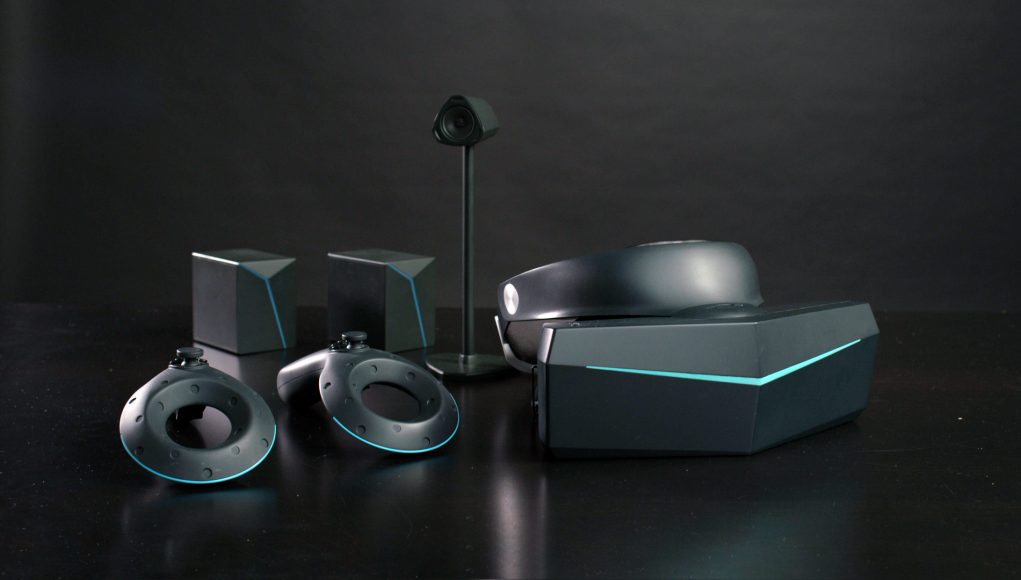 As Pimax surpasses Oculus’ original Kickstarter, it only really signifies consumer interest in the ‘next generation’ of VR. Although Pimax calls their headsets “8K” and “5K”, they actually respectively feature dual 3,840 × 2,160 LCD panels and dual 2,560 × 1,440 OLED panels. The standard “8K” headset also actually upscales a 4K signal to 8K, hence the “8K” in quotation marks. An “8K” X is also on offer that removes the upscaler, and making it capable of accept 8K input, but the headset’s effective per-eye 4K resolution remains the same. Questionable marketing aside, these display resolutions are quite a bit higher than Oculus Rift or HTC Vive, which both offer dual 1080 × 1200 OLED displays.
The real fanfare though comes from the headsets’ reported 200 degree FOV, and ability to hook into Valve’s SteamVR tracking solution, making it both the first consumer-grade high FOV headset and the first publicly available headset outside of HTC Vive to use Valve’s room-scale positioning tech.
As Pimax stands on the shoulders of giants with a valid product in hand, it remains to be seen if they can craft the obvious consumer interest into a business that will make them leaders in the field over time.
See the full story here: https://www.roadtovr.com/pimax-8k-surpasses-oculus-rift-top-vr-headset-kickstarter-project-2-45m-raised-far/
Does Saudi robot citizen have more rights than women?
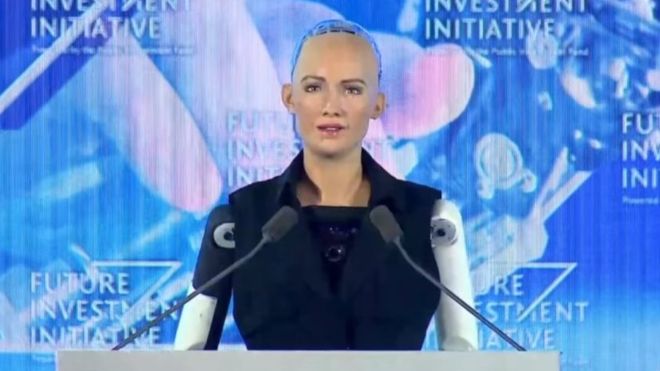 Meet Sophia, a robot who made her first public appearance in the Saudi Arabian city of Riyadh on Monday.
Sophia was such a hit she was immediately given Saudi citizenship in front of hundreds of delegates at the Future Investment Initiative in Riyadh on 25 October.
But as pictures and videos of Sophia began circulating on social media many started to ask why a robot already seemed to have secured more rights than women in the country.
What A Defaced Jeff Koons Sculpture Tells Us About Land Ownership In Augmented Reality
 In the case of cybersquatting, the reliance on legally protected identifiers with a long body of trademark case law from the physical world made it possible for the courts to eventually circumscribe much of the practice. Augmented reality, on the other hand, poses something fundamentally new – geographic overlays that do not have natural correspondence with existing legal frameworks. Air rights, land rights, water rights, mineral rights – the classes of property rights that exist in the United States are numerous, yet all rely on usage of physical space in the physical world.
In contrast, attaching a piece of content in a virtual world to a GPS coordinate poses more complex challenges to the notion of “ownership” and “control” of space.
Can a company exert the right to commercial activity at a specific latitude and longitude coordinate across all digital applications present and future merely because they own that right in the physical world? Do online companies enjoy the right to plaster public spaces with digital billboards and commercialize government-owned land for free? What happens when an augmented reality startup is bought by another company – do all of the geofenced advertisements it had sold (themselves essentially micro-term digital land leases) transfer to the purchasing company? Does a company in the physical world have to pay money to Facebook to run an advertisement for users visiting its physical location? Or does Facebook’s digital overlay count itself as a new form of land ownership where it alone acts as landlord and legal system? Moreover, given the nature of the online world, a company in Russia can easily sell geofenced ads across the United States and vice-versa, meaning companies across the world can now act as virtual landlords across all the world’s physical space. Even if the US were to pass a law tying virtual use of a location to its physical ownership, could it stop a foreign company from erecting its own overlays over US soil?
In contrast, assigning ownership to abstract sequences of numbers across myriad applications that grow in number each day representing constructed overlays atop our physical world begs a deeper question of just what it means to “own” a space and in our ever-more-virtual world just what rights we have to the spaces we inhabit.
See the full story here: https://www.forbes.com/sites/kalevleetaru/2017/10/25/what-a-defaced-jeff-koons-sculpture-tells-us-about-land-ownership-in-augmented-reality/#692fc14c3b43
And a related article here: https://shift.newco.co/weve-not-thought-through-the-legal-and-ethical-disruption-of-augmented-reality-e244769c6e9b
We’ve Not Thought Through the Legal and Ethical Disruption of Augmented Reality
Let’s not repeat the mistakes we made with social media
Nomadic’s forthcoming free roam attraction brings physical objects into the virtual world
 TheWrap went on that VR adventure at a demo set up by virtual reality startup Nomadic, a company founded by former Lucasfilm special effects execs that was running a temporary installation at the Technicolor Experience Center in Culver City, California. The objects were all real – TheWrap held an actual flashlight with a working switch and opened a rickety file cabinet – and are fitted with sensors and mapped in 3-D so they appear in the virtual world in the exact same place they do in reality. That precision is critical to the whole thing; after all, reaching for a doorknob that’s off by an inch or two would ruin the illusion.
Nomadic’s platform involves being strapped to a computer-equipped backpack connected to a headset, which allows users to roam freely and feel truly immersed.
See the full story here: http://www.stamfordadvocate.com/entertainment/the-wrap/article/Is-This-How-Virtual-Reality-Goes-Mainstream-12307096.php