How virtual reality can defuse conflicts over building projects
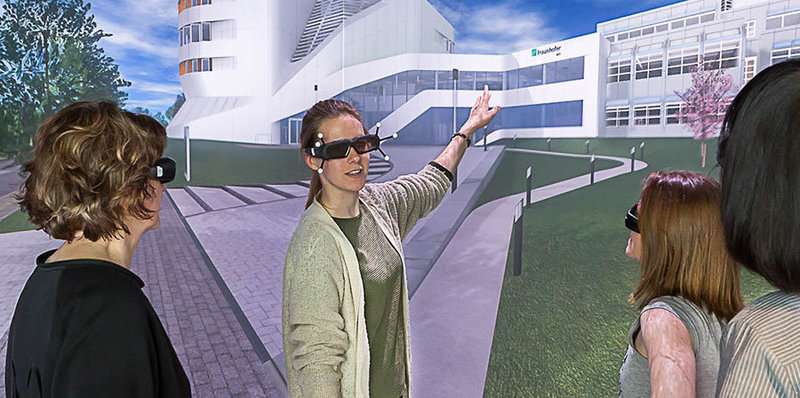 New visualization technologies bring projects to life before they are built. In virtual reality simulations, citizens can explore buildings, play out use scenarios, and inspect visual relationships – as if they were actually there on site. Comparing alternatives becomes child's play: one click and you can replace one façade with another, move the access road to a different location, or see what it looks like with new grass on the plaza. Moreover, planning criteria and environmental impediments finally become visible and easy to comprehend. "Virtual reality not only furthers the utility of public participation, but it also inspires citizens to get involved," says Prof. Frank Brettschneider, who heads up the University of Hohenheim's involvement in the "Visualization in Public Participation" (VisB+) project. Peter Steinhagen, Head of Business Development at Ed. Züblin AG, adds: "The combining of Building Information Modeling with new visualization techniques such as virtual reality is opening up fascinating new possibilities for stakeholder communication.
Read more at: https://phys.org/news/2017-10-virtual-reality-defuse-conflicts.html#jCp
Sony to Introduce 3D ‘Time-of-Flight’ Sensors for AR Devices
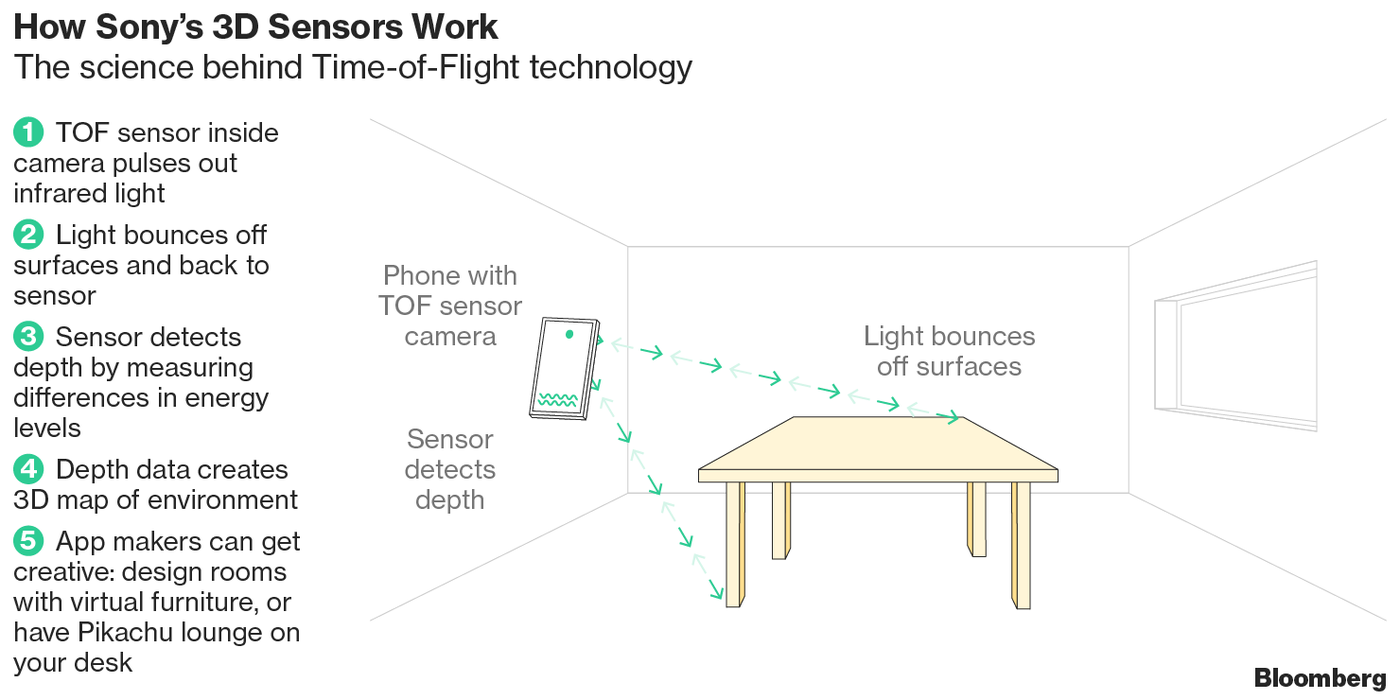 At Sony’s Atsugi Technology Center outside Tokyo, engineers are developing a new kind of 3D sensor aimed for use first in smartphones and augmented reality devices. The sensors will be able to detect people and objects by relying on calculations on how long it takes for light to reflect off their surfaces. Sony, which will go into mass production next year, is betting that the new sensors could eventually be used in drones, self-driving vehicles, gaming consoles, and other machines that interact with their environments.
“Instead of making images for the eyes of human beings, we’re creating them for the eyes of machines,” Yoshihara said. “Whether it’s AR in smartphones or sensors in self-driving cars, computers will have a way of understanding their environment.”
Sony’s TOF sensors, which are being made at its Kyushu factories, will likely be adopted by Apple for future devices, predicted Fuji Chimera Research sensors analyst Yusuke Toyoda, who said that other smartphone manufacturers will follow suit.
Sony’s chief rival in TOF sensors is the Geneva-based STMicroelectronics, whose FlightSense sensors are used “by Apple and more than 80 smartphone models.”
See the full story here: http://www.etcentric.org/sony-to-introduce-3d-time-of-flight-sensors-for-ar-devices/
The remarkable robots that are transforming filmmaking
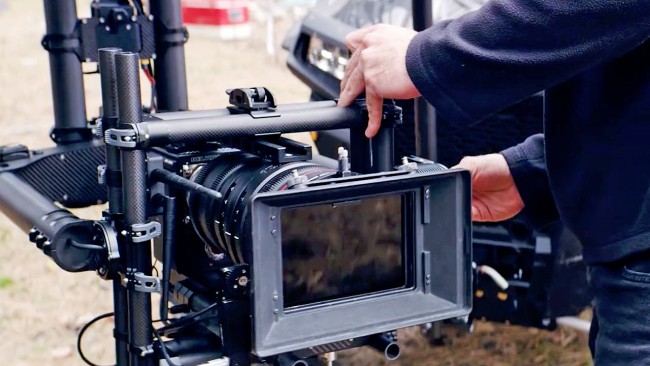 As the realm of the camera department comes to include advanced machinery, the roles of the engineer and technical artist are converging to create a position which requires considerable technical knowledge as well as the training to operate a system with multiple, incredibly strong, motors often right near an operator or technician’s fingers.
Remote control
In addition to camera stabilising hardware systems, modern cinema robotics also include remote controlled and under and over-slung suspension systems which allow for operators and directors of photography to pilot and direct the cinematography from a distance.
While an organic approach to filmmaking will likely continue to live on at the independent and lower budget levels of production, it is becoming very evident in studio cinema and in our world as a whole, that the robotic revolution is upon us, displacing the tried and true methods of the past.
By embracing the changing robotic revolution, a filmmaker today can breathe a sigh of relief as we finally have entered a period where the sky really is the limit when it comes to what is possible within the cinematic art form.
The days of the cyborg film crew are dawning and the possibilities of the art form in this future world are limitless and amorphous.
See the full story here: https://www.redsharknews.com/production/item/4983-the-remarkable-robots-that-are-transforming-filmmaking#.WfICGWeOsQs.facebook
Explainable Artificial Intelligence (XAI)
Mr. David Gunning 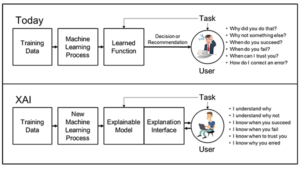
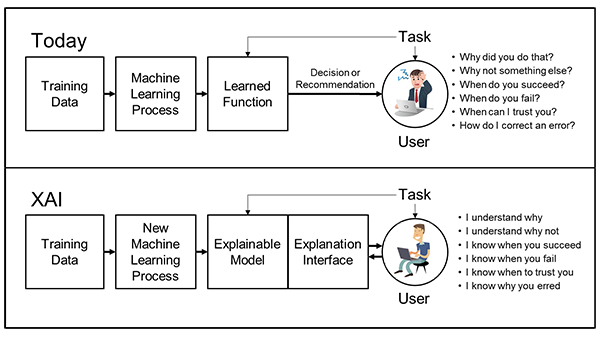
At the end of the program, the final delivery will be a toolkit library consisting of machine learning and human-computer interface software modules that could be used to develop future explainable AI systems. After the program is complete, these toolkits would be available for further refinement and transition into defense or commercial applications.
See the full proposal here: https://www.darpa.mil/program/explainable-artificial-intelligence
Facebook research automatically creates an avatar from a photo
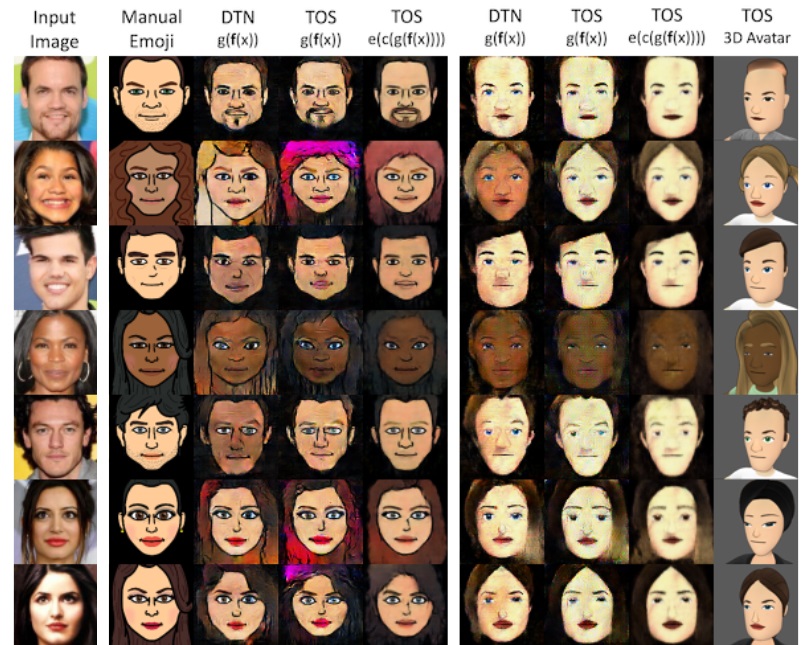 The idea being pursued was a system that really makes the best possible representation of a given face, using whatever tools it has at hand. So whether it’s emoji, Bitmoji (shudder), Mii, a VR face generator or anything else, it could still accomplish its task. To paraphrase the researchers, humans do it all the time, so why not AI?
What’s great about this technique is that because it isn’t tied to any particular avatar type, it works (theoretically) on any of them. As long as there are good representations and bad ones, the system will match them with the actual face and figure out which is which.
Facebook could use this information for many useful purposes — perhaps most immediately a bespoke emoji system. It could even update automatically when you put up a picture with a new haircut or trimmed beard.
The full paper is pretty technical, but it was presented at an AI conference, so that’s to be expected.
See the full story here: https://techcrunch.com/2017/10/23/facebook-research-automatically-creates-an-avatar-from-a-photo/
SMPTE: Industry Leaders Gather to Discuss the Future of AI
October 25, 2017
SMPTE kicked off its 2017 Annual Technical Conference & Exhibition on Monday with an all-day symposium on artificial intelligence and its emerging role in entertainment production and distribution. Among the day’s presentations, SMPTE’s Richard Welsh presented a compelling primer on AI, Google’s Jeff Kember discussed the differences between supervised and unsupervised systems, Hitachi Vantara’s Jay Yogeshwar addressed using machine learning and AI for production workflow, Yvonne Thomas of Arvato Systems looked at the value of effective data analytics, Greg Taieb of Deluxe addressed language localization for multilingual distribution, and Aspera co-founder Michelle Munson examined next generation network design.
Richard Welsh, SMPTE’s VP of education, began the day with an excellent 30-minute primer on AI. The term AI is used to describe three very different levels of computational capabilities.
Machine learning (ML) involves algorithms that are trained to do a specific task. Deep learning (DL) involves regenerative algorithms; they can learn through unsupervised feedback loops, but are cognitively constrained to one area of expertise. General artificial intelligence (GAI) involves free learning networks.

GAI is what most people think of when they think of AI, but GAI does not yet exist in the commercial arena. Most of what people and marketing calls AI is really a machine learning implementation.
There are two forms of machine learning algorithms, regressive algorithms (decision trees) and classification algorithms (index and compare). Welsh cautioned the crowd not to anthropomorphize the technology. AI does not mimic the human mind. It is “necessarily incomprehensible” he said, which can lead it to come up with unexpected yet valid responses.
Jeff Kember from Google’s office of the CTO discussed the difference between supervised systems where you have a specific output in mind, and unsupervised systems in which reinforcement learning takes place and both the algorithm and the output are modified.
He described how machine learning will enhance the end-to-end production workflow, from adding content and technical metadata to camera raw through supporting multi-channel day-and-date distribution and long-term archiving.
Dr. Jay Yogeshwar, Hitachi Vantara’s director of worldwide media, broadcast and entertainment, explained how content intelligence would enable operational efficiencies throughout the workflow. Hitachi is involved in using machine learning and AI to optimize video compression, nonlinear editing and media asset management systems, better recommendation engines, and OTT contextual ad insertion.
Yvonne Thomas, product manager for Arvato Systems, explained how data analytics become both more valuable and more complex as you move down the descriptive, diagnostic, predictive, and proscriptive analytics chain.
She described how you train a machine learning algorithm this way. Once you input your starting data set, the algorithm outputs a decision, the system accepts feedback on that decision by comparing it to the established set of rules and goals, and the algorithm’s parameters are adjusted prior to the next round of input. She stressed that “using a media analytics service requires some sort of social responsibility.”
Greg Taieb, senior director of localization product development at Deluxe Entertainment Services explained that language localization for multilingual distribution of content requires four things: 1) adaptation, 2) context and tone, 3) chucking (e.g. pauses or natural text breaks), and 4) timing and specification-based restrictions.
He calls the language localization process “transcreation” because you are trying to recreate the sense of the dialog as you translate, taking culture, slang, and other elements into account.
He sees AI starting to play a role in all of this, especially with the rapid development of resources like Google Translate. He also sees a new job title developing, post editor, responsible for QC-ing the machine translation.
After lunch, Aspera co-founder Michelle Munson offered a deep dive into next generation network design. Machine learning applied to network design can dramatically reduce the network footprint (hardware requirements), optimize bandwidth, and more efficiently adapt to changes in network load in real time.
Martin Wahl, principal program manager for Microsoft’s Azure Media Services group described the company’s Cognitive Services bundle. It includes visual language, speech knowledge, and most interestingly video indexing on a frame-by-frame level.
In response to a question from a Library of Congress archivist, Wahl noted that they use their own metadata nomenclature, so any merging into a standardized database would require transcreation processing.
Konstantin Wilms, principal solutions architect at Amazon Web Services, said that one of AWS’s clients is already offering personalized linear content streaming experiences. CNN is using AI to finish rendering animations.
Videos of the SMPTE presentations should be available free to SMPTE members on www.smpte.org in a few weeks.
See the original post here: http://www.etcentric.org/smpte-industry-leaders-gather-to-discuss-the-future-of-ai/