Google’s New Pixel Phones Are “factory calibrated and optimized for AR”, Now With 60 FPS Tracking
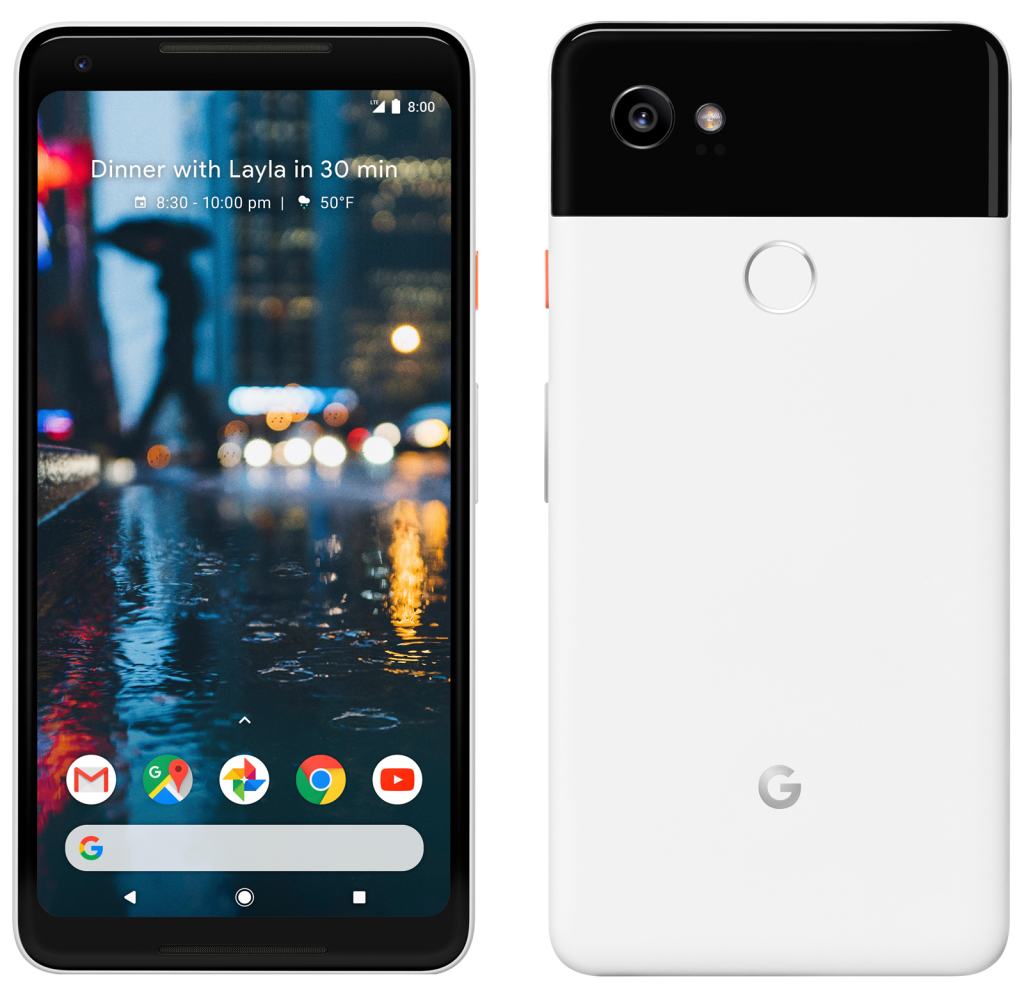 Google says its specially calibrated Pixel 2 camera enables robust tracking, even in low-light conditions, allowing the phone to track the environment and render AR objects at 60 frames per second (FPS).
Apple made a similar claim when they unveiled the iPhone 8 last month, saying that each camera is “individually calibrated, with new gyroscopes and accelerometers for accurate motion tracking.” The new iPhone line also boasts 60 FPS tracking.
Featuring a single 12.2MP camera with f/1.8 aperture lens, Google’s Pixel 2 nearly matches the same portion of the spec sheet as iPhone 8’s 12MP camera with f/1.8 aperture lens, putting the two on par in terms of AR rendering ability, at least on paper.
Google’s AR function, thanks to the ARCore SDK, is said to support “millions of devices” capable of running Android 7.0 Nougat and above. Apple, with its ARKit SDK, has also said they’ve pushed AR to “hundreds of millions of iPhones and iPads” capable of running its newest operating system iOS 11, which includes pretty much everything back to the iPhone 5s and even the 6th generation iPod Touch.
Google family of products: Pixel, Daydream, Home, Pixel Buds, Pixel Clip
 There were a lot of updates to existing products: shiny Pixel 2 and Pixel 2 XL smartphones, a new version of the Daydream virtual-reality headset, smaller and larger versions of Google’s Home personal assistant speaker, and a convertible Pixelbook laptop. There were also two less-expected items: a square life-logging camera called Pixel Clips and a pair of wireless earbuds called Pixel Buds aimed at real-time (or, probably more realistically, close to real-time) translation when used with one of the company’s Pixel smartphones.
Hardware, built from the inside out
We’ve designed and built our latest hardware products around a few core tenets. First and foremost, we want them to be radically helpful. They’re fast, they’re there when you need them, and they’re simple to use. Second, everything is designed for you, so that the technology doesn’t get in they way and instead blends into your lifestyle. Lastly, by creating hardware with AI at the core, our products can improve over time. They’re constantly getting better and faster through automatic software updates. And they’re designed to learn from you, so you’ll notice features—like the Google Assistant—get smarter and more assistive the more you interact with them.
You’ll see this reflected in our 2017 lineup of new Made by Google products:
- The Pixel 2 has the best camera of any smartphone, again, along with a gorgeous display and augmented reality capabilities. Pixel owners get unlimited storage for their photos and videos, and an exclusive preview of Google Lens, which uses AI to give you helpful information about the things around you.
- Google Home Mini brings the Assistant to more places throughout your home, with a beautiful design that fits anywhere. And Max is our biggest and best-sounding Google Home device, powered by the Assistant. And with AI-based Smart Sound, Max has the ability to adapt your audio experience to you—your environment, context, and preferences.
- With Pixelbook, we’ve reimagined the laptop as a high-performance Chromebook, with a versatile form factor that works the way you do. It’s the first laptop with the Assistant built in, and the Pixelbook Pen makes the whole experience even smarter.
- Our new Pixel Buds combine Google smarts and the best digital sound. You’ll get elegant touch controls that put the Assistant just a tap away, and they’ll even help you communicate in a different language.
- The updated Daydream View is the best mobile virtual reality (VR) headset on the market, and the simplest, most comfortable VR experience.
- Google Clips is a totally new way to capture genuine, spontaneous moments—all powered by machine learning and AI. This tiny camera seamlessly sends clips to your phone, and even edits and curates them for you.
Assistant, everywhere
Across all these devices, you can interact with the Google Assistantany way you want—talk to it with your Google Home or your Pixel Buds, squeeze your Pixel 2, or use your Pixelbook’s Assistant key or circle things on your screen with the Pixelbook Pen. Wherever you are, and on any device with the Assistant, you can connect to the information you need and get help with the tasks to get you through your day. No other assistive technology comes close, and it continues to get better every day.
Artist virtually vandalises Jeff Koons’ Snapchat artwork to protest “AR corporate invasion”
 The team made an identical 3D AR Balloon Dog covered in graffiti and geo-tagged it to the exact coordinates, “as if the result of an overnight protest” says Sebastian. “It is vital to start questioning how much of our virtual public space we are willing to give to companies,” he continues. “Right now such sculptures exist in a realm dominated by social media corporations, offering us ‘free’ services that we voluntarily join. Nevertheless, with time, the boundaries between reality and virtual reality fade. The virtual world, where the majority of our social interactions take place, becomes our reality. Once we begin experiencing the world predominantly through AR, our public space will be dominated by corporate content designed to subconsciously manipulate and control us.
“Swift responses to create awareness and invite discussion are imperative to such milestone initiatives. If Snapchat X Jeff Koons [is] the first to create a geo-tagged augmented reality artwork, we will be the first to vandalise it as a way to question its legitimacy.”
See the full story here: https://www.itsnicethat.com/news/sebastian-errazuriz-vandalises-jeff-koons-snapchat-ar-balloon-dog-art-051017#.WdcFDHWRveg.twitter
Microsoft’s VR headsets now up for pre-order, launching October 17 / Google’s new VR headset is still a prototype — but it really works
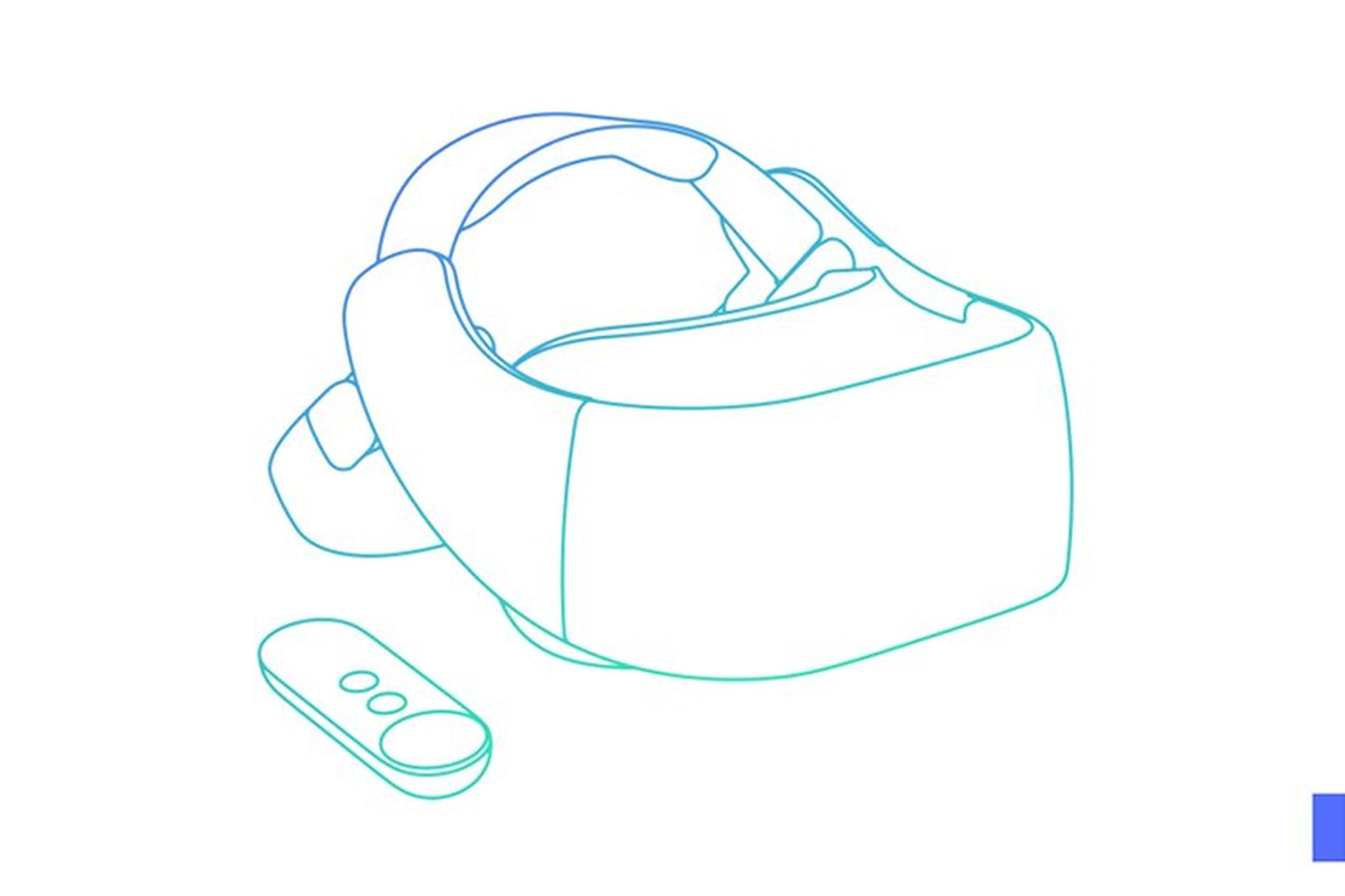 Google’s standalone VR headset, announced yesterday at I/O, was both obvious and unexpected. People have been talking about a self-contained Google headset for over a year, and speculating (quite confidently) that the company would eventually use Tango augmented reality tracking in lieu of outside cameras. But Google head of VR Clay Bavor didn’t just announce the existence of new hardware — he promised a reference design and two commercial versions, made by HTC and Lenovo, by the end of the year.
That’s an aggressive timeline, suggesting that Google’s already got something in pretty good shape. Despite this, Bavor didn’t show much on stage besides a line drawing of the planned hardware. After the keynote, though, I was part of a small group that got to check out an early prototype — and while it’s too early to say whether Google can pull off a fully self-contained VR headset, the core technology really does work.
Anyone hoping for some Microsoft-style inside-out motion controllers from Google will have to wait a while. The first generation of Google’s standalone headsets will use an ordinary Daydream controller, which offers only limited motion tracking.
The operative element we were supposed to be trying was the WorldSense tracking system, which is indeed based on Tango.
In the first of two demos, wearers could walk around a virtual ocean floor, complete with wandering jellyfish and a circling sea turtle. The second put them in a large Imperial hanger from Rogue One, complete with a dour K-2SO.
See the full story here: https://www.theverge.com/2017/5/18/15656290/google-io-prototype-standalone-vr-headset-hands-on-htc-lenovo-qualcomm
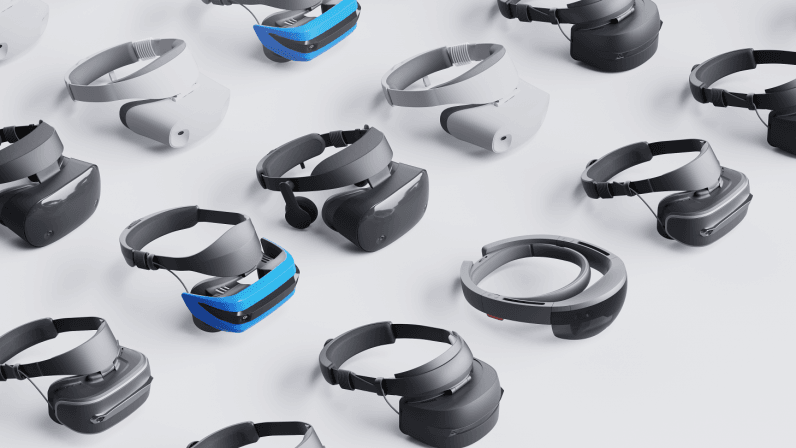 At an event in San Francisco today, the company announced you can pre-order any of Microsoft’s partner headsets today, almost all of which will arrive on October 17 (with one exception). That’s the same day Microsoft is dropping the Windows 10 Fall Creator’s update, which finally brings the company’s mixed reality hub to the masses.
Those models are from Acer, Dell, HP, Lenovo, and as of today, Samsung. They all hover around $400-$500, including Microsoft’s Oculus-like mixed reality controllers, or $300-$400 without them. You can find out more about prices and the features of each individual headset here.
The Samsung headset looks particularly interesting, as the only headset with OLED displays and ‘premium’ AKG headphones. You’ll have to wait longer for that one – it launches on November 6.
Microsoft’s has two main advantages over the competition its hoping to leverage. Its partner headsets don’t need external camera to track six degrees of movement, for one, and they can run on lower spec machines – even integrated graphics. And though the company is emphasizing games to start, it’s preparing for a world where mixed reality could be our primary way of interacting with computers.
See the full story here: https://thenextweb.com/microsoft/2017/10/03/microsofts-vr-headsets-now-pre-order-launching-october-17/#.tnw_wznhwH8z
Magic Leap Chief Game Designer Talks Internal Demos and “Everyday Adventure” Format for AR
 Graeme Devine is a long time games industry vet, having worked at studios such as Id Software, Ensemble Studios, Microsoft, and more. He’s now been working with Magic Leap for nearly four years. During his keynote presentation at Games for Change 2017, Devine told the audience that a big part of his job is helping the company think about what augmented reality (which Magic Leap calls “mixed reality) really is, and how content should be designed for it.
Devine says each pitch was given a set of criteria:
- Five Mile Test – if you’re five miles from your house and realize you’ve forgotten the experience, is it compelling enough that you’d go back for it?
- Toothbrush Test – is it something people will use every day?
- The Halo Test – will people buy an AR device because of this?
- Innovation – Does it make something in the world so useful that people are sad when they don’t get to use it in AR?
- Does it convincingly interact with the world via world meshing and spatialized audio, and what are the controls?
- Can Magic Leap learn from it?
Devine said the company’s favorite project to from from Pitchfest has been Cat Astrophe!.
“In Cat Astrophe! the idea was you had a controller that was either a water bottle or a laser pointer, or a little cat toy with a bell on it. And you had to herd the cats into their carrier […] and it was 20 cats. And you had these toys down on the floor that they would use and see. You’d put the tube down and they’d recognize it was there and they’d do interesting things,” Devine said. “There was a line to play this Pitchfest demo… people lined up for hours to go and play this thing. And what we noticed was, every single person would use their feet to try and herd the cats. Didn’t do a thing, but they thought it did!”
He continued on to paint a picture of an experience that you don’t turn on and off like other forms of media, but instead, the ‘everyday adventure,’ weaves throughout your real life; at any time an adventure could be just around the corner. This type of AR experience, Devine believes, will “define a generation.”
See the full story here: https://www.roadtovr.com/magic-leap-chief-game-designer-talks-internal-demos-ar-and-the-everyday-adventure/
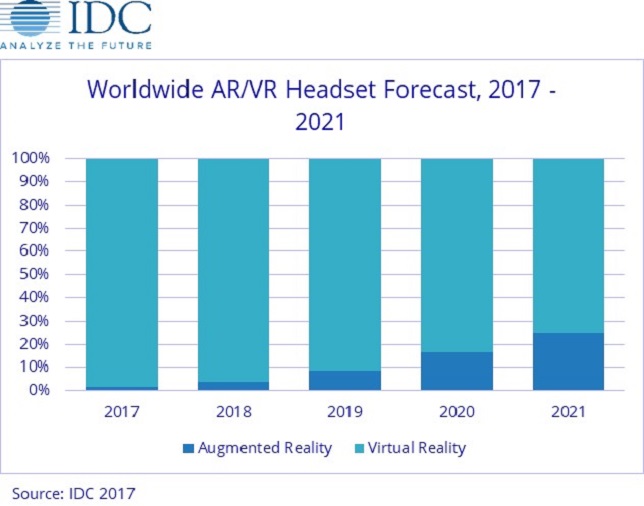
Augmented Reality Headsets Gaining Momentum
 See the full story here: https://campustechnology.com/articles/2017/10/02/augmented-reality-headsets-gaining-momentum.aspx?admgarea=news
VIRTUAL REALITY SYSTEM FOR ROBOTS DEVELOPED BY MIT ALLOWS HUMANS TO CONTROL THEM REMOTELY
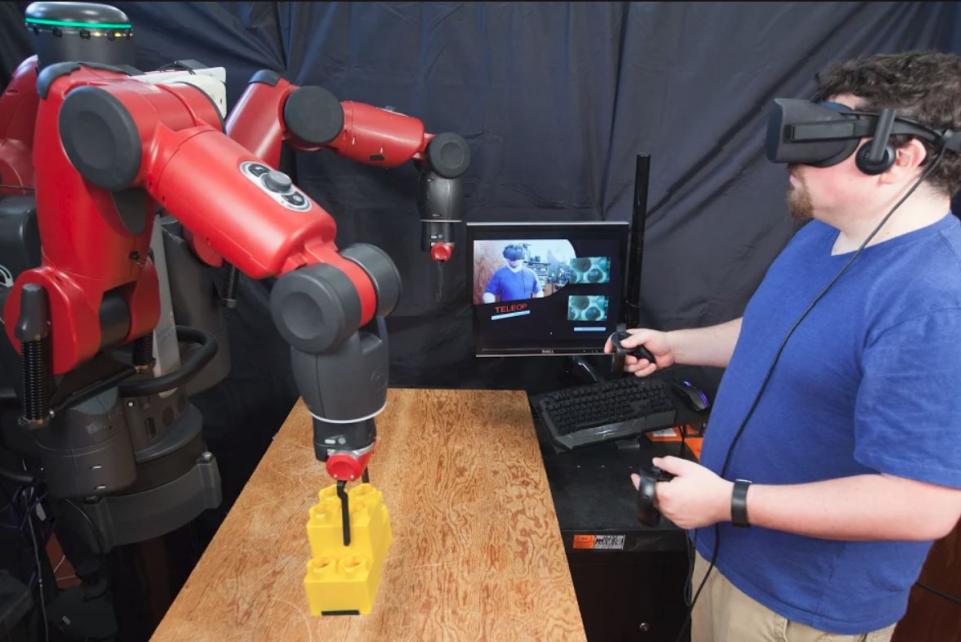 MIT’s system uses off-the-shelf gaming and VR technology to place users in a virtual cockpit, making it more flexible and user-friendly compared to previous systems. Researchers found that users with gaming experience had much more ease with the system than those without.
See the full story here: http://www.newsweek.com/mit-develops-virtual-reality-control-system-robots-676285
Snapchat will put Jeff Koons’ art installations in augmented reality
 Snapchat plans to launch a new art initiative tomorrow aimed at using augmented reality to feature art installations around the world. A website, art.snapchat.com, mysteriously spawned a countdown clock this afternoon, and a snippet of javascript underlying the page appears to confirm that the reveal is a collaboration with renowned artist and big Snapchat fan Jeff Koons.
It’s unclear exactly how the art project will manifest in the real world. But it will likely involve digital works designed by Koons that appear in real-world locations, geo-locked to a user’s location in ways similar to Niantic’s AR mobile game Pokémon Go.