Disney puts a new spin on its accelerator

An innovative sound company that creates a continuous sound field with a sense of depth and dimension through any device with stereo speakers, bringing an immersive sound experience to everyone.
A broad-based esports company built by leading sports team owners with ownership interests in esports teams and esports content distribution. The company has a majority stake in Team Liquid, a top esports team in the US and Europe with 60 pro players, coaches, and analysts competing in nine games as well as a minority stake in Super League Gaming.
A digital media company that inspires, educates and entertains real women with a creative spirit. Through inspirational content, online classes, and products, Brit + Co enables their audience of over 125 million to use creativity to shape their best lives.
Creators of Unreal Engine technology, which is used by millions of developers to ship visually stunning, high-quality games and experiences across PC, console, mobile, VR and AR platforms. Developers also choose Epic’s Unreal Engine for cinematic production, visualization, design and simulation. Epic is known for creating the Unreal, Gears of War and Infinity Blade series of games, as well as newer titles such as Fortnite, Paragon and Robo Recall.
A local news and content discovery platform, that uses machine learning to distribute geotagged and relevant content from hundreds of media partners into websites or mobile apps. Hoodline also analyzes data sets to unlock insights for businesses and media companies.
A game-based learning platform with more than 50 million monthly active users in 180 countries. Kahoot! makes it easy to create, discover, play, and share fun learning games in minutes—for any subject, in any language, on any device, for all ages.
A tool for storytellers and creators focused on improving creative collaboration in Film, TV, and Theatre production. ProductionPro pulls scripts, research, designs, and continuity together to empower creative decision-making.
A frictionless e-commerce over mobile messaging experience: customers simply reply “YES” to buy the product and have it delivered.
A data and analytics company providing essential television insights by leveraging a source of real-time, opt-in viewership data across broadcast, cable TV, OTT, and digital media. Through software integrations with smart TV manufacturers, Samba recognizes content and associated viewership patterns making TV audiences more addressable and measurable while helping marketers activate cross-screen campaigns and maximize their impact.
A robotics company that develops and deploys autonomous indoor delivery robots that work alongside people in busy environments such as hotels, logistics facilities, and high-rise apartment buildings. The company’s flagship product, Relay, is an autonomous delivery robot that is already installed in dozens of hotels worldwide.
A location-based entertainment company that fully immerses guests in virtual experiences with friends and family, engaging all of their senses. The VOID combines interactive sets, virtual reality, real-time effects, and state of the art technology to bring guests into their experience.
See the full story here: https://techcrunch.com/2017/07/11/disney-puts-a-new-spin-on-the-accelerator/
Apple’s Augmented Reality Is Coming to FaceTime, Using Light Field Camera Tech
 Apple has won patent protection for a new way of using light field cameras, included in the iPhone 7 Plus–although it has been used by other brands as well–to project images into a live video chat.
The iPhone version of the tech overlays the images from two cameras to create a sense of depth, resulting in the “bokeh” effect where the subject of a photo is held in sharp focus while the background is blurred.
Using more cameras in the array, and focusing them on objects other than the main subject–like your fellow caller, in a video chat situation–makes it possible to radically expand the visuals of a video call.
Such technology is already available in webcams such as the Razor Stargazer and the 4k video-enabled Logitech Brio, which use infrared sensors to separate a caller from their surroundings. It’s also the key ingredient to the Windows Hello facial recognition software.
See the full story here: https://www.videoconferencingdaily.com/latest-technology/apples-augmented-reality-coming-facetime-using-light-field-camera-tech/
Warner Bros. Studio Releases ‘Dunkirk’ VR Experience
 What’s most interesting about the just over five minute experience is the choice to focus on heavy imagery rather than fast-paced, chaotic action to represent the dire mood of the full film. Slow-motion shots of soldiers killed in action sinking into dark waters, the first-person perspective of a pilot as he crashes into the ocean, a group of desperate soldiers routinely preparing for incoming fire. These moments are made all the more impactful by their choice to trade in action for tone.
Dunkirk’s VR experience launched this weekend with access on YouTube 360, Facebook 360, LIFE VR, and most major headset platforms like the HTC Vive.
See the full story here: https://vrscout.com/news/warner-bros-studio-dunkirk-vr-movie/#
Digital Privacy to Come Under Supreme Court’s Scrutiny
 Devices connected to the internet, from cellphones to watches to personal training trackers that facilitate our personal habits and communications, are a fact of daily life, and the Supreme Court will have to start drawing clear lines around what types of electronic information are — and are not — protected by the Fourth Amendment. Simply asserting that there is a right to privacy does not provide much help in determining how far that protection should extend in a digital world.
See the full story here: https://www.nytimes.com/2017/07/10/business/dealbook/digital-privacy-supreme-court.html
W3C Approves the EME Standard for DRM-Protected Video
 “Web creator Tim Berners-Lee and W3C project manager Philippe Le Hégaret write that they believe EME is better for accessibility, because it complies with other web accessibility standards, and that having DRM support built into the web, instead of requiring plugins, makes life easier for browser developers,” notes The Verge. They also state that, with regard to protections for security researchers, they “didn’t want to hold up the standard just because all parties couldn’t come to agreement on this issue.”
The Verge notes that the disagreement boils down to a difference in philosophy. Whereas the EFF doesn’t like DRM and “would like to see a much more open solution … W3C seems to have decided that since DRM is going to get used anyway, the web may as well standardize and avoid security horrors like Flash.”
See the full story here: http://www.etcentric.org/w3c-approves-the-eme-standard-for-drm-protected-video/
‘Sharknado’ Augmented Reality Mobile Game Debuts
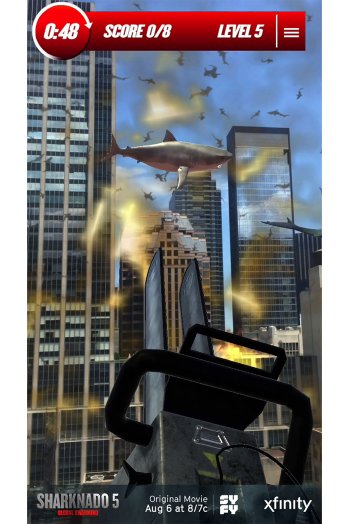 In advance of Sharknado 5: Global Swarming, which debuts Aug. 6 on Syfy, fans can experience a Sharknado of their own with a new augmented reality mobile game.
Sharknado: ShARkmented Reality puts the player in the shoes of Fin (played by Ian Ziering in the TV franchise) and April (played by Tara Reid). Users will be able to impose a virtual Sharknado on their surroundings, armed with various virtual weapons — such as a chain saw — to defeat the sharks. Each level up will unlock new weapons and new sharks to battle.
See the full story here: http://www.hollywoodreporter.com/behind-screen/sharknado-augmented-reality-mobile-game-debuts-1019024