Grindr, virtual reality and vlogging: new ways to talk about sexual health
 The first Global Advisory Board for Sexual Health and Wellbeing brings together a group of individuals who are using innovative ways to reach more people with information about sex and relationships. Here are some of the projects they’ve been working on:
Grindr to reach patients at risk of HIV in the US
Usigli thought about using Grindr, a dating app for gay men, to raise awareness of HIV. He set up a profile as a male nurse to tell at-risk patients about the services offered at the clinic. He then developed a script for healthcare professionals to use.
The success rate has been astonishingly high. In the first month of using the app in this way, more than 20 new at-risk patients came to the clinic for a variety of preventative services, such as sexual health counselling, HIV/STI testing and pre-exposure prophylaxis (PrEP).
Virtual sex education aimed at overcoming societal taboos in India
In India, there are high levels of domestic violence , mostly against women. Both women and men refuse to report such crimes to the police.
In June 2017, Love Matters, a website providing information on relationships, sex and love, produced India’s first virtual reality immersive experience on physical, sexual or psychological harm by a current or former partner or spouse. The film, Kya Yahi Pyar Hai? (Is this love?), uses VR to narrate a powerful story and connect with young people.
See the full story here: https://www.theguardian.com/healthcare-network/2017/jul/21/grindr-virtual-reality-vlogging-new-ways-talk-sexual-health
Culture for a digital age
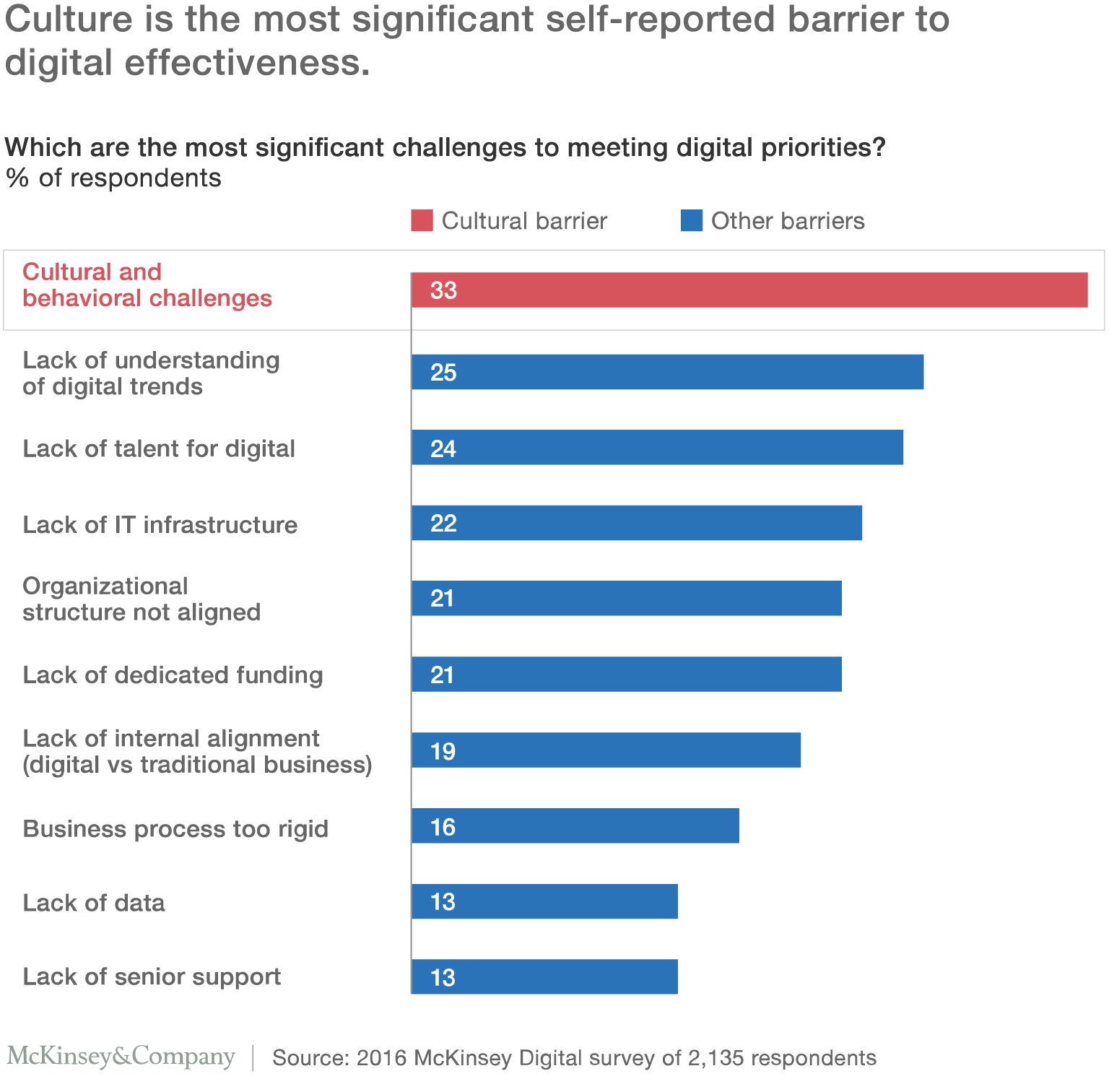 McKinsey’s recent survey of global executives (Exhibit 1), which highlighted three digital-culture deficiencies: functional and departmental silos, a fear of taking risks, and difficulty forming and acting on a single view of the customer.
As Ed Catmull of Pixar said in a 2016 McKinsey Quarterly interview, “One of the things about failure is that it’s asymmetrical with respect to time. When you look back and see failure, you say, ‘It made me what I am!’ But looking forward, you think, ‘I don’t know what is going to happen and I don’t want to fail.’ The difficulty is that when you’re running an experiment, it’s forward looking. We have to try extra hard to make it safe to fail.”
Capital markets have typically been averse to investments that are hard to understand, that underperform, or that take a long time to reach fruition.
See the full story here: http://www.mckinsey.com/business-functions/digital-mckinsey/our-insights/culture-for-a-digital-age?curator=MediaREDEF
A Gamer Channel’s Mission: Send the Trolls and Harassers Packing
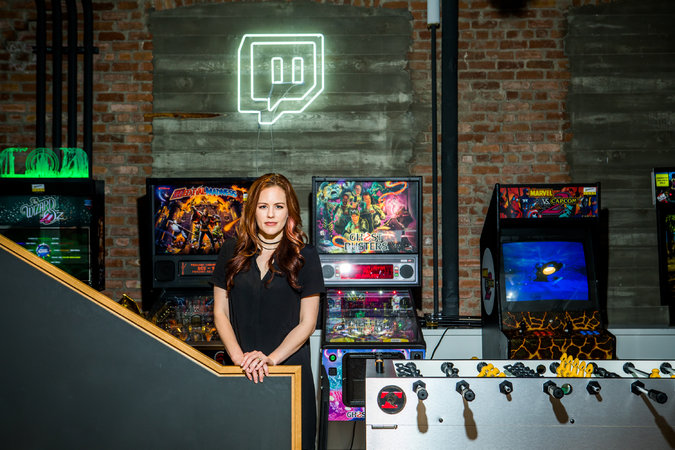 What sets Misscliks apart is its response to such behavior. Whenever a sexist remark pops up, the Misscliks community quickly jumps in to explain that the channel’s mission is to be a diverse space where underrepresented gamers can feel safe from harassment and bullying. Commenters who persist are given timeouts, or sometimes banned outright.
“Misscliks is an example of a space grown from the ground up to model a different and less toxic environment,” said Naomi Clark, an assistant arts professor at New York University’s department of game design. “Their team deliberately set expectation and policy from the beginning to counter harassment.”
Of the 2.2 million channels on Twitch, which is owned by Amazon,Misscliks was one of the first to explicitly lay out a goal of being a place where people of all genders and backgrounds could participate in gamer culture without fear, prejudice or harassment.
The popularity of the Misscliks mission has yet to be determined. The channel has just over 23,000 followers, a fraction of the millions of followers drawn to some of the more popular Twitch channels.
See the full story here: https://www.nytimes.com/2017/07/19/technology/personaltech/a-gamer-channels-mission-send-the-trolls-packing.html
Crytek’s ‘The Climb’ is The Best Selling Rift Game To Date
 Oculus has confirmed that Crytek’s The Climb is the platform’s best selling Rift game to date, and among a handful of titles that have grossed more than $1 million on the company’s VR storefront.
... the exact metric behind the listing is not known, nor the time period over which it’s calculated.
Rubin however confirmed that The Climb is the Rift’s “#1 seller” of all time, which we take to mean by unit sales (though given the game’s $50 price tag, it’s likely to be the top grossing too). That, of course, means that the game is one of four titles which the company recently confirmed have made at least $1 million on the Oculus store alone.
The Climb is somewhat unique because it managed to be something of a double-launch title; first with the Rift launch in early 2016—played at the time with the gamepad—and then with the Touch launch in late 2016 when it was updated to be played with motion controllers.
Blippar is embracing licensing as it faces competition from Apple and Google
 In a major strategic shift, Blippar also said it would license the new technology to third parties to embed in their own apps.
Business Insider has documented Blippar's historical struggles to decide on a business model, as recounted by former staff. The startup has pivoted from being a creative agency to being a visual browser, raising almost £80 million, axing sales staff, and shuttering offices along the way.
An obvious revenue-generating move for Blippar would have been to license or white-label its technology more aggressively.
At one time, after buying Amsterdam rival Layar in 2014, the company did offer its Layar software development kit (SDK) to third parties. That theoretically meant companies could embed Blippar's augmented reality technology into their own applications.
Blippar has previously told Business Insider that there are apps that white-label its tech — but there aren't any recent examples on its site.
See the full story here: http://www.businessinsider.com/augmented-reality-app-blippar-says-it-will-finally-sell-its-tech-to-third-parties-2017-7
LA-based augmented reality company to open a site in Oakland County, Michigan
 A Los Angeles-based augmented reality company announced it is choosing among sites in Oakland County for an automotive product development center. It will announce the location in the upcoming weeks, according to a news release of the Michigan Economic Development Corporation.
See the full story here: http://www.theoaklandpress.com/business/20170719/la-based-augmented-reality-company-to-open-a-site-in-oakland-county