A NEW GOOGLE PROJECT SETS OUT TO SOLVE ARTIFICIAL STUPIDITY
 Google is starting a new research push to understand and improve the relations between humans and AI. PAIR, for People + AI Research initiative, was announced today and will be led by two experts in data visualization, Fernanda Viégas and Martin Wattenberg. One thing they hope to do is create a toolkit of techniques and ideas about how to design AI systems less prone to disappointing or surprising us humans.
Viégas says that she’s interested in studying how people form expectations about what such systems can and can’t do—and how virtual assistants themselves might be designed to nudge us toward only asking things that won’t lead to disappointment.
The deep learning algorithms that have lately proved so useful for analyzing our personal data or diagnosing diseases from medical imaging also have a reputation for being what researchers dub “black boxes”, meaning it can be difficult to see why a system spat out a particular decision, such as a diagnosis.
That’s a problem as such software gets closer to being used in life-or-death situations in the clinic or on our roads inside autonomous vehicles.
Today the Ethics and Governance of Artificial Intelligence Fund, with backers including the Knight Foundation and LinkedIn cofounder Reid Hoffman, announced $7.6 million in grants to civil society organizations to study the changes AI might cause in areas such as labor markets and criminal justice systems.
See the full story here: https://www.wired.com/story/google-artificial-intelligence-people-ai-research/
Apple Embraces VR: Every Virtual Reality Announcement From Today’s WWDC Keynote
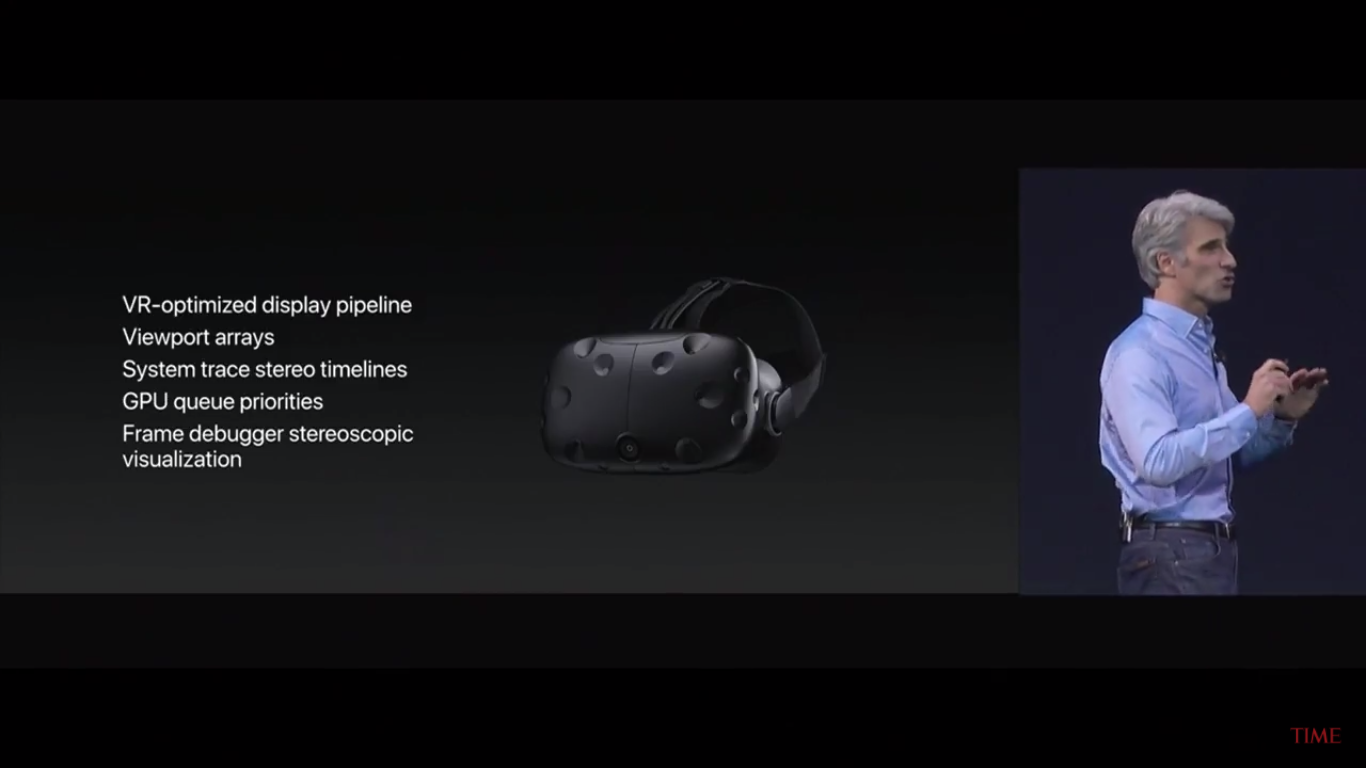 While Steam has been Mac compatible for some time now, Apple announced that Valve will be bringing SteamVR to Mac too, allowing the HTC Vive to run VR games on Mac systems.
To show the audience the power of the company’s new VR Ready 27-inch iMac—and a taste of what it’s like to be in VR—Apple showed a demo running on the HTC Vive that was created by Industrial Light and Magic. Using Epic’s Unreal Engine VR Editor, they showed how developers could build VR content inside of VR itself, using Star Wars assets.
Apple also says that both Unity and Unreal Engine—the leading VR content creation tools—will support their VR SDKs on Mac, allowing developers to create VR content on Apple’s machines.
Apple is updating their professional video editing application, Final Cut Pro X, to support 360 degree video editing. That means that video editing’s leading tools, Final Cut and Adobe’s Premiere Pro, now both offer 360 video editing capabilities, with Premiere having added support back in 2016.
STRING THEORY’S WEIRDEST IDEAS FINALLY MAKE SENSE—THANKS TO VR
 Extra dimensions are a critical part of Greene's field of study. String theory posits that the universe is built not just from three spatial dimensions (up/down, side/side, forward/backward) and the single dimension of time, but at least six other dimensions. These extra dimensions would be too small for humans to detect—about 10-33 centimeters. But, according to the theory, the six, curled up dimensions play a major role in controlling how subatomic strings vibrate, and those vibrations determine how quarks, electrons, and other fundamental particles behave. Ultimately, these phenomenon scale up to explain modern how gravity and quantum mechanics fit together: Otherwise known as The Biggest Question in Physics. "String theory," says Greene, "is speculative and hypothetical, but mathematically quite compelling."
It's also quite confusing. Those six extra dimensions some string theorists predict come wrapped together in what are known as Calabi-Yau manifolds. Greene is a great writer—bestselling, even—but even he can't perfectly explain what these things look like. VR helps him make the shapes make sense. Sort of. Greene brings up a video of a wire in the virtual reality space. To a human, he says, this is a two dimensional object: a line. The video zooms in, and something new appears: an ant, walking in a circle around the wire's girth. The lesson here is that extra dimensions are invisible unless you are the right size to see them.
Virtual Reality Could Help Combat Social Isolation in Ageing Population
 “We are primarily interested in creating opportunities for creating meaningful social interactions in a virtual world,” Baker said.
Baker said the current study, which has 23 participants over the age of 70 called “Technology Explorers”, protected the identity of participants and enabled them to create their own virtual reality avatars.
“The first stage of the project had participants sitting in different parts of the university and they were all able to interact and have conversations with each other in that virtual environment as the avatars,” he said.
Baker said the next stage of the project was to explore with participants what types of virtual reality environments they could build.
“Our project is about giving people agency and allowing them to move around and make decisions and interact in a virtual world,” he said.
Baker said after a workshop exploring different possibilities, the team had decided to build a virtual reality card game and a “highway of life”.
“In the highway of life, participants will be able to go back in time to explore different time periods and see stories from that time and be able to contribute their own artifacts,” Baker said.
The project was co-funded by the Australian Research Council and the Microsoft Centre for Social Natural User Interfaces, and the team is working in collaboration with the National Aging Research Initiative and the John Richards Initiative at Latrobe University.
See the full story here: https://probonoaustralia.com.au/news/2017/07/virtual-reality-help-combat-social-isolation-ageing-population/
Also podcast http://radioadelaide.org.au/2017/07/11/older-adults-living-socially-in-vr/
Self-Driving Cars Will Get Ethics Lessons in Virtual Reality
 ...one of the best known studies, conducted at MIT in 2015, found that people wanted self-driving cars to make utilitarian decisions that would minimize death toll even if it sacrificed the car's occupants, so long as they weren't personally occupying the car.
Now, a team of German researchers have put test subjects into virtual reality and had them make split-second decisions between crashing into adults, children, animals, and inanimate objects to see if understanding the way we make tough decisions in a simulated environment will help build a model of human behavior in the real world.
In the study, published last week in Frontiers in Behavioural Neuroscience, volunteers put on an Oculus Rift headset that simulated driving a vehicle down a suburban street. In front of the car, a pair of obstacles—sometimes people or animals, sometimes inanimate objects—would appear in two lanes, and the subject had to steer the vehicle into one of them, sacrificing it to preserve the other. (Human characters were mostly static to avoid suggesting they would move out of the way.) After multiple test runs with more than a hundred subjects, the researchers put together a hierarchy of how things were valued in relation to one another. The results were mostly unsurprising: Drivers would save a human rather than an animal, and run over an adult rather than a child.
But according to the study's authors, the specific results are less important than assessing the general suitability of VR for testing ethical scenarios.
But when algorithms do start to make decisions in life-or-death situations, designing for transparency and accountability is an important value in itself.
See the full story here: https://motherboard.vice.com/en_us/article/a3d7dk/self-driving-cars-will-get-ethics-lessons-in-virtual-reality
Disney puts a new spin on its accelerator

An innovative sound company that creates a continuous sound field with a sense of depth and dimension through any device with stereo speakers, bringing an immersive sound experience to everyone.
A broad-based esports company built by leading sports team owners with ownership interests in esports teams and esports content distribution. The company has a majority stake in Team Liquid, a top esports team in the US and Europe with 60 pro players, coaches, and analysts competing in nine games as well as a minority stake in Super League Gaming.
A digital media company that inspires, educates and entertains real women with a creative spirit. Through inspirational content, online classes, and products, Brit + Co enables their audience of over 125 million to use creativity to shape their best lives.
Creators of Unreal Engine technology, which is used by millions of developers to ship visually stunning, high-quality games and experiences across PC, console, mobile, VR and AR platforms. Developers also choose Epic’s Unreal Engine for cinematic production, visualization, design and simulation. Epic is known for creating the Unreal, Gears of War and Infinity Blade series of games, as well as newer titles such as Fortnite, Paragon and Robo Recall.
A local news and content discovery platform, that uses machine learning to distribute geotagged and relevant content from hundreds of media partners into websites or mobile apps. Hoodline also analyzes data sets to unlock insights for businesses and media companies.
A game-based learning platform with more than 50 million monthly active users in 180 countries. Kahoot! makes it easy to create, discover, play, and share fun learning games in minutes—for any subject, in any language, on any device, for all ages.
A tool for storytellers and creators focused on improving creative collaboration in Film, TV, and Theatre production. ProductionPro pulls scripts, research, designs, and continuity together to empower creative decision-making.
A frictionless e-commerce over mobile messaging experience: customers simply reply “YES” to buy the product and have it delivered.
A data and analytics company providing essential television insights by leveraging a source of real-time, opt-in viewership data across broadcast, cable TV, OTT, and digital media. Through software integrations with smart TV manufacturers, Samba recognizes content and associated viewership patterns making TV audiences more addressable and measurable while helping marketers activate cross-screen campaigns and maximize their impact.
A robotics company that develops and deploys autonomous indoor delivery robots that work alongside people in busy environments such as hotels, logistics facilities, and high-rise apartment buildings. The company’s flagship product, Relay, is an autonomous delivery robot that is already installed in dozens of hotels worldwide.
A location-based entertainment company that fully immerses guests in virtual experiences with friends and family, engaging all of their senses. The VOID combines interactive sets, virtual reality, real-time effects, and state of the art technology to bring guests into their experience.
See the full story here: https://techcrunch.com/2017/07/11/disney-puts-a-new-spin-on-the-accelerator/
Apple’s Augmented Reality Is Coming to FaceTime, Using Light Field Camera Tech
 Apple has won patent protection for a new way of using light field cameras, included in the iPhone 7 Plus–although it has been used by other brands as well–to project images into a live video chat.
The iPhone version of the tech overlays the images from two cameras to create a sense of depth, resulting in the “bokeh” effect where the subject of a photo is held in sharp focus while the background is blurred.
Using more cameras in the array, and focusing them on objects other than the main subject–like your fellow caller, in a video chat situation–makes it possible to radically expand the visuals of a video call.
Such technology is already available in webcams such as the Razor Stargazer and the 4k video-enabled Logitech Brio, which use infrared sensors to separate a caller from their surroundings. It’s also the key ingredient to the Windows Hello facial recognition software.
See the full story here: https://www.videoconferencingdaily.com/latest-technology/apples-augmented-reality-coming-facetime-using-light-field-camera-tech/
Warner Bros. Studio Releases ‘Dunkirk’ VR Experience
 What’s most interesting about the just over five minute experience is the choice to focus on heavy imagery rather than fast-paced, chaotic action to represent the dire mood of the full film. Slow-motion shots of soldiers killed in action sinking into dark waters, the first-person perspective of a pilot as he crashes into the ocean, a group of desperate soldiers routinely preparing for incoming fire. These moments are made all the more impactful by their choice to trade in action for tone.
Dunkirk’s VR experience launched this weekend with access on YouTube 360, Facebook 360, LIFE VR, and most major headset platforms like the HTC Vive.
See the full story here: https://vrscout.com/news/warner-bros-studio-dunkirk-vr-movie/#