Stetson economics professor awarded virtual reality grant
 Green, Ph.D., assistant professor and chair of Stetson’s Economics Department, is one of just 50 instructors at elementary, secondary and post-secondary schools around the world to be awarded as part of the inaugural Virtual Reality Grant Program founded by Nearpod. The education technology company develops digital learning tools, virtual reality and interactive content for use in classrooms.
Green, who also is director of Africana Studies at Stetson, will have access to Nearpod VR headsets and more than 25 VR-based lesson plans. The grant also includes professional development, one-on-one support services and a Nearpod license for the university.
As a teacher and research economist, Green focuses on international development, trade and poverty, but he also conducts research on effective pedagogy. That research led him to use a Nearpod teaching app this past year.
“I can use their app and put questions in it and build in presentations, quizzes, activities, all sorts of things,” Green said. “During class I’ll be lecturing, but then I’ll mix in questions that students answer on their phones, laptops or whatever. Rather than them passively sitting there, they’re being forced to hear something and answer a question about it. So they have to think about it, process it and hopefully understand it.”
My field research is in economic development, studying poor countries around the world and how they can grow. So we can take a trip to a country in sub-Saharan Africa and get a really strong visual of a village, what people live like, what their houses are like. That makes a lot stronger impression than me just giving students numbers on GDP per capita.”
More than 300 schools applied for the Nearpod grants, which were awarded to schools across the United States as well as in Nigeria, Japan and Spain.
see the full story here: http://www.stetson.edu/today/2016/05/stetson-economics-professor-awarded-virtual-reality-grant/
MIT startup lets seniors enter the world of virtual reality
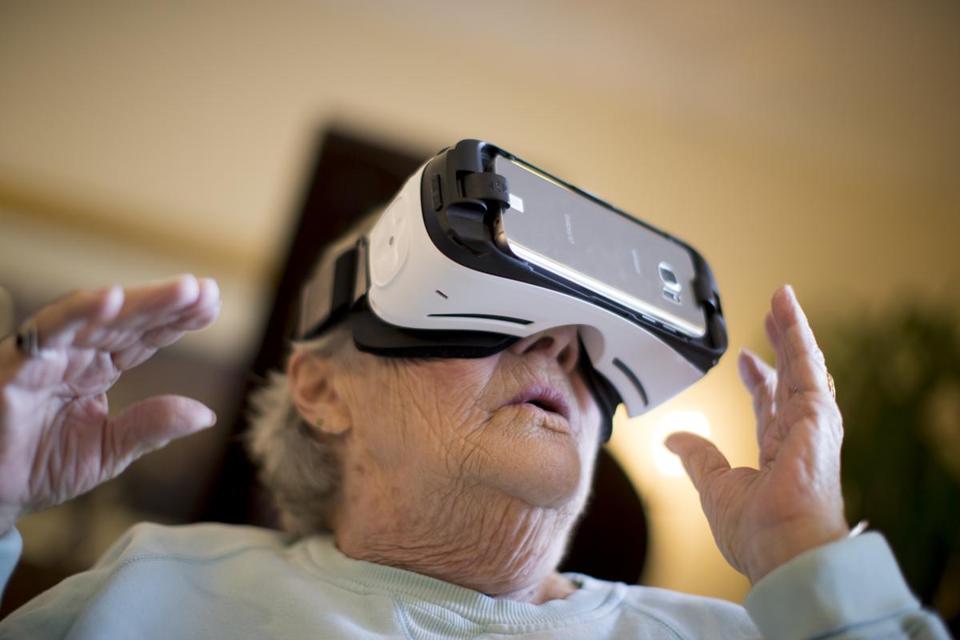 Norma Gorman could barely contain her excitement as she donned a set of goggles that transported her, in time and space, from her assisted living center in Sudbury to her childhood home in Lynn.
Through a virtual reality headset, Gorman revisited Marianna Street, pointing her finger in different directions as she described the old neighborhood to other seniors at the Orchard Hill facility: there’s the house where she grew up, her grandmother’s, over there the Hennesseys and the Murphys, and the former police chief’s, whose last name she couldn’t remember — each discovery punctuated with an “Oh my goodness!”
“I can’t believe that, did you see?” the 88-year-old Gorman exclaimed in disbelief. “You can go anywhere in the world. Whoa!”
Gorman owes her world travels to Reed Hayes, 28, and Dennis Lally, 27, two MIT Sloan School of Management graduate students whose startup, Rendever Health , is developing virtual reality programs to provide entertainment in assisted living facilities, and down the road, to test and treat seniors for the effects of aging.
“We started to notice once they were done with the demo they would go back to their friends at their table and talk about what they experienced. It was social, it lit a spark,” Hayes said. “Can you imagine coming up with a new conversation after being there 10 years and you haven’t been out?”
Hayes and Lally have developed their own software platform to use with the VR headsets, including adventures like a trip to Paris or an up close experience with performers from Cirque du Soleil. They plan on adding 360-degree virtual reality video cameras so family members can share events, such as weddings, with elderly relatives at an assisted living facility.
Hayes and Lally have poured about $13,000 of their own funds into Rendever Health and are looking for investors.
See the full story here: https://www.bostonglobe.com/business/2016/05/12/mit-startup-lets-seniors-enter-world-virtual-reality/XbaWge6EseufMYu2tZ87TN/story.html
China will account for 40% of virtual reality headset shipments in 2016
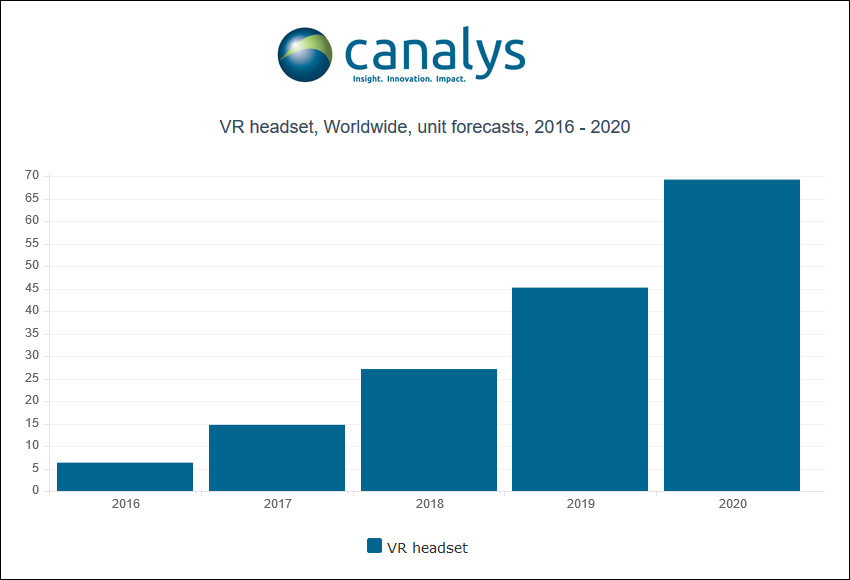 Canalys predicts vendors will ship 6.3 million virtual reality (VR) headsets worldwide in 2016, of which 40% will be in China. VR has the potential to thrive in the country and Canalys believes competition will be fierce this year. Barriers to enter the VR market have been lowered. Local vendors are releasing VR headsets that overcome the quality and performance issues of simple viewers, such as Samsung’s Gear VR and Google’s Cardboard.
Canalys Analyst Jason Low said, ‘The competition is around the user experience, hardware quality and content. Currently, there isn’t a clear leader for VR content in China. Local content providers, game publishers and service providers are racing to exercise their influence on the development of VR beyond hardware. Numerous Chinese vendors are exhibiting their VR headsets at CES Asia 2016 this week. Attendees are willing to suffer long queues to experience the VR demonstrations. Leading Chinese vendors such as DeePoon, Pico, Pimax and Idealens are attracting the most interest from consumers.’
‘CES Asia has become a great platform for local VR vendors to demonstrate and let users try their products,’ Low added. ‘But it is still a huge challenge to translate that into product sales and the creation of content.’ Canalys believes that though inexpensive, simple viewers appeal to many consumers, vendors must look beyond these to more advanced VR headsets, where the longer-term opportunity lies. ‘The Chinese market is highly fragmented and vendors such as Huawei and DeePoon are moving quickly to form partnerships. Local VR ecosystem companies need to move fast before international vendors, such as HTC, Oculus and Sony, get a foothold.’
See the full post here: http://www.canalys.com/newsroom/china-will-account-40-virtual-reality-headset-shipments-2016
Miraffe Proves That Augmented Reality Doesn’t Have to Be Complicated or Creepy
 Shenzen-based Xiaoxi Technology, a Chinese startup is trying to prove that augmented reality, which combines computer-generated images with the real world, doesn’t have to be complicated, expensive and creepy.
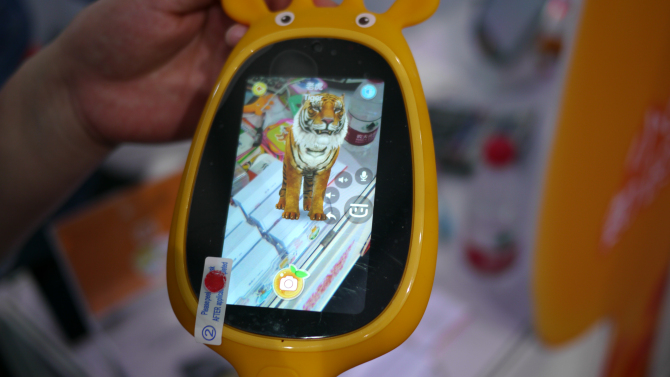
Miraffe, a “magic mirror” for kids with a phone-sized screen and a front-facing camera to recognize objects and combine animated characters with the real world.
Xiaoxi Technology demoed Miraffe at CES Asia in Shanghai this week, showing how the device could recognize everyday objects like a calculator and a phone, and spell the word for each object in English as well as Chinese. In a test with Variety, Miraffe had some trouble recognizing a pair of glasses, and a spokesperson said that the device currently has a 60 to 70 percent accuracy rate for object recognition.
The device also ships with a number of paper cards that depict various animals. Miraffe is capable of recognizing these animals, and then displays an animated 3D version, which is combined with whatever is in the viewfinder of the device’s camera.
[Not original, but] Miraffe’s positioning as a dedicated augmented reality device for kids opens up a middle ground between general purpose mobile phones and expensive headsets or glasses.
See the full story here: http://variety.com/2016/digital/news/miraffe-augmented-reality-kids-kickstarter-1201771240/
Online gamer died on Poolbeg Pier ‘capture’ mission, inquest hears
 A player of an online game requiring physical visits to landmark sites died during a late-night mission, an inquest in Dublin has heard.
Frank Maxwell (48), of Portacarran, Oughterard, Co Galway, was playing Ingress, an augmented reality game that involves “capturing” landmark buildings, or “portals”, for points, when he died.
See the full story here: http://www.irishtimes.com/news/ireland/irish-news/online-gamer-died-on-poolbeg-pier-capture-mission-inquest-hears-1.2645636
Augmented reality-reveal for Expo 2020 master plan
 Using augmented reality, Dubai Expo 2020's organising team offered visitors of Arab Media Forum a glimpse of how the Expo 2020 site will "look and feel" upon completion.
The event is to be held between 20 October, 2020 and 10 April, 2021.
Spanning 2sqkm, the Expo site will revolve around the Al Wasl meeting plaza.
The Expo's pavilions have been planned along the sub-themes of opportunity, mobility, and sustainability.
Reem bint Ibrahim Al Hashemi, Minister of State for International Cooperation and director-general of Expo 2020 Dubai, said the Expo 2020 Dubai’s master plan "truly reflects the theme of ‘Connecting Minds, Creating the Future’".
See the full story here: http://www.constructionweekonline.com/article-38993-augmented-reality-reveal-for-expo-2020-master-plan/