Magnify – The Virtual/Augmented Reality Pacific Summit
 Presented by Air New Zealand
Spend two days with some of the best minds in Virtual and Augmented Reality. If anyone is interested in Gaming, Story-telling, Advertising, Fine Arts, Journalism, Digital Marketing and any other form of creative expression, then this is the event for them!
See the full story here: https://www.thebigidea.nz/events/207143-magnify-the-virtual-augmented-reality-pacific-summit
Get real! How augmented reality toys could make VR feel like a gimmick
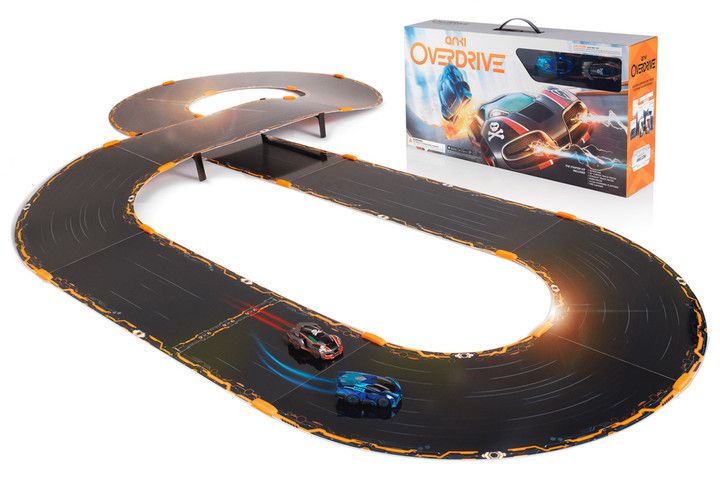 Anki is the maker of Overdrive slot-less, slot-car racers that utilize AI driven cars and smartphone controls to add whole new levels to the classic living room racing experience. The toy has proved a winning combination over the past few years, earning it several awards at toy tradeshows.
“People have an emotional connection to a physical product they can hold in their hand” said Mark Palatucci, co-founder of Anki. “But video games can be a lot more fun. They’re adaptive, they scale the difficulty with the skill of the player. Overdrive takes the emotion and powerful connection with a physical product and combines it with the magic that makes video games so engaging.”
Silas Adekunle, founder of Reach Robotics – which makes real-life robots with augmented reality features – agrees. “People love to play with toys,” he said. “And that’s when they are happy to make big purchases, too. They’ll spend $100-$200 on a physical product, where they wouldn’t spend anything like that on a game.”
See the full story here: https://www.yahoo.com/tech/real-augmented-reality-toys-could-101504497.html
One Year Later, Oculus and Valve Still Mum on Timeline to Open Tracking to Third-parties
 [Philip Lelyveld comment: open and interoperable standards are the key to building a market for the higher value VR experiences. Google is setting the baseline by launching and ecosystem to support nearly device- and OS-agnostic live 360 VR streaming capture and playback, including free training at their facilities. Oculus and Valve remaining closed on the higher-level functionality will slow market growth as consumers wonder wither either will be able to maintain an adequate experience-stream to justify buying, and regularly upgrading, the hardware.]
Both Oculus and Valve have gone on the record to say that they’d be opening up their respective tracking systems for third-parties to make use of, but after a year, neither company is ready to talk specifics.
So called ‘6DOF’ (degrees of freedom) tracking is critical to virtual reality. VR systems need to know where your head is and precisely how it’s moving through space in order to render a virtual world which moves around you as you would expect to see in real life. 6DOF tracking is also important for adding motion input to allow users to effortlessly interact with the virtual world.
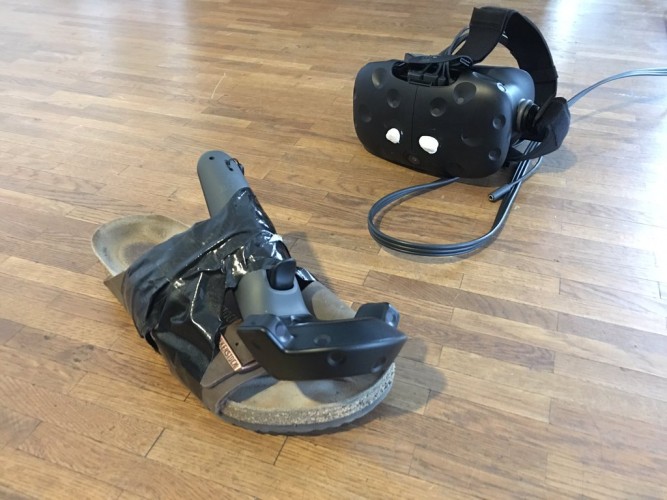
But extending those tracking systems beyond the head and hands has a wide range of uses; tracked third-party peripherals could open up a world of new opportunities for VR interactivity. One major use-case is simply mirroring the virtual item—be it a bat, golf club, sword, etc.—to the real object that the player is holding. This enhances immersion because not only is the object shaped and held just as it would be in real life, but the user benefits from all the expected forces like weight, leverage, and momentum from the object’s mass.
Third-party controllers with features that go beyond the first-party offering would also be viable with access to an established tracking system. Tactical Haptics, for instance, is creating a VR controller with ‘Reactive Grip’, a unique haptic solution which can create feedback not possible with rumble alone.
Both companies have gone on record to say that they plan to open up their tracking systems, but have been extremely tight-lipped about timelines or specifics.
Given that it could mean increased developer interest, I’m quite surprised neither company has been vying to be first and best when it comes to opening up their tracking systems to third-parties. Surely both Oculus and Valve/HTC have been busy dealing with some not-so-smooth initial launches, but it’s clear that there’s demand from developers and companies to track more than just head and heads in VR.
See the full story here: http://www.roadtovr.com/oculus-constellation-valve-lighthouse-open-tracking-third-party-api/
New Virtual Reality Cannabis App Dōs is Breathtaking
 The Dōs VR app is a cannabis app meant to virtually take you on a journey reflective of any given strain of cannabis.
Users can see a Santa Monica sunset or the flirty fountains in front of the Bellagio in Vegas. Unlike YouTube videos and pictures, the app uses 360-degree filing techniques so the user can move the phone up, down and all around to see everything normally out of range on a small screen.
You don’t see this app, you experience it.
Gerome described it simply as a platform where companies (for a sponsorship fee) can curate a video library of virtual experiences to evoke the emotions that they want to associate with their particular strain of cannabis.
See the full story here: http://www.marijuanatimes.org/new-virtual-reality-cannabis-app-dos-is-breathtaking/
SPACEVR RAISES $1.25 MILLION TO LAUNCH VIRTUAL REALITY CAMERA SATELLITES INTO SPACE
 The company has just announced that they have raised a respectable amount of seed financing led by a $1 million investment from Shanda Group as well as another $250,000 from Skywood Capital. The investments will be used to accelerate the continued development and launch of SpaceVR’s Overview 1, what they are saying will be the world’s very first virtual reality camera satellite.
The tiny Overview 1 virtual reality satellite is equipped with two 4K sensors that have been paired with a 2D 360° camera and several wide field of view lenses that will capture an immersive sphere of video
See the full story here: https://3dprint.com/132185/spacevr-camera-satellites/
NextVR Partners With Golden Boy Promotions To Bring Virtual Reality To Boxing Fans
 NextVR has partnered with Golden Boy Promotions to give fans an exclusive virtual reality experience of WBC, Ring Magazine, and Lineal Middleweight World Champion Canelo Álvarez training for his fight May 7 against two-time world champion Amir “King” Khan.
For fans that want to be fully immersed they will need the Gear VR for mobile. The alternative option is to view the content on YouTube or Facebook 360, where they are able to click and move around as they wish.
This is only the beginning for the NextVR and Golden Boy Promotions as they plan to continue working together to give boxing fans a virtual experience.
See the full story here: http://www.sporttechie.com/2016/05/01/nextvr-partners-with-golden-boy-promotions-to-bring-virtual-reality-to-boxing-fans/
Mapping the Israeli virtual reality and augmented reality startup landscape
See the full story here: http://www.geektime.com/2016/05/01/mapping-the-israeli-virtual-reality-and-augmented-reality-startup-landscape/
How Games Are Changing the Museum Experience
 “We got a group of students together and spent a couple of months teaching them about the science of what would be in the exhibit, teaching them the basics of game design, and then working with them to create this prototype for what would eventually become MicroRangers,” Joseph said.
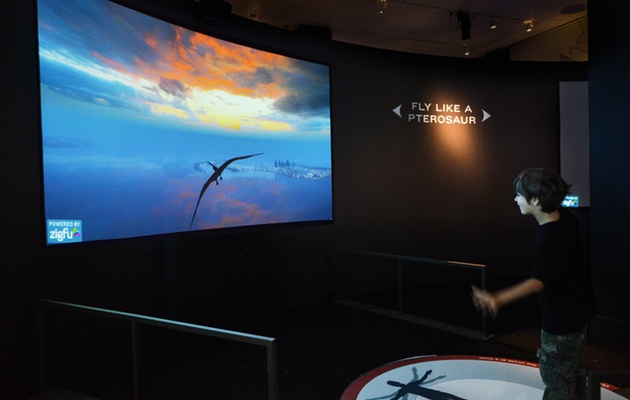
The result demonstrates how AMNH, along with many other museums, are integrating both analog and digital gameplay into the visitor experience as a way to connect with exhibitions on new levels. The idea is not to edge out the more traditional ways of exploring collections, like aimlessly wandering through halls or reading about the backstory of specific displays, but rather to complement them with new avenues of engagement.
...over a decade later, the idea that games to augment and enhance educational experiences is becoming more mainstream, and museums are more eager than ever to adopt these interactive elements into their exhibits.
See the full story here: http://motherboard.vice.com/read/how-games-are-changing-the-museum-experience