‘The Jungle Book’: Creating Virtual Reality Experiences with VFX Supervisor Keith Miller
In September, Disney invested over $60 million in the Virtual Reality start-up company Jaunt, another sign that the once-dormant format was back on the upswing. It wasn’t too long ago that VR was considered a joke, a relic from the 90s as kitschy and outdated as The Lawnmower Man. But the VR movement has now come back full circle into the limelight. Last year, ILM released the ‘Trials on Tatooine’, a short VR piece in conjunction with Star Wars: The Force Awakens and just this month, Disney released two short The Jungle Book VR experiences. In King Louie: Cold Lairs, you see through Mowgli’s eyes as he comes face to face with titular Great Ape.
See the lengthy interview here: http://collider.com/the-jungle-book-vfx-supervisor-keith-miller-interview/
IS VIRTUAL REALITY THE FUTURE OF MUSIC VIDEOS?
But one experience might spearhead an entirely new genre: the virtual reality music video. In “Old Friend,” creator Tyler Hurd, who cut his teeth as a video game animator, drops you into the center of a psychedelic dance circle set to Future Islands' song of the same name. As the tune’s high-pitched synth hook kicks in on your headphones, you’re confronted by an almost psychotically happy drum major who twirls his baton, lip syncs, dances like a madman, and makes it all but impossible for you not to do the same.
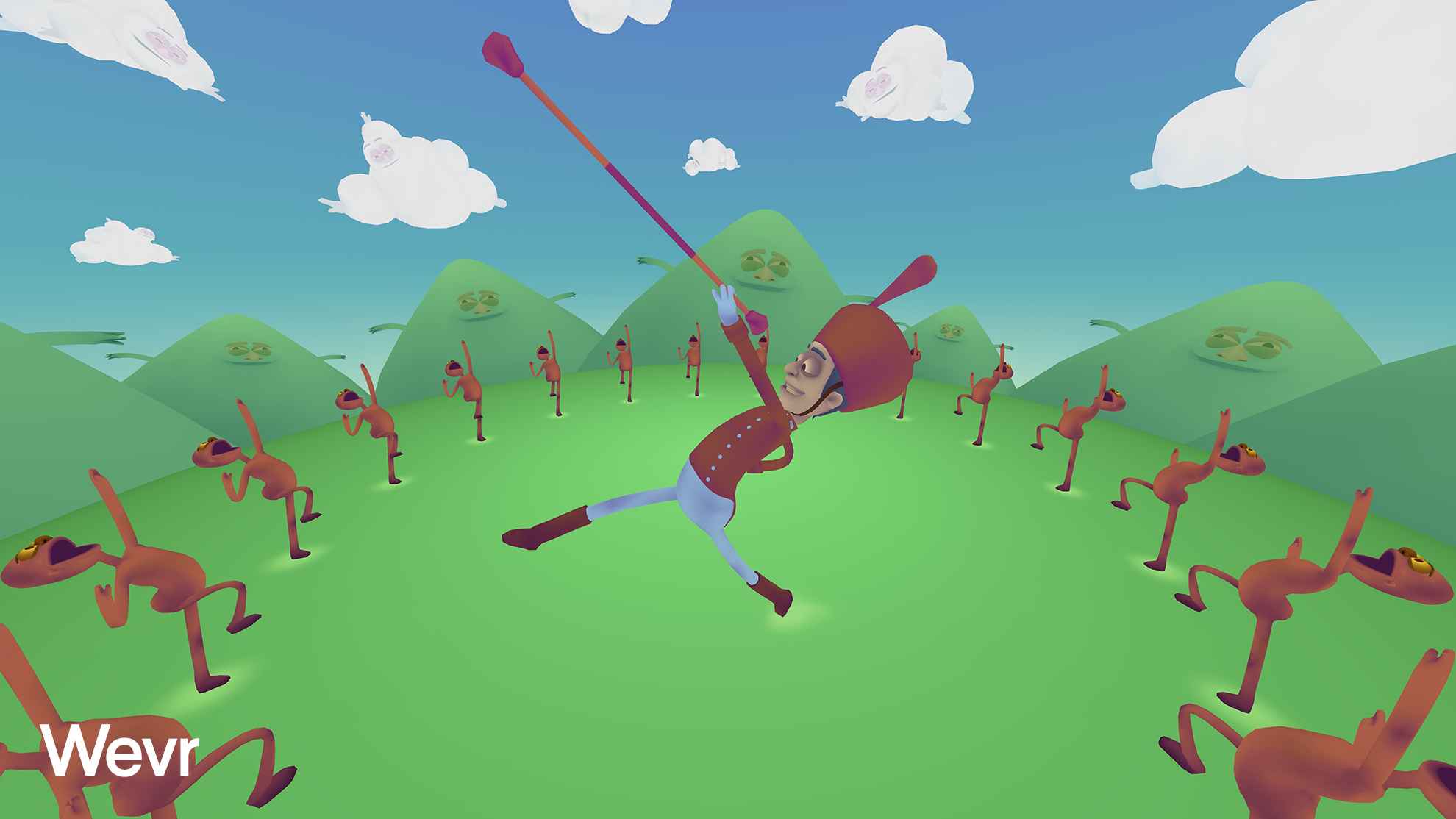
All around you are colorful elastic characters shaking their colorful elastic limbs with the kind of liberated abandon that’s only possible on a virtual dance floor in an imaginary universe hidden behind an actual, real-world curtain. Beyond your dance circle, big anthropomorphic mountains shake and shimmy, and every cloud smiles the instant you look at it. And, what’s this? Your own arms (which move via the HTC Vive’s controllers) are long and wavy and seem re-designed for the sole purpose of indiscriminate virtual dancing! Look down, and your feet are wiggling in uncontrollable joy. In other words, you’re not just listening to the music; you are the music.
By the time the video ends, just about everybody who exits those curtains looks like they just got a free trip to space—and when they got there it was just one giant rave, thrown in their honor.
“I modeled all the dance moves after my friends,” says Hurd. “I was like, ‘Just come over and we’ll all get wasted and make some videos!’” Once he had his material, Hurd played the videos back frame by frame and made his virtual dance troupe pull off the same moves. “Old Friend” took Hurd nine months to complete (he did all the animations and coding himself). But it was a labor of love, he says, because once he got a glimpse of what was possible with VR, the one-time 2D-only animator was hooked.
See the full story here: http://www.popsci.com/is-virtual-reality-future-music-videos
Verizon’s AOL Buys Virtual Reality Video Specialist RYOT

Verizon Communications Inc.’s AOL has agreed to acquire virtual reality and 360-degree video company RYOT Corp., the companies announced Wednesday. Financial terms of the deal were not disclosed.
The acquisition comes as marketers and digital media organizations are investing heavily in virtual reality and 360-degree video to publish to platforms such as Facebook, YouTube and Snapchat in addition to their owned-and-operated properties.
RYOT and its 25 staffers will form a new unit under AOL’s The Huffington Post, and will also work with other publications across AOL’s portfolio of properties including TechCrunch, Engadget and Autoblog. RYOT’s capabilities and services will also be offered to clients of AOL’s Partner Studio division, which creates branded content for marketers.
“RYOT will work on big editorial projects, but also with brands. It will work across everything we’re doing at The Huffington Post,” said Arianna Huffington, co-founder and editor-in-chief of The Huffington Post.
See the full story here: http://www.wsj.com/articles/verizons-aol-buys-virtual-reality-video-specialist-ryot-1461153651
Spirit Aerosystems deploys Airbus augmented reality tool for composite fuselage brackets
 [Philip Lelyveld comment: I assume the humans will be replaced by computers when computer vision is adequately precise.]
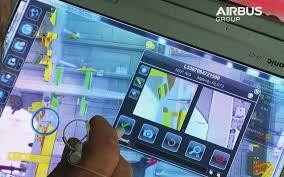
Airbus Group Innovation (Ottobrunn, Germany) developed MiRA technology to reduce the inspection time for tens of thousands of brackets that hold hydraulic pipes and wire bundles in place and attach them to the composite fuselage sections of the latest production aircraft. Using a tablet-based interface equipped with a camera for visual inspection, operators superimpose a digital mock-up over “as built” reality. In other words, workers access the 3D model of the aircraft and compare the built and installed assemblies to their digital designs to inspect for missing, wrongly positioned or damaged brackets. At the end of the inspection, a report is automatically generated that includes details of any non-conforming parts which can be replaced or repaired quickly.
See the full story here: http://www.compositesworld.com/news/spirit-aerosystems-deploys-airbus-augmented-reality-tool-for-composite-fuselage-brackets
Grindex unveils Augmented Reality digital tool
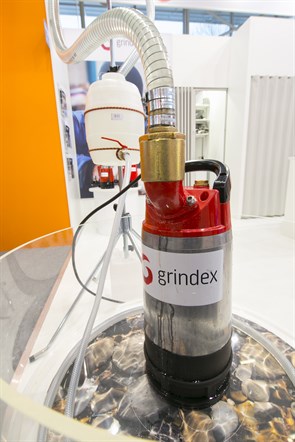 It’s fair to say that bauma 2016 might feel like Augmented Reality for Grindex.
Among world leaders in electric submersible pumps, the firm is this week unveiling a digital tool based on Augmented Reality technology – offering an X-ray vision of the firm’s products.
“Simply point the tablet’s camera at a pump and a cut-away image will be added on the screen, providing the user with buttons that explain and/or animate certain features,” Grindex sales manager Peter Uvemo explained.
See the full story here: http://www.worldhighways.com/event-news/bauma/2016/news/grindex-unveils-augmented-reality-digital-tool/
VR porn is coming to hotels on the Las Vegas strip
 Sin City is about to get a bit more sinful, as VR content platform VR Bangers and headset maker AuraVisor are teaming up to offer in-room adult experiences (via virtual reality) at hotels on the strip in Las Vegas.
What makes this partnership particularly interesting is that users who purchase the in-room AuraVisor will be viewing content that was filmed in a hotel room that looks similar to the one where they’re staying, making the fantasy that much more immersive.
Interested hotel guests simply pay $20 on their credit card to have an AuraVisor headset in the room. This headset is pre-loaded with sexy-time content, and all the user has to do is specify the preferred gender of their virtual partner.
See the full story here: http://techcrunch.com/2016/04/19/vr-porn-is-coming-to-hotels-on-the-las-vegas-strip/