Play an augmented reality game on your Android Wear watch with Tilt
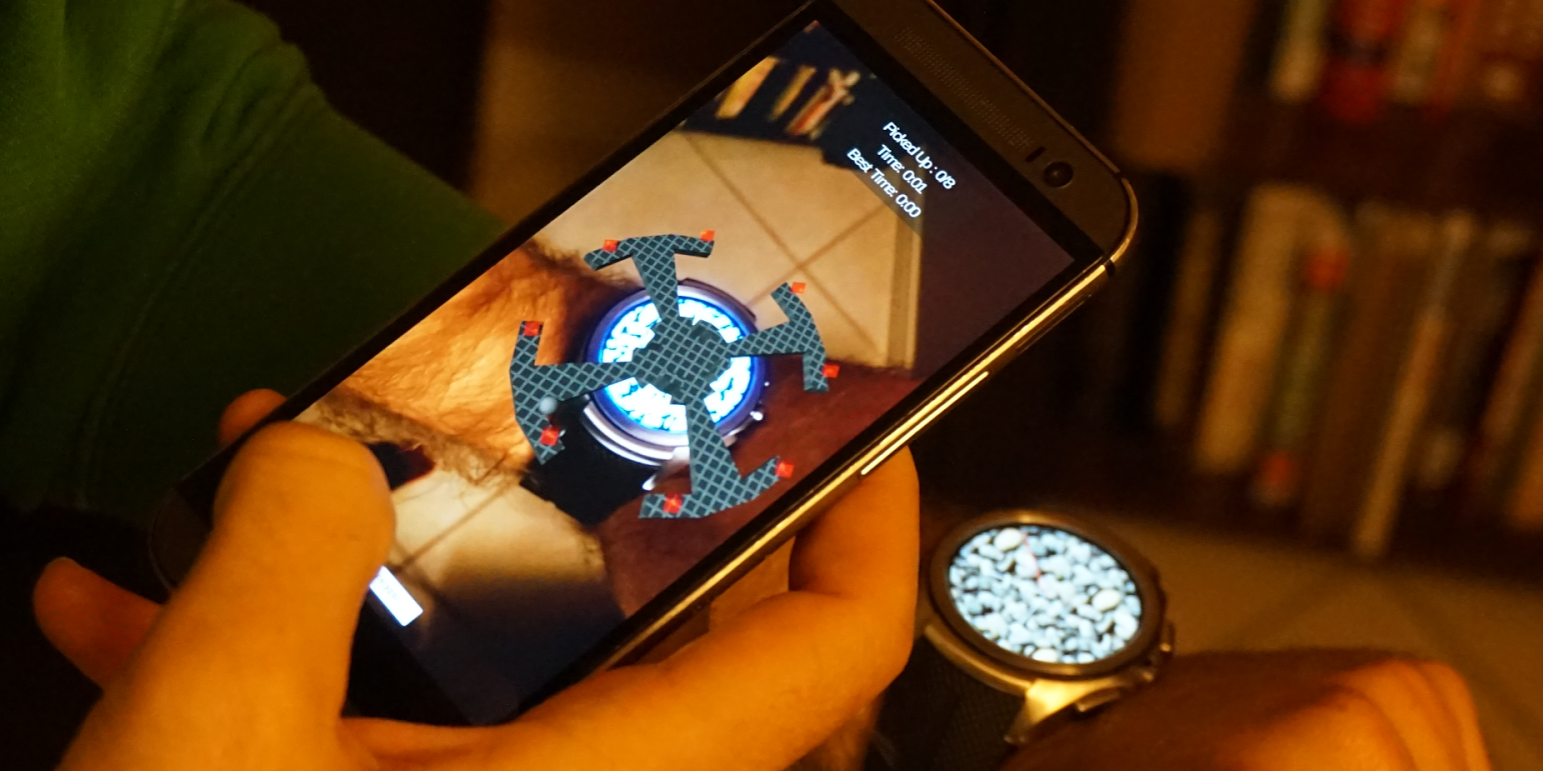 One developer made an app that turns an Android Wear watch when viewed through a camera into a game.
In Tilt, your task is to guide a ball to pick up objects while staying away from holes. When you look through the camera view in the Tilt app, your Wear device becomes the board that you tilt around to move the ball. In the mean time, your watch is displaying a pattern for the phone to project a virtual reality board on.
It’s a fun tech demo, probably worthy of being an Android Experiment. Graphics are blocky and not the most high-resolution, and it’s not the most practical game to play (holding a phone up at a specific angle can quickly get tiresome and certainly looks odd from afar), but it does serve as a good demo and introduction for what an AR game could be in the future.
The game is ad free and there are no in-app purchases, and the developer will be releasing an expanded version with more levels and features in the future. They are taking feedback and bug fixes in the reviews section of the Play Store.
See the full story here: http://9to5google.com/2015/12/29/tilt-augmented-reality-android-wear/
Voxelus Virtual Reality Currency Presale Begins On Uphold Platform
[Philip Lelyveld comment: Mike Terpin is advising and doing PR for this company that hopes to create a bridge between VR and the blockchain to enable walled-garden VR business development.]
 The Voxelus virtual reality (VR) content creation platform is making its VOX currency available on the Uphold cloud money platform in a beta pre-sale. Uphold users can order VOX on Upland before its general release on March 30, 2016, according to Anthony Watson, president and CEO of Uphold Inc.
Voxelus allows users to create VR games and experiences without having to rewrite code. It offers a VR player app that plays content using the desktop content tool on Samsung VR or Oculus Rift and is developing even more features.
According to the Voxelus website, the voxel will be the first digital currency besides bitcoin that is exchangeable on a major currency exchange for Euro, USD, gold silver and more than 30 other currencies.
The current exchange rate, independently determined by Voxelus at this writing, is 1 BTC for 650 Voxel/VOX, via debit or credit card, banks transfer or with the user’s currently-held funds.
See the full story here: https://www.cryptocoinsnews.com/voxelus-virtual-reality-currency-presale-begins-uphold-platform/
Kim Kardashian and Katy Perry Are ‘Living and Breathing Intellectual Property,’ Glu Says
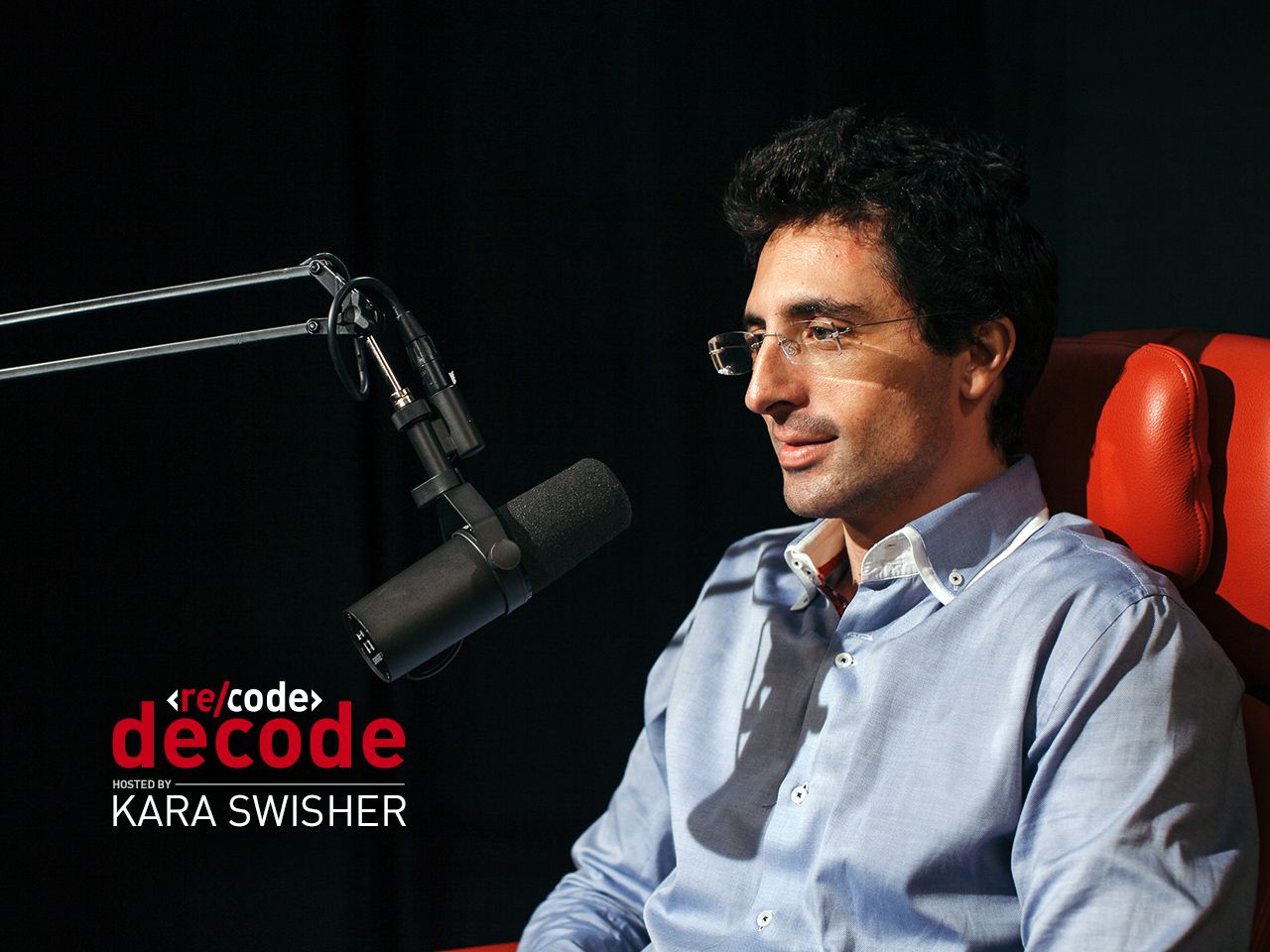 “We’re looking to turn these games into permanent services — call it late-night TV,” de Masi said. “It’s the Kim TV show, but instead of just Sunday for 30 minutes or an hour, you have to tune in or you miss it, effectively these games are giving you access to Kim’s world whenever you want.”
De Masi wants to shift consumers’ mindsets so that gaming, across all the different screens in their lives, will be a constant part of their relationship with celebrities.
“The personalization of media is an enduring trend,” he said. “It’s living and breathing intellectual property.”
See the full story here: http://recode.net/2015/12/28/kim-kardashian-and-katy-perry-are-living-and-breathing-intellectual-property-glu-says/?
US Troops Need Training to Battle in Future Megacities, Marine General Warns
 US land forces will eventually find themselves locked in fights within huge, dense urban environments where skyscrapers tower over enormous shanty towns, and these troops need more realistic training to operate within these future megacities, a US Marine general is warning.
“I’ve trained in every environment, jungle, the desert, the mountains, cold weather, but I’ve never really trained well in an urban environment,” said Brig. Gen. Julian Alford, the Marine Corps Warfighting Laboratory commander, earlier this month at the Interservice/Industry Training, Simulation and Education Conference (I/ITSEC) in Orlando, Florida.
For him, that’s a problem because “the first time I ever dropped a bomb, shot a rocket, threw a grenade, killed a person was for real in an urban environment,” he said. “That should never happen again.”
The one-star general asked industry participants at I/ITSEC to help coming up with ways to prepare troops to better fight in an environment that is becoming a reality.
“We are going to have these megacities that are ringed with these shanty towns and we are going to fight there because it will be the people who are uneducated, unemployed, the young men who are not married and they are mad about their lot in life,” Alford said.
“We talk about the three-block war, but we are moving quickly to the four-floor war,” he added. “We are going to be on the top floor of a skyscraper . . . evacuating civilians and helping people. The middle floor, we might be detaining really bad people that we’ve caught. On the first floor we will be down there killing them. … At the same time they will be getting away through the subway or subterrain. How do we train to fight that? Because it is coming, that fight right there is coming I do believe with all my heart.”
Augmented reality shows a real landscape and other troops but can, using head-mounted displays, superimpose or overlay virtual reality images and effects such as vehicles, explosions and aircraft dropping bombs.
See the full story here: http://www.defensenews.com/story/defense/training-simulation/2015/12/28/us-troops-need-training-battle-future-megacities-marine-general-warns/77826210/
[Dolby] Virtual reality filmmakers are discovering new things about the power of audio
 Joel Susal, Dolby’s director of virtual and augmented reality.
Audio has always been Dolby’s bread and butter. The division Susal runs only came about in March—largely because Jaunt, a VR studio whose backers include Disney, was searching for audio technology to create immersive “3D” sound. One of Jaunt’s board members, Peter Gotcher, happened to be the chairman of Dolby, and helped make the connection.
Dolby turned out to be a good fit because it already had a technology that could be adapted for virtual reality: Dolby Atmos.
To translate Atmos to headphones, Dolby updated its algorithm to render audio in such a way that tricks the brain into believing sound is coming from multiple sources when there are only two speakers embedded in the headphone cups.
“It’s not really about the number of speakers,” explains Brett Crockett, Dolby’s vice president of research and development. “It’s about recreating spatial resolution.” To achieve this, Atmos directs the audio at specific angles so the sound waves bounce off parts of the ears before reaching the ear canal. (Dolby has also partnered with speaker manufacturers to create Atmos-enabled computer speakers and TV sound bars. In those products, the sound waves bounce off the ceiling to create 3D audio.)
Because VR viewers are constantly moving their heads to see different parts of a scene, audio needs to remain consistent, so that a knock from the door doesn’t appear to come from the wall just because a viewer changed positions.
Filmmakers also have to reconcile moving audio objects and stationary sound—an orchestral soundtrack, for example, that doesn’t come from any particular direction.
“This is a VR-specific feature that never existed before,” explains Susal.
See the full story here: http://qz.com/579185/virtual-reality-filmmakers-are-discovering-new-things-about-the-power-of-audio/
2015: The year that Microsoft started getting the benefit of the doubt
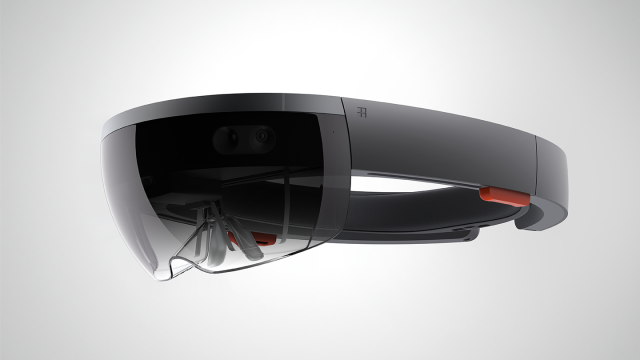 This focus on the positives represents a shift in perception of the company. It's not a product of any one thing; as cool as HoloLens is, there's a broader backdrop: the greater openness to creating software for other platforms, the greater embrace of open source, the more communicative Windows 10 development process. These all add up.
The optimism has its limits, and Microsoft certainly has to prove that it was warranted. The release of HoloLens development units next year will be significant; if it goes well, it should reinforce the belief that Microsoft really can do bold, innovative new things and that the company is still one that can shape our future. It will take a long time for Microsoft to build an image and perception that's as resiliently positive as Apple's. Nonetheless, that people are willing to give the company the benefit of the doubt makes 2015 a special year. Microsoft is changing—and so are we.
See the full story here: http://arstechnica.com/gadgets/2015/12/2015-the-year-that-microsoft-started-getting-the-benefit-of-the-doubt/