Q&A — Aaron Thibault and Corey Carbonara on VR and AR
 TVT: Does the current research suggest that "cyber-sickness" is a technical glitch that is likely fixable or something inherent in this type of presentation? How does "cyber-sickness" affect men and women differently?
Corey Carbonara: According to the research, cyber-sickness is not just a technical "glitch" because it is a phenomenon where we just do not have all of the answers because we do not know all of the factors that affect it. This is because we still do not know exactly how all of the senses in the human body work together. We tend to focus on visual and vestibular factors, but it turns out it is much more than that. So, it is not merely a timeline where we might reach a technology threshold, for even if we had a display that was absolutely perfect, we still would just be addressing the visual factors not all of the senses combined.
The research out there indicates there is a difference between the number of cases of cyber-sickness and gender and our research at Baylor supports that. It appears that women do get cyber-sick more than men. Factors the research discusses that could account for this result is based on differences in the way that men and women process information in the brain, but more research is still needed to understand this more fully.
Haptic glove for surgeons enables virtual reality operations
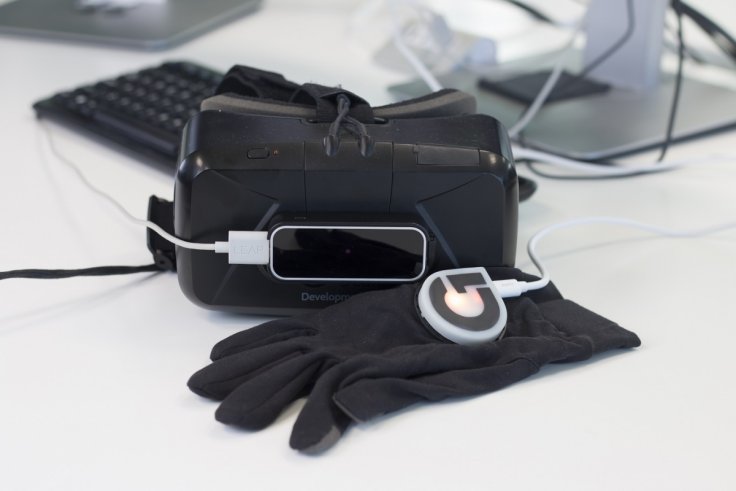 The surgical Laparoscopy Virtual Trainer developed by Neurodigital Technologies makes use of the Gloveone to create a multisensory experience that combines visual, aural and tactile simulation through haptic feedback, sensor fusion and finger tracking. The Gloveone enables a concept known as "extended virtual reality" that allows interaction with a virtual world.
As well as receiving £35,000 to develop the concept, Neurodigital Technologies will work alongside King's College London to help develop it.
See the full story here: http://www.ibtimes.co.uk/haptic-glove-surgeons-enables-virtual-reality-operations-1526101
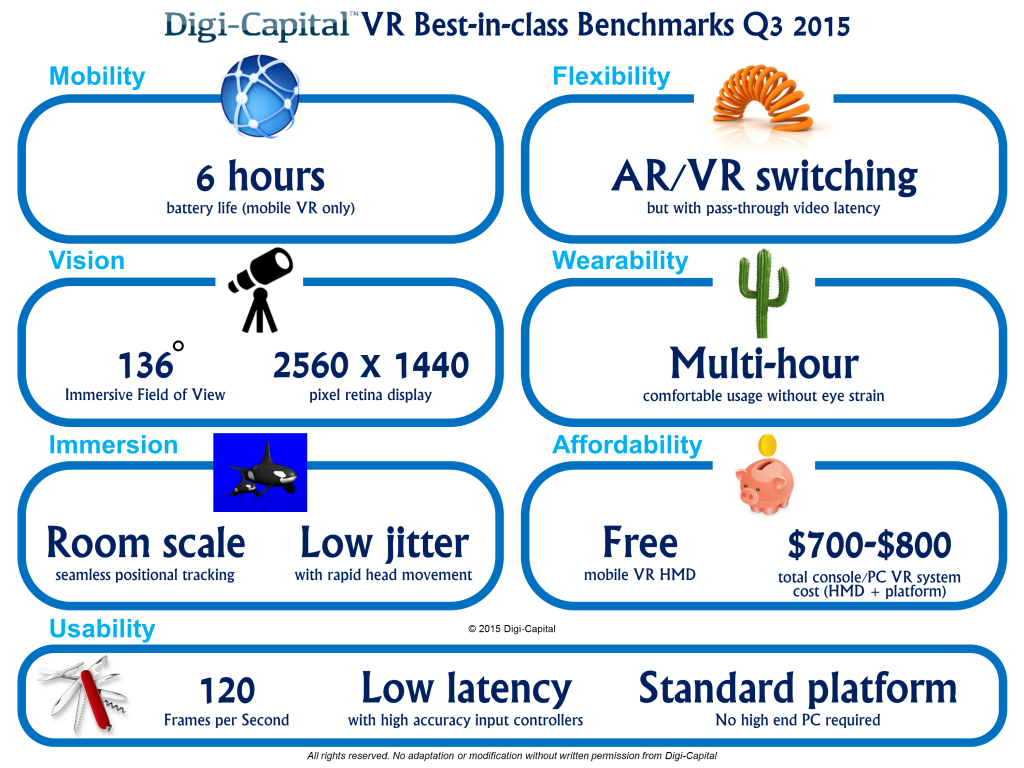
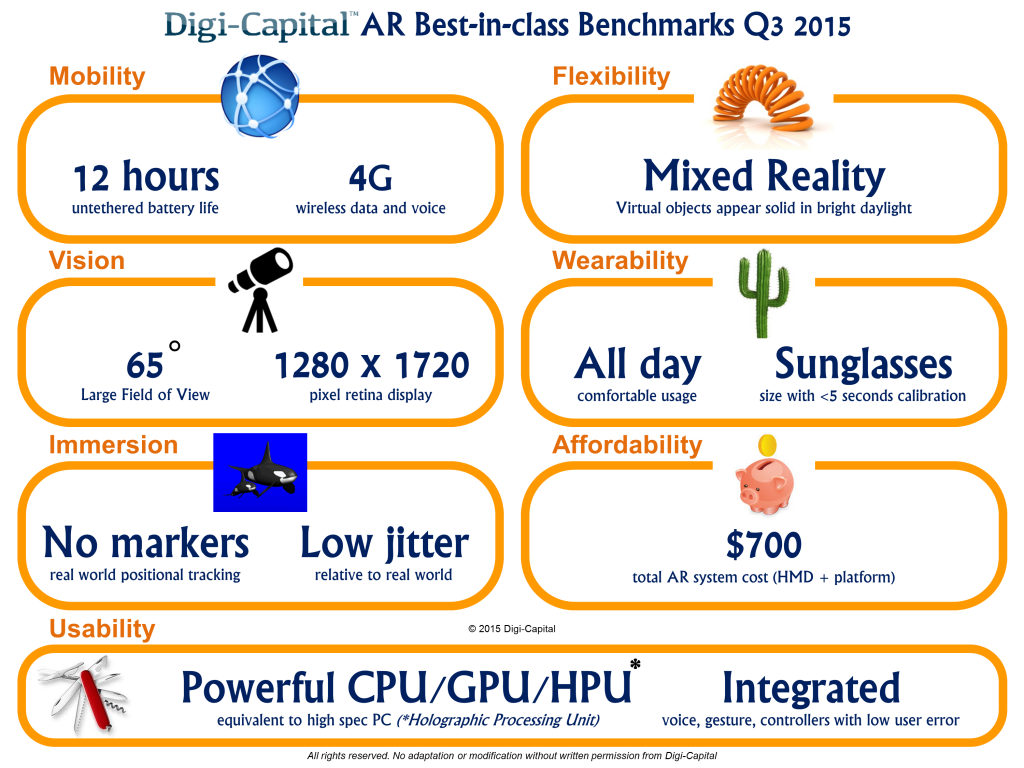
Digi-Capitol: AR/VR technical benchmarks show how far we’ve come
See the full story here: http://www.digi-capital.com/news/2015/10/arvr-technical-benchmarks-show-how-far-weve-come/#.VjGavYSadbw
Sony could take early virtual reality lead over Oculus
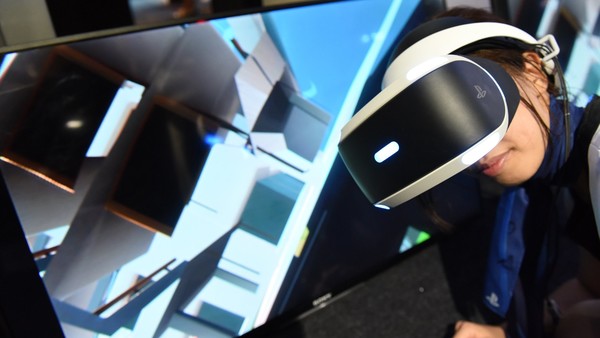 Venture capitalists have invested tens of millions of dollars in VR software start-ups such as Jaunt, Improbable, Altspace and 8i in recent months. Yet IHS is cautious about the VR content market.
“Overall we expect a slow ramp up of adoption and consumption of VR content,” said Piers Harding-Rolls, analyst at IHS. “While the market is more advanced than ever, there are still a number of hurdles that need to be overcome before we see broader consumer adoption.”
However, IHS warned that shortcomings in both technology and content will keep VR to a “niche” audience of early adopters and gamers in its first five years. Its analysts predict that headset sales will lag behind those of Blu-ray players or even 3D television sets at the same point after their launch, with sales of high-end VR systems such as Oculus, Vive and PlayStation VR totalling 2.5m units next year.
“Conditions are more suited to virtual reality technology and content adoption than ever before,” IHS said in its first in-depth study of the market, while adding: “It is neither a bubble nor the next big thing.”
See the full story here: http://www.ft.com/intl/cms/s/0/95749b98-7c8b-11e5-98fb-5a6d4728f74e.html#axzz3pvSlT1Sq
Blippar launches R&D lab and expands into virtual reality with an educational Google Cardboard app
 More than $40 million in funding later, the now New York-based company has launched Blippar Lab, a research and development unit that will be used to explore “innovative use cases for AR and VR across a variety of industries.” The first of these Blippar Lab-branded products is Cardio VR for Google Cardboard, which is aimed at helping children learn about the human body through virtual reality.
If the distinction between augmented reality and virtual reality is lost on you, here’s a summation. AR is when the real, physical world is “augmented” with digital content, such as images or text layered upon a screen. VR is the full recreation of a world in digital, or “virtual,” form.
Cardio VR is available today for Android and iOS (iPhone). To use the app, you’ll need to procure a Google Cardboard device to place your smartphone in, but other brands will work too — I used OnePlus Cardboard to check it out. Without one of the aforementioned VR headsets, the app will look a little something like this.
See the full story here: http://venturebeat.com/2015/10/27/blippar-launches-rd-lab-and-expands-into-virtual-reality-with-an-educational-google-cardboard-app/
Sacramento Kings Take Equity Stake in Virtual Reality Leader VOKE
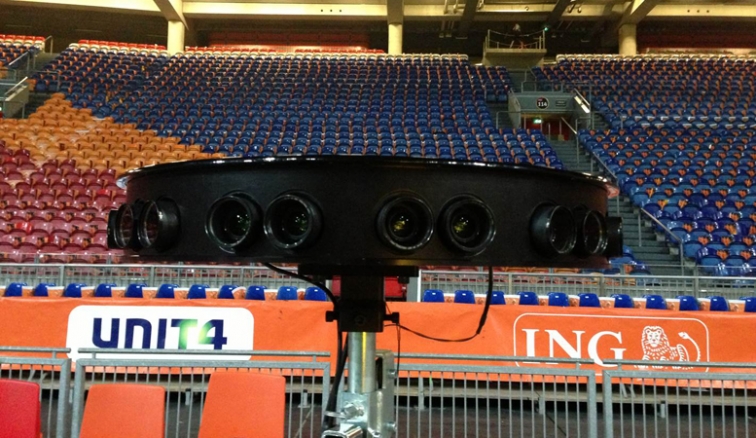 VOKE’s media platform utilizes a synchronized multiple point-of-view stereoscopic panoramic camera system that allows fans to be immersed in live action, as well as access multiple seat locations. A seamless 180 degree view allows viewers to follow the action in every direction. The technology enables mobile devices, computers and virtual reality headsets to utilize the same feed, as well as provide special control in 2D and 3D. Virtual add-ons like scoreboards, advanced player metrics and custom video provides the viewer with more information than ever before.
See the full story here: http://www.nba.com/kings/news/kings-equity-stake-virtual-reality-leader-voke
Wevr Thinks You’ll Spend Hours in Virtual Reality
 The technology Wevr is developing, he added, is intended to make it possible for creators to make something once and publish it on the myriad of VR devices heading to market.
That’s more complicated than it sounds, because those devices can be dramatically different. Some are powered by Android smartphones, while others run on sophisticated personal computers. When a VR app made for the PC won’t run on a phone, for example, Wevr’s plan is to offer users — via apps or embeddable Web widgets — the ability to buy and remotely download that software to their more powerful computers.
“We want to make it frictionless for people who peruse VR to find content,” co-founder Anthony Batt said. “We want developers to know for sure, ‘I can get this out there.'”
The studio has already convinced some Hollywood talent, including “Pulp Fiction” screenwriter Roger Avary and “The Walking Dead” producer David Alpert, to sign on to this plan. Simultaneously, it’s developing more of its own content, including a longer version of theBlu (the CGI whale demo) as well as several live-action video projects, including a 12-minute video/CGI film starring comedian Reggie Watts and a 40-minute trap music concert film.
Batt disagreed with the conventional wisdom that consumers won’t sit through a 40-minute virtual reality experience.
see the full story here: http://recode.net/2015/10/26/wevr-thinks-youll-spend-hours-in-virtual-reality/
Emergent VR, A Smartphone-Based VR Video Capture And Viewing Startup, Raises $2.2 Million
 Emergent VR, a startup that promises full video capture that can be viewed on virtual reality headsets like the Gear VR, has raised $2.2 million from Accel Partners, Rothenberg Ventures and Google Ventures.
Emergent VR’s play is that it can build a simpler experience for users who want to capture video that can be viewed through VR devices. The three Emergent VR demos Wilkins showed me indicated that there would be some element of live video capture as part of the service. The goal was to make it a more seamless user experience than “setting up 20 GoPro cameras” when it comes to capturing VR-optimized video, he said.
One of the big selling points of the company is that the entire capture is done through a smartphone, Wilkins said, which is then shared to Emergent VR’s network.
“We did some tests, and we were able to create a really compelling experience using just content from the smartphone,” he said. “It takes a lot of work to get there, with what we can do with algorithms to make that automatic. We want to just make it a seamless app that people can download, and bring it out of the realm of professional video capture.”
Wilkins was mum on the capture technology, so it remains to be seen whether it works.
This is also Accel Partners’ first investment in a virtual reality startup.
See the full story here: http://techcrunch.com/2015/10/15/emergent-vr-a-smartphone-based-vr-video-capture-and-viewing-startup-raises-2-2-million/?mc_cid=c1edb09e1f&mc_eid=cd6a4d9ecf
Virtual Reality is the New Reality
 If you look at film and cinema, the idea behind it has always been to forget who you are and become lost in another world. You can experience something else and be somewhere else. Virtual reality does that in a game-changing way. It truly is the next evolution of storytelling, and the future of entertainment in general.
CG: Los Angeles continues to attract many innovative companies, entrepreneurs, and startups. Given the intersection between your work and the entertainment industry it seems logical for you to be based out of "Silicon Beach." Overall, what is your take on the Silicon Beach startup ecosystem?
MM: We think it's incredible - it's the future. If you look at the reason that Silicon Valley started there, it's because it's where the chip manufacturers went. Here in LA we focus on entertainment. For example, Snapchat is one of the biggest tech companies in Silicon Beach and they deal with content. Content is a driving force of entertainment.
The name Silicon Beach is clever. But it could even switch away from Silicon Valley, because Silicon Beach is not based on silicon. The really neat companies in Los Angeles are really more about connecting people through entertainment.
See the full story here: http://www.huffingtonpost.com/carlos-m-gutierrez-jr-/virtual-reality-is-the-ne_1_b_8283072.html