Will Virtual Reality Get Lost in the Uncanny Valley Of Sound?
 Visuals get the front page (for obvious reasons), but we’re quietly entering an age of more advanced speaker technology. Binaural audio, for instance, puts a microphone close to each ear and drastically increases the numbers of loudspeaker in sound systems. Rumsey, the technical chair of the Audio Engineering Society and the director of sound consulting company Logophon, tells Inverse that this represents progress, but not a breakthrough. “In many cases what we would call the timbral quality of sound — that’s the sound of color, and what novices think of as sound quality — has not necessarily increased correspondingly,” he explains. “And that led me to wonder whether there was something rather similar to what has happened in the video animation field.”
The best systems out there right now use surround sound or wave field synthesis systems, which use a large number of loudspeakers to simulate movement and the audio effects of environment. According to Rumsey, “the results are not as convincing as we’d hope them to be.”
Binaural audio and other virtual reality sound reproduction methods have the potential to be very good, “but also potentially very odd and disturbing if they’re not done absolutely perfectly.”
The uncanny valley isn’t a completely mapped-out psychological landscape — some researchers doubt its existence or think that it might disappear with conditioning, but other scientists have proposed an uncanny cliff, in which attempts to go back up the other side to human ultimately fail.
In the 2009 paper “The audio Uncanny Valley: Sound, Fear and the Horror Game,” music professor Mark Grimshaw, then at the University of Bolton in the U.K., proposes that freaky sounds are desirable in certain settings.
When it comes to 3D spatial sound, you could mess with the binaural phase so that “the sound to one ear is pushing where the other one is pulling,” according to Rumsey. Otherwise, intentionally altering voices to make them artificial or odd (the Bane effect) isn’t really a new idea. “People have done that forever,” Rumsey says. He’s worried more about our unintentional flubs, because the auditory equivalent of rubberized Tom Hanks is all the more disturbing when you’re least expecting it.
See the full story here: https://www.inverse.com/article/5365-will-virtual-reality-get-lost-in-the-uncanny-valley-of-sound
This Dubai hotel entices would-be guests with virtual reality experiences before they ever book
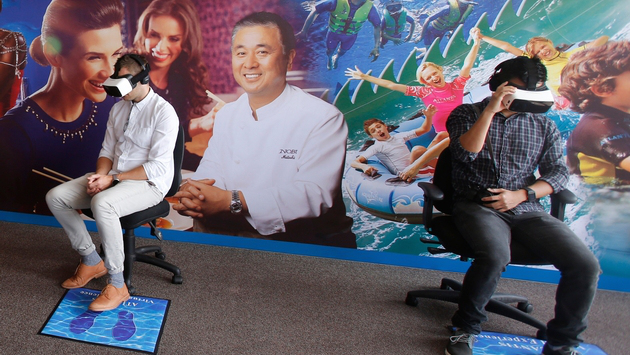 You don’t have to fly to the Middle East to plummet down the world’s largest water slide or zipline across an island oasis. Atlantis, The Palm – Dubai’s luxury hotel island – has deployed a virtual reality headgear program to entice would-be guests into making the journey across the globe to experience these attractions and more.
The headsets have been making their way across the world on the travel industry conference circuit this summer, popping up in the Middle East and Los Angeles.
The technology doesn’t stop once guests have booked a stay. The Palm has deployed interactive Apple iBeacons — electronic beacons that communicate with guests when they pass certain points — throughout the property. Guests can even play a mobile explorer game when they visit the resort’s massive Lost Chambers Aquarium and travel through resurrected ruins of the mythical lost city of Atlantis. Liam Findley, vice president of marketing for Atlantis, The Palm says the industry is only just getting started adopting this type of technology.
Learn Immersive raises money to build out language learning concept
 [Philip Lelyveld comment: Great idea, but curious implementation. I'd suggest piggybacking on Periscope / Meerkat and creating live language sessions with strangers.]
To Tony Diepenbrock, the best way to learn a new language is to travel to a country where that language is spoken and try to make life work there. Just drop into the middle of France or Spain and learn how to buy groceries or park your car by reading signs, asking questions and responding to native speakers. However, Diepenbrock and Learn Immersive co-founder Charles Moyes raised a $400,000 angel round to build out their immersive language learning platform that can extend from the browser to room-scale VR. They hope a 3D environment and the feeling of presence people experience in VR will provide the same kind of exploratory learning experience as actually being there along with the sink-or-swim motivation to absorb information, all without spending the time and money to relocate.
The pair started Learn Immersive and they’ve built out a basic concept in Unity that allows teachers to use a drag-and-drop interface in an Internet browser to build out a virtual scenario for students learning a language with questions, answers and audio cues. They call it “Blueprint” and hope that by starting in the browser it will give people without access to head-mounted displays a way to use the platform to build out scenarios that can teach English, French or Spanish. However, they are banking on the idea that a more powerful learning experience is possible with high-quality, low-cost VR like the Rift and Vive giving people the sensation of reaching out and grabbing objects.
See the full story here: http://uploadvr.com/learn-immersive-language/?mc_cid=78762c11fd&mc_eid=cd6a4d9ecf
SIGGRAPH 2015: More on VR and 360 Degrees of Experience
August 17, 2015
Last week we reported that beneath the aura of excitement generated this year at SIGGRAPH 2015 by the prevalence of virtual reality, a number of compelling panels examined the nuts and bolts of creating VR experiences, including managing workflow and assets. Part 2 of our report on SIGGRAPH VR panels continues with coverage of the VR Village sessions Creating on the Edge and Convergences in Film and Games Technologies, featuring perspectives from professionals in production, post production, visual effects, gaming and journalism.
Creating on the Edge featured case studies from VR creators that, the conference program guide defined, “illustrate the power of the VR/AR/immersive medium and convey a vision of its potential impact on our lives.”

Emblematic Group’s Nonny de la Pena, who develops Immersive Journalism VR experiences, responded to the question about the need for photorealism by saying that we are hardwired to accept representations of ourselves. We can accept abstract representations as long as the experience feels real.
Jaunt Studios head Grant Anderson tackled some of the practical lessons of shooting VR. “Consider splitting the 360 degree camera shoot into two 180 degree shoots until we learn how to handle it better,” he suggested. This is one way to get around the need to find ways to hide the crew, such as making them costumed background players or hiding them behind rocks and trees.
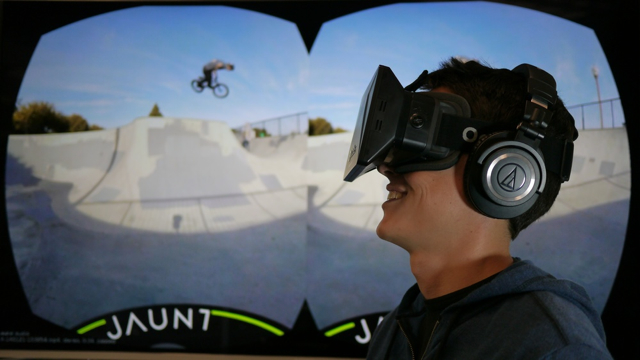
Anderson, who brings many years of experience as a 3D supervisor also pointed out that while a “close-up” is a “big-up” in 3D, it is an “in your face” in VR.
Walt Disney Imagineering’s Mike Mine noted that Disney had to address the creative issues linked to a 360 degree viewing experience decades ago with Circle-Vision. They found that the audience felt like they had to look everywhere, which could feel like work to them.
Workflow and asset management were themes at the Convergences in Film and Games Technologies panel.
Bill Polson, director of Industry Strategy at Pixar, noted that there is now a sharing of production tools and techniques between games and film. But, he added, once you get to post production, the nomenclature changes. He is wrestling with the problem that asset creation and labeling is still a very one-off process. A coffee cup may be one object or a group of components. Asset management is based on the structure of the organization, and must be able to accommodate multiple representations of the same artistic creation, he said.
Rob Bredow, an award-winning visual efforts supervisor and technologist now leading the forward-thinking ILMxLAB, noted that you need to think in terms of systems and content rather than shots. In a CG-rendered VR experience, it is “a 12 hour show. You can’t noodle individual scenes.”
Colin Penty of The Coalition, the team at Microsoft Studios responsible for the blockbuster “Gears of War” franchise, pointed out that game engines must run complex systems that interact. That interaction can reveal story, so game engine design should be viewed as another creative VR storytelling tool.
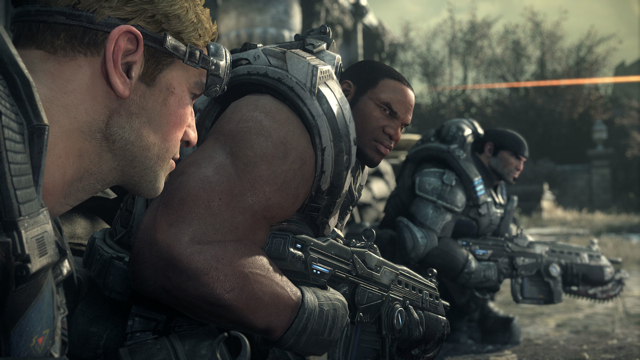
Today the metrics for CGI-rendered movies and rendered games are very different, Penty noted. A single frame in an animated movie may take over one hundred hours to render, but he measures render time for photorealistic games in milliseconds.
In his closing comments, Pixar’s Polson said that VR is a chance to reinvent workflow.
ILMxLAB’s Bredow said that in Hollywood, content is king. In gaming, fun is king. But in VR we are converging on a place where the story behind the fun is increasingly important.
For more of our VR coverage from SIGGRAPH 2015, check out Part 1 of this story.
See the original post here: http://www.etcentric.org/siggraph-2015-more-on-vr-and-360-degrees-of-experience/#more-95249
8i Introduces 3D Video #100humans Portrait Series
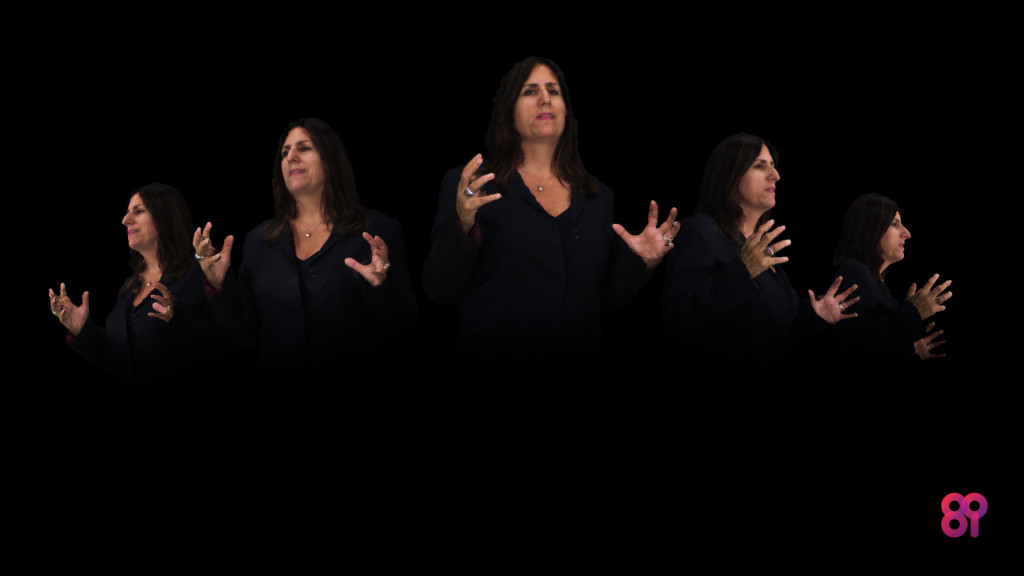 With the likes of Samsung, Nokia, and Google touting their latest 360-degree cameras, 8i is moving forward with a different approach and taking off-the-shelf video cameras to create 3D videos that can be viewed from different angles. 8i is basically transforming flat video into rich 3D experiences that will mesh with VR devices like the Oculus Rift or HTC Vive.
8i is not just testing this on just a few subjects either. Over the past month, they have opened up a studio in LA and have been inviting artists, athletes, educators, social media influencers, and even a few familiar veteran VR faces, to stand in for their #100humans portrait series.
See the full story here: http://vrscout.com/projects/8i-introduces-3d-video-100humans-portrait-series/
Hollywood Uses Bigger Screens to Tell Sophisticated Stories
 “There is a kind of show business in the fall that we’ve never had before,” said Greg Foster, the chief executive of the IMAX Corporation’s entertainment unit. He spoke of the confluence of films aimed at adults, many in 3-D, that will be delivered in IMAX and other large (and premium-priced) formats this year, pointing toward higher seasonal ticket sales, and perhaps a significant shift in viewing habits.
Some film executives see potential for industry transformation, if mature viewers indeed flock to a more sophisticated lineup of event films. “The word I would use is ‘necessary,’ ” Tom Rothman, the chairman of Sony Pictures Entertainment’s motion picture group, said of the envisioned change.
If adults are more willing to don 3-D glasses — among those ages 50 to 59, 3-D viewing hit a peak in 2013, when Alfonso Cuarón’s “Gravity” was a hit — that is partly because film exhibitors and related companies have been courting them to fill newly created capacity.
This year RealD, a supplier of 3-D technology, pushed its screen count past 27,000, up more than 6 percent from last year, even as 3-D viewing among the young fell sharply from a high in 2011, when “Harry Potter and the Deathly Hallows — Part 2” was a draw, before rebounding this summer. Similarly, the Cinemark, Regal and AMC theater chains now operate more than 430 proprietary premium large-format screens, up 34 percent from 320 in 2013.
IMAX, a giant-screen pioneer, has pushed its global screen count to almost 1,000.
“The more palpable and immersive the experience,” he said, “the more personal the film feels.”
SIGGRAPH 2015: Talking About VR, 360 Degrees of Experience
Beneath the aura of excitement generated this year at SIGGRAPH 2015 by the prevalence of Virtual Reality, a number of panels drilled into the nuts and bolts of creating VR experiences, including managing the workflow and assets. From a Birds of a Feather interest group discussion to panels of senior artists from the major studios and visual effects companies, almost everyone agreed that VR represents creativity on the edge. Siggraph offered a 360 degree look at the issues and lessons so far learned. PART 1 Birds of a Feather meetings at Siggraph tend to welcome a diverse group of professionals and aspirants. In the session Let’s Talk VR, the group got into specifics on the current state of the VR experience.
Cinematographer Andy Schulkind of HeadcaseVR noted that high frame-rate capture is a ‘gamer attitude.’ He finds that 30 fps looks more cinematic.
Mike Murdock of Other World Interactive recommended that you keep the experience design simple to reach the widest audience. Don’t even assume that the magnet on the side of Google Cardboard works, he said. Murdock is using gaze-based storytelling techniques. Since the viewer can look anywhere, his software monitors head motion and doesn’t advance the story until the viewer has looked in the direction of key story elements.
“When you are introducing a new technology, you should keep the story simple and timeless, so the viewer doesn’t have to figure out two things (e.g. tech and story) at once,” said Mirada’s Andrew Cochrane. 
The game Nevermind was mentioned a few times as an interesting niche experience using specialized peripheral devices. Nevermind takes data from biofeedback monitors and increases the scariness of this VR horror story as the player’s heart rate increases.
During the VR: Creating at the Edge panel, Disney Imagineering’s Mark Mine commented that the resolution and FOV (field of view) in VR displays is still too low. He would like 60 pixels per degree, which translates to an 8K display, he said. He also stressed that vertical FOV is possibly more important than horizontal FOV. We look down a lot. His framerate sweet spot is 80-90Hz. Attractions in Disney Parks, like Soarin’ Over California, use 120Hz and have low persistence projectors.
Richard Marks of Sony Magic Lab reported that the Morpheus HMD has a 100 degree FOV, a 120Hz display, and a user-friendly design. The display tilts up so you can see the real world when you need to without having to take the entire HMD off. He pointed out that it is easier to design VR experiences for a game platform than for the PC, since the specs on the game platform are standardized.
As for user experience, Richard reported that a multiplayer collaborative VR experience is surprisingly satisfying. Enabling the players to talk to each other, and implementing spatial audio so each avatar has a sense of their position relative to other avatars, adds a lot. Their user tests also found that people enjoy simple physical gestures, such as waving to each other. Development challenges include creating more realistic movement, such as more natural gesturing, involving Inverse Kinematics (IK).
Our report on VR sessions at Siggraph continues next week.
See the original post here: http://www.etcentric.org/siggraph-2015-talking-about-vr-360-degrees-of-experience/
Zero Latency: The VR revolution begins in Melbourne, Australia
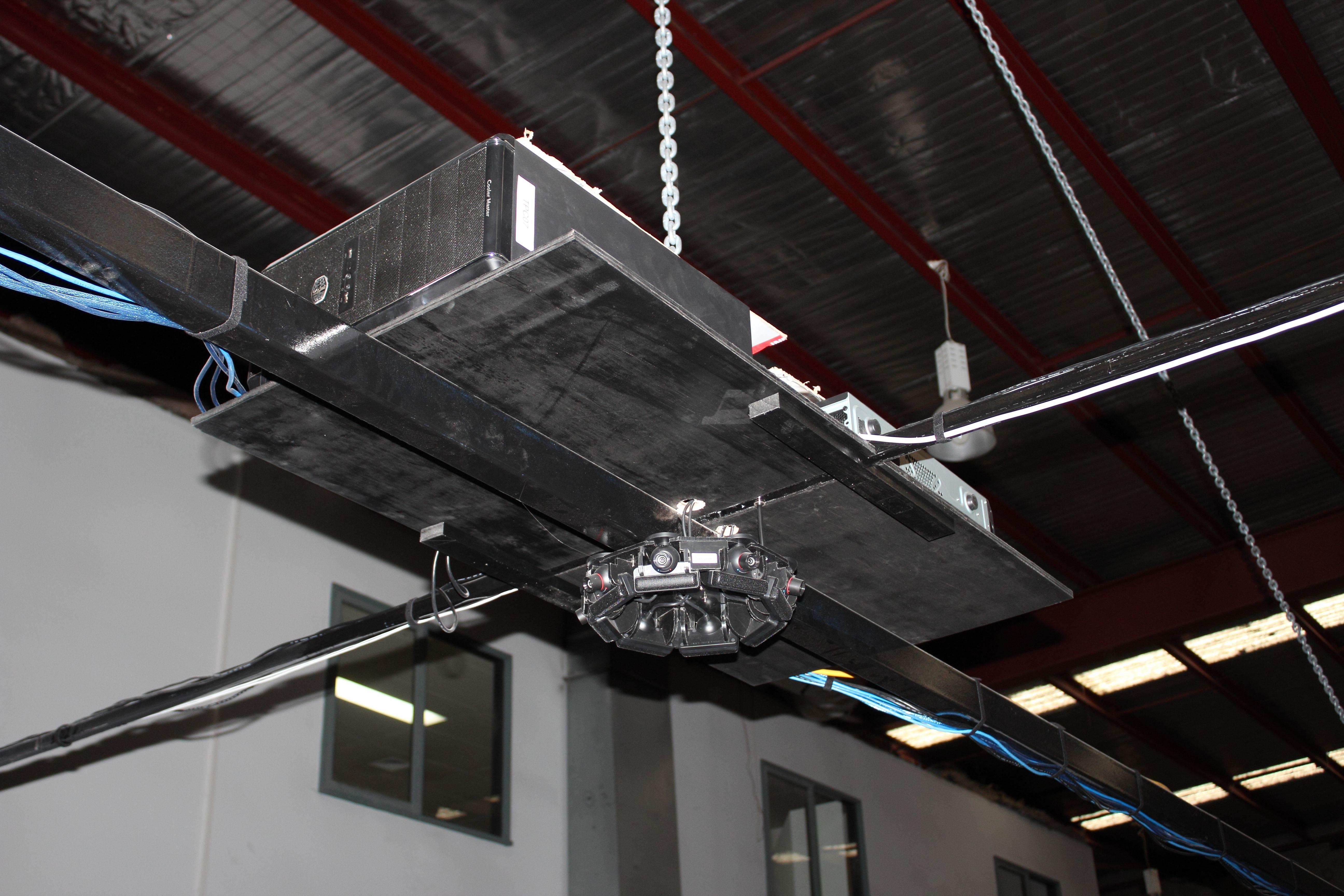
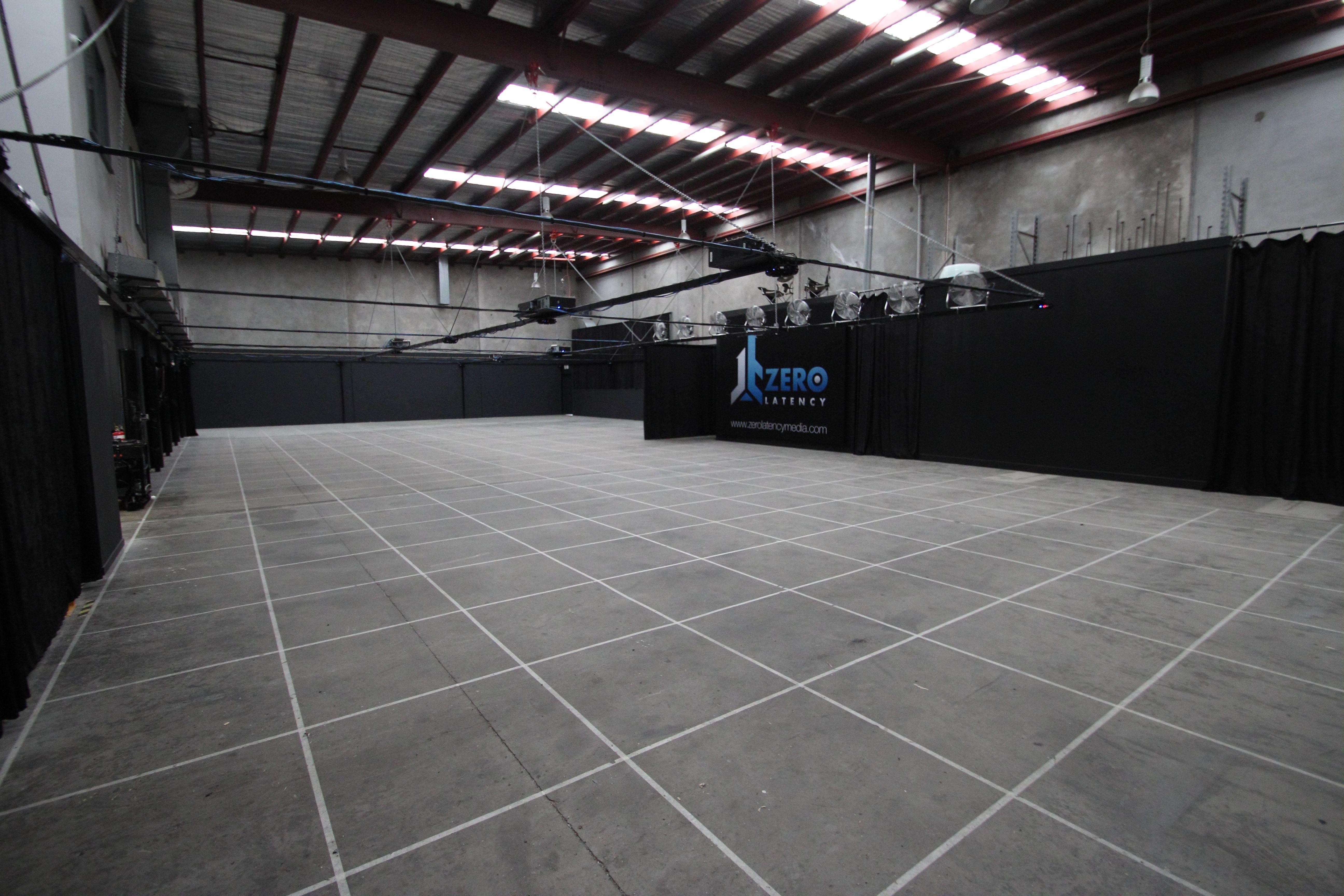 I've been playing Zero Latency for mere moments and already I'm amazed at how it overwhelms my senses. This is the world's largest virtual reality (VR) attraction, and its doors open August 15 in North Melbourne, Australia.
Vandonkelaar had been working on an optical tracking system to track battles of radio-controlled battleships armed with BB-guns, but when he saw the success of the Oculus Kickstarter campaign, he realized his tracking system could work beautifully when combined with VR.
Like the HTC Vive, Vandonkelaar's idea allowed players to walk around a real-world, physical space whilst wearing a head-mounted display. However, Vandonkelaar had grander ambitions about the size of the playing area. Instead of keeping the action confined to a single small room like Vive, he wanted to place up to six players in a much larger space.
Zero Latency soon formed and grew to a team of six full-time staff with extra contractors brought on board for specialist duties.
...Next stop on the funding tour was Film Victoria, a state government funding body, where a grant for $60,000 was approved. ... under the title "Zombie Fort: Smackdown."
After three years of research and development, Zero Latency is ready to open its doors to the public on August 15. The game offers a one-hour cooperative experience for four or six players, and tickets are currently selling for AU$88 (about £40 or $65) per person. Online sales began in early August, and in a week, hundreds of eager gamers had already signed up for this world-first experience.
All 400 square metres (4,300 square feet) are covered in a white grid pattern to aid camera rigs mounted above the playing area in monitoring each player's movements. Covering the entire play space are 129 Sony PlayStation Eye cameras driven by the team's proprietary software. They're arranged in circular rings that cover a 360-degree view, each ring with its own dedicated controller PC.
As the games master suits us up for the battle ahead, I'm pleasantly surprised by the weight and comfort of the backpack. Each pack houses a heavily customised Alienware Alpha PC to render each player's view of the world. Looking like a Proton Pack from "Ghostbusters," it sits easily in the square of my back, despite including its own power source. The Oculus Rift DK2 and a set of quality headphones are tethered to the backpack, and a glowing orb sits on top of the headset.
We're then handed our weapon for the impending zombie apocalypse: a large five-pound rifle machined from a solid block of PVC plastic on the massive computer-controlled milling machine, tucked away in a workshop at the back of the warehouse....
The next 40 minutes are spent walking through a variety of virtual locales, from open city streets to cramped laboratories. The warehouse itself was around 100 metres (328 feet) in length, but clever use of loading screens and level design mean I ended up walking over 10 times that during my experience. Combine this with the weight of the gun and by the end of the hour I was exhausted, dripping in sweat and my arms ached.
It's the best virtual reality experience I have ever had. And I have tried them all since Dactyl Nightmare almost made me puke back in 1991.
See the full story here: http://www.cnet.com/news/zero-latency-vr-entertainment-revolution-begins-melbourne-australia/?curator=MediaREDEF
VR Sickness? Leave Your Sick Bags Behind Thanks to Light Field VR
The Stanford team found a clever way to make your eyes focus inside its device. Using the same principal as a "light-field" camera like the Lytro, but in reverse, they built a headset that has transparent LCD panels stacked in layers, which each layer representing a light field with the correct depth information. As shown in the video simulation (bottom) that helps your eyes to naturally shift focus between front and near objects.
Before any of that can happen, however, there's still a lot of work to do. The extra images required for light-field effects cause "rendering times to grow quadratically," according to the paper. The stacked display will also need to be brighter and have more resolution to reduce artifacts like diffraction.
See the full story here: http://www.vrcircle.com/post/VR-Sickness-Leave-Your-Sick-Bags-Behind-Thanks-to-Light-Field-VR