First Quantum Music Composition Unveiled
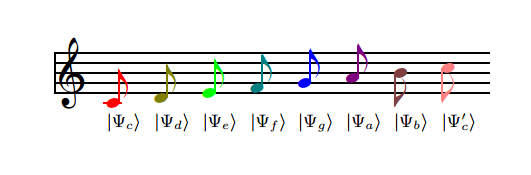 They begin by thinking of the seven notes in a quantum octave as independent events whose probabilities add up to one. In this scenario, quantum music can be represented by a mathematical structure known as a seven-dimensional Hilbert space.
A pure quantum musical state would then be made up of a linear combination of the seven notes with a specific probability associated with each. And a quantum melody would be the evolution of such a state over time.
An audience listening to such a melody would have a bizarre experience. In the classical world, every member of the audience hears the same sequence of notes. But when a quantum musical state is observed, it can collapse into any one of the notes that make it up.
And since this process is random for all observer, the resulting note will not be the same for each member of the audience.
The researchers go on to discuss the strange quantum phenomenon of entanglement in the context of music. Entanglement is the deep connection between quantum objects that share the same existence even though they may be in different parts of the universe. So a measurement on one immediately influences the other, regardless of the distance between them.
There is one obvious problem, however. Nobody knows how to create quantum music or how a human might be able to experience it. Svozil and Putz’s work is entirely theoretical.
Google Glass mark X gets eye-tracking with new patent
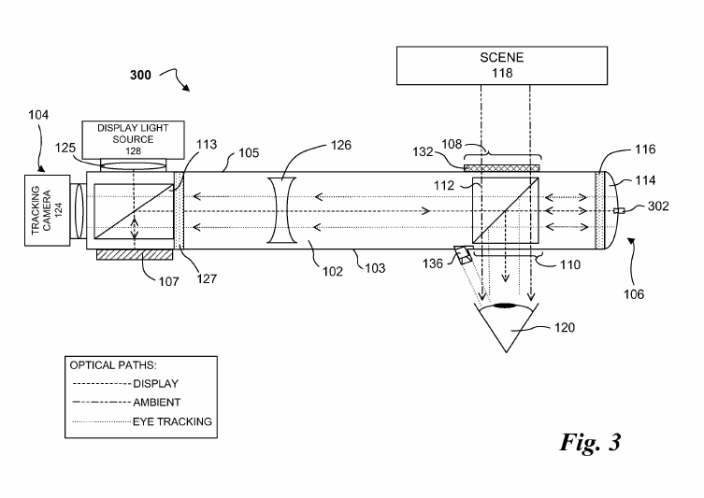 The patent that is fueling the rumors about Google Glass describes a complicated technology that uses prisms to take photos of the eyes and juxtapose the data from that photo (the direction the eye is looking at) and synchronizing the images captured by the video feed and with GPS data in order to provide relevant information about the location you’re pointing at.
See the full story here: http://www.geeksnack.com/2015/04/14/google-glass-mark-x-gets-eye-tracking-with-new-patent/
Eating the Uncanny Valley: Inside the Virtual Reality World of Food
 Myo Studios is banking on the notion that providing an enhanced visual experience through virtual reality will markedly up its food blog’s ante. Users will be able to “sit down in front of a steak from some restaurant, even though there’s no reservation for three months.” The VR food blog will also be able to “teach someone to cook from a first-person perspective.” DePaula-Santos told me, “One of my hopes is to not just take photographs of food, but also be able to animate it. If you see a sizzling steak in front of you, that’s just one way of stimulating more senses.”
“What about smell?” Perception Fixe is not quite there yet—it is only a visual virtual reality experience.
...what about the all-important act of actually consuming food in the VR world? Word of mouth led me to an ongoing project out in LA, ...
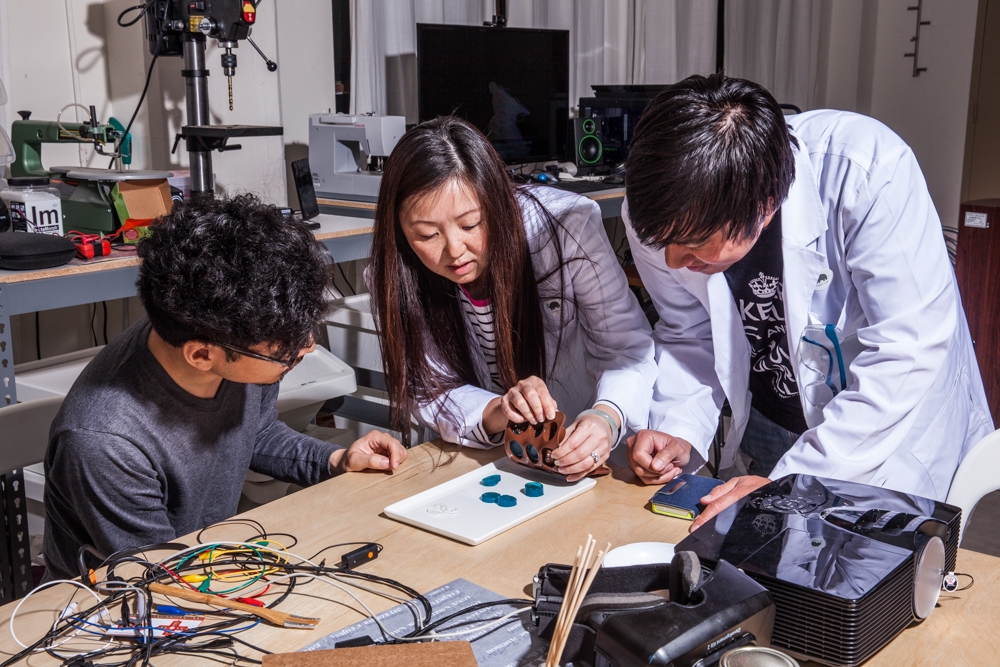
Project Nourished—created by Kokiri Labs and its founder, the ever-entrepreneurial Jinsoo An—bills itself as a “gastronomical virtual reality experience.” This mashup of molecular gastronomy and virtual reality allows users to “experience fine dining without concern for caloric intake of other health-related issues.”
...here’s the deal: You put on your VR headset, Oculus or otherwise; you lift your “food detection sensor,” which, at this stage of development, looks like nothing more than a wooden fork with two prongs wrapped in tinfoil; you eat a hydrocolloid—a flexible substance that is “viscous, emulsifiable, and low caloric”—that has been shaped in a 3-D printed mold to “add physical characteristics to the ‘faux’ food.” Then, with the help of a motion sensor, an aromatic diffuser, and a bone conduction transducer (more on that later) you experience a gourmet meal with no downside in the way of calories, carbs, or allergy-inducing ingredients.
The first three foods to be replicated in hydrocolloid form? Sushi, steak, and apple pie.
Despite its humble roots as a one-man endeavor, Project Nourished has ballooned into a multi-headed beast with a total of 11 creatives, each with varying backgrounds, including Mike Resendez, the molecular mixologist from The Bazaar’s Beverly Hills outpost, and Mark Manguera, the co-founder of LA’s Kogi and Chego.
As hard as it is to get smell right, hitting the mark when it comes to replicating texture or toothsomeness is even more difficult.
...Project Nourished is being pitched as a possible remedy for anorexia, bulimia, diabetes, heart disease, obesity and allergies.
See the full story here: http://munchies.vice.com/articles/eating-the-uncanny-valley-inside-the-virtual-reality-world-of-food
NAB Show: Peter Guber Calls on Broadcasters To Embrace Virtual Reality
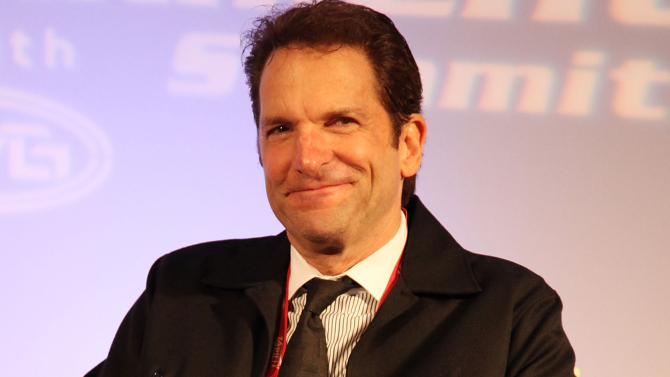 the industry should be devoted to a single idea: “a constant and never-ending quest to deepen the engagement and immersion of our audiences. This imperative must be kept centerstage if you want your technology and your content to yield treasures instead of time bombs.”
Guber said that while then entrenched powers in entertainment would prefer to see a gradual evolution, “What we have on our hands to today is a revolution, and revolutions can be lethal. But in that chaos lies all of our opportunity.”
Then he turned specifically to virtual reality headsets. The arrival of VR on cell phones — which we’re all addicted to, according to Guber — combined with immersive content, “will change everything,” he said. “It will not end newspapers, it will not end radio, it will not end television. … But it does drive the most important single imperative: audience immersion and engagement with the medium.”
See the full story here: http://variety.com/2015/digital/news/nab-show-opening-keynote-peter-guber-virtual-reality-1201471360/
Latest Version of ‘Virtual Desktop’ is Here, The Free App That Makes Your Entire Windows Computer Oculus Rift-capable
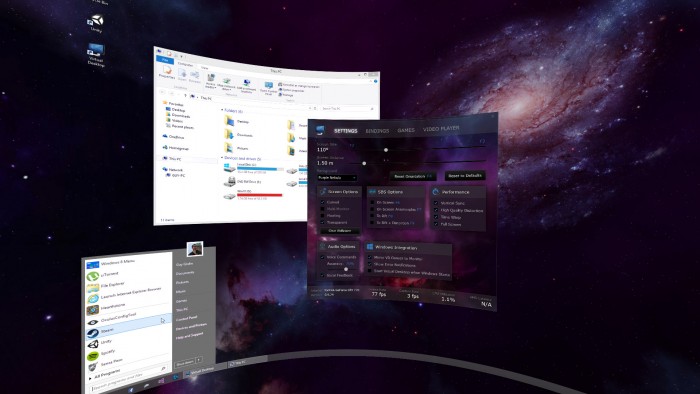 Virtual Desktop, a free app that instantly makes the entire Windows operating system VR-capable. Essentially anything that you can use on your monitor—whether it be Minecraft, Facebook, or Photoshop—you can use in VR with Virtual Desktop.
When you launch Virtual Desktop and don the Oculus Rift, you’ll be greeted with a curved, floating version of your familiar Windows desktop—wallpaper, icons, Start button and all—albeit surrounded by stars.
Given the relatively low resolution of the Oculus Rift DK2, some Windows programs will be more usable than others. Fortunately, Virtual Desktop makes it easy to change the field of view on the fly, allowing you to zoom in (F3) and out (F2) as needed. At 100 degrees right now I’m typing quite comfortably with text that’s easy to read. If I was watching Netflix however, I might dial it back to 80 degrees or so to ensure that I can see the whole screen.
Virtual Desktop also allows for easy viewing of side-by-side content (like 3D photos and videos) as well as spherical video in both 180 or 360 degrees, and optionally in 3D.
Virtual Desktop may still be in beta according to its developer, but it works surprisingly well. At the great price of free there’s no reason not to check it out.
See the full story here: http://www.roadtovr.com/the-latest-version-of-virtual-desktop-is-here-the-free-app-that-makes-your-entire-windows-computer-oculus-rift-capable/
MINI Reveals Augmented Reality Vision: Big Data Goggles for Drivers

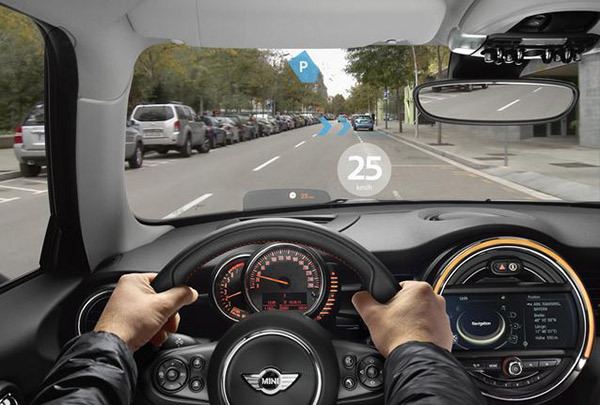 The automaker is debuting augmented-vision eyewear at the Shanghai auto show (which opens on April 22) that will allow drivers wearing them to see “through” blind spots in the vehicle, and use big data to better navigate, park and manage communications.
The project was spearheaded by BMW Group Designworks (which has just rebranded in the US to simply “Designworks” but is still owned by the German auto giant) in partnership with Qualcomm.
The glasses’ coolest feature may well be the “X-ray vision” that allows for drivers to see what’s on the other side of blind spots. Cameras mounted on the vehicle will help drivers see pedestrians, obstacles and other vehicles in a whole new way.
The eyewear will capture and monitor data inputs from the driver, including navigation data, speed, speed limits, points of interest, messaging alerts from a connected phone, and, of course, augmented parking.
See the full story here: http://brandchannel.com/2015/04/10/mini-augmented-reality-041015/
Israeli augmented reality startup nabs $5M funding led by Japanese Pachinko company
 InfinityAR makes a software-based augmented reality (AR) engine that will let people interact with augmented content in their physical surroundings. It’s less Google Glass and more Microsoft Hololens. InfinityAR says it "can turn any device with two simple cameras into a powerful content augmentation platform."
InfinityAR’s technology maps the 3D environment, in real time, and enables projecting augmented reality 3D scenes as if they were part of the real world. Furthermore, it enables the user to control augmented reality content using natural hand movements.
The technology works indoors and outdoors and requires less computation and energy resources than competitors, says the company in a statement.
See the full story here: https://www.techinasia.com/israeli-augmented-reality-startup-nabs-5m-funding-led-japanese-pachinko-company/