Fidelity’s Oculus App Lets You Fly Through Your Investments
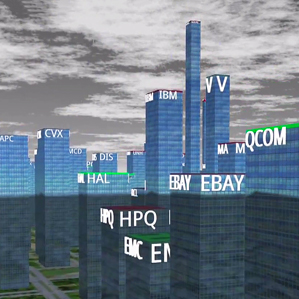 [Philip Leyveld comment: VR allows you to break out of the limitations of the computer display 'frame' and be surrounded by data. This is an example of immersive data visualization. Productivity tools, even more than entertainment, may be VR's future.]
In Fidelity’s prototype virtual environment—which it says is the first financial services app written for Oculus—stocks are represented as office towers and lumped together in sector “neighborhoods.” The buildings’ footprints are shaped by trading volume and their rooftops are red or green depending on changes in price.
Fidelity is not claiming to have solved any actual problems with the app. But with $2 trillion under management, it wants to get ahead of how new interfaces might be used. “We have a hypothesis that virtual reality will take off in the consumer set in the next three to five years, so therefore we want to understand the technology,” says Hadley Stern, vice president at Fidelity Labs, a research wing of the brokerage company. “We want to get their feedback on this and start to think: how would active traders and other investors use virtual worlds to understand data?”
The company is unveiling the app, called StockCity, this week at a trade show for stock traders in Las Vegas.
But for now, Fidelity isn’t letting anyone access actual brokerage accounts until it works out security and user-authentication protocols for goggle-wearers.
5 Insights for New VR Developers from DreamWorks Animation Head of Technology Product Development
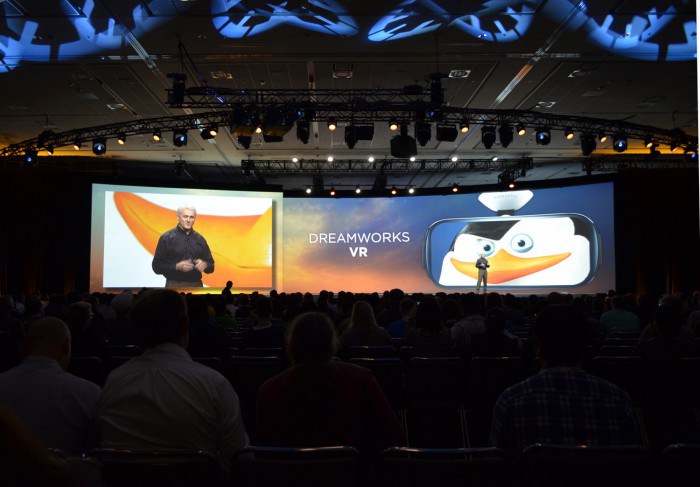 At Samsung’s 2014 developer conference last week, Warren Mayoss, Head of Technology Product Development at DreamWorks Animation, took to the stage during the second day keynote to talk VR. Mayoss shared some of the initial work that DreamWorks has done with virtual reality, including five insights for new VR developers.
Mayoss, who worked previously with EA for many years, was crucial to the launch of DreamWorks’ virtual reality initiative which seeks to extend the company’s storytelling franchises into new immersive experiences. That initiative manifests in the ‘DreamLab’, led by Brad Herman, where the company is experimenting with virtual reality.
1. Develop for the Medium “Don’t just assume that a flat screen will work.
2. Real World Phobias May Translate to VR Because VR is so immersive, developers have a responsibility to not only make experiences comfortable, but also not traumatic (unless of course that’s what the user wants).
3. VR is a New Medium “What you don’t want to do is present them with a lot of menus and instructions to get them into the game. Get them get into the experience and let them get comfortable and then start to tell them what to do… guide them with what you want them to do,” rather than bombarding them with text and info.
4. Start Prototyping
VR is new, and like the early days of any medium, best-practices are still being defined. Methods for everything from functional UI design to avoiding sim sickess are still being uncovered. Time and time again we hear stories of researchers and developers deploying what seem like obvious solutions only to have their expectations crumpled up and tossed to the trash bin.
“Start prototyping and developing. The only way we’re going to understand what works in VR and what doesn’t is to actually just start developing,” Mayoss said.
“We worry about motion sickness in these kinds of things so we’ve been experimenting with low-frequency vibrations and audio to try to make people more comfortable, it interrupts your processing…”
“For mobile VR, the high framerates and low latency requirements are very critical…
5. Business of VR Gear VR’s launch will help us in the mass market consumer proposition and so we think that app monetization will be similar to mobile,” he said. “You need to ask yourself what you want to do, what your goals are, and what you would do to stand out…”
See the full story here: http://www.roadtovr.com/5-insights-new-vr-developers-dreamworks-animation-head-technology-product-development/
Industry Leaders Join Forces to Form Streaming Video Alliance
 In an effort to develop universal standards and best practices for high-scale Internet video services, 17 content companies, service providers and technology vendors have gathered to create the Streaming Video Alliance. Together, these companies hope to improve the online video experience. SVA will initially focus on open architecture, quality of experience, and interoperability. Formation of the group comes as net neutrality continues its path as a complex and controversial issue.
The Streaming Video Alliance has three tiers of membership: sponsor/founding member ($25,000 annually); full member ($12,500); and supporting member ($5,500).
The group will focus on three initial areas: open architecture, to define specifications for network and cloud-based streaming and caching infrastructure; quality of experience, to create a common approach to defining, measuring, optimizing and reporting quality of the video streaming; and interoperability, to create standards for streaming video.
The group consists of the following companies: Alcatel-Lucent, Charter Communications, Cisco Systems, Comcast, Epix, Fox Networks Group, Korea Telecom, Level 3 Communications, Liberty Global, Limelight Networks, Major League Baseball Advanced Media, Qwilt, Telecom Italia, Telstra, Ustream, Wowza Media Systems and Yahoo.
Interestingly, SVA was founded without Netflix or YouTube, which are currently the greatest sources of Internet bandwidth usage, and have both invested heavily in their own distribution infrastructures.
Founding members of the Streaming Video Alliance (streamingvideoalliance.org) will meet together at least twice per year in person, and committees will have regular calls and meetings to create specs. The SVA is not a standards body, Rayburn said; rather, it plans to propose technical specs to relevant standards bodies.
See the full story here: http://variety.com/2014/digital/news/streaming-video-alliance-trade-group-launches-without-netflix-or-youtube-1201356366/
and here: http://www.etcentric.org/industry-leaders-join-forces-to-form-streaming-video-alliance/
Microsoft pilots 3D audio technology to help blind people navigate
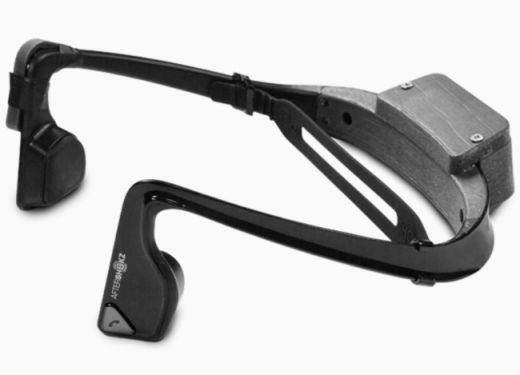 [Augmented Reality technology has tremendous potential for helping sensory-impaired people. Adding motion-capture (Kinect, Leap Motion, ...) technology to headsets could allow visually impaired people to hear their surroundings. This Microsoft approach, though, seems like a commercial development with an ADA pitch tagged onto it. You'd have to put beacons on everything around the person to make this useful for the visually impaired.]
Microsoft is piloting a project in the UK to investigate the potential benefits of its 3D audio technology on those with visual impairments.
The computing giant partnered with the Guide Dogs charity, alongside Network Rail, Reading Borough Council, Reading Buses, Future Cities Catapult (an urban planning company) and supermarket powerhouse Tesco.
Using a set of bone-conducting headphones placed around the back of the wearer’s skull, a mini network of indoor and outdoor beacons work in tandem with a smartphone to enable the user to ‘hear’ their way around an area.
The Bluetooth beacons are fixed to physical objects which then communicate information back to the walker. It’s effectively creating what it calls a “sensor-boosted physical environment” and a 3D soundscape with verbal cues – this may be GPS navigation, bus time arrivals, or even tourist information.
You may be wondering why Tesco’s help has been sought here. Well, for the pilot, users can be guided to the aisle they’re looking for.
See the full story here: http://thenextweb.com/microsoft/2014/11/06/microsoft-pilots-3d-audio-technology-help-blind-people-navigate/
Self-Tracking Suitcase Passes $1M On Indiegogo
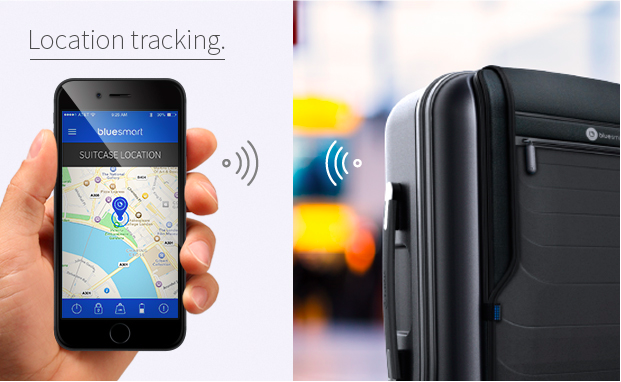 [Philip Lelyveld comment: Given that the internet of things is rapidly coming, this product could have a very short window of first-mover advantage. It cries out for standardization, so airlines could be issued one-time unlocking keys and we could go back to locking our luggage.]
From wearables to moveables, the rise of the sensornet rolls on: a Bluetooth-connected suitcase which keeps tabs on where in the world you’ve traveled and tracks its own location using GPS so you’ll never have to leave the lost luggage department with a crestfallen face has passed $1 million raised on the Indiegogocrowdfunding website.
Other smart features stuffed into an otherwise relatively ordinary-looking 34L, 21.5″ x 14″ x 9″ suitcase are a digital, proximity-triggered lock which can secure the case when it’s out of range of your phone for peace of mind. The proximity feature can also trigger in-app alerts when you and your case are parted to combat forgetfulness or theft.
There’s also a built in digital scales that apparently lets you view the weight of the packed case via a companion app — so you don’t go overboard on hand luggage limits. And a quick access pouch for accessing your electronics devices so you can easily unbox them at security.
At the time of writing their campaign has raised just over $1,003,500 from almost 4,500 backers with eight days left to run, so they have more than enough pre-order cash pledged (considering they were only looking to raise $50,000) — albeit they still need to nail down the manufacturing process and build the companion iOS and Android apps. So there’s plenty to keep them busy. As with all crowdfunded hardware projects it pays to expect delays.
Indiegogo pre-orders convinced by the Bluesmart concept can pick up the case for $235, which is around half what its makers say they expect the full retail price to be next year.
See full story here: http://techcrunch.com/2014/11/17/bluesmart-indiegogo/?ncid=tcdaily
Touching virtual reality with Nimble VR’s Sense camera
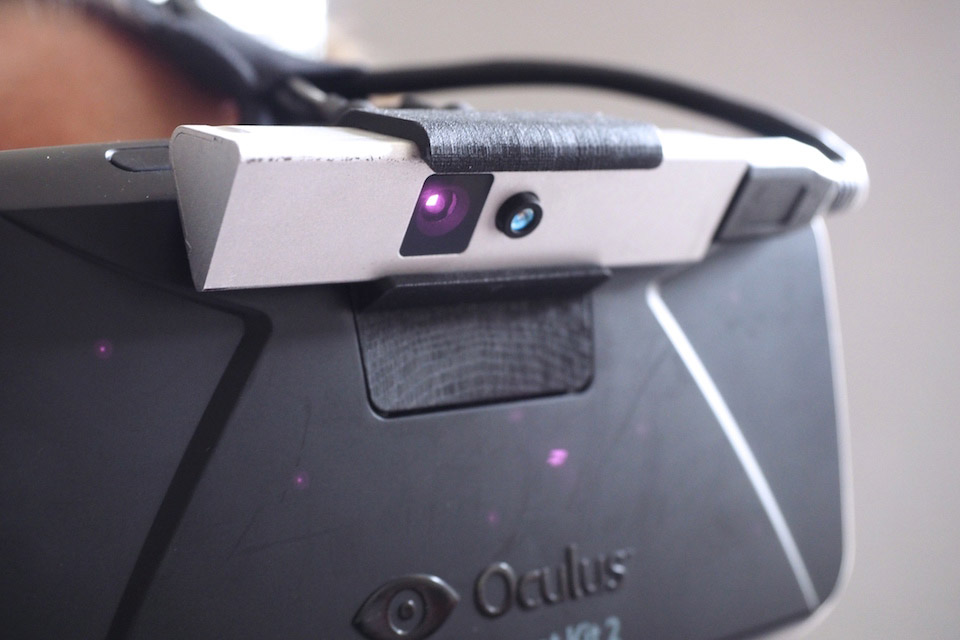 The Nimble Sense camera is a skeletal-tracking camera/laser combination based on PMD Technologies' chip -- it picks up and tracks human skeletal movement, as well as creating a point cloud of the world around you. It's not quite pass through vision (seeing "through" the VR headset into reality), but it enables a blurry version of your own body and the world around you. Enough so that you could, say, drink from a cup.
The device attaches directly to the top of the latest Oculus Rift dev kit (DK2) via a 3D-printed mount. It points down at an angle, intentionally aimed at your hands while you look straight ahead.
If you think this sounds like Leap Motion, that's because it's very similar to Leap Motion. Nimble actually created a video explicitly showing the difference....
Nimble VR's Sense camera is still a prototype, and the only way to reserve one is chipping in $99 on Kickstarter. The group's already surpassed their goal ... June 2015 promised delivery date.