It’s hard to explain to regular people how much technology barely works, how much the infrastructure of our lives is held together by the IT equivalent of baling wire.
Computers, and computing, are broken.
See the full story here: https://medium.com/message/81e5f33a24e1
 First things first, what are we talking about here specifically? A peripheral. We're talking about a virtual reality headset -- along the lines of Oculus Rift, but more akin to the Android-powered GameFace Labs prototype (seen below) -- created by Samsung, powered by Samsung products. This is not the rumored "Galaxy Glass" project.
We're told it has an OLED screen, as good or better than in the second Rift dev kit; it's not clear how the headset connects to your phone/tablet, but we're guessing it's a wired connection rather than wireless. Given VR's reliance on immediacy, a wired setup is a requirement (any lag introduced breaks the immersion, and often makes people sick). It's also not clear how, or if, Samsung's VR headset tracks head movement depth-wise. In the case of both Project Morpheus and Oculus Rift, separate cameras face the player and track depth by reading sensors on the respective headsets.
Beyond beating the competition to market, Samsung's said to be targeting a lower price tier with its headset. Don't expect anything too low -- we're still talking about a VR headset -- but the idea again is to undercut Oculus and Sony. Unlike Galaxy Gear smartwatches, we're told that Samsung's in-house OS, Tizen, doesn't play a part in the VR headset.
This is a device meant for use with games. What type of games? Android games! Sure, but which ones? That's certainly the question.
See the full story here: http://www.engadget.com/2014/05/22/samsung-vr-headset/
1. Atomic GPS
Because of the high costs of maintaining satellites for the Global Positioning System (GPS), DARPA has been researching other ways to locate a person or device more accurately and without the satellites. Research on atomic physics details how the Earth’s magnetic field acceleration and position is effecting individual atoms, so that GPS systems could use chip-scale combinatorial atomic navigation, C-SCAN, and Quantum Assisted Sensing, QuASAR, to find a person or device’s location on Earth that is 1,000 times more accurate than any current GPS system.
2.Terehertz Frequency Electronics and Meta-materials
3.A Virus Shield for the Internet of Things
4. Rapid Threat Assessment
See the full story here: http://www.defenseone.com/technology/2014/05/four-darpa-projects-could-be-bigger-internet/84856/
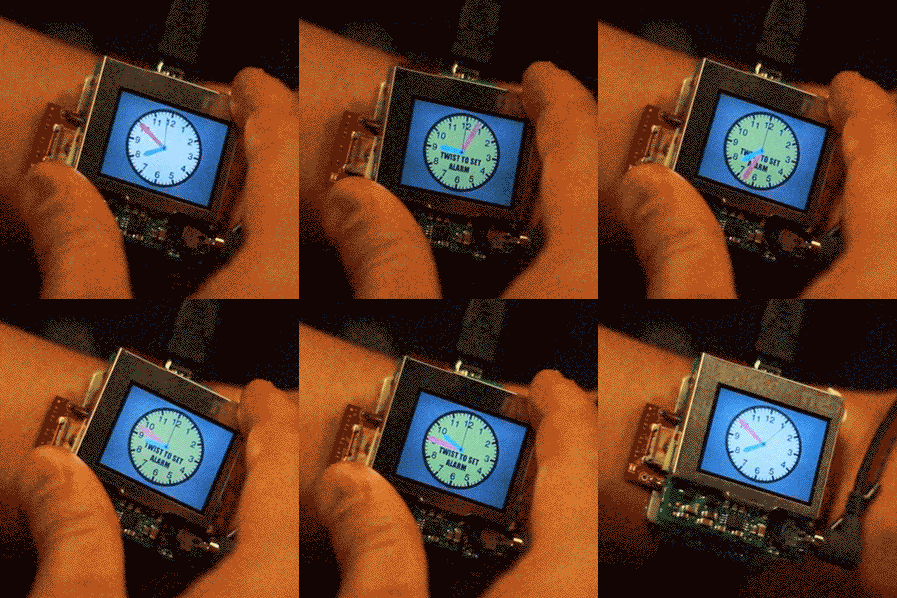 A project at Carnegie Mellon University suggests a better way to control these new gadgets: allowing users to physically tilt, click, and twist the watch’s bezel, the area around the screen. This could make it much easier to do things like set up appointments, play music, or navigate a map on the tiny display.
“It’s not that these watches aren’t fast enough or even have enough battery life—it’s that we can’t get the input and output good enough,” says Chris Harrison, an assistant professor of human-computer interaction at Carnegie Mellon University, who worked on the project with several colleagues.
The group built a prototype device and presented a paper detailing it at the recent ACM CHI Conference on Human Factors in Computing Systems in Toronto.
See the full story here: http://www.technologyreview.com/news/527211/a-smart-watch-controlled-by-twists-tilts-and-clicks/?utm_campaign=newsletters&utm_source=newsletter-daily-all&utm_medium=email&utm_content=20140522
Researchers at MIT have developed a method for teaching computers to understand what is happening in video content. The method uses a similar approach to textual analysis, such as natural language processing, by looking at each part of a video to figure out what the whole thing means. The researchers created an algorithm to identify what occurs in individual frames of the video, and then determines what those mean when combined in a certain order.
See the full story here: http://gigaom.com/2014/05/14/mit-researchers-teach-computers-to-learn-whats-happening-in-videos/
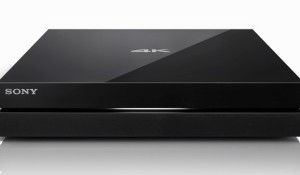
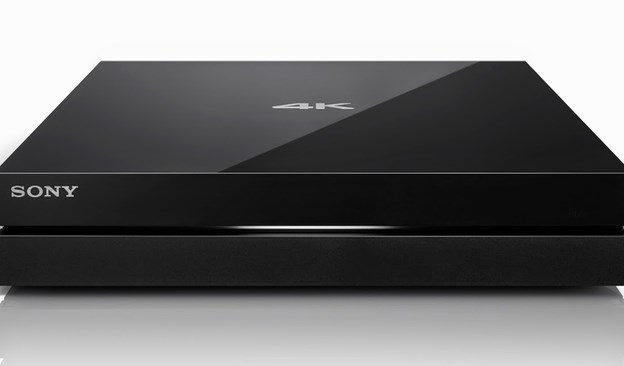
Sony has announced the pricing and availability of its 4K Ultra HD Media Player, compatible with any Sony 4K Ultra HD TV or 4K Ultra HD projector.
The FMP-X10 will retail for $699 and is available now for pre-ordering online. It officially becomes available July 15, but customers who pre-order the player between now and July 15 will save $200. It can be ordered at
store.sony.com as well as at Sony stores and other authorized dealers nationwide.
The media player has 1 TB of built-in storage and also supports Sony’s TRILUMINOUS Color display technology. Users can download, stream and store more than 200 titles from Sony’s Video Unlimited 4K service as well as stream 4K content from Netflix. Sony says its library is the world’s largest repository of 4K content and includes such recent titles as “American Hustle” and “The Monuments Men.” Over 50 titles in the library are available to customers at no charge.
See the original post here http://www.tvtechnology.com/news/0086/sony-releases-k-media-player/270472
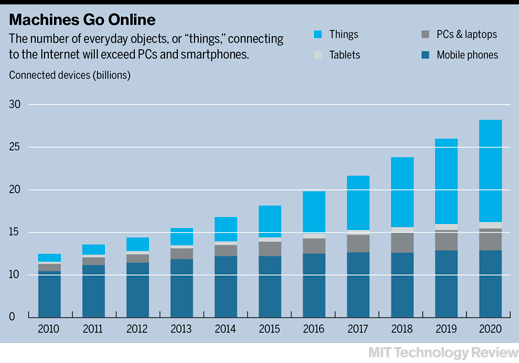
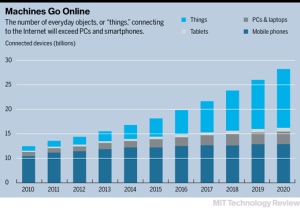 ...as ordinary products become connected, their manufacturers may enter information businesses whose economics are alien to them. It’s one thing to manufacture shoes, but what about a shoe that communicates? Products could turn out to be valuable mainly as the basis for new services. “You might find the data is more valuable than the shoe,” says Van Alstyne.
See the full story here: http://www.technologyreview.com/news/527356/business-adapts-to-a-new-style-of-computer/?utm_campaign=newsletters&utm_source=newsletter-daily-all&utm_medium=email&utm_content=20140520
When Facebook announced their $2 billion acquisition of Oculus Rift, Jaunt swears it took them by surprise. The small Silicon Valley company is working on the goal of creating cameras and audio recording equipment that lets anyone create a fully immersive, 360-degree virtual world. Jaunt's particular product goal, which still is in prototype mode, is a modular camera system designed for immersive films.
Done right, Jaunt's product can be amazing. I sat down for a demo viewing several weeks ago of some of the company's sample videos in downtown Los Angeles. As I strapped on a prototype Oculus Rift headset (Jaunt's leadership notes that their movies can be viewed on any other VR headset, and indeed on tablets and smartphones as well), I was impressed. Various clips of a day in the park in San Francisco, of martial arts demonstrations, and of other outdoor events came through with full immersive video and all-engulfing audio. Instead of the polygons and almost-real-but-not-quite textures of other Oculus products I had used, this was real video.
And Jaunt's pioneering work is just one part of a growing ecosystem of tech companies adopting Oculus Rift for all sorts of commercial purposes.
Condition One is a small San Francisco startup devoted to making movies for Oculus Rift. They are working in much the same sphere as Jaunt, and the company plans to release a movie for Oculus called Zero Point later this year. Judging by the trailer, it's an intriguing proof-of-concept for Oculus as a movie-watching platform.
A laboratory at the University of Southern California is exploring ways to turn the Oculus Rift and headsets like them into journalism devices. Late last year, I wrote about how a researcher at USC named Nonny de la Pena is working with Google, the Associated Press, and the Tribeca Film Institute to create 3-D, fully immersive journalism through virtual reality. Two fully-immersive videos her lab has put out so far place users in a food bank line where a bystander is going into diabetic shock, and at the U.S.-Mexico border when a man was beaten to death by Border Patrol officers.
See the full story here: http://www.fastcolabs.com/3030732/the-oculus-business-ecosystem?curator=MediaREDEF
Harris drew inspiration for the startup when he helped form the band Riot !n Paris, and found that interactive versions of their music videos did significantly better than videos in standard formats. He realized that there was a need for easy-to-use technology that could be used to create interactive videos.
See the full story here: http://techcrunch.com/2014/05/13/adventr-launch/
“Games for the Morpheus are going to be very different,” said Jed Ashforth, a senior game designer with Sony, who has spent the past 18 months playing and experiencing everything virtual reality has to offer to discover what’s possible with the new headsets. “The sense of having a presence within the game is something totally new. It’s a very different experience.”
See the full story here: http://www.theguardian.com/technology/2014/may/12/sonys-project-morpheus-virtual-reality-console-gaming?curator=MediaREDEF
 First things first, what are we talking about here specifically? A peripheral. We're talking about a virtual reality headset -- along the lines of Oculus Rift, but more akin to the Android-powered GameFace Labs prototype (seen below) -- created by Samsung, powered by Samsung products. This is not the rumored "Galaxy Glass" project.
 Sony has announced the pricing and availability of its 4K Ultra HD Media Player, compatible with any Sony 4K Ultra HD TV or 4K Ultra HD projector.
 ...as ordinary products become connected, their manufacturers may enter information businesses whose economics are alien to them. It’s one thing to manufacture shoes, but what about a shoe that communicates? Products could turn out to be valuable mainly as the basis for new services. “You might find the data is more valuable than the shoe,” says Van Alstyne.