Hate Parking Tickets? Fixed Fights Them In Court For You
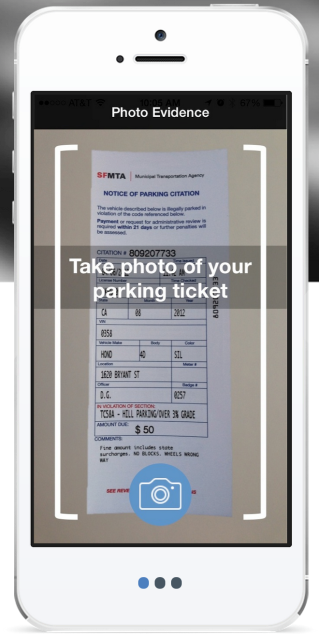 [Philip Lelyveld comment: this exploits an inefficiency in the manual parking ticket appeals process. In a sense it is making money through statistical analysis - the Moneyball technique. What other mass-market fines could be subject to this approach?]
Here’s how it works:
- Sign-up for Fixed (currently in a small beta trial in San Francisco) and enter your credit card details.
- Come back to your car, find a parking ticket you think was unfairly issued, take a photo of it with Fixed, and type in the violation number.
- Fixed looks up the violation type, tells you the probability of getting that type dismissed, and prompts you to take photos as evidence.
- If the ticket is for street cleaning, you might be prompted to take a photo of a missing street cleaning times sign. If it’s a “red curb” violation, you might be asked to photograph the faded curb paint. Fixed supplements the evidence with data like when the curb was supposed to be repainted, or whether the street was actually steep enough to warrant a “wheels not curbed” ticket.
- Fixed prepares a “contest letter” to fight the ticket, has you digitally sign it, mails it on your behalf, and takes care of all correspondence with the court.
- If Fixed gets your ticket dismissed, you pay it 25 percent of what the ticket would have cost. If it loses, you pay the ticket like normal but pay Fixed nothing.
Read the full story here: http://techcrunch.com/2014/01/15/fight-parking-ticket-fixed/?ncid=tcdaily
What Does Big Data Look Like? Visualization Is Key for Humans
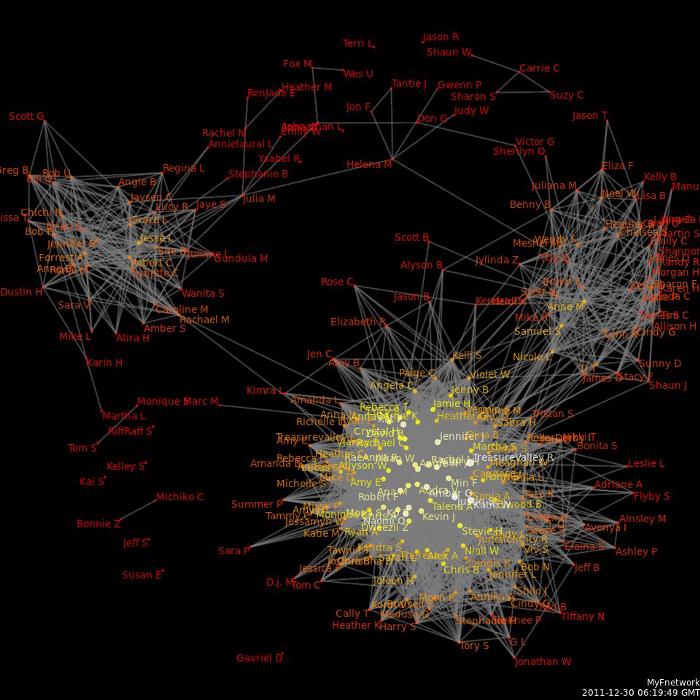
 One of the most valuable means through which to make sense of big data, and thus make it more approachable to most people, is through data visualization. Data visualization is wayfinding, both literally, like the street signs that direct you to a highway, and figuratively, where colors, size, or position of abstract elements convey information. In either sense, the visual, when correctly aligned, can offer a shorter route to help guide decision making and become a tool to convey information critical in all data analysis. However, to be truly actionable, data visualizations should contain the right amount of interactivity. They have to be well designed, easy to use, understandable, meaningful, and approachable.
Author David Hoffer is Head of User Experience at Declara.
Read the full story here: http://www.wired.com/insights/2014/01/big-data-look-like-visualization-key-humans/#!
Data is Beautiful
[Phil Lelyveld comment: this is a nice short piece on basic visualization concepts.]
“Yet designers often fail to achieve a balance between form and function, creating gorgeous data visualisations which fail to serve their main purpose — to communicate information” -Friedman
See the full article here: https://medium.com/data-and-analysis/57043a7c778b?curator=MediaREDEF
NSA’s Preference for Metadata
 [Phil Lelyveld comment: Although this article is about the NSA, it explains how Google and other companies can know everything about you.]
Metadata collection can answer all but one of the five “W’s” of journalism: the Who, What, Where and When. Given time, it can even respond to “Why” someone interfaces with digital information systems the way they do. It can do this because it is possible to discern patterns of behavior in metadata.
See the full story here:
Fox Bypassing Pilot Season, Says It’s a Relic
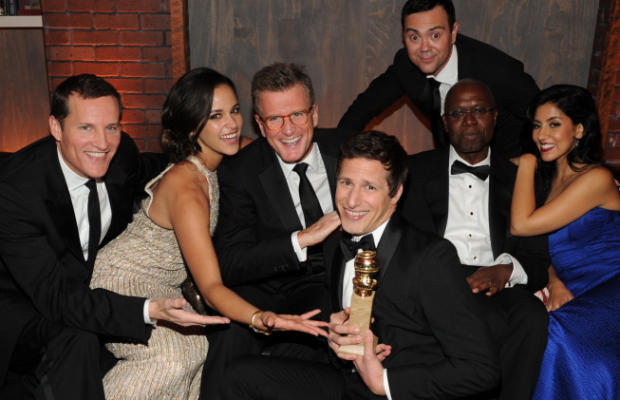 He said networks sometimes perpetuate the myth that there is only quality programming from September to May, but that that is no longer the case. ”There are advertisers that want and have money to spend in those summer months,” he said.
See the full story here: http://www.thewrap.com/fox-bypassing-pilot-season/
TROY CARTER: FIRED BY LADY GAGA AND LOVING IT
 This helps explain why, as Gaga rose to fame, Carter methodically prepared to live without her. He doesn't put it that way; he speaks of diversification, of curiosity, of building a stronger business. But that's what it is. He's an investor in more than 50 startups, from Uber to Dropbox, and has elevated himself to a fixture in the tech scene, now one of the best human bridges between the complicated frenemies of Hollywood and Silicon Valley. He's acquired heady titles like Aspen Institute Henry Crown Fellow and UN Foundation Global Entrepreneurs Council member. He earned a reputation as a branding genius for his work with Gaga, but like any megasuccessful manager, he was bolstered by her once-in-a-lifetime talent. Now that he isn't known as Gaga's manager, he's ready to be known for something else--but right now that "something else" is a patchwork of things, each promising in its own right, but not yet a revival.
Read the full story here: http://www.fastcompany.com/3024171/step-up-troy-carter?curator=MediaREDEF
More Movies at Sundance Are Sidestepping the Big Screen
 The very concept of a “sale” — the old Sundance measuring stick — has shrunk along with a diminishing theatrical audience. Companies that once paid millions of dollars for the right to distribute a film will now often acquire a picture for no money down. Instead they promise to put it in front of viewers, and give the filmmaker a cut of the proceeds, if there are any.
See the full story here: http://www.nytimes.com/2014/01/13/business/media/more-movies-at-sundance-sidestepping-big-screen.html?curator=MediaREDEF
I Came Not to Be Buried by CES, But to Be Dazed by It
 [Philip Lelyveld comment: Kara Swisher wrote an excellent color piece on CES 2014.]
In the vast halls of the Las Vegas Convention Center, where giant televisions or radios or computers were constantly blaring, with no real sound discernible over the massive cacophony. After several days, it felt like a low-level headache, an endless buzz of very loud nothing.
I don’t pretend to hate it, because I do not, despite the noise, the crowds, the endless come-ons by PR people trying to sell a story where there often is not one. I’ll bite enough times, of course, because it’s part of the game to find meaning, a pattern, some sort of sense in what has been put on display in the latest incarnation of CES.
This year the big theme emerged almost immediately: Wearables. There is, of course, no CES without a major meme to chew over, to ponder with graveness, to pundit about by people who are frequently wrong, but never ever in doubt.
And is it hard to forget the endless kickline of tweeting refrigerators? There was a new one this year again, from South Korea’s LG Electronics. It was offering a service it called HomeChat, using the popular messaging app in Japan called Line. Using it, you can apparently communicate with your home appliances.
Let me spell it out for you here: No one wants to talk to the toaster — or at least very often.
Read the full article here: http://recode.net/2014/01/12/i-came-not-to-be-buried-by-ces-but-to-be-dazed-by-it/?curator=MediaREDEF
CES Is Not What You Think It Is
 Save one, all of the biggest, game-changing products during my CES tenure were introduced to the world at other events, away from the cacophony of CES. Their creators chose to reveal them at times that are far more propitious in the annual tech sales cycle than in January, right after the big holiday season and months away from the important back-to-school season.
The one really big electronics product in recent years that did use CES as a launch platform was HDTV. For the TV makers, who were there long before Silicon Valley showed up, CES remains a prime stage. But it took years and years of repeated flogging of HDTV at CES before it took off.
Now, the same TV makers are pushing a higher-resolution type of TV, called 4K or Ultra High Definition (UHD). But, if it succeeds, it will also take years. (This year, some were also pushing an odd new idea that struck many attendees I spoke to as at best a niche — curved TVs.)
...This isn’t to say that CES has no value. A lot of networking and a lot of business is done there. Some genuinely interesting new products are shown behind closed doors to a select few, in meeting rooms and hotel suites — the sub rosa CES. Those are the main reasons I attend.
... But for all those folks on those tours of the main CES floor, remember this: You are unlikely to see the next huge, disruptive tech product while trailing that perky guide.
See the full story here: http://recode.net/2014/01/10/ces-is-not-what-you-think-it-is/?curator=MediaREDEF