[Phil Lelyveld comment: this explains in simple detail how Tupac was brought back to life at Coachella. ]
Based on a Victorian-era light projection system called 'Pepper's Ghost' which was developed by two inventors -- Henry Dircks and John Pepper -- in the 1860s, Musion Eyeliner offers a range of spectacular stage effects that, in addition to bringing Frank Sinatra back to life, have been used to reanimate Tupac Shakur, Michael Jackson and Elvis Presley.
Uwe Maass, the inventor or Musion Eyeliner, explains that when it was first developed in the 19th century, Pepper's Ghost was quite straightforward: "The Pepper's Ghost system is relatively simple. It is a piece of foil in a 45 degree angle and it reflects the image from the floor onto the stage." From the audience's perspective the light projection can offer all kinds of effects including making realistic 3-D people appear on stage."
Maass -- an accomplished electronic engineer with 30 years experience in optics -- advanced the concept of Pepper's Ghost with modern video projection and animation techniques that serve to update the old technology.
Maass's main innovation is to replace the glass used in original systems with an invisible polymer foil to offer a more substantial image while also allowing the stage behind to remain visible. Maass's developments quickly attracted interest from senior figures around the entertainment industry.
[Philip Lelyveld comment: Peter Guber announces his new marketing startup.]
I’ll tell you what I’ve decided to do. After that fateful class, I joined with Jonathan Cohen—the founder of SocialChorus, the first influencer marketing platform—and the authors of Trillions—who run the world’s premiere independent pervasive computing consultancy called MAYA and I became a founding investor in a new kind of agency dedicated to made media. Think of it as “Tell to Win meets Trillions.” The first native made media agency focused on helping organizations prepare, manage, and thrive as products become influencers and consumers, and their products tell their own connected stories. We call it AoT (Link: http://www.aot.co ) and I am very excited to say that it is launching this week at CES.
[Philip Lelyveld comment: interoperability will be the key, along with simplicity to minimize the threat of hacking.]
Smart home appliances could become more common thanks to efforts by major companies including Lowe’s and Staples to make gadgets compatible.
At CES, Staples announced that products from an additional nine companies’ products would be compatible with the system. They include the Goji’s smart door lock and one from Withings, a company that makes Internet-connected health devices such as scales, and which at CES launched a new sleep-monitoring system called Aura.
Strategy Analytics' new ConsumerMetrix survey carried out over the past few weeks with 2024 US consumers found very strong interest in UHD TV. 19 percent of people said they would be very likely to buy a UHDTV and 37 percent somewhat likely within the next two years. Only 24 percent said they would be unlikely to buy one.
The survey question was phrased as follows:
Ultra HD or 4k TV is a new type of TV which offers significantly improved images compared to today's HDTV. Assuming the price elsewhere of an Ultra HD or 4k TV was acceptable to you, and assuming the image quality was as good as is claimed, how likely would you be to buy a new Ultra HD or 4k TV within the next two years?
This looks like great news for the CE vendors introducing new UHD models this week. If they get the pricing right UHD could provide a significant business uplift over the near to medium term states David Mercer, Principal Analyst.
But what’s most likely to capture the attention of millennials isn’t a 105-inch TV or a refrigerator that can send text messages, but wearable devices that are affordable, stylish and truly convenient alternatives or aides to the smartphones and other devices we already own.
See the full story here: http://www.etcentric.org/ces-2014-what-millennials-will-be-talking-about-and-buying/
Alan Batey, senior vice president of Global Chevrolet, told journalists in Las Vegas Sunday that his company was committed to making high-speed Internet connectivity a standard feature of any car. “Passengers in the back of a car with LTE, for example, could be able to download movies to watch just as they might in their living room,” he said.
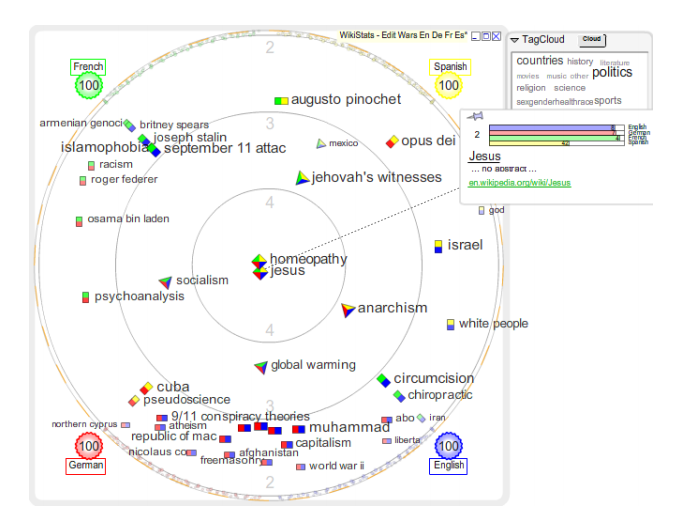
These guys begin by defining what they mean by a controversy. In Wikipedia, the editorial history of every article is easily accessible but the number of changes is by no means a measure of controversy; it may simply indicate a rapidly changing topic.
Instead, Yasseri and co focus on “reverts”, edits in which one author completely undoes changes made by another and so returns the article to an earlier version. Reverts are relatively common in Wikipedia and may not necessarily be indicative of controversy.
So Yasseri and co looked instead for “mutual reverts” in which one editor reverts another’s work and vice versa, so both editors are undoing each other’s changes.
That leads to a relatively straightforward definition of controversiality: “The controversiality of an article is defined by summing the weights of all mutually reverting editor pairs, excluding the topmost pair, and multiplying this number by the total number of editors involved in the article,” say Yasseri and co.
That gives a simple list of the most controversial articles in each language. In English, the top 10 most controversial articles are as follows:
George W Bush
Anarchism
Muhammad
List of World Wrestling Entertainment, Inc. employees
[Philip Lelyveld comment: Since today most content is 2K, a key selection criteria should be how well a set converts 2K content for 4K display. Many Japanese sets do it beautifully. Many lower priced Chinese sets don't.]
Companies including Sony Corp. 6758.TO +2.30% and LG Electronics Inc.066570.SE -1.34% now sell UHDTV sets in the U.S. for as low as $3,000, down from $4,500 a few months ago. Even in Japan, the price of Toshiba Corp.'s 6502.TO +1.14%55-inch model has halved to as low as ¥300,000, or $2,850. Meanwhile, some smaller models from lesser-known Chinese brands sport tags below $1,000.
Meanwhile, Japanese TV makers are trying to justify their price tags by using extra chips that adapt regular high-definition content so an improvement is noticeable on 4K sets.
LG's Mr. Alessi says he fears that the lack of such features on the less-expensive Chinese-made sets will give UHDTV a bad name.
"Side-by-side comparison tends to show a big difference," says Paul Gagnon, director of North American TV research at NPD DisplaySearch. "The question is whether or not it is worth two times the price. That's something that's going to take time to figure out."
The average price of UHDTVs sold in China is expected to fall to $973 in 2014, compared with $1,288 in 2013, according to NPD DisplaySearch. Outside of China, the firm expects the average to slide to $1,637 from $4,313.
Crowdfunding is helping many startups’ dreams come true. 2013 saw a slew of extremely popular crowdfunding projects smash through goals and world records. Many great new technologies are emerging from successful fundraising rounds on platforms such as Kickstarter and Indiegogo.
2012 had a handful of breakout products — such as the Pebble smartwatch — but 2013 saw crowdfunding hit the mainstream with more projects funded and more money committed to them.
We’ve rounded up a selection of the hottest campaigns in the technology category, how much they’ve raised and what they’re up to now.
The company's annual report of five predictions for the next five years is all about the benefits of big data: stores, cities, classrooms, and hospitals.
 These guys begin by defining what they mean by a controversy. In Wikipedia, the editorial history of every article is easily accessible but the number of changes is by no means a measure of controversy; it may simply indicate a rapidly changing topic.