Artists often find this discovery argument seductive, but only up to a point. Patrick Carney of Black Keys said in 2011: "For unknown bands and smaller bands, it's a really good thing to get yourself out there. But for a band that makes a living selling music," streaming royalties are "not at a point yet to be feasible for us". How do you make the transition from "I'll give away anything to get noticed" to "Sorry, now you have to pay for my music"? Carney's implied point is important – the core issue is about sustainability; how can artists survive in the long term beyond that initial surge of interest?
Musicians might, for now, challenge the major labels and get a fairer deal than 15% of a pittance, but it seems to me that the whole model is unsustainable as a means of supporting creative work of any kind. Not just music. The inevitable result would seem to be that the internet will suck the creative content out of the whole world until nothing is left. Writers, for example, can't rely on making money from live performances – what are they supposed to do? Write ad copy?
As Lowery has pointed out, there's no reason artists should simply accept the terms and join up with whatever new technology comes along. Now I'm starting to sound like a real Luddite, but taking a minute to think about the consequences before diving in seems like a pretty good idea in general. You shouldn't have to give up your privacy, or allow all sorts of information about yourself to be used, whenever you go online, for example.
Read the full editorial here: http://www.theguardian.com/music/2013/oct/11/david-byrne-internet-content-world?curator=MediaREDEF
[Philip Lelyveld comment: it is good that the issue is being revisited, especially in light of Google and Facebook's new policies that don't give you the option of protecting your privacy and using your identity in 3rd party ads. But his proposed solution, cryptographic wrappers, fundamentally won't work because of the open nature of OS's.]
“Now that you’re just being observed, whether it’s for commercial purposes or other activities, we have to move to a new model.”
Mundie, who until late last year was in charge of Microsoft’s research wing as its chief research and strategy officer, thinks a system of DRM technology, accompanied by laws and regulations to enforce it, could provide the answer. “I think we’re going to have to have a usage-based way of controlling this now,” he said. “One way to do that is to put cryptographic wrappers around these things that control uses of this data.”
...said Mundie: “You want to say that there are substantial legal penalties for anyone that defies the rules in the metadata. I would make it a felony to subvert those mechanisms.”
The service is called PornIQ and it uses an algorithm to create personalized video playlists for the viewer based on his or her porn preferences, the time of day, what part of the world they live in, and the available amount of time the viewer has to enjoy it. It’s not unlike Songza, a service that creates music playlists based around similar data points. Think of it as a “porn concierge.”
Data plays heavily into the recommendations made by PornIQ, and indeed Pornhub is known for collecting some fascinating sociological and behavioral information on its users, like what kind of porn people in Afghanistan watch.
Read the full story here; http://pandodaily.com/2013/10/09/what-media-companies-can-learn-from-pornhub-and-its-new-porniq-service/
 Data analytics are being used to implement a subtle form of discrimination, while anonymous data sets can be mined to reveal health data and other private information, a Microsoft researcher warned this morning at MIT Technology Review’s EmTechconference.
In a new paper, she and a colleague propose a system of “due process” that would give people more legal rights to understand how data analytics are used in determinations made against them, such as denial of health insurance or a job.
See the full story with a link to her paper here: http://www.technologyreview.com/news/520131/data-discrimination-means-the-poor-may-experience-a-different-internet/?utm_campaign=newsletters&utm_source=newsletter-daily-all&utm_medium=email&utm_content=20131010
[Philip Lelyveld comment: What does it mean to cable companies, local monopolies, bandwidth allocation, etc. when a cable company encourages the use of Twitter to tag and forward pieces of subscription content over the web?]
Comcast customers will soon be able to reach some television shows from Twitter messages about those shows, the two companies announced on Wednesday, in what they hope will become an industrywide practice.
The feature — called See It — will initially be turned on only for Twitter posts published by Comcast-owned channels, like NBC, about their shows, like “The Voice.” But the companies said they were talking with other distributors and channel owners about extending the feature to other shows. Eventually Comcast wants See It to show up on other Web sites and apps as well, so that online conversation and news coverage about TV series and movies can directly lead users to those series and movies.
The technology will test the interconnectedness of television and the social Web, two media platforms that enhance each other while also competing for advertising dollars and attention. It was announced as part of a broader partnership between Twitter and Comcast, the nation’s largest cable television provider. It comes as the privately held Twitter prepares to sell stock to the public.
See the full story here: http://www.nytimes.com/2013/10/10/business/media/through-twitter-partnership-comcast-hopes-to-encourage-tv-viewing.html?_r=0
 [Philip Lelyveld comment; So if big data allows the 'house' to identify players operating outside of their expected patterns, how big a step is it to develop an algorithm to increase the house's odds to just the point where the player's losses and hope are in optimal balance?]
Online game developers have vast amounts of rich, unstructured data at their fingertips that they could use to help achieve revenue stability. The data delivers an understanding of each player and what they are doing while in the game. That same data could be manipulated to identify and stop fraudulent game activities in real time.
Recently, we had the opportunity to test this premise with one of the world’s largest casual online gaming companies, which was plagued by revenue leakage due to cheating players. By using analytics to examine and model the game, we could determine common player navigational paths. We could then design mathematical algorithms that could place parameters around the average player and predict the average way he or she would progress in the game. This information determined the threshold range for what would be acceptable play; any players that fell outside of the threshold range would be flagged as being potentially fraudulent. The game developer could then choose to immediately freeze accounts for those advancing too quickly — thereby plugging the revenue hole.
Read more at http://venturebeat.com/2013/10/03/big-data-blocks-gaming-fraud/#BbG6PWUr4llMD03T.99
See the full story here: http://venturebeat.com/2013/10/03/big-data-blocks-gaming-fraud/
 The blocks move thanks to a flywheel inside their bodies that can spin at a blistering 20,000 revolutions per minute and then can break straight down to zero in a blinding 10 milliseconds, said MIT roboticist Kyle Gilpin. When the flywheel suddenly stops, all the energy from that angular momentum transfers into the cube’s frame, causing it to flip.
The boxes have magnets on the edges that can grip their cube-mates, allowing one to flip around into a new configuration without breaking the connection.
Ultimately, the goal would be to make smaller, millimeter-sized versions of these robots, Rus said. And the bots should have a number of applications, from building temporary bridges after a collapse to probing a suspect pipe.
See the full story here: http://www.latimes.com/science/sciencenow/la-sci-sn-mit-block-self-assembling-robots-cubes-terminator-20131004,0,4903811.story
 The particular model is less important than the fact that the world’s leading smartphone manufacturer is investing in AMOLED screens, which are more durable and deliver higher quality images, and pushing towards using them without the rigid glass it currently encases them in.
Flexible screens are currently hamstrung by the challenge of finding flexible electronics components durable enough to withstand repeated bending at a price consumers will pay. But a midway point involves putting some of the componentry of the electronics into the AMOLED surface, while leaving the others packaged in a rigid container.
See the full story here: http://singularityhub.com/2013/10/03/samsung-promises-flex-screen-phone-by-the-end-of-the-year/
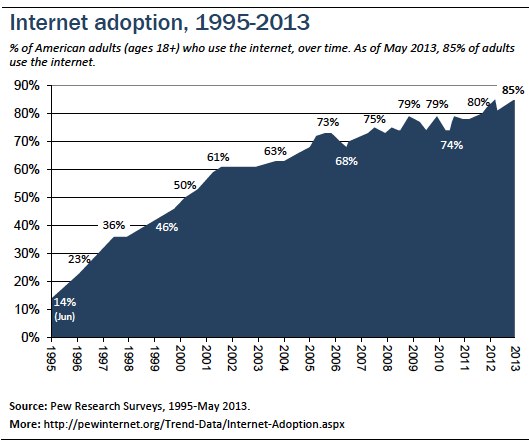
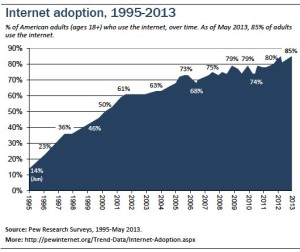 A large portion of the people not online are over 65 yrs old.
As of May 2013, 15% of American adults ages 18 and older do not use the internet or email.
Asked why they do not use the internet:
- 34% of non-internet users think the internet is just not relevant to them, saying they are not interested, do not want to use it, or have no need for it.
- 32% of non-internet users cite reasons tied to their sense that the internet is not very easy to use. These non-users say it is difficult or frustrating to go online, they are physically unable, or they are worried about other issues such as spam, spyware, and hackers. This figure is considerably higher than in earlier surveys.
- 19% of non-internet users cite the expense of owning a computer or paying for an internet connection.
- 7% of non-users cited a physical lack of availability or access to the internet.
See the full story here: http://pewinternet.org/Reports/2013/Non-internet-users.aspx
Ray Kurzweil says he’s developing systems atGoogle Inc. that will allow computers to understand what data actually means, allowing businesses to make better decisions based on information they’re amassing through Big Data platforms.
Mr. Kurzweil made his remarks Monday during a panel discussion at the Global Directions 2013 conference sponsored by Kodak Alaris.
Mr. Kurzweil says Google can already reliably establish what individual pages, books and even video are about by extracting words contained in those documents and associating them with concepts in its database structure that indicate what they mean. But he says Google is now developing a data model that will allow its systems to understand the underlying meaning of language. “We haven’t done this yet — this is what I’m working on at Google — is to understand the meaning of documents…
See the full story here: http://stream.wsj.com/story/latest-headlines/SS-2-63399/SS-2-336774/
 [Philip Lelyveld comment; So if big data allows the 'house' to identify players operating outside of their expected patterns, how big a step is it to develop an algorithm to increase the house's odds to just the point where the player's losses and hope are in optimal balance?]
 The blocks move thanks to a flywheel inside their bodies that can spin at a blistering 20,000 revolutions per minute and then can break straight down to zero in a blinding 10 milliseconds, said MIT roboticist Kyle Gilpin. When the flywheel suddenly stops, all the energy from that angular momentum transfers into the cube’s frame, causing it to flip.
 A large portion of the people not online are over 65 yrs old.