Gesture recognition–first step toward 3D UIs?
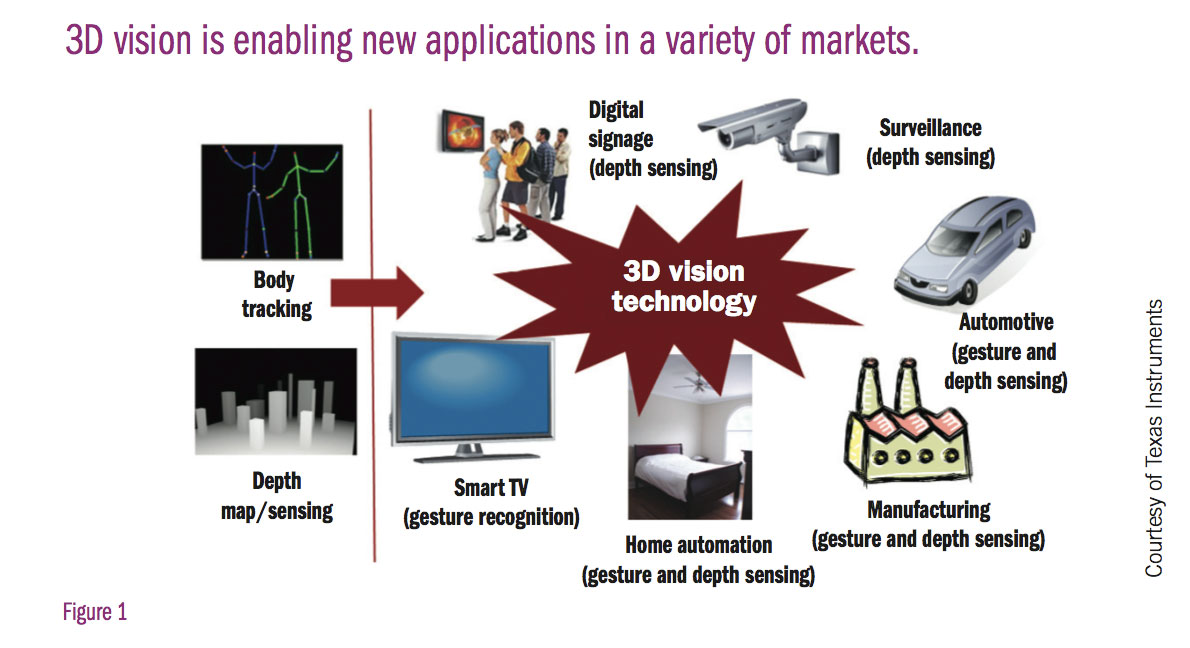
Gesture recognition is the first step to fully 3D interaction with computing devices. The authors outline the challenges and techniques to overcome them in embedded systems.
As touchscreen technologies become more pervasive, users are becoming more expert at interacting with machines. Gesture recognition takes human interaction with machines even further. It’s long been researched with 2D vision, but the advent of 3D sensor technology means gesture recognition will be used more widely and in more diverse applications. Soon a person sitting on the couch will be able to control the lights and TV with a wave of the hand, and a car will automatically detect if a pedestrian is close by. Development of 3D gesture recognition is not without its difficulties, however.
Limitations of (x,y) coordinate-based 2D vision ...
"z"(depth) innovation...
3D vision technologies ...
z & human/machine interface ...
Read the full story here
3D Goggles in True Steampunk Style

We’re huge fans of the steampunk aesthetics (you know, combining past and future, Victorian looks and steam-operated machinery with current gadgets) , and when we saw Etsy user Will Rockwell had committed enough as to create a pair of googles that look more fitting to soar the skies with a zeppelin than to sit at home, in front of our biggest 3d TV and watch a movie, we knew we were in front of something special.
The author explains on the product page that this accesory is made with actual 3D lenses, and will work in movie theaters. They should be particularly comfortable to wear as they come with soft leather padding around the eye cups, and best of all, don’t really touch your nose. The metal used is actually brass, while the strap (which can be regulated and is pretty long, so it could be worn with hats or helmets) is black leather for full authenticity.
See the full post here:
3D gaming in 2011: Tips, tricks, and buying advice
So you haven’t gone the stereoscopic 3D route yet — but with top-notch, winter-release games like Skyrimand Batman: Arkham City making good use of 3D tech, you’re seriously considering it. The holiday season is upon us, too, and good, PC-centric 3D gear is now very affordable indeed. But where do you start? Is it like active- and passive-3D TVs, where there’s a huge variety in image quality? Is it better to stick with your current LCD panel and buy a separate emitter, or simply jack it all in and buy an all-in-one 3D monitor?
After extensive testing, with technology like Nvidia’s 3D Vision 2 and some of the top games of 2011, here is the best advice we can give you:
Spring for an all-in-one monitor...
Play the games you want to play...
Take breaks...
Try before you buy (if you can)...
Walk away if you need to...
Don’t expect miracles...
With upwards of 500,000 pairs of 3D Vision glasses out there in the wild, clearly the technology is gaining in popularity. But everyone dealing in 3D games, from AMD and Nvidia to the studios, need to remember that the only thing that makes a good stereoscopic 3D game is a good game; the more of those there are, the better a deal stereoscopic 3D will be. With such unpredictable quality among some of the most popular titles this holiday season, clearly the industry still has a way to go. But I, for one, am astonished and impressed at how far stereoscopic 3D has already come. If it keeps on like it has, the future’s so bright, I gotta wear active-shutter glasses.
See the full story here
Portland OR 3D Museum – come for 3D picture with Santa
 c
c
The 3D Center of Art & Photography is hosting a 3-D photo shoot with Santa Claus.
See the original posthere
Learning science to become a 3D experience (India)
The school classroom is changing, and fast. With tech toys becoming a part of our lives, can they be kept out of the learning experience? A few schools in the city seem to think that time has come for a technological aids must be used for teaching itself.
Soon, these schools will have smart classrooms with 3D-enabled projection and DTS sound systems. ...
"The new method of teaching and learning to be adopted at schools should slowly do away with the spoon-feeding method. Instead of thrusting academics upon students, children should be brought closer to the syllabus. Too much of technology is actually a different method of spoon-feeding which should be avoided. Instead activity-oriented learning should be adopted in schools," said R Manimohan, chairman, co-ordination committee, Students Welfare Association of Parents, Coimbatore.
See the full article here
Out of the Box – Overview of future 3D / holographic display research
A screen currently under development reveals an object’s sides when you peek around it. And an in-the-works teleconferencing system made of a spinning mirror can conjure up floating faces worthy of the Wizard of Oz. Other approaches bypass the trickery completely and go straight for the tried-and-true 3-D experience of holography: A postcard-sized Princess Leia made her debut earlier this year (SN Online: 1/26/11), and the military recently acquired a prototype table akin to Dr. Morbius’.
“The technology is getting closer to creating something that looks like a sculpture made out of light,” says Gregg Favalora, a veteran 3-D display designer who works for the consulting company Optics for Hire in Arlington, Mass.
...
Douglas Lanman of MIT’s Media Lab and his colleagues are attempting to solve the problem with objects that rotate as a person walks by.
...
Four LCD screens stacked on top of one another show videos from up to seven viewpoints via the same trick. The display will be presented this month in Hong Kong at a meeting of the Association for Computing Machinery’s Special Interest Group on Computer Graphics and Interactive Techniques.
A second approach out of Lanman’s lab mashes together many pairs of perspectives into a single image on an LCD screen. A pattern on a second overlying screen flickers faster than the eye can see, filtering the image for different viewing angles.
...
At the University of Southern California in Los Angeles, Paul Debevec has figured out a way to pack hundreds of different viewing angles together to eliminate eyestrain. He’s ditching flat screens in favor of a rapidly flickering projector. It bounces images off a pair of aluminum plates jointed together like an A-frame tent, a double-sided mirror of sorts that spins 900 times per minute.
...
“The holographic display is the closest to how human beings see around themselves,” says Nasser Peyghambarian, a physicist at the University of Arizona in Tucson. ...
His first prototype, a transparent plastic screen slightly larger than a playing card, updated only once every two seconds, a far cry from movies’ 24 to 30 frames per second. Since reporting on the device last year in Nature (SN: 12/4/10, p. 8), he has increased the size to a foot on each side, but still hasn’t achieved the 10 frames per second he is shooting for.
At MIT, engineer Michael Bove has used mostly inexpensive, off-the-shelf parts to make small holographic videos that update 15 times per second. He is in talks with the electronics industry about developing a television that might cost no more than a few hundred dollars to build. Currently, though, the display is fuzzy and in just one color.
...
The largest holographic video display to date, measuring 6 feet diagonally, belongs to the military. For five years, the Defense Advanced Research Projects Agency, or DARPA, funded the development of a tabletop display that projects videos up to a foot high, visible from angles greater than 45 degrees above the table.
...
Ultimately, the introduction of new 3-D technologies into the home may be stymied by a problem that even the cleverest engineer can’t solve: “There hasn’t been a huge wave of 3-D content yet into the marketplace,” says Stephen Baker, vice president of industry analysis for NPD Group, a market research company headquartered in Port Washington, N.Y.
Realistic 3-D television displays won’t be worth much if there’s nothing to watch. In the end, moviemakers must choose to film in three dimensions and network sports producers need to decide that basketball games really do look better with a little depth.
Read the full story here
3D TV Prices In China Reduced By Almost 50%
Plans are now afoot in China to introduce 3D TV channels, which also includes a trial broadcast of the Olympic Games all set to be held in London in 2012. As a result of this move and the predictable high demand the 3D TV makers in the country have already begun a belligerent price war. ...
See the full story here
Samsung Imagines A Future With Flexible 3d AMOLED Screens
This is a very interesting 3o second CONCEPT video of a portable, flexible, transparent video screen.
See the full article and the video here
Stereo-3D Smartphone Market Poised to Explode
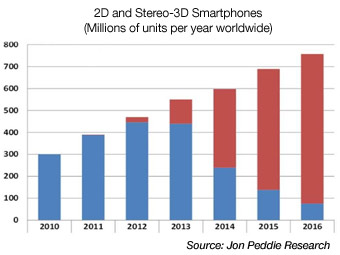 What new features will you get when the iPhone finally goes 3D? Beyond the obvious 3D imaging capabilities and 3D gaming, a whole new world of gesture-based interaction and augmented-reality apps opens up. A phone with twin cameras mounted on the front and back could create a virtual version of the space around the handset and monitor movement — like what your fingers are doing — inside that space.
3D phones are just a tiny sliver of the market today, and JPR isn't forecasting that to change much in 2012 or even 2013. But in 2014, the company's projections show an explosion of 3D-enabled smartphones dominating the market. The company's figures anticipate a fairly linear expansion of the smartphone market, with yearly shipments increasing steadily from 300 million units worldwide in 2010 to more than 750 million in 2016. ...
See the full post here:
Android Gingerbread on over half of devices, as Ice Cream Sandwich challenge begins
[SlashGear]
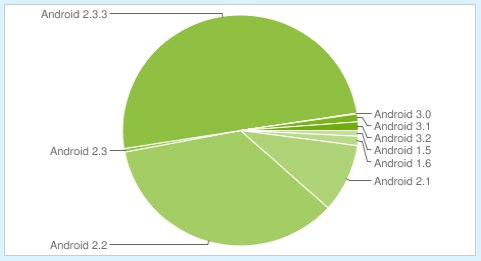
Google and its Android manufacturing partners have finally managed to get the majority of devices in the wild up to date with Gingerbread… just in time for them to be outdated again thanks to Ice Cream Sandwich. According to the latest platform distribution stats, 2.3.x is now found on 50.6-percent of allAndroid devices– or at least those which accessed the Android Market in the fourteen days prior to December 1 – up from 43.9-percent last month. ...
Gingerbread’s share should increase some in next month’s batch of stats, with a number of devices getting Android 2.3 upgrades in the past week or so. Verizon’s DROID CHARGE and the EuropeanMilestone 2, along with the LG Optimus 3D all saw OTA updates being pushed out in November.
More on Ice Cream Sandwich in the full SlashGear review.
Read the full story here: