Can 3D Shed Its Need For Glasses?
 The iPont processor is "taking the side-by-side stream that you get with a normal stereoscopic 3DTV service, and adding virtual cameras to create the number of views the auto-stereoscopic screen needs.’"
See the full story here:
Pioneer’s Amazing 3D Floating Vision Display (video)
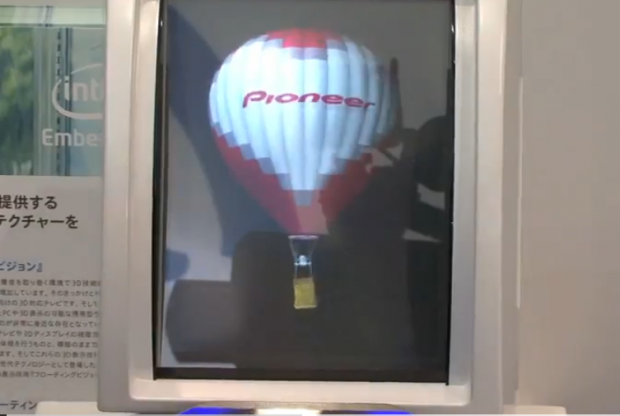 Pioneer has been working on “Floating Vision” displays for quite a while, and now the company has shown the technology used in embedded systems. The naked-eye 3D display Pioneer recently showed at an exhibition in Tokyo lets users view images or videos “floating” in space – embedded in a prototype car navigation system.
See the full story here.
TOP 5 REASONS WHY DAVID LYNCH SHOULD MAKE A 3D MOVIE
 It is possible that David Lynch could utilise 3D in a way that will enhance his next feature and in doing so show filmmakers how to use it properly. It may take a few technical advancements for it to be totally possible, but nonetheless here are some strong reasons why David Lynch should take his bizarre visions into the 3D realm…
1: Lynch has already expressed an interest in 3D
2: Werner Herzog has already made one
3: David Lynch’s Unsettling Dreams
4: Voyeurism
5: Mark Kermode will physically eat his shoe
Read the full article, with one video clip per reason,here
(E3 prep) A brief breakdown of what the University Press expects to see at E3 2011
 The Entertainment Electronics Expo, a.k.a. E3, is the world’s largest technology and video game convention that takes place every year in Los Angeles, Calif. from June 6 to 9. Because there is so much going on in the four days of the convention, we’ve compiled a comprehensive breakdown of what we expect from the big three — Microsoft, Sony and Nintendo — plus some other companies we plan to check out and talk to.
See the full post here
YouTube Adds Stereoscopic 3D Video Support (And 3D Vision Support, Too)
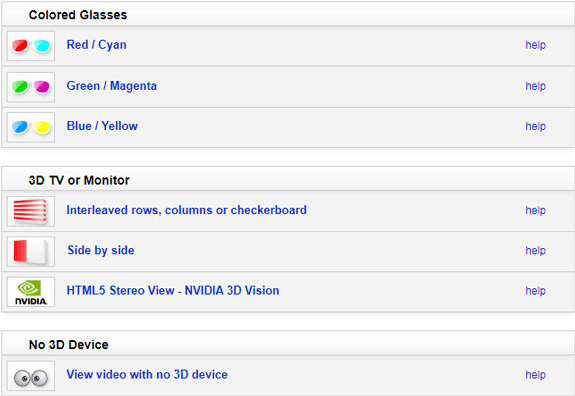 Today Google will be officially activating stereoscopic 3D video support on YouTube.Google has been experimenting with stereoscopic 3D support as early as 2 years ago, but the feature never left the dark depths of alpha testing. Since then Google has worked out the kinks in the system, and along with some new features in HTML5 is formally launching it today.
See the full original post here
Disney’s ‘The Lion King’ to Return to Theaters in Digital 3D
 Set for a Sept. 16, 2011 release, it is the latest classic library title to get the 3D treatment.
Disney is bringing The Lion King back to theaters on Sept. 16, 2011, this time in digital 3D.
Read the full story here
World’s First 3-D Erotic Film Is Coming to America
 Initial release likely would be on 50 to 60 screens in the U.S. and Canada, and expand to up to 200 screens if there’s strong demand.
While the movie serves up plenty of nudity, it is primarily adult erotica and shuns the explicit hard-core sex scenes found in porn films. The 25 million Hong Kong dollar (US$3.2 million) Cantonese-language film is a remake of “Sex and Zen,” a 1991 sex farce that has since reached cult status and earned its place as one of Hong Kong’s most successful Category III films.
See the full story here
Studios must revisit d-cinema (Audience experience not what it could be)
 At studio screenings, 3D movies look reliably sharp and reasonably bright. But when I saw "Thor 3D" at the ArcLight's Cinerama Dome in Hollywood, it was shockingly dark and fuzzy. My wife took off her Xpand 3D glasses and refused to put them back on. "Too dark," she whispered.
Steven Poster, prexy of the ASC, warns that if the industry continues to abuse the audience, they'll give up on seeing movies in theaters. "The quality of the 3D Blu-rays that are coming out on 3D television is extraordinary. They have to match that in the theater. Every element of every image informs the audience," Poster says. "If they can't see those elements, if they're too dark, or it's too uncomfortable, where are they going to go? They're going to go home to their TVs."
See the full story here.
Software Transforms Photos Into 3-D Models
 Ever wished you could take an object in a museum home with you instead of settling for some photos?
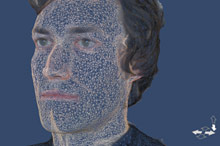
The design software company Autodesk will release free software next week that could turn those snapshots into your own personal replica from a 3-D printer. Called Photofly, the software extracts a detailed 3-D model from a collection of overlapping photos.
"We can automatically generate a 3-D mesh at extreme detail from a set of photos—we're talking the kind of density captured by a laser scanner," says Brian Mathews, who leads a group at the company known as Autodesk Labs. Unlike a laser scanner, though, the equipment needed to capture the 3-D rendering doesn't cost tens or hundreds of thousands of dollars. An overlapping set of around 40 photos is enough to capture a person's head and shoulders in detailed 3-D, he says.
Read he full story here.
Are Consumers Tiring of 3D movies?
A quick note by Philip Lelyveld
There have been a number of stories in the last few days (actually multiple versions of the same story) about the decline of North American moviegoer interest in seeing movies in 3D. The rest of the world still trends toward the 3D version over the 2D version when they have the choice.
Here is the raw data that some of the early stories point to. (click on it to enlarge it)
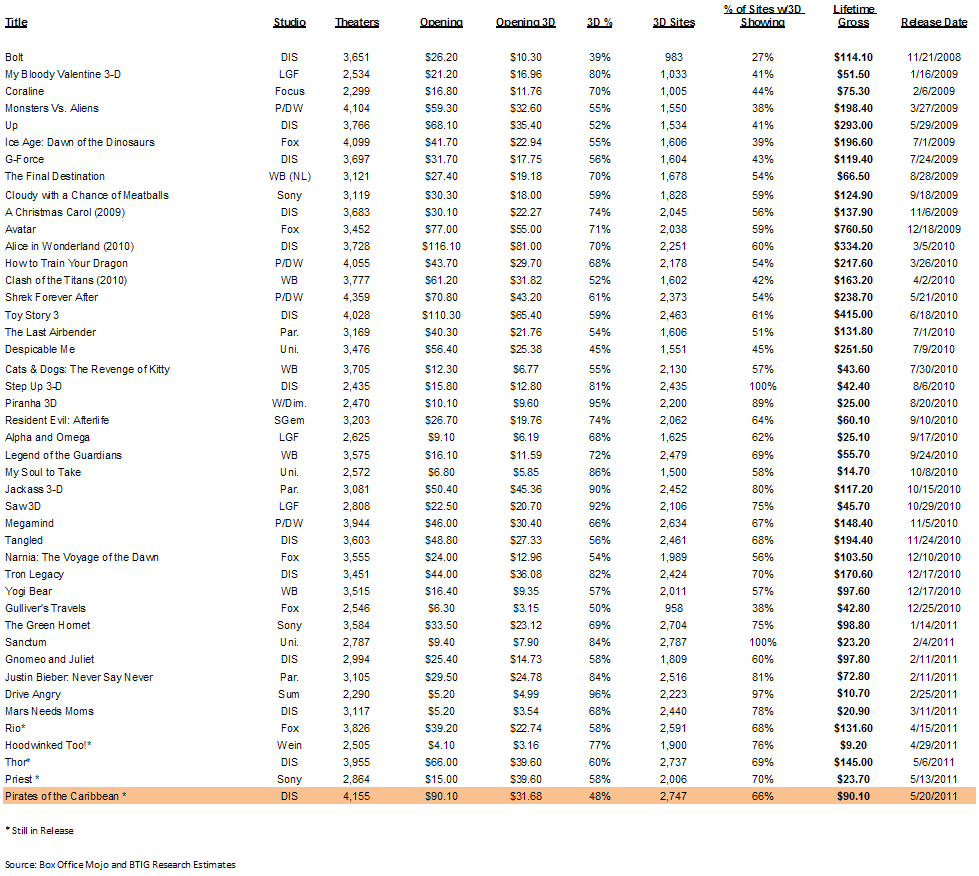
The data reports various statistics for opening week (only) boxoffice. I have charted the raw data for the percentage of the boxoffice revenue from 3D tickets (blue line) and the percentage of multiplexes showing the movie on a 3D screen (red line). Note that because a multiplex can show the same movie on both a 3D and a 2D screen, it is possible for red to equal 100% yet blue be less than 100%.
The timeline on my chart runs from the opening week of Avatar through the opening week of Pirates 4.
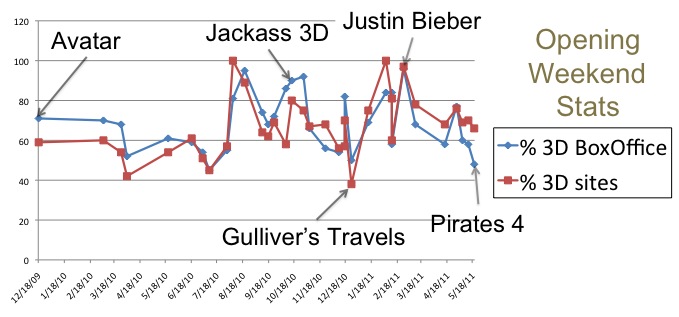
You can see that there is tremendous variability in the data.
Early on people wanted to experience 3D and there weren't enough screens to meet demand (blue over red).
As more 3D screens were installed, the impact on the 3D screens has lessened (red over blue). It is clear that consumers are making a choice between seeing a movie in 3D or 2D. What isn't clear from the data is the reason.
The news stories interpret this flip as clear evidence of consumer pushback against 3D. While that is quite possibly one contributing factor, the decline observed in the stats is also no doubt due to audience preference for specific genres in 3D (ex. horror movies) that haven't opened in theatres recently, the high cost of taking a family to a 3D family movie due to the significant ticket upcharge, competition among movies in the multiplex that push people to see the movie on the 2nd weekend (these are only opening weekend stats), and many other factors.