AR eyewear gaining more attention from consumers [Epson BT-100]
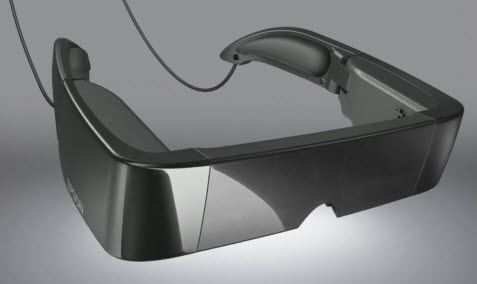 Check out this video for more info: http://bcove.me/gpxrkw6w
See the full post here: http://www.qrcodepress.com/augmented-reality-glasses-may-find-competition-from-epson/858840/
Two more studios for 3D immersive sound to open in Hong Kong and Los Angeles.
The Impossible, the next feature by Juan Antonio Bayona, is finalizing sound mixing in the new state of the art studio imm sound — which works with 3D immersive sound — that has been opened in Barcelona. It is the first film to try the new imm sound system, based on the licensed technology IAW (Immersive Audio Workstation) a hardware unit that allows the engineer to create 3D pannings. Two more imm sound studios will open in the next months in Hong Kong and Los Angeles.
... imm sound exhibition system is already working in 29 theaters all over the world form Brazil to Japan and Las Vegas. And 11 more cinemas are being readied. “We are just at the height of our expansion since we have a great technology ready to work in business with a very complete catalogue. We are competing at the highest level”. ...
See the full article here:
John Carmack Looks Back On Wolfenstein 3D In This Commentary Video
There’s a generation of gamers out there who may have never heard or played a Wolfenstein game and that makes me feel quite old and depressed. It’s fine for gamers to have Call of Duty as their #1 FPS game, but it’s always good to look back at what helped the FPS genre as things likely wouldn’t be where they are now if the team at id Software never created Wolfenstein in the first place.
To celebrate the 20th anniversary of the Wolfenstein series, id Software co-founder/current tech wiz John Carmack decided to do something special. No, he didn’t create a rocketship adorned with Wolfenstein signage since he has the money and knowledge to do such a thing, but he instead decided to do a special audio commentary of Wolfenstein 3D. John Carmack may do a fair bit of public speaking here and there, most of the time involving tech talk that goes over our heads, but rarely does he ever talk in-depth about a previous game he worked on, let alone one that’s older than most gamers today. ...
To check out John’s commentary on Wolfenstein 3D just watch the video below and skip to the 9 minute mark if you want to go straight to the commentary.
See the full original post here:
Movie Magic to Leave Home For? [CinemaCon Rpt.]
 [Philip Lelyveld comment: This is a good overview of future technologies being considered for the traditional movie theatre experience.]
[Wall Street Journal]
... Such were the possibilities raised last month at the CinemaCon convention in Las Vegas, where technology companies pitched theater operators on the merits of faster projection rates to improve clarity; new, immersive, surround-sound audio systems; laser 3-D projectors; paperless ticketing; and more. ...
Dolby Laboratories Inc., for example, is expected to test its Atmos audio system in screenings in 10 to 15 world-wide theaters of "Brave," a film from Walt Disney Co.'s Pixar Animation Studios scheduled to premier in June. ...
IMAX Corp. is showcasing an early prototype of a digital-projection system, developed with Barco Inc., that uses lasers instead of bulbs to project images onto screens, casting a brighter, more reliable light. The projectors won't be ready for the market until late 2013, at the earliest, the film and technology companies say, but some CinemaCon attendees got a sneak peek. ...
Another new technology: Later this year, upgraded 4K digital projectors from Sony Corp. will start showing films at the higher, 48 frames-per-second rate, making images appear crisper and more lifelike than the current 24 fps—in use since the late 1920s.
"The Hobbit: An Unexpected Journey," the first of two prequels to Peter Jackson's "Lord of the Rings" trilogy, will be the first feature film shown at 48 fps when it opens in December. (Regal Entertainment Group cinemas is upgrading its projectors to use the faster frame rate; other theater companies are considering it.) ...
While a broad uptake in 3-D technology over the past few years has tempted a sizable chunk of movie goers, especially adolescents and young adults, there isn't any guarantee the newest—frequently pricey—advances in viewing technology will pay off for cinemas. ...
As of March 31, 69% of the roughly 40,000 theaters in the U.S. and Canada had converted to digital projectors and screens, according to an estimate from IHS Screen Digest. By year's end, that number will be closer to 85%, the research firm estimates. ...
Some manufacturers are trying to smooth the transition for theater owners. Sony Digital Cinema will offer for sale to current users of its 4K digital cinema projectors a remote software update to make sure its projectors will be able to play movies like "The Hobbit" at the higher, 48 fps frame rate. ...
See the full story here: http://online.wsj.com/article/SB10001424052702304203604577394331145205406.html?mod=googlenews_wsj
The next digital image revolution? [Lytro, 3D, and movie production]
....
Tech it Up!: So what's next? What else will light field technology let the photographer do?
Ng: By capturing the full light field, Lytro cameras provide an immersive 3D picture that goes beyond the conventional stereo 3D. Parallax and 3D functionality [which provides the viewer a chance to capture more of a scene, and shift the focus of that scene, like a gyroscope, adding a sense of movement] will be available later in 2012 -- any living picture taken now can be viewed on a 3D display when the software update is available.
Tech it Up!: And down the road? Where do you see the light field capability going?
Ng: Light field sensors will become increasingly more sophisticated, capturing even more light rays to be useful for more advanced scientific, medical, commercial or industrial applications. Light field videography is also possible, creating entirely new production capabilities for filmmakers.
See the full story here: http://news.yahoo.com/the-next-digital-image-revolution-.html
Godard working on a 3D film
 Coming off the divisiveFilm Socialisme, French New Wave pioneer Jean-Luc Godard is not simply resting on his laurels.The Breathlessdirector is already in production in his next film, titledGoodbye to Languageand the production company Wild Bunch have revealed the currently shooting film will be in 3D, along with information on the cast and first sales poster for the film they’re taking to the Cannes market. ...
While there is no official synopsis, Godard previously expressed interest in 3D back in 2010, saying he likes“when new techniques are introduced. Because it doesn’t have any rules yet.”He went on to say this film will be about”a man and his wife who no longer speak the same language. The dog they take on walks then intervenes and speaks. How I’ll do it, I don’t yet know. The rest is simple.”
It sounds like he’s figured it out, as Godard is in production already. ...
See the full story here:
Lightplot: Painting with Light in 3D Space
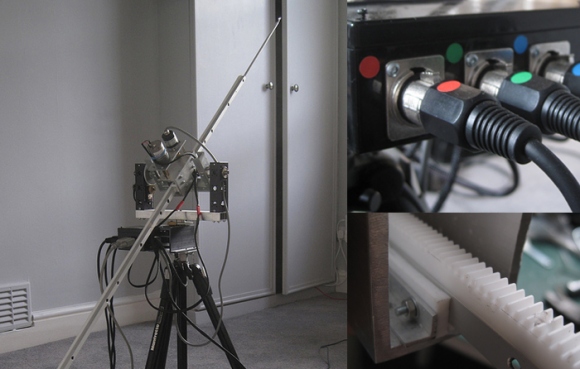
I absolutely love Ben Cowell-Tomas’s Lightplot, a 3D light painting system. Here’s how it works: an animation is imported from 3DS Max into his custom software which, in turn, drives a robotic arm to draw each frame with an LED in a 3D space. The software also controls a DSLR camera to take long exposure photographs of each frame of the animation. Ben documented the build process in great detail and also shows off what the machine is capable of in some beautiful animations, ...
See the full story and the videos here:
Pepsi Launches 3D Nicki Minaj Advertising Campaign
 Pepsi has officially launched its global ‘Live for Now’ campaign with a new commercial that features a remix of Nicki Minaj’s single ‘Moment for Life.’ The commercial, which is available on YouTube, even includes an option to switch the playback settings so that it can be watched in 3D.
...
YouTube allows viewers to change the video to 3D and use a number of alternate color settings to watch the ad with 3D glasses or a “no glasses” option which displays the ad in two panes but requires Pepsi/Nicki fans to cross their eyes for the visual effect to work.
...
See the full article and watch the video here:
YOU On Demand to Launch the First 3D Video On Demand Service in China; Signs Content Deal With 3net
YOU On Demand Holdings, Inc. CBBD +6.94% , China's leading national Pay-Per-View (PPV) and Video On Demand (VOD) platform, announced today that it has signed a distribution deal with 3net, the leading U.S. 3D television channel and global production studio, for Transactional Video On Demand (TVOD) and Subscription Video On Demand (SVOD) in China.
In connection with this deal, YOU On Demand will be launching a separate 3D SVOD package this summer.
Among the titles that will be available are "African Wild," which takes viewers on a journey into the secret world of Africa's largest and most dangerous animals and "Feeding Time," a behind the scenes look at the fussy eating habits and individual personalities of some of the world's most adored and iconic creatures.
"With the addition of 3net's content, YOU On Demand is uniquely positioned to bring the 3D viewing experience to our subscribers. This is such an important time to launch 3D content, as it is a major initiative for our cable partners," said Shane McMahon, Chairman and CEO of YOU On Demand. "We share 3net's mission of bringing viewers the highest quality and most immersive in-home 3D viewing experience."
"China represents one of the most dynamic international markets for 3D television, and we're pleased to be able to bring our compelling, native 3D content to viewers in the region through our partnership with YOU On Demand," said Tom Cosgrove, President and CEO of 3net.
See the original press release here:
Technology spurring a new manufacturing revolution
...As The Economist magazine noted in a special report in April (“The Third Industrial Revolution”), 3-D computers are already transforming industrial production around the world and, along with other comparable advances, returning the making of high-end things to rich countries.
In his report, Paul Markillie, the magazine’s innovation editor, introduces 3D Systems Inc., a pioneer in three-dimensional computer technology, in a novel way. While he toured 3D’s headquarters in South Carolina, he writes, the company printed him a complimentary gift: a custom-designed, fully usable hammer, “complete with a natty, wood-effect handle.”
Known technically as “additive manufacturing,” three-dimensional printing cranks out finished products in thin layers of plastic ink, thin layer on thin layer. The industry already produces a wide range of goods, ranging from car parts to dresses, that can be altered – reshaped, redesigned – by a keystroke. More complex assignments await. Mr. Markillie quotes a scientist at GE Global Research: “One day we will print an engine.”
Although patented in the 1980s, 3-D printing has emerged as a transformative, commercial technology only in the past few years. For high-end products, it makes assembly lines obsolete and eliminates the usual advantages of cheap labour. (3D Systems, by the way, markets printers for home use, heralding a new era of innovation by Edisonian inventors working in basements and garages.)
The first industrial revolution began in Britain in the 1800s, the second in the United States in the early 1900s. “Now,” Mr. Markillie writes, “a third industrial revolution is under way.” Many remarkable technologies are converging – among them, clever software, novel materials, dexterous robots and miniature, nanotech tools for quick and easy surgery.
With the increasing irrelevance of inexpensive Asian labour, off-shoring has already lost much of its historic advantage...
Two reasons explain the coming industrial renaissance. First, profit-driven invention. Second, technology-driven productivity. China’s achievements in manufacturing notwithstanding, the United States remains the biggest manufacturer in the world with 20 per cent of global production (compared with China’s 18 per cent). Why? The U.S. uses only 10 per cent of the work force that China uses to manufacture roughly the same quantity of goods.
Governments will try to stop the coming industrial transformation, of course. They always have. Progress is notoriously disruptive. As The Economist concludes, however, governments will ultimately fail again – and “leave the rest to the revolutionaries.”
See the full article here: